
Physician assistant contract red flags often appear in standard-form employment and independent contractor agreements that initially look routine. A competitive salary or favorable schedule can distract from provisions governing productivity calculations, restrictive covenants, termination rights, malpractice coverage, and repayment obligations. These terms may affect a PA’s income, professional liability, and ability to accept another position long after the agreement is signed.
Understanding these risks requires more than reviewing the headline compensation figure. Physician assistants should examine how pay is calculated, whether benefits or bonuses are discretionary, what happens when employment ends, and which obligations survive termination. Contracts drafted primarily to protect the employer may use vague definitions or broad management authority to shift financial, operational, or regulatory risk to the PA.
This guide explains the physician assistant contract provisions that frequently create financial and career risk. It covers compensation formulas, repayment clauses, malpractice insurance, restrictive covenants, scope-of-practice language, operational duties, and termination rights. Because these provisions often interact, attorney-led review can help a physician assistant understand the practical effect of the entire agreement before signing.
Compensation and Financial Red Flags
Salary, Productivity Metrics, and Hidden Pay Traps
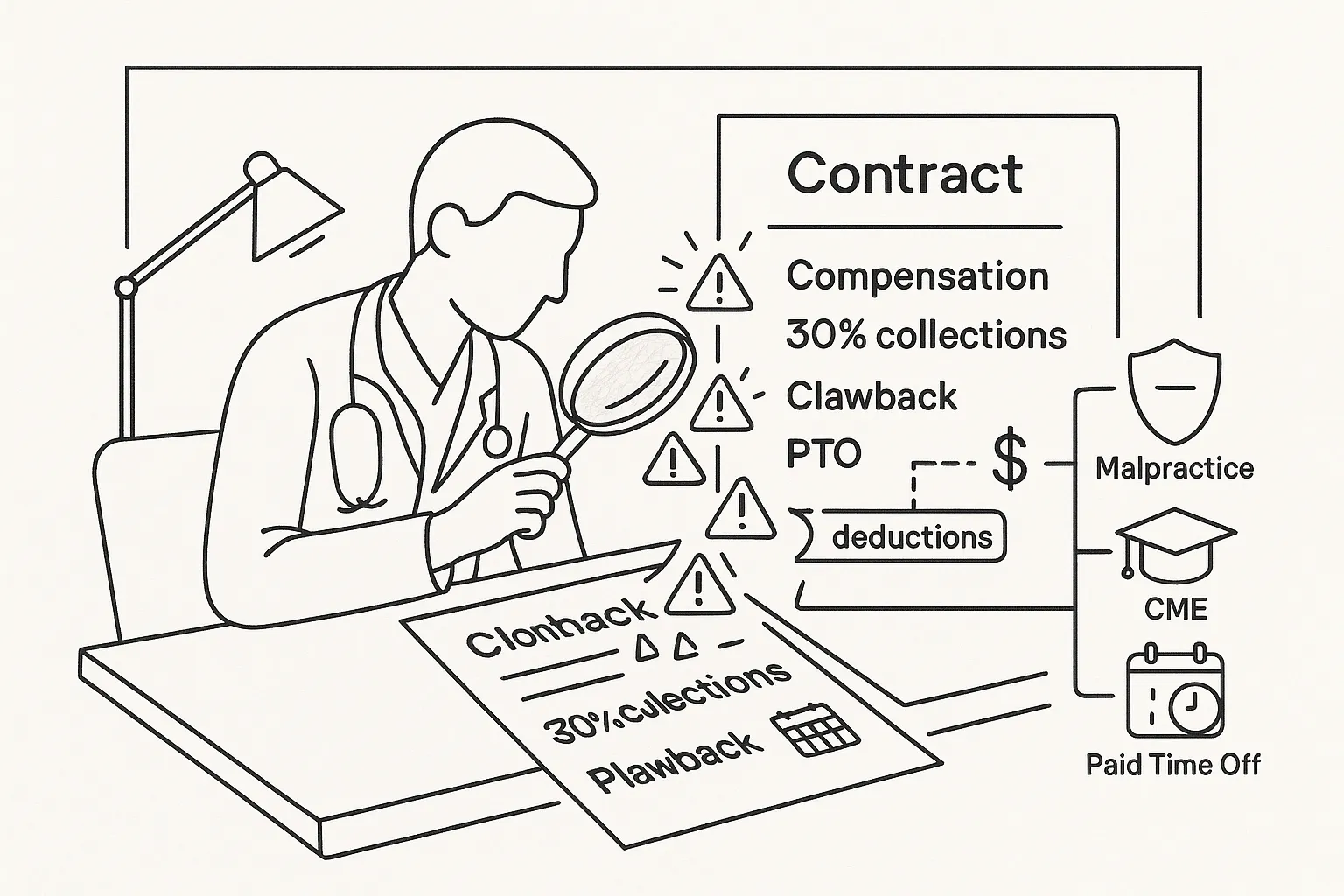
Compensation language is often the most important part of a physician assistant agreement. The contract should explain whether the base salary is a true guarantee or an advance subject to later reconciliation. A detailed review of compensation and productivity terms should also address how RVUs, collections, quality measures, and other performance metrics are calculated.
Common problems include unclear definitions of collections, billed charges, attribution rules, and productivity thresholds. Negative accrual language may allow an employer to carry a productivity deficit into a later period or recover earlier payments when performance falls below a target. Delayed reconciliation, incomplete reporting, or an employer’s unilateral ability to revise a compensation plan can make the PA’s actual earnings difficult to predict.
A collections-based percentage may appear favorable until the agreement explains which adjustments are made before compensation is calculated. Payer write-offs, administrative deductions, credentialing delays, billing practices, and reimbursement timing may reduce the collections attributed to the PA. The agreement should state when reports will be provided and whether the physician assistant can review or dispute a calculation.
RVU compensation requires similar precision. The contract should identify the RVU source, conversion factor, applicable threshold, and services that count toward production. For example, 4,000 RVUs multiplied by a $40 conversion factor equals $160,000 before any threshold, offset, or reconciliation adjustment. Administrative work, split visits, global-period services, and employer-controlled scheduling can materially affect whether the stated target is achievable.
Benefits, Bonuses, and Repayment Obligations
Benefits should be described with enough detail to determine their practical value. The agreement should address health insurance, retirement contributions, paid time off, continuing medical education, licensing fees, DEA registration costs, and malpractice premiums. Language making these benefits subject to employer discretion or an external policy that can be changed at any time may weaken what appeared to be part of the compensation package.
Signing bonuses, relocation assistance, and educational benefits frequently include repayment conditions. The PA should determine whether repayment is prorated over the service period, whether the full balance becomes due immediately, and whether the obligation applies after both voluntary resignation and employer-initiated termination. Reviewing sign-on bonus repayment terms before accepting the payment can clarify how much financial exposure remains throughout employment.
Bonus provisions should state whether payment is discretionary or earned when objective conditions are met. Clawback clauses may permit recovery of a bonus after later billing adjustments or a compensation reconciliation. Paid time off and CME language should likewise explain accrual, approval, carryover, and whether unused time is paid when employment ends.
Many physician assistant agreements contain provisions that appear routine but create substantial professional or financial risk. Career guidance from the American Academy of Physician Associates also encourages clinicians to review the key elements of PA employment contracts before signing.
Restrictive Covenants That Limit Career Mobility

Non-Compete, Non-Solicitation, and Confidentiality Restrictions
Non-compete provisions can limit where and how a physician assistant works after leaving a position. A careful review should consider the restricted services, geographic area, duration, and locations used to calculate the restriction. When non-compete clauses apply to every facility operated by a health system rather than the PA’s actual work location, the restricted territory may be much broader than expected.
Enforceability depends on applicable law and the specific employment relationship, but the language still matters when evaluating practical risk. Restrictions covering multiple sites, a broad range of clinical services, or telehealth work may interfere with nearby employment even before enforceability is tested. The agreement should also explain whether termination by the employer changes or releases the restriction.
Non-solicitation clauses may restrict contact with former patients, employees, referral sources, vendors, or professional contacts. Red flags include unclear definitions of “solicit,” indefinite restrictions, and liquidated-damages provisions that impose a preset financial penalty. Confidentiality terms should protect legitimate patient and business information without creating uncertainty about ordinary professional knowledge or lawful post-employment communications.
Malpractice Insurance, Tail Coverage, and Indemnification
Malpractice provisions determine how professional liability is handled during employment and after the relationship ends. The contract should identify the policy type, coverage limits, named insureds, and whether the physician assistant must obtain separate coverage. Vague language stating only that the employer will provide “appropriate” insurance may not explain the PA’s actual protection.
Claims-made coverage generally protects a claim only when the policy is active and the claim is reported during the applicable coverage period. When employment ends, claims based on earlier services may require tail coverage. Occurrence coverage instead applies to incidents occurring during the policy period regardless of when the claim is later filed.
The agreement should clearly allocate responsibility for malpractice tail insurance. Some contracts require the employer to pay, while others shift the entire cost to the PA or change responsibility depending on whether the physician assistant resigns, is terminated without cause, or is terminated for cause. Because tail coverage can create a significant post-employment expense, the trigger and payment process should not be left to an unwritten policy.
Indemnification provisions require separate attention. Broad language may attempt to make the physician assistant responsible for defense costs, losses, or claims connected to employer systems and administrative practices. The PA should understand how indemnification obligations interact with malpractice insurance and whether the provision extends beyond conduct covered by the policy.
Scope of Practice, Credentialing, and Workload Expectations
Supervision, Delegation, Credentialing, and Clinical Privileges
Contract language governing supervision, collaboration, delegation, and prescriptive authority should align with the requirements applicable where the physician assistant practices. An employer may also impose operational standards that go beyond regulatory requirements, including physician-availability rules, documentation protocols, or on-site coverage expectations. Those obligations should be clearly defined so the PA can evaluate whether the promised role is workable.
The agreement may require the physician assistant to maintain licensure, DEA registration, facility credentials, payer enrollment, and clinical privileges. It should explain the credentialing process, who controls the required submissions, and what happens if employment begins before credentialing is complete. Delays outside the PA’s control can affect the start date, salary, bonus eligibility, and productivity calculations.
Provisions permitting unilateral suspension of privileges or immediate termination after a credentialing issue should be reviewed alongside any cure rights and reporting consequences. The contract should also identify which procedures, facilities, or service lines are part of the position rather than leaving the scope of clinical duties entirely to later policies.
Operational terms can materially change the value of the agreement. Call requirements, weekend coverage, moonlighting restrictions, telehealth duties, EMR access, and assignments to multiple locations should be defined whenever possible. Unspecified “reasonable call” or broad reassignment authority may allow the employer to increase workload without corresponding pay. A separate review of call schedules and coverage requirements can help identify missing limits, compensation terms, and scheduling protections.
Termination Rights and Employer-Controlled Contract Terms
Termination provisions determine how quickly employment may end and which financial obligations survive. For-cause definitions often include loss of licensure, dishonesty, policy violations, or failure to follow clinical protocols. Red flags include vague cause standards, immediate termination for issues that could be corrected, and no opportunity to cure an alleged breach.
Without-cause termination usually permits either party to end the relationship with advance notice. The contract should state the notice period, whether the employer can provide pay in lieu of notice, and whether the PA must continue working during the notice period. A termination-clause review should also examine how the reason for separation affects bonuses, repayment obligations, tail insurance, restrictive covenants, and final compensation.
Post-termination compensation should not be left ambiguous. The agreement should address the final paycheck, accrued paid time off, collections received after departure, and productivity bonuses earned before termination. Repayment acceleration clauses are another concern because they may make the full balance of a signing bonus or relocation payment due immediately instead of prorating it based on time worked.
Employer discretion can also appear in broad job descriptions, at-will language, incorporated policies, and amendment clauses. A provision allowing management to change compensation, benefits, schedules, or work locations without consent may undermine negotiated terms. Assignment clauses can transfer the agreement to an affiliate or purchaser, while automatic renewal provisions may extend the contract unless notice is provided before a specific deadline.
Renewal and amendment language should be reviewed together with notice deadlines and post-employment restrictions. A missed renewal deadline can extend the agreement and delay the PA’s ability to leave, while unilateral amendment rights can create uncertainty about future duties or pay. Material commitments should appear in the signed agreement rather than only in a handbook, recruitment email, or verbal representation.
How to Review a Physician Assistant Contract Before Signing
Contract review should focus on how the provisions work together, not simply whether each section sounds reasonable in isolation. A physician assistant should compare the compensation formula with scheduling control, credentialing timelines, assigned locations, call duties, and termination rights. A high productivity target may be less attractive if the employer controls patient volume or can assign substantial uncompensated administrative work.
Questions for review should include whether compensation formulas are objectively defined, who pays for tail coverage, what triggers repayment, and which obligations continue after termination. Any discretionary language should be evaluated to determine whether the employer can modify an important term without the PA’s agreement. The physician assistant should also confirm that verbal commitments about schedule, compensation, location, support staff, or clinical duties appear in writing.
Redlining can convert vague promises into measurable obligations. Compensation provisions can identify specific reporting and payment dates, restrictive covenants can define the applicable location and services, and repayment clauses can use a prorated schedule. The physician assistant employment agreement checklist provides a useful framework for organizing these issues before negotiations are complete.
Chelle Law provides attorney-led physician assistant contract review focused on clarifying compensation, identifying liability and regulatory concerns, and explaining how contract terms may affect income and professional mobility. Reviewing the complete written agreement before signing gives the PA an opportunity to seek clarification or negotiate changes before the obligations become binding.
Frequently Asked Questions
What are the most serious red flags in a physician assistant contract?
Serious red flags include undefined compensation formulas, unrealistic productivity targets, broad non-compete restrictions, unclear malpractice tail obligations, immediate for-cause termination rights, unprorated repayment clauses, and language allowing the employer to change pay or duties unilaterally. The significance of each provision depends on how it interacts with the rest of the agreement.
Is a discretionary physician assistant bonus guaranteed?
No. Language describing a bonus as discretionary generally gives the employer authority to decide whether it will be paid, even when performance targets appear to have been met. The contract should state when a bonus is earned, how it is calculated, when it is paid, and whether the PA must remain employed on the payment date.
Who pays for malpractice tail insurance when a PA leaves?
The contract should specify who pays for tail coverage when claims-made insurance is used. Responsibility may rest with the employer, the physician assistant, or either party depending on how employment ends. If the agreement is silent or ambiguous, the PA may face an unexpected post-employment expense.
What should a PA examine in a non-compete clause?
A PA should examine the restricted services, geographic area, duration, covered practice locations, and events that trigger the restriction. The review should also consider whether the clause applies after employer-initiated termination and whether related non-solicitation or liquidated-damages provisions create additional exposure.
Can termination trigger repayment of a signing bonus or relocation payment?
Yes. Many agreements require repayment when employment ends before a stated service period is completed. The physician assistant should determine whether repayment is prorated, whether the full amount becomes due immediately, and whether the obligation applies after resignation, termination without cause, or termination for cause.
When should a physician assistant have a contract reviewed?
A physician assistant should obtain review before signing the initial agreement, amendment, renewal, compensation plan, or material addendum. Reviewing the complete documents before acceptance allows time to clarify ambiguous terms and request revisions before compensation, repayment, malpractice, termination, or restrictive-covenant obligations take effect.
Identify PA Contract Risks Before You Sign
Chelle Law reviews physician assistant agreements to explain compensation, malpractice obligations, restrictive covenants, repayment terms, and termination risks before they affect your career.
Contact Chelle LawExplore Physician Assistant Contract Guidance
Review legal services, practical resources, and state-focused guidance for physician assistant agreements.