
A physician assistant employment agreement determines more than salary. It allocates professional duties, schedule and call expectations, malpractice responsibility, termination rights, repayment obligations, and restrictions that may affect where a PA can work after leaving. Because employers often use standardized or employer-favorable language, the practical effect of a provision may not be clear from its heading alone.
This checklist explains the provisions physician assistants should evaluate before signing, including role expectations, compensation mechanics, benefits, liability protection, restrictive covenants, credentialing, and termination. A structured review can reveal financial and professional risks that may otherwise emerge only after employment begins. For a line-by-line assessment of a proposed agreement, Chelle Law provides physician assistant contract review.
Employment Terms, Duties, and Work Expectations

Position, Duties, and Scope of Practice
The job title and description establish the foundation for a physician assistant’s responsibilities. Review how the agreement describes patient care, specialty duties, supervision or collaboration, delegation, prescribing, documentation, and administrative work. An employer may define the role more narrowly than state law permits or use broad language that allows duties to expand without a corresponding adjustment to compensation or schedule.
The agreement should also explain how performance will be measured. Undefined productivity requirements, subjective quality standards, or vague compliance obligations may later be used to support discipline, compensation changes, or termination. Duties and performance standards should be sufficiently clear for the PA to understand how the position will operate in practice.
Employment Status, Schedule, Locations, and Contract Term
Confirm whether the relationship is structured as W-2 employment or independent contractor work because the classification affects taxes, benefits, expenses, and other contractual obligations. PAs offered contractor status should compare the agreement against the practical differences between W-2 and 1099 arrangements. The contract should also identify the start date, initial term, renewal process, and any notice required to prevent automatic renewal.
Schedule provisions should address expected hours, weekends, holidays, call, coverage obligations, and any right to change shifts. Location clauses deserve close attention when an employer operates multiple facilities because reassignment can affect commute time, workload, and the geographic reach of a non-compete. Telehealth provisions should identify remote-work expectations and account for applicable licensure and prescribing requirements.
A complete role review should answer the following questions:
- What clinical and administrative duties are required?
- Who controls schedule changes, call, and coverage assignments?
- Can the employer add facilities or reassign the PA?
- Does compensation begin on the stated start date or only after credentialing?
- Does the agreement renew automatically, and what notice prevents renewal?
- Are outside work, moonlighting, or telehealth activities restricted?
The American Academy of Physician Associates also publishes a professional contract assessment and negotiation checklist that PAs may consult when evaluating an offer.
Compensation, Benefits, and Financial Incentives
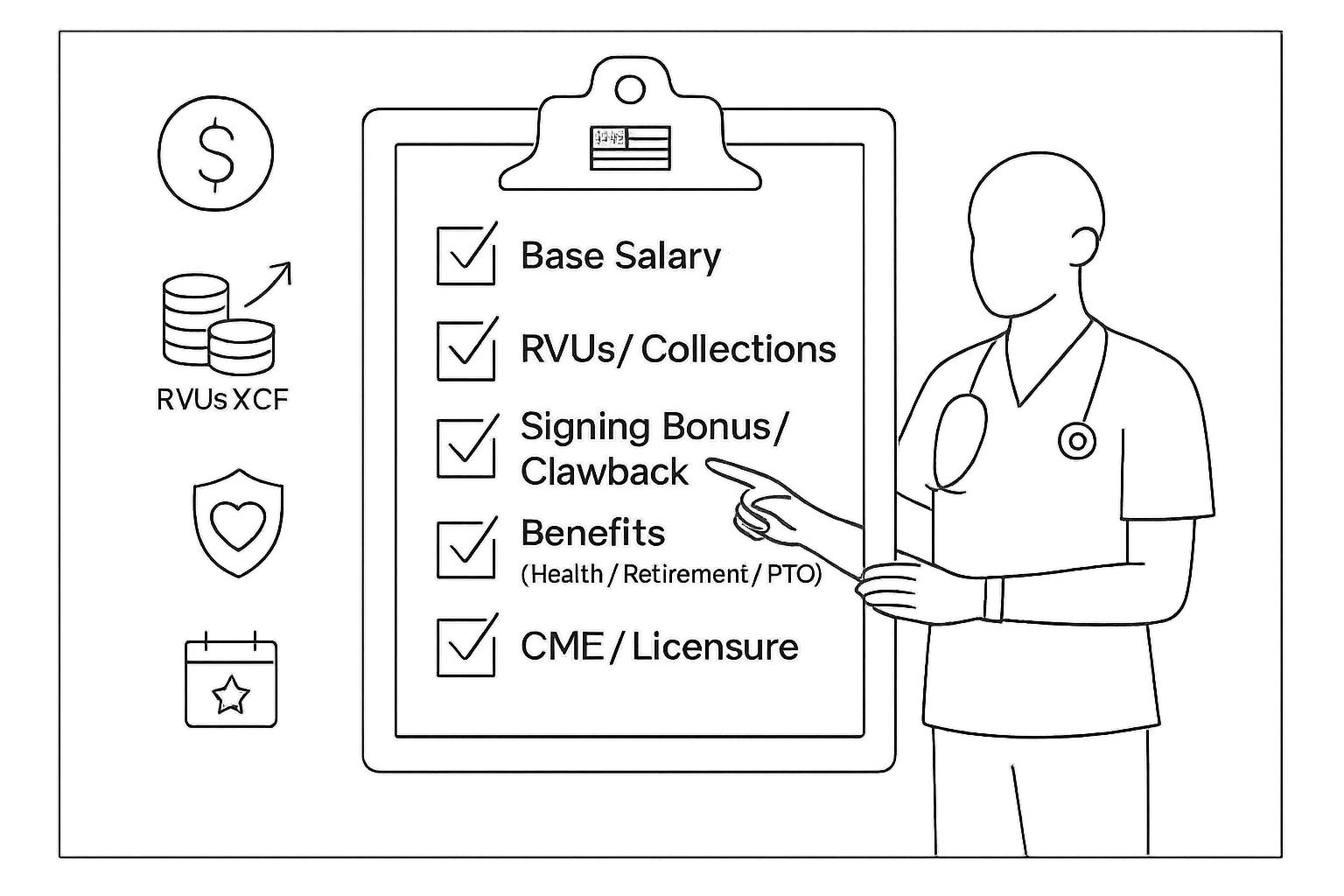
Base Pay, Productivity, and Bonus Calculations
Base compensation should state the amount, pay frequency, and when payment begins. Determine whether the salary is guaranteed or conditioned on credentialing, continued employment, productivity, collections, or another event. The agreement should also explain any right to make deductions, offset amounts owed, correct overpayments, or retroactively adjust compensation.
Productivity compensation may use RVUs, collections, quality measures, or a hybrid formula. The contract should define the threshold, conversion factor, included services, measurement period, reconciliation process, and payment date. It should also explain how denials, shared services, refunds, and work performed near termination affect the calculation. A focused PA compensation and productivity review can help determine whether the written formula is understandable and whether the PA can independently verify the resulting payment.
Benefits, Signing Incentives, and Repayment Terms
Total compensation may include health insurance, retirement contributions, paid time off, continuing medical education allowances, professional dues, and reimbursement for licensing or certification expenses. Confirm eligibility dates, employer contribution levels, rollover rules, and whether a separate benefit plan controls. The contract should also clarify whether CME time is paid and whether unused leave has any value when employment ends.
Signing bonuses, relocation assistance, and student loan support frequently carry service commitments or repayment obligations. Review the events that trigger repayment, whether the amount is prorated, when payment becomes due, and whether the obligation applies if the employer ends the relationship. These terms can create substantial exposure when employment ends earlier than expected, so the checklist should include a close review of all sign-on bonus repayment conditions.
Malpractice Coverage, Indemnification, and Liability
Malpractice provisions should identify the policy type, coverage limits, covered activities, exclusions, and the party responsible for premiums. Occurrence coverage generally applies to incidents that occur during the policy period regardless of when the claim is made. Claims-made coverage generally requires coverage to be active when the claim is reported, which can create a need for tail coverage after employment ends.
If the employer uses claims-made coverage, determine who must obtain and pay for tail insurance, whether that responsibility changes based on the reason for termination, and whether an acceptable alternative form of coverage is permitted. The agreement should also address defense costs, claim-reporting requirements, and access to coverage information. A detailed guide to tail insurance for physician assistants explains why this obligation can become an important post-employment expense.
Indemnification language requires separate attention because it may obligate the PA to reimburse the employer for specified claims, losses, or expenses. Review whether the clause is limited to conduct outside the scope of employment, whether it overlaps with insured risks, and whether the obligation survives termination. Broad indemnification language can shift liability beyond what the malpractice policy covers.
Restrictive Covenants and Post-Employment Rights
A non-compete may limit the services a physician assistant can provide within a stated area and period after employment. Its practical impact depends on the restricted activities, duration, geographic scope, covered employer locations, affiliates, and events that trigger the restriction. A clause tied to every employer facility can be more restrictive than one based only on the PA’s actual practice location. State law also affects how these provisions are evaluated, making a specific non-compete review important when future mobility is a concern.
Non-solicitation provisions may restrict contact with patients, employees, or referral sources, while confidentiality clauses may continue after employment ends. Review how restricted groups and confidential information are defined, whether patient communications are addressed, and whether the language accounts for professional or legal obligations. The agreement should also explain whether compliance with a restrictive covenant is a condition for receiving earned bonuses, deferred compensation, or other post-termination payments.
Termination, Credentialing, and Administrative Controls
Most employment agreements distinguish termination for cause from termination without cause. Review the definition of cause, any opportunity to cure an alleged breach, the required notice period, and the employer’s ability to suspend the PA during an investigation. Without-cause termination provisions should identify how notice must be delivered, whether the PA must continue working during the notice period, and whether the employer may end duties immediately while continuing or stopping compensation. PAs considering departure should review the contract’s specific requirements for ending the employment relationship.
Termination can also activate repayment obligations, tail coverage, restrictive covenants, and deadlines for returning property or completing records. The agreement should explain whether earned productivity compensation will be paid after departure and how final compensation is calculated. These connected provisions should be evaluated together rather than as isolated contract sections.
Credentialing and privileging terms should allocate responsibility for applications, fees, documentation, and delays. If compensation depends on completing credentialing, determine what happens when an insurer, facility, or employer causes the delay. The agreement should also address responsibility for maintaining licensure, certification, prescriptive authority, and other required credentials. Additional risks associated with PA credentialing delays may be particularly important when a start date or guaranteed salary depends on approval.
Administrative provisions may govern medical records, documentation, audits, billing compliance, outside work, and employer policies. Determine whether policies can be changed unilaterally and whether those changes can alter compensation, schedule, duties, or performance standards without a written amendment. Audit rights should define their scope and explain whether an audit can result in retroactive compensation adjustments.
Frequently Asked Questions
What should a physician assistant confirm about duties and scope of practice?
The agreement should clearly describe clinical duties, administrative responsibilities, supervision or collaboration, prescribing, documentation, schedule expectations, and practice locations. The PA should also determine whether the employer can expand duties, change locations, or modify performance standards without a written amendment.
How should a PA evaluate productivity compensation?
Review the productivity metric, threshold, conversion factor, included services, measurement period, reconciliation process, and payment timing. The formula should also explain how denials, shared services, refunds, and employment termination affect the calculation.
Who pays for tail insurance when PA employment ends?
The employment agreement should state whether tail coverage is required and whether the employer or physician assistant must pay for it. Responsibility may depend on the policy type, the reason employment ends, and the specific language of the contract.
Which contract terms control a physician assistant’s departure?
Key provisions include termination for cause, termination without cause, notice requirements, cure rights, final compensation, repayment obligations, malpractice coverage, and post-employment restrictions. These provisions should be reviewed together because termination can activate several obligations at once.
How can credentialing delays affect a physician assistant contract?
Credentialing or privileging delays may postpone the start of clinical work or compensation when the agreement makes payment contingent on approval. The contract should allocate responsibility for applications and costs and explain how delays outside the PA’s control will be handled.
Why have an attorney review a PA employment agreement before signing?
An attorney can evaluate how compensation, termination, malpractice, repayment, and restrictive covenant provisions interact and identify language that may create financial or professional risk. Review before signing also gives the PA an opportunity to seek clarification or proposed revisions before becoming contractually bound.
Have Your PA Employment Agreement Reviewed
Chelle Law reviews compensation, malpractice coverage, restrictive covenants, termination rights, repayment terms, and other provisions that can affect your income and career flexibility.
Contact Chelle LawExplore Physician Assistant Contract Guidance
Review legal services, practical contract resources, and state-specific guidance for physician assistants.