
A physician assistant non-solicitation clause can limit what a PA may do with patients, employees, contractors, referral sources, and other professional relationships after leaving an employer. Although these provisions are often grouped with restrictive covenants, their practical reach depends on the contract’s definitions. A narrow clause may prohibit targeted efforts to recruit identified patients or coworkers, while broader language may restrict indirect contact, public announcements, responses to unsolicited inquiries, or work involving an employer’s wider network.
The consequences frequently become clear only when the relationship ends. A broadly written restriction can affect a PA’s ability to communicate with former patients, recruit trusted colleagues, work for an organization serving the same population, or participate in telehealth, consulting, locum tenens, and business-development activities. Financial exposure may also arise if the agreement connects an alleged violation to liquidated damages, incentive repayment, legal fees, injunctive relief, or another contractual remedy.
Reviewing the clause requires more than identifying its duration. The analysis must account for the protected relationships, prohibited conduct, exceptions, triggering events, governing law, forum, remedies, and interaction with compensation, confidentiality, non-compete, and termination provisions. Chelle Law reviews these connected terms so physician assistants can understand the restriction’s potential effect on patient communications, income, compliance, and career mobility before signing.
What a PA Non-Solicitation Clause May Restrict
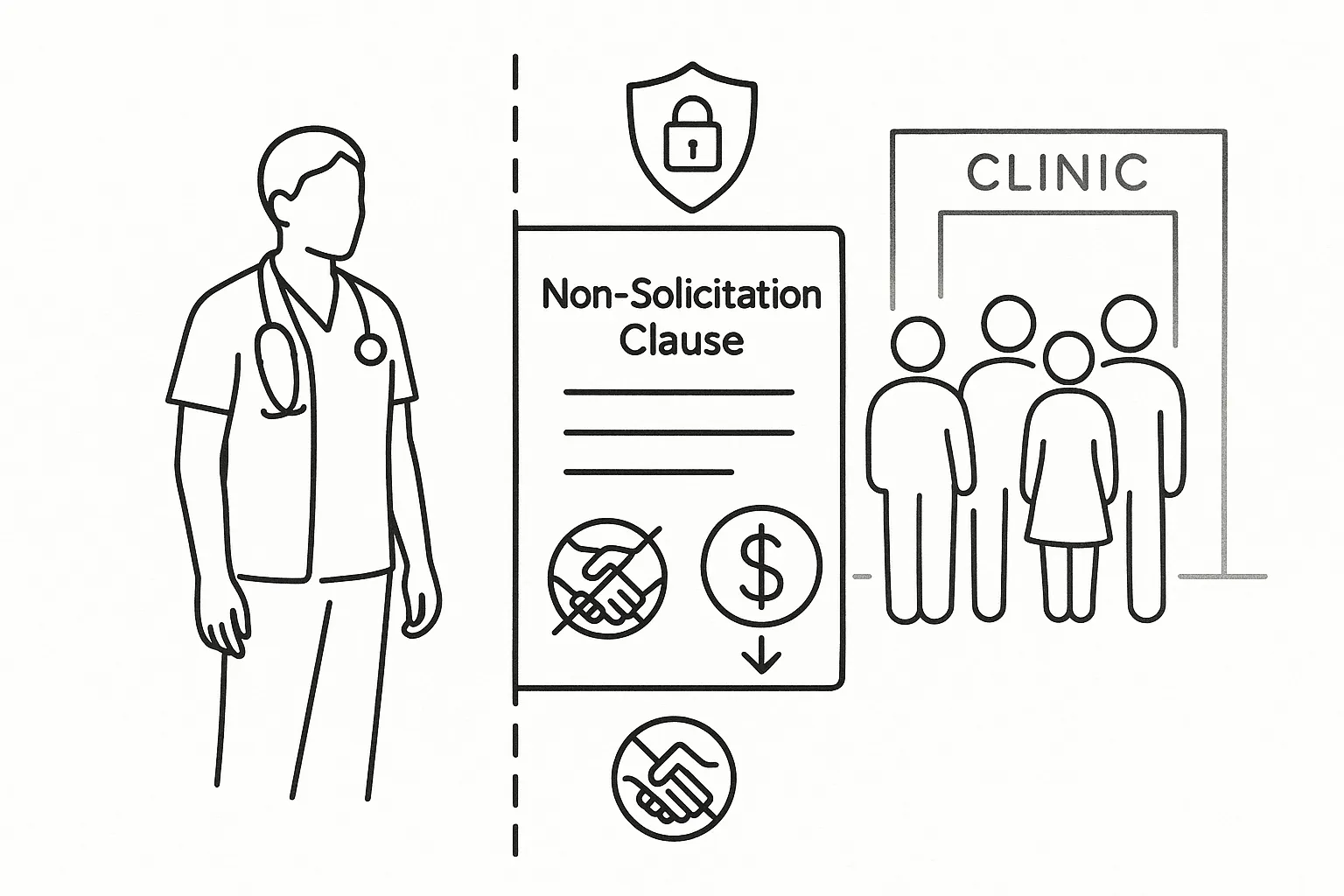
Employers use non-solicitation provisions to protect patient relationships, workforce stability, referral networks, recruiting investments, and other business connections. The clause may prevent a departing PA from encouraging patients to transfer care or asking employees and contractors to join another organization. Some agreements extend the restriction to vendors, affiliated entities, prospective employees, or referral sources that generate patient volume.
The provision’s reach may be limited to relationships the PA personally developed or handled. More expansive language can cover every patient, employee, contractor, or business relationship associated with the employer and its affiliates, including people the PA never treated or contacted. That difference matters because a restriction tied to known relationships is easier to evaluate than one that attempts to reserve a large, unidentified network.
Non-solicitation language does not always prohibit a PA from accepting another position, but it can make a new role difficult to perform. A nearby practice may serve the same patient population, depend on familiar referral sources, or employ people who worked with the PA previously. The restriction may also affect consulting, telehealth, locum tenens, or part-time work when those arrangements involve relationships connected to the former employer.
Contract Definitions Determine the Provision’s Reach

The heading attached to a restrictive covenant reveals little about how it will operate. Its practical effect comes from defined terms, exceptions, survival provisions, incorporated policies, and remedies located throughout the agreement. A meaningful review therefore examines the full contract rather than treating the non-solicitation paragraph as a stand-alone obligation.
Protected Patients, Employees, and Referral Relationships
A patient restriction may apply only to individuals the PA personally treated during a stated lookback period. Alternatively, it may cover all current, former, or prospective patients of the employer and its affiliates. The agreement may also define patients by location, service line, payer, referral source, or access to information rather than by an actual treatment relationship.
Workforce restrictions require similar attention. “Employee” may include clinicians, administrative staff, independent contractors, locum tenens professionals, applicants, or anyone who worked for the organization during a specified period. Referral-source language can reach physicians, facilities, community organizations, and other sources of patient volume. When these groups are not clearly identified, a PA may have difficulty determining whether ordinary communication at a new job creates contractual risk.
Solicitation, Acceptance, Duration, and Geography
“Solicit” may mean a direct request, but some agreements expand the term to include indirect encouragement, assistance provided to a new employer, or communication reasonably expected to influence a patient or employee. A restriction against accepting business is materially broader because it may apply even when a former patient or referral source initiates contact. Public advertising, social media posts, and professional-network updates can also become disputed when general communications are treated as indirect solicitation.
Most provisions continue for a stated period after separation, but there is no nationwide duration that governs every PA agreement. A comparatively short restriction can still be burdensome if it protects a large patient population, workforce, or referral network. Geographic language may increase that burden when the defined area includes every facility, office, or market in which the employer or an affiliate operates.
Triggering and survival language identifies whether the covenant follows resignation, termination without cause, termination for cause, expiration, or nonrenewal. Reviewing the restriction together with guidance on terminating a physician assistant contract can help clarify when the obligation begins and what duties remain after the PA’s final day.
Patient Communications and Continuity of Care
Patient-related restrictions require a careful distinction between active recruitment and communications associated with an orderly transition. A departing PA may need to finish documentation, coordinate follow-up, respond to record requests, communicate with referring clinicians, or address an urgent clinical issue. Those actions do not necessarily reflect an effort to redirect business, but an agreement without clear exceptions can leave the PA uncertain about what is permitted.
Potential carve-outs may address general announcements, passive advertising, responses to unsolicited inquiries, emergency communications, legally required disclosures, patient notices, and transfer-of-care activity. They may also clarify who controls a departure notice, which patients receive it, and what information it may contain. Precise language can separate targeted requests that a patient follow the PA from communications needed to protect care continuity and complete administrative responsibilities.
The American Medical Association’s restrictive-covenant ethics guidance emphasizes patient choice and continuity of care in the physician context. It offers useful professional context, but it is not a universal legal rule for physician assistants and does not automatically override contract language. Patient notification, records transfer, privacy, licensing, and continuity obligations must be reconciled with the agreement, applicable state law, and any governing PA board requirements.
Enforceability Varies by State and Practical Effect
No single nationwide rule determines whether a physician assistant non-solicitation clause is enforceable. State statutes and court decisions vary, and governing-law and forum provisions may affect where and under which law a dispute is evaluated. Relevant considerations can include the relationships protected, the conduct prohibited, the duration, geographic or relational scope, the employer’s asserted business interest, and the burden imposed on the PA.
Some jurisdictions distinguish patient, customer, and employee non-solicitation restrictions from traditional non-competes. Others focus on what the clause actually prevents the worker from doing. Cornell Law School’s overview of non-solicitation agreements likewise explains that permissible scope and enforceability depend on state law. Current statutes and decisions governing the particular agreement must be checked rather than inferred from a general rule.
When a Non-Solicitation Clause Functions Like a Non-Compete
A provision labeled “non-solicitation” may operate like a non-compete if it effectively prevents the PA from accepting other work, serving a broad patient population, or establishing a viable practice. That concern is more pronounced when the clause prohibits accepting unsolicited business, covers every patient or referral source in a large network, or combines expansive relational and geographic limits.
The Federal Trade Commission’s final Noncompete Rule is not currently in effect or enforceable. It therefore does not create a nationwide rule invalidating PA non-competes or non-solicitation clauses. State law remains central, although the practical effect of a broadly drafted customer or patient restriction may still matter when determining whether it functions as a de facto non-compete. A focused PA non-compete and restrictive-covenant review can evaluate the combined burden of these provisions.
Worker Restrictions Versus Competitor No-Poach Agreements
A restriction imposed by one employer on its own departing worker is different from an agreement between competing healthcare employers not to recruit or hire one another’s employees. The latter arrangement can raise distinct federal antitrust concerns. The U.S. Department of Justice’s Antitrust Guidelines for Business Activities Affecting Workers explain that agreements among competitors affecting worker recruitment or mobility may expose companies and individuals to civil or criminal liability.
This distinction does not mean every employee non-solicitation provision in an individual employment agreement is unlawful. It means the identity of the parties and the nature of the arrangement matter. A clause governing a PA’s post-employment conduct requires state-specific contract analysis, while coordination among competing employers presents a separate competition-law issue.
How Related Contract Terms Increase the Risk
Non-solicitation provisions rarely operate alone. They commonly appear beside non-compete restrictions, confidentiality clauses, intellectual-property terms, repayment obligations, and post-employment cooperation requirements. Each provision addresses a different interest, but their combined effect can be more restrictive than any clause appears in isolation. A non-compete may reduce available workplaces while a non-solicitation clause limits interaction with familiar patients, colleagues, and referral sources.
Compensation terms can magnify the practical impact. When pay depends on encounters, collections, patient volume, or productivity, losing access to established relationships may reduce earnings at a new position. The actual formula controls, so the analysis should account for definitions, attribution rules, reconciliation periods, and negative adjustments. Chelle Law’s guide to physician assistant compensation models explains how these structures allocate financial risk.
An alleged violation may also trigger liquidated damages, injunctive relief, fee-shifting, forfeiture, or repayment demands. If the PA received a signing bonus, relocation assistance, retention payment, or training benefit, the agreement may connect repayment to termination or breach. Those consequences are not automatically enforceable in every jurisdiction, but they warrant review alongside the underlying covenant and the contract’s sign-on bonus repayment terms.
Reviewing and Clarifying the Clause Before Signing
Drafting details determine whether a non-solicitation clause targets deliberate recruitment or creates uncertainty around routine professional conduct. Warning signs may include undefined references to “any patient” or “any referral source,” protection of people with whom the PA had no contact, restrictions on accepting unsolicited business, indefinite obligations, and language broad enough to include public announcements or passive online activity.
More precise language may limit protected patients to those personally treated during a stated period, distinguish active solicitation from general advertising, and permit responses to unsolicited inquiries. Other clarifications may address transition communications, record requests, emergency care, legally required reporting, and the employer’s process for notifying patients. Before signing, review should address:
- Every non-solicitation, non-compete, confidentiality, repayment, and post-employment provision in the agreement and incorporated documents.
- The definitions of patient, employee, contractor, referral source, affiliate, prospective customer, and other protected relationships.
- Whether direct contact, indirect assistance, public advertising, online activity, accepting business, and passive responses are treated differently.
- The duration, geographic or relational reach, triggering event, survival language, governing law, and dispute forum.
- Exceptions for patient notices, continuity of care, record transfers, emergency communications, required disclosures, and unsolicited contact.
- Potential remedies, including injunctions, damages, legal fees, forfeiture, and repayment obligations.
- The combined effect on future employment, compensation, patient volume, referral access, and professional relationships.
Attorney review can be particularly useful when the provision is ambiguous, unusually broad, or connected to significant financial obligations. A broader physician assistant employment agreement checklist can help identify related terms, while a complete physician assistant contract review can evaluate how the clauses work together under the agreement’s governing framework.
Frequently Asked Questions
Whom can a physician assistant non-solicitation clause protect?
The clause may protect patients, employees, independent contractors, referral sources, vendors, prospective hires, or affiliated organizations. Its definitions determine whether the restriction covers only relationships the PA personally handled or a broader group connected to the employer.
How does a non-solicitation clause differ from a non-compete?
A non-compete generally restricts where, when, or for whom a PA may work. A non-solicitation clause limits contact with or recruitment of specified patients, employees, referral sources, or other relationships. Broad non-solicitation language can sometimes function like a non-compete because of its practical effect.
Can a social media announcement violate a non-solicitation clause?
Possibly. Some agreements permit general announcements and passive advertising, while others define indirect solicitation broadly enough to create questions about targeted posts, messages, or online updates. The wording and applicable state law determine the risk.
What happens if a former patient contacts the PA first?
The answer depends on whether the clause prohibits only active solicitation or also prohibits accepting business and responding to unsolicited contact. A clear exception can address passive responses, record requests, emergency communications, and continuity-of-care activity.
Are PA non-solicitation clauses enforceable nationwide?
No nationwide rule makes every PA non-solicitation clause enforceable or unenforceable. State law, governing-law and forum terms, the provision’s scope, the employer’s asserted interests, and the clause’s practical burden all may affect the analysis.
What terms deserve review before a PA accepts the restriction?
Review the protected relationships, definition of solicitation, restrictions on accepting business, duration, geographic or relational scope, triggering events, permitted communications, governing law, remedies, and interaction with compensation, confidentiality, termination, non-compete, and repayment provisions.
Review Your PA Non-Solicitation Terms Before Signing
Chelle Law can analyze how patient, employee, and referral restrictions interact with compensation, termination, repayment obligations, and other restrictive covenants in your agreement.
Contact Chelle LawExplore Physician Assistant Contract Guidance
Find contract-review services, practical resources, and state-focused information for physician assistants.