
Productivity bonuses are a common component of physician assistant compensation packages, but their financial and legal implications are frequently misunderstood. Many PA employment agreements include productivity-based compensation structures tied to work relative value units (wRVUs), patient volume, procedures, or collections generated from the PA’s services. The definitions, thresholds, reporting methods, reconciliation rules, and payment schedule can materially affect total income and financial predictability.
This guide explains how common productivity bonus models operate, which contract provisions control the calculation and payment of bonuses, and how clawbacks, employment classification, termination, and reporting rights can create additional risk. Because a productivity formula operates alongside base salary, benefits, malpractice coverage, scheduling obligations, and post-employment terms, physician assistants should evaluate the entire agreement rather than treating the bonus provision as a standalone benefit.
How Physician Assistant Productivity Bonuses Work
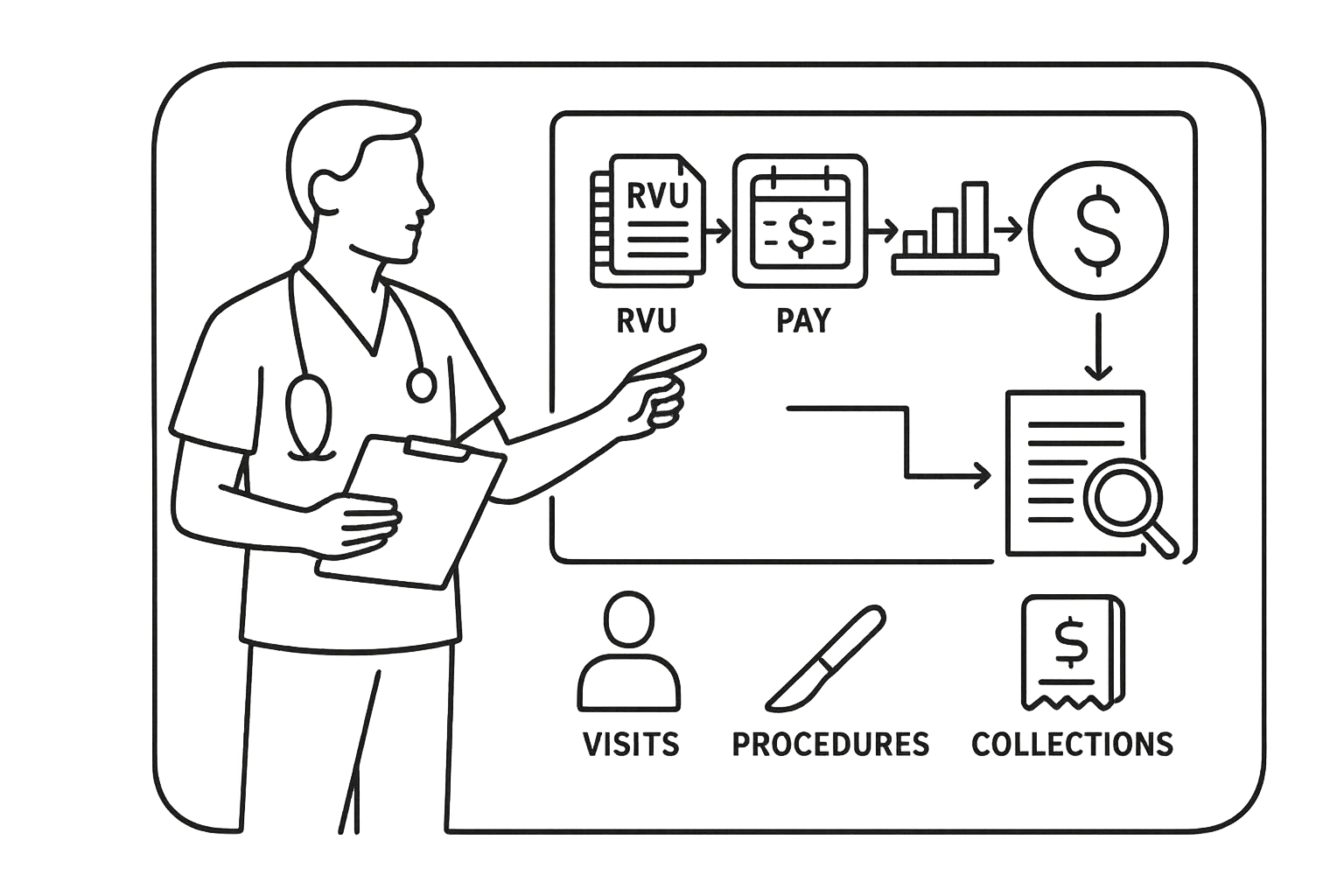
Employers use productivity bonuses to connect physician assistant compensation with measurable clinical output, patient volume, efficiency, or collected revenue. A typical program has three core elements: the metric that triggers compensation, the formula used to calculate the payment, and the schedule for measuring and paying the bonus. Common metrics include wRVUs, net collections, patient encounters, and qualifying procedures.
The calculation may use a flat payment per unit, a percentage of collections, or tiered rates that increase after specified thresholds. Bonuses may be paid each pay period or reconciled monthly, quarterly, or annually. These differences matter because a PA may perform the clinical work long before the employer recognizes the related productivity or revenue.
Employer-drafted provisions may also reserve discretion over definitions, reporting methods, reconciliation, or later adjustments. During a comprehensive physician assistant contract review, the bonus language should therefore be evaluated together with scheduling, supervision, malpractice insurance, termination, and restrictive covenant provisions. Productivity plans commonly rely on patient encounters, revenue, or RVUs, which are also used in broader physician assistant productivity measurement.
Common PA Productivity Bonus Models
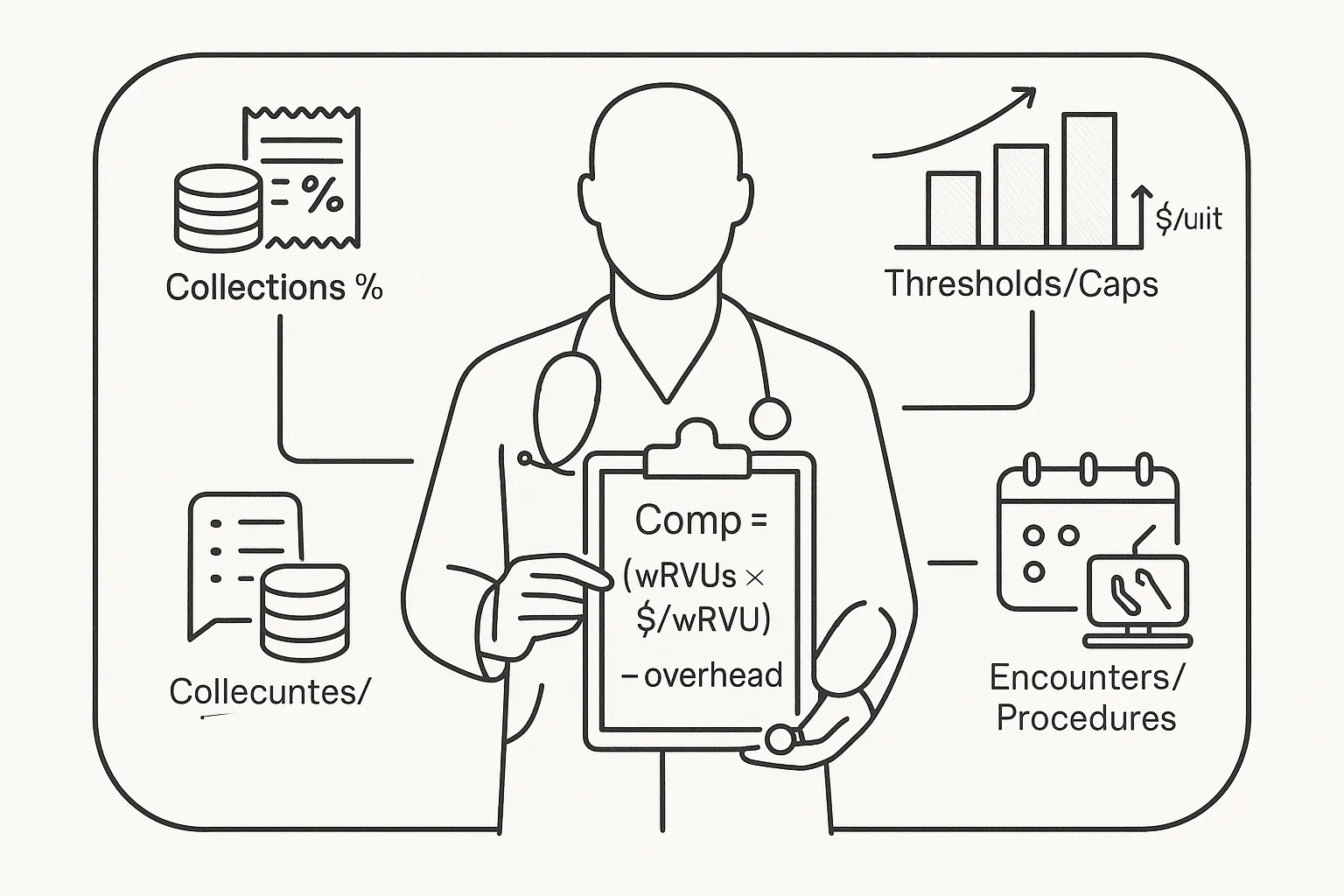
The value and predictability of a productivity bonus depend on what the employer measures and how the agreement translates that measurement into compensation. The contract should identify the controlling metric, calculation method, data source, performance period, and any deductions or adjustments.
RVU and wRVU Bonus Formulas
RVU-based plans convert measured clinical work into compensation. Productivity is commonly measured using work relative value units and RVU compensation formulas, which assign values to medical services based on the work involved. A basic formula may multiply credited wRVUs by a stated dollar-per-wRVU conversion rate.
The agreement should specify which RVU schedule applies, whether the conversion factor can change, who reports the data, and which services receive credit. It should also address whether only professional billing RVUs count, whether facility-related activity is included, and how productivity is credited when services involve another clinician. Ambiguous definitions can materially alter the expected payment.
Collections and Revenue-Share Bonuses
Collections-based plans pay a percentage of revenue attributed to the physician assistant’s services. The contract must distinguish among gross charges, net collections after contractual adjustments, and amounts remaining after write-offs, denials, refunds, or billing corrections. A percentage that appears favorable may produce a much smaller payment when applied only to narrowly defined net collections.
These models expose the PA to billing delays, payer denials, collection practices, and reimbursement timing that may be outside the PA’s control. The agreement should explain when revenue is credited, how long collections remain attributable to a performance period, and whether later payer recoupments permit the employer to revise a previously paid bonus.
Encounter, Procedure, Threshold, and Hybrid Models
Some practices pay bonuses based on patient encounters, visits, procedures, or other defined activities. These models may be used in urgent care, surgical assist, and telehealth settings. The agreement should define a qualifying encounter or procedure, explain how split or shared services are counted, and address whether bundled services or work across multiple locations receives productivity credit.
Hybrid plans combine a base salary with thresholds and tiered incentive rates. A PA may need to reach a specified production level before receiving any bonus, after which different rates apply to successive tiers. The contract should disclose annual caps, prorating for part-time work or leave, and whether the employer may change thresholds, rates, or caps without the PA’s agreement. Comparing the bonus with the overall physician assistant compensation model helps show how much income is guaranteed and how much remains variable.
Contract Terms That Control Productivity Pay
A productivity formula is only as reliable as the definitions and procedures supporting it. The agreement should identify the billing or reporting system used, who maintains the data, how discrepancies are resolved, and whether the PA receives regular statements. Vague references to “practice reports,” “standard billing data,” or employer calculations may leave the employer with broad discretion over compensation.
Measurement, Reconciliation, Clawbacks, and Reporting
Performance periods may be monthly, quarterly, or annual, and the selected window affects both cash flow and predictability. Contracts should state when a bonus becomes earned, when it is paid, and whether payer audits, claim denials, or accounting corrections permit retroactive adjustments. The PA should also understand whether a partial period will be prorated when employment begins or ends during a measurement cycle.
Salary draws, productivity advances, and deficit carryforwards may create repayment exposure. Agreements containing negative accrual provisions should explain whether a shortfall carries into a later period, how long the employer may look back, and whether repayment can be deducted from later compensation or final wages. Broad clawback language can leave a PA responsible for adjustments long after the original payment.
Reporting rights are equally important. Regular productivity statements, access to the relevant underlying data, and a defined process for disputing calculations allow the PA to verify payments. A contract that restricts access to reports or makes the employer’s determination final can make errors difficult to identify or challenge.
Productivity Bonus Examples and Practical Scenarios
Assume an illustrative agreement pays $20 per wRVU up to 5,000 wRVUs and $30 per wRVU for production from 5,001 through 6,000 wRVUs. If the PA generates 5,500 wRVUs, the stated calculation would be:
- 5,000 wRVUs × $20 = $100,000
- 500 wRVUs × $30 = $15,000
- Total illustrative bonus before contractual adjustments = $115,000
The actual payment could differ if the contract applies overhead deductions, excludes certain RVUs, uses a different reporting source, or prorates production for part-time schedules. The same concern arises when an agreement describes the initial production level as a threshold rather than a payable tier. The document must clearly state whether compensation applies to every unit or only to units generated above the threshold.
In a collections model, a PA might generate $200,000 in billed charges during a quarter while only $120,000 is collected during the measurement window. If the bonus is based on collected revenue, the employer will use the smaller amount even though the remaining claims may still be pending. Later denials or recoupments can further reduce compensation if the agreement permits retroactive reconciliation.
Part-time, float, and multi-site assignments create additional allocation questions. Targets based on full-time expectations should address prorating, while multi-site agreements should identify whether productivity follows the individual PA, a supervising physician, or a pooled department. Clear crediting rules help prevent clinical work from being excluded or assigned elsewhere.
Legal, Tax, and Compensation Red Flags
Employment classification affects how productivity compensation is paid and reported. W-2 compensation generally involves payroll withholding and may interact with benefits or retirement plan calculations, while a 1099 arrangement may shift tax and business expenses to the PA. A contract labeled as an independent contractor agreement may also warrant closer review when the employer retains significant control over scheduling, credentialing, supervision, and working conditions. PAs comparing these arrangements can review the broader differences between W-2 and 1099 physician assistant work.
The agreement should explain whether bonus payments are subject to payroll deductions and whether they count as compensation for employer-sponsored benefits. Productivity arrangements can also present healthcare compliance concerns when compensation is tied improperly to referrals or designated services. The compensation formula should not require conduct that creates regulatory risk or distorts clinical decision-making.
Common contract red flags include undefined terms, unrealistic targets, employer-controlled data with no review rights, unilateral changes to the formula, uncapped look-back periods, and repayment obligations that survive employment. A PA should also investigate whether staffing, patient volume, credentialing delays, scheduling restrictions, or inadequate support could make the stated target difficult to achieve.
Productivity Bonuses When Employment Ends
Termination provisions can determine whether a PA receives compensation for work performed before departure. The agreement should address bonuses earned but not yet calculated, collections received after the final day of employment, partial performance periods, final reconciliation, and the deadline for payment. It should also state whether termination for a particular reason changes bonus eligibility.
A provision that requires active employment on the payout date may cause the PA to forfeit compensation tied to previously completed work. Conversely, post-termination reconciliation language may allow the employer to demand repayment months later. Reviewing termination and final compensation terms before signing can clarify how productivity pay will be handled when the relationship ends.
When to Seek Physician Assistant Contract Review
Attorney-led review is particularly useful when an agreement includes a complex formula, multiple productivity tiers, collections-based compensation, negative accrual, repayment obligations, employer discretion, or assignments across several facilities. The review should determine how productivity is measured, which data controls, when compensation becomes earned, and whether the employer may later alter or recalculate the payment.
A clearly drafted productivity plan can increase compensation while giving both parties a workable method for measuring performance. Ambiguous definitions, retroactive adjustments, and inadequate reporting rights create uncertainty about whether the promised bonus will be attainable or paid. Evaluating these provisions before signing gives the PA a better understanding of guaranteed income, variable income, and the financial risks that may continue after employment ends.
Frequently Asked Questions
How is a physician assistant productivity bonus calculated?
The calculation depends on the employment agreement. Common methods multiply credited wRVUs by a conversion rate, pay a percentage of defined collections, or assign a payment to qualifying encounters or procedures. Thresholds, tiers, caps, deductions, and reconciliation rules can change the final amount.
What is the difference between an RVU bonus and a collections bonus?
An RVU bonus measures credited clinical work using specified RVU data, while a collections bonus depends on revenue the employer actually receives. Collections plans are more directly affected by billing delays, payer denials, write-offs, and reimbursement timing.
Can an employer change a PA productivity bonus formula?
The contract determines whether and how changes may occur. Language allowing the employer to revise thresholds, conversion rates, caps, or reporting methods unilaterally can reduce income predictability and should be reviewed carefully before signing.
What is negative accrual in a productivity compensation plan?
Negative accrual generally means a productivity shortfall or compensation deficit can carry into a later period. Depending on the agreement, future bonuses may be reduced until the deficit is satisfied, or the employer may assert a repayment obligation.
What happens to an unpaid productivity bonus after termination?
The result depends on provisions governing when the bonus is earned, active-employment requirements, partial measurement periods, post-termination collections, and final reconciliation. The agreement should state whether previously performed work remains eligible for payment and whether later adjustments are permitted.
What productivity records should a PA be allowed to review?
The contract should provide enough information to verify the calculation, such as regular productivity statements and access to the relevant RVU, encounter, procedure, or collections data. It should also include a reasonable process for identifying and resolving reporting errors.
Review Your PA Productivity Bonus Before You Sign
Chelle Law reviews productivity formulas, thresholds, reporting rights, clawbacks, and termination provisions so physician assistants can understand how their compensation will work in practice.
Contact Chelle LawExplore Physician Assistant Contract Guidance
Review Chelle Law services, practical contract resources, and state-specific information for physician assistants.