
Physician assistants reviewing employment agreements should understand how restrictive covenants can affect income, career mobility, and long-term practice options. These provisions include non-compete, non-solicitation, confidentiality, and related work restrictions that may limit how and where a PA can practice during or after employment. Employers generally use them to protect patient relationships, confidential information, staff, and referral sources, but broadly drafted restrictions can make it difficult for a clinician to remain in a preferred location, specialty, or healthcare system.
This guide explains the principal restrictive covenants found in physician assistant contracts, the factors that may affect enforceability, and the financial and professional risks created by unclear terms. Because state law varies and these clauses often interact with compensation, termination, malpractice coverage, and practice requirements, they should be evaluated within the full agreement rather than in isolation. An attorney-led review can identify how the language may affect post-employment opportunities before the PA signs.
Types of Restrictive Covenants in PA Agreements

Restrictive covenants limit specified activities during employment or after the relationship ends. In physician assistant employment and independent contractor agreements, they may regulate where the PA works, which patients or referral sources the PA may contact, whether the PA may recruit employees, and how confidential information or patient records are handled. They may also restrict moonlighting, telehealth, consulting, academic work, or services for another healthcare organization.
Non-Compete Clauses
Non-compete clauses restrict a physician assistant from providing specified clinical services within a defined area for a stated period after employment ends. The restriction may apply whether the PA resigns or is terminated, depending on the contract. A broadly defined geographic area, a restriction measured from multiple facilities, or language covering several specialties can sharply reduce local job opportunities and future negotiating leverage.
The practical effect depends on more than the clause’s label. PAs should examine the restricted services, covered locations, duration, affiliated entities, and events that trigger the covenant. A detailed guide to physician assistant non-compete agreements can help clarify these components, while a focused non-compete review evaluates how the actual language affects the PA’s options.
Non-Solicitation and Non-Interference Provisions
Non-solicitation provisions may restrict direct or indirect contact with patients, employees, referral sources, or business partners after separation. Non-interference language can be broader, potentially limiting conduct that the employer believes disrupts a business relationship even when the PA did not initiate contact. The agreement should define who is protected, what conduct is prohibited, and whether ordinary professional communication could be characterized as solicitation.
These clauses sometimes connect to liquidated damages, compensation adjustments, or repayment obligations. Understanding the reach of PA non-solicitation restrictions is therefore important when assessing both mobility and potential financial exposure.
Confidentiality and Outside-Work Restrictions
Confidentiality clauses are intended to protect patient data, financial information, business methods, and other proprietary material. They should be reviewed for language that could interfere with lawful reporting obligations, credentialing, access to information needed for continuity of care, or compliance with professional requirements. Contracts should also distinguish confidential business information from a PA’s general knowledge, skills, and experience.
Outside-work restrictions may require approval for moonlighting, consulting, academic work, or services for another healthcare entity. They can also reach remote clinical services, making the definition of competitive activity particularly important when the PA expects to practice across locations or provide telemedicine. PAs anticipating remote work should compare these restrictions with the agreement’s broader telehealth contract terms.
Restrictive covenants in healthcare agreements are commonly evaluated in light of the employer’s asserted business interests, the clinician’s ability to practice, and patient access concerns, concepts also discussed in the American Medical Association’s overview of restrictive covenants in healthcare contracts.
How Enforceability Is Evaluated
The enforceability of a restrictive covenant depends on applicable state law and the language of the agreement. Courts and regulators may examine whether the employer has a legitimate interest to protect and whether the restriction is reasonable in duration, geographic reach, and prohibited activity. Healthcare-related analysis may also consider patient access, continuity of care, and the effect of enforcement in underserved areas or essential care settings.
Duration, Geography, State Law, and the PA’s Role
A restriction may create significant practical difficulty even when its duration appears limited. Geographic boundaries measured from every facility in a health system can cover a much larger area than a radius tied to the PA’s primary worksite. Similarly, language prohibiting all healthcare work may be more burdensome than a restriction limited to the clinical services the PA actually performed.
The PA’s duties, patient relationships, compensation, and consideration received for the covenant may also be relevant. State approaches differ substantially: some jurisdictions limit certain healthcare non-competes, while others may enforce reasonable restrictions under particular circumstances. A general statement that a covenant is “standard” does not establish whether it is enforceable or appropriate for a specific physician assistant.
Career and Financial Risks for Physician Assistants
Restrictive covenants can prevent a PA from accepting a position with a nearby practice, hospital, or affiliated health system. They may complicate a specialty change, relocation, or move into telehealth, and restrictions covering multiple facilities can eliminate more opportunities than the PA expected. Even uncertainty about enforceability can affect career decisions because a prospective employer may be unwilling to assume the risk of a dispute.
Financial risk may arise when covenant compliance is linked to a signing bonus, relocation payment, productivity incentive, or other benefit. If the PA leaves before satisfying a service period or the employer alleges a post-employment violation, the agreement may require repayment or permit compensation adjustments. These provisions should be compared with the contract’s sign-on bonus repayment terms and termination language so the PA understands which obligations survive separation.
Operational restrictions can create additional concerns when they intersect with scope of practice, supervision, collaboration, delegation, or facility requirements. For example, restrictions on providing services at certain locations may narrow the settings in which the PA can lawfully and practically work. Legal expenses and lost income may also result if the parties disagree about what the covenant prohibits.
Contract Terms That Define the Restriction
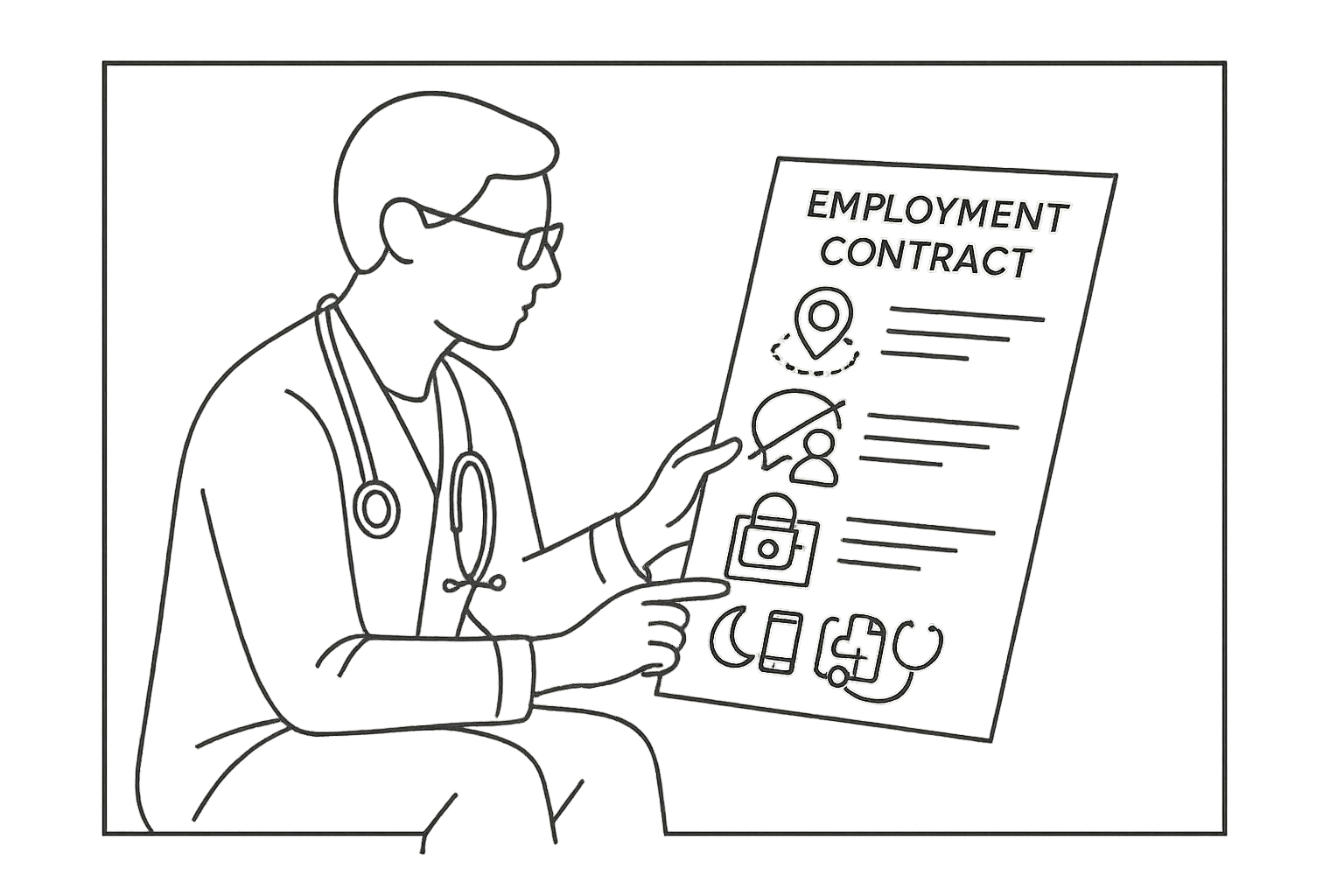
Small drafting differences can substantially change a restrictive covenant’s effect. The agreement should identify the patients, services, entities, and locations covered by the restriction rather than relying on vague phrases such as “any patient,” “local area,” or “competitive services.” Definitions of the employer, affiliates, practice sites, and competing businesses deserve particular attention when the organization operates across a broad network.
The contract should also state when the restriction begins, how long it lasts, and whether it applies after every form of separation. A PA should determine whether the covenant remains in effect following termination without cause, nonrenewal, an employer breach, a material change in duties, or closure of a location. These questions should be considered alongside the agreement’s termination and notice provisions.
Carve-outs can preserve appropriate work opportunities by excluding specified hospital-based services, emergency care, academic roles, telehealth work, or locations where the PA did not practice. Other provisions may establish a buyout, damages remedy, or repayment obligation. Each exception or remedy should be precise enough for the PA to understand the cost and conduct required after employment ends.
When to Seek a Physician Assistant Contract Review
A formal review is advisable before signing an employment or independent contractor agreement containing post-employment restrictions. Because restrictive covenants often interact with compensation, malpractice insurance, termination, credentialing, and supervision requirements, reviewing only the covenant may miss important consequences elsewhere in the contract. A complete review should generally include the agreement, exhibits, addenda, compensation plans, job description, benefit summaries, applicable supervision or delegation materials, and any related offer letter.
Attorney review can identify ambiguous definitions, assess how the restriction operates under the agreement, and explain potential repayment or mobility risks. Chelle Law’s physician assistant contract review examines restrictive covenants within the full allocation of professional and financial risk, helping the PA understand the terms before committing to the position.
Frequently Asked Questions
What is the difference between a restrictive covenant and a non-compete clause?
A restrictive covenant is a broad category of contractual limitation. A non-compete is one type of restrictive covenant, while non-solicitation, confidentiality, non-interference, and outside-work restrictions are other common examples.
Can a PA non-compete apply if the employer terminates the agreement?
It may, depending on the contract language and applicable state law. The agreement should be reviewed to determine whether the covenant applies after termination without cause, for cause, nonrenewal, resignation, or an employer breach.
Which non-compete terms should a physician assistant review most carefully?
The PA should examine the duration, geographic boundary, restricted services, covered facilities and affiliates, triggering events, exceptions, and available remedies. The combined effect of these terms determines the covenant’s practical impact.
Can a non-solicitation clause prevent patients from following a PA?
A non-solicitation clause may restrict the PA from encouraging or initiating patient contact, but its exact reach depends on how solicitation, protected patients, and prohibited conduct are defined. The clause should also be reviewed for indirect-contact and non-interference language.
Do restrictive covenants affect moonlighting or telehealth work?
They can. Some agreements require prior approval for outside work or define competing activity broadly enough to include moonlighting, consulting, or telehealth services during or after employment.
Why should the entire PA agreement be reviewed with the restrictive covenant?
Restrictive covenants often interact with termination rights, bonus repayment, compensation adjustments, malpractice obligations, and professional practice requirements. Reviewing the complete agreement reveals consequences that may not be apparent from the covenant alone.
Understand Your PA Contract Before You Sign
Chelle Law reviews restrictive covenants alongside compensation, termination, malpractice, and other contract terms so you can evaluate the full professional and financial risk.
Contact Chelle LawExplore Physician Assistant Contract Guidance
Review legal services, practical resources, and state-specific contract information for physician assistants.