
Relative value unit compensation ties some or all of a physician assistant’s earnings to measured clinical productivity. Most PA plans use work RVUs, or wRVUs, assigned to reported services, but the number of credited units is only one part of the calculation. The applicable fee schedule, attribution rules, conversion factor, productivity threshold, measurement period, and payment timing can materially change what the physician assistant earns.
These details matter because clinical work does not always translate directly into credited productivity. Split/shared visits, incident-to billing, coding changes, documentation requirements, payer adjustments, credentialing delays, and employer-controlled scheduling may affect the final total. A formula that appears favorable can also create unexpected exposure if a salary guarantee is actually a recoverable draw, deficits carry forward, or previously paid compensation remains subject to a broad clawback.
This guide explains how PA RVU compensation is built, how common salary and bonus models operate, and which provisions affect actual pay. It also examines the relationship between productivity compensation, scope of practice, malpractice coverage, termination, and repayment obligations. A focused PA compensation review can evaluate the complete formula and identify terms that may warrant clarification before the agreement is signed.
The Building Blocks of PA RVU Compensation

An RVU is a numerical measure associated with a medical service. Services reported under Current Procedural Terminology and related billing codes receive values reflecting the resources involved in furnishing care. An employer may accumulate the RVUs attributed to a physician assistant over a month, quarter, or year and then apply the compensation formula stated in the employment agreement or an incorporated policy.
The basic sequence is a patient service, an assigned billing code, an associated RVU value, attribution of that value to a clinician, and application of a contractual dollar rate. Every step can affect compensation. The agreement therefore needs more than a statement that the PA will receive “RVU pay”; it needs a sufficiently definite method for identifying the units, calculating the payment, and resolving later adjustments.
Work RVUs Compared With Total RVUs
Each service’s total RVU generally consists of three components: the work RVU, practice-expense RVU, and malpractice RVU. The work component reflects clinician time, effort, technical skill, judgment, and decision-making. The other components account for practice overhead and professional liability expense.
- Work RVU: measures the professional work associated with the service.
- Practice-expense RVU: accounts for clinical labor, supplies, equipment, and other practice costs.
- Malpractice RVU: reflects professional liability expense associated with the service.
PA productivity plans frequently use wRVUs rather than total RVUs. Because those measures produce different totals, the contract must identify which one controls. The documents also need to identify the schedule or data set used to assign values, especially if the employer reserves the right to update that source during the contract term.
Medicare Values and the Employer’s Contractual Conversion Factor
The Medicare Physician Fee Schedule is a common reference point, but Medicare reimbursement and contractual productivity compensation are not the same calculation. CMS publishes annual Physician Fee Schedule relative value files containing work, practice-expense, and malpractice values. Medicare payment then incorporates geographic adjustments and an annual conversion factor.
For 2026, CMS uses separate Medicare conversion factors for qualifying alternative payment model participants and clinicians who do not qualify. Those federal payment factors do not automatically establish the dollar amount an employer pays a PA for each wRVU. A contract may use a different rate, an internal schedule, a specialty-specific methodology, or a formula that applies only after the PA crosses a threshold. The agreement should distinguish the employer’s contractual conversion factor from any Medicare reimbursement reference.
Medicare also generally pays covered PA professional services outside hospital and skilled nursing facility settings at 85% of the physician fee schedule amount, subject to CMS payment rules. That reimbursement methodology does not mean a PA must receive 85% of a physician’s contractual wRVU rate. The employer’s collections and the PA’s compensation are separate concepts unless the agreement expressly connects them. Current federal information about Medicare payment for physician assistant services provides regulatory context, but the signed compensation documents control the employment formula.
How Services Become Credited RVUs
A physician assistant may perform substantial clinical work without receiving the expected productivity credit if the compensation plan does not clearly address attribution. Coding, billing-provider selection, place of service, claim edits, documentation, payer rules, and later corrections can all influence what appears on the employer’s productivity report. The agreement or incorporated plan should identify which reported services qualify and whether credit depends on billing, claim submission, adjudication, or actual collection.
Documentation also matters. CMS requires records to support the reported CPT, HCPCS, and diagnosis codes, and coding edits or documentation deficiencies can change a claim after the patient encounter. A useful compensation methodology explains whether corrected claims add or remove RVUs, how modifiers are handled, how long adjustments remain open, and which version of the data is used for the final calculation.
Split/Shared Visits and Incident-to Services
Split/shared facility evaluation and management visits require particular attention. Under current Medicare policy, the substantive portion may be established by more than half of the total time or by a substantive part of the medical decision-making, depending on the service and documentation. Time is therefore not the only consideration. The billing clinician identified on the claim may receive the employer’s productivity credit even when both a physician and PA participated in the encounter.
Incident-to billing presents a different attribution issue. CMS distinguishes a PA’s personally furnished professional services from auxiliary services billed incident to a physician or another eligible practitioner. Incident-to treatment-course, supervision, office-setting, and billing-provider requirements do not automatically determine who receives internal productivity credit. The contract or compensation policy needs its own rule for assigning those services, and that rule should be consistent with compliant billing and documentation practices.
These distinctions make sample reports valuable. A report can reveal whether encounters are assigned by rendering clinician, billing clinician, department, location, collections account, or another internal field. It can also show whether split/shared services, procedures, global-period work, telephone services, telehealth encounters, or services later corrected by billing staff are included in the PA’s total.
Common RVU Compensation Structures
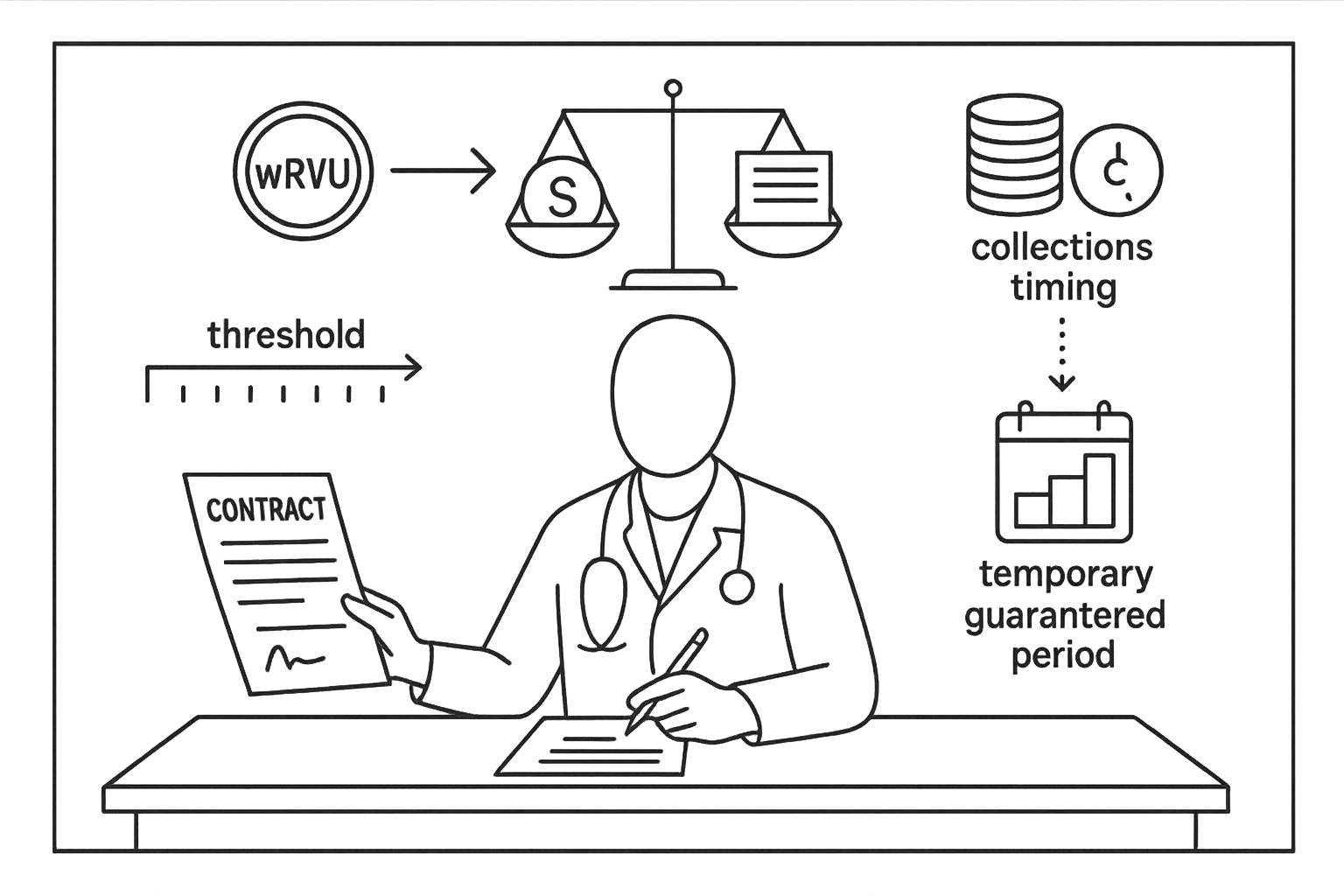
RVU compensation can determine total earnings or supplement a guaranteed salary. Understanding which structure applies is essential because identical conversion factors can produce very different results. A broader comparison of physician assistant compensation models can help distinguish RVU formulas from collections-based, salary-only, and hybrid arrangements.
Base Salary, Thresholds, Guarantees, and Draws
A common model provides a base salary and pays an incentive after the PA exceeds a stated annual or periodic wRVU threshold. The threshold may represent the production already covered by salary. For example, the plan might pay a fixed amount for each credited wRVU above 4,000 units, rather than multiplying every unit by the conversion factor.
The measurement period changes the result. A monthly threshold can create a bonus in a productive month while disregarding a later shortfall. A cumulative annual model may offset strong periods against weak ones before paying anything. Quarterly reconciliation may fall between those approaches. The plan also needs to address whether deficits carry forward and whether thresholds are prorated for a partial year, approved leave, reduced schedule, or termination before year-end.
A ramp period may protect earnings while the PA completes credentialing, receives training, builds a patient panel, or transitions into a new specialty. The critical distinction is whether the stated guarantee is non-repayable salary or an advance against later production. If it is a draw, an unfavorable reconciliation may create a deficit. A negative accrual clause can carry that deficit into later periods or, depending on the wording, permit recovery after employment ends.
Collections-based compensation operates differently. Payment depends on revenue received rather than units generated, so payer delays, denials, recoupments, and the employer’s billing performance can affect earnings. Hybrid plans may combine a wRVU threshold with a collections adjustment or profitability measure. Each metric needs a defined role so the employer cannot select whichever calculation produces the lower payment after the work has been performed.
Contract Terms That Determine Actual Pay
The conversion factor attracts attention, but several less visible terms often have an equal or greater financial effect. A complete compensation provision identifies the RVU source, included services, attribution method, target, conversion factor, measurement period, reconciliation process, reporting schedule, and payment date. It also explains whether the formula may be changed and what notice or consent is required.
- Measurement and proration: whether targets are monthly, quarterly, or annual and how partial periods are treated.
- Reporting rights: what data the PA receives, how often reports are delivered, and whether encounter-level detail is available.
- Corrections and disputes: how the PA can question missing services, coding changes, or calculation errors.
- Payment timing: when an incentive becomes earned, calculated, payable, and no longer subject to adjustment.
- Formula changes: whether the employer can revise the schedule, conversion factor, threshold, or attribution policy unilaterally.
- Leave and operational disruption: how approved leave, credentialing delays, clinic closures, or reduced patient access affect the target.
Reporting is particularly important because a PA cannot independently verify an incentive without access to the underlying data. Summary totals may not reveal that encounters were assigned to another clinician, omitted because of a coding edit, or removed after a payer adjustment. Reports should provide enough information to trace credited services and reproduce the payment calculation.
Bonus provisions also need to define continued-employment conditions. Some plans state that no incentive is payable unless the PA remains employed on the scheduled payment date, even when the work was completed months earlier. Other agreements calculate production through the last day worked and provide a final reconciliation. The distinction can determine whether a PA forfeits substantial compensation after giving notice. The related guide to PA productivity bonuses examines these timing and forfeiture issues in greater detail.
Clawbacks create a separate concern. An employer may reserve the right to reverse credit because of coding corrections, denied claims, audits, payer recoupments, or documentation issues. The provision needs boundaries: which events permit recovery, how long adjustments remain open, whether the PA receives supporting records, and whether recovery is limited to future incentive compensation. Separate repayment language may also apply to signing bonuses, relocation assistance, training expenses, or an advance against future production.
Operational, Regulatory, and Liability Risks
An aggressive productivity target does not expand a physician assistant’s legal authority or clinical privileges. PA services remain subject to applicable state law, supervision or collaboration requirements where applicable, prescribing rules, credentialing, payer conditions, employer policy, and facility privileges. CMS likewise requires covered PA services to be legally authorized in the state where they are performed and supported by the medical record. Compensation pressure cannot substitute for compliant practice.
Operational conditions also determine whether a target is attainable. Appointment templates, patient volume, staffing, clinical support, administrative duties, call coverage, multi-location assignments, scheduling control, and access to procedures may all affect production. A target derived from another PA’s historical output may be misleading if the specialty, schedule, referral base, staffing, or job duties are materially different.
Credentialing and payer enrollment deserve specific treatment because delays can prevent claims from being billed or attributed even when the PA is ready to work. The documents should explain whether the salary guarantee remains intact, whether the target is prorated, and whether productivity lost through an employer-controlled enrollment process creates a deficit. Similar questions arise when the employer reduces clinic hours, changes locations, modifies appointment templates, or assigns substantial non-billable duties.
Higher volume may also increase professional liability exposure. The agreement needs to identify the malpractice coverage provided for the PA, policy limits, coverage form, and responsibility for post-employment protection. If the policy is claims-made, the allocation of tail insurance costs can materially affect the value of the compensation package.
Termination provisions must be read alongside the productivity formula. Notice requirements, for-cause definitions, without-cause termination rights, final-pay language, bonus forfeiture, repayment obligations, and post-employment adjustments may interact. A PA evaluating an exit can use the guide to terminating a physician assistant contract to identify the broader obligations that may accompany a final RVU reconciliation.
Testing the Formula With Compensation Scenarios
Scenario one: salary plus production above a threshold. Assume a plan provides a $120,000 base salary, sets an annual target of 4,000 wRVUs, and pays $45 for each wRVU above the target. If the PA generates 4,500 credited wRVUs, the incentive would be based on 500 excess units, producing $22,500 before any adjustment. Multiplying all 4,500 units by $45 would be incorrect unless the agreement states that the conversion factor applies to every unit.
Scenario two: compensation stated as total production value. If the agreement applies a $45 contractual rate to all 4,000 credited wRVUs, the formula produces $180,000. That number may represent total compensation rather than a bonus payable in addition to salary. The documents need to explain whether the base salary is included in, offset against, or separate from the calculated amount.
Scenario three: procedural production with later adjustments. At $60 per wRVU and 6,000 credited units, the initial formula produces $360,000. Actual compensation may be lower if the plan excludes certain procedures, treats salary as a draw, applies a threshold, reassigns split/shared visits, or permits billing corrections and benefit offsets. A high conversion rate is not necessarily favorable if the attribution and adjustment provisions are restrictive.
Scenario planning should include conservative, expected, and high-production outcomes. Each projection can account for credentialing time, seasonal volume, approved leave, payer adjustments, administrative duties, and the period required to build a patient panel. If the agreement uses a recoverable draw, the analysis should also estimate the potential deficit at each production level and determine whether repayment can survive termination.
Documents and Questions to Review Before Signing
The employment agreement may not contain the entire compensation formula. Definitions and operational rules often appear in exhibits, offer letters, compensation plans, billing policies, handbooks, or documents the employer can revise separately. Every incorporated document should be obtained and reviewed before the PA relies on projected income.
Useful materials include sample productivity reports, the current RVU schedule, historical production data for the position, the written attribution methodology, and policies governing coding corrections, modifiers, claim adjustments, bonus timing, and reconciliation. Historical data is most useful when it reflects a comparable specialty, schedule, location, patient population, and scope of duties rather than a system-wide average.
- Which RVU measure and annual schedule does the formula use?
- Who receives credit for split/shared, incident-to, and jointly performed services?
- Does the conversion factor apply to every credited unit or only units above a threshold?
- Can the employer change the target, rate, schedule, or attribution methodology during the term?
- Are deficits carried forward, and is any guarantee characterized as a repayable draw?
- How are credentialing delays, leave, partial years, and employer-caused scheduling reductions treated?
- What reports will be provided, and what process applies to missing or disputed credit?
- When is an incentive earned, and can it be forfeited or recovered after termination?
Warning signs include undefined RVU terminology, targets unsupported by comparable production data, unilateral formula changes, limited reporting access, non-prorated annual thresholds, indefinite adjustment periods, broad clawbacks, and repayment language that continues after employment. Reviewing the compensation section with the termination, malpractice, restrictive covenant, and repayment provisions provides a more accurate picture of the agreement’s financial risk than reading the RVU formula alone.
Frequently Asked Questions
What is the difference between a work RVU and a total RVU?
A work RVU measures the clinician’s time, effort, skill, and decision-making. A total RVU also includes practice-expense and malpractice components. Because the resulting totals differ, the compensation documents need to identify which measure controls the PA’s pay.
Is an employer’s RVU conversion factor the same as Medicare’s conversion factor?
Not necessarily. Medicare uses annual conversion factors as part of its federal payment methodology, while an employer may establish a different contractual dollar rate for PA compensation. The agreement should state the applicable rate and explain whether it applies to all credited units or only production above a threshold.
Can a physician assistant be required to repay a salary guarantee?
Repayment may be possible if the agreement characterizes the guarantee as a draw or advance rather than non-repayable salary. The documents should explain how deficits are reconciled, whether negative balances carry forward, and whether repayment can be pursued after termination.
How can split/shared or incident-to billing affect RVU credit?
The billing provider identified under applicable payer rules may not be the clinician who receives internal productivity credit. The compensation plan should separately define how split/shared and incident-to services are assigned and provide reports that allow the PA to verify those encounters.
What happens to an earned RVU bonus when PA employment ends?
The result depends on the agreement’s earning, payment, termination, and forfeiture provisions. The contract should explain whether production through the termination date is calculated, whether employment on the scheduled payment date is required, and when the final reconciliation occurs.
What records should a PA request before accepting RVU compensation?
Useful records include the written RVU methodology, sample productivity reports, the applicable RVU schedule, comparable historical production data, and policies addressing attribution, coding corrections, billing adjustments, bonus timing, disputes, and reconciliation.
Have Your PA RVU Compensation Terms Reviewed
Chelle Law can analyze the conversion factor, productivity threshold, attribution rules, reporting rights, clawbacks, and termination provisions affecting your compensation.
Contact Chelle LawExplore Physician Assistant Contract Guidance
Review legal services, practical resources, and state-focused contract information for physician assistants.