
Tail insurance for physician assistants is an important contract issue that often appears in employment agreements and independent contractor arrangements using claims-made malpractice coverage. Tail insurance, also called extended reporting coverage, protects against claims reported after the policy ends when the underlying care was provided during the policy period. For physician assistants, responsibility for tail insurance can significantly affect the financial value of a job offer and the cost of leaving a position.
Many physician assistant contracts mention malpractice insurance without clearly explaining whether the employer provides claims-made or occurrence coverage, who pays the premiums during employment, or who is responsible for tail coverage after separation. Those distinctions matter because tail insurance can be expensive, and the obligation to purchase it may arise at the end of employment, after a without-cause termination, or even after a dispute with the employer. Contract language governing tail insurance therefore has a direct impact on income, liability exposure, and post-employment planning.
This guide explains what tail coverage is, how it differs depending on the type of malpractice policy, common ways employers allocate the cost, and the contract terms physician assistants should review before signing. Because malpractice provisions can create substantial post-termination financial obligations, an attorney-led review can help a PA understand how tail insurance affects both risk and compensation under a proposed agreement.
What Tail Insurance Covers and Why It Matters

Tail insurance is extended reporting coverage purchased to protect a clinician against malpractice claims reported after a claims-made policy ends. Under a claims-made malpractice policy, coverage generally depends on the policy being active both when the clinical service occurs and when the claim is reported. If the policy ends when a physician assistant leaves employment or a practice changes insurers, claims reported afterward may not be covered unless tail insurance is in place.
Because many employer-provided malpractice policies are written on a claims-made basis, the end of employment or termination of the group’s policy can create a coverage gap. Tail insurance extends the reporting period for claims related to care provided while the policy was active. This issue is also addressed in guidance concerning physician assistant malpractice insurance basics.
Financial Exposure, Career Mobility, and Income
Without appropriate tail coverage, a physician assistant may face legal defense costs and potential liability for claims tied to prior clinical work. Even when an employer has indemnification obligations, the contract may contain reimbursement provisions that shift part of the financial risk to the PA. Future employers may also request evidence of continuous malpractice protection, making documentation of tail coverage or prior acts coverage important when moving between positions.
Tail premiums can also change the economic value of an offer. The obligation may interact with signing bonuses, relocation payments, severance, or other post-employment liabilities. Because physician assistant employment agreements are often drafted primarily to protect the employer, the agreement should clearly state who pays, when coverage must be purchased, and whether termination or repayment provisions alter that responsibility.
Claims-Made and Occurrence Malpractice Policies
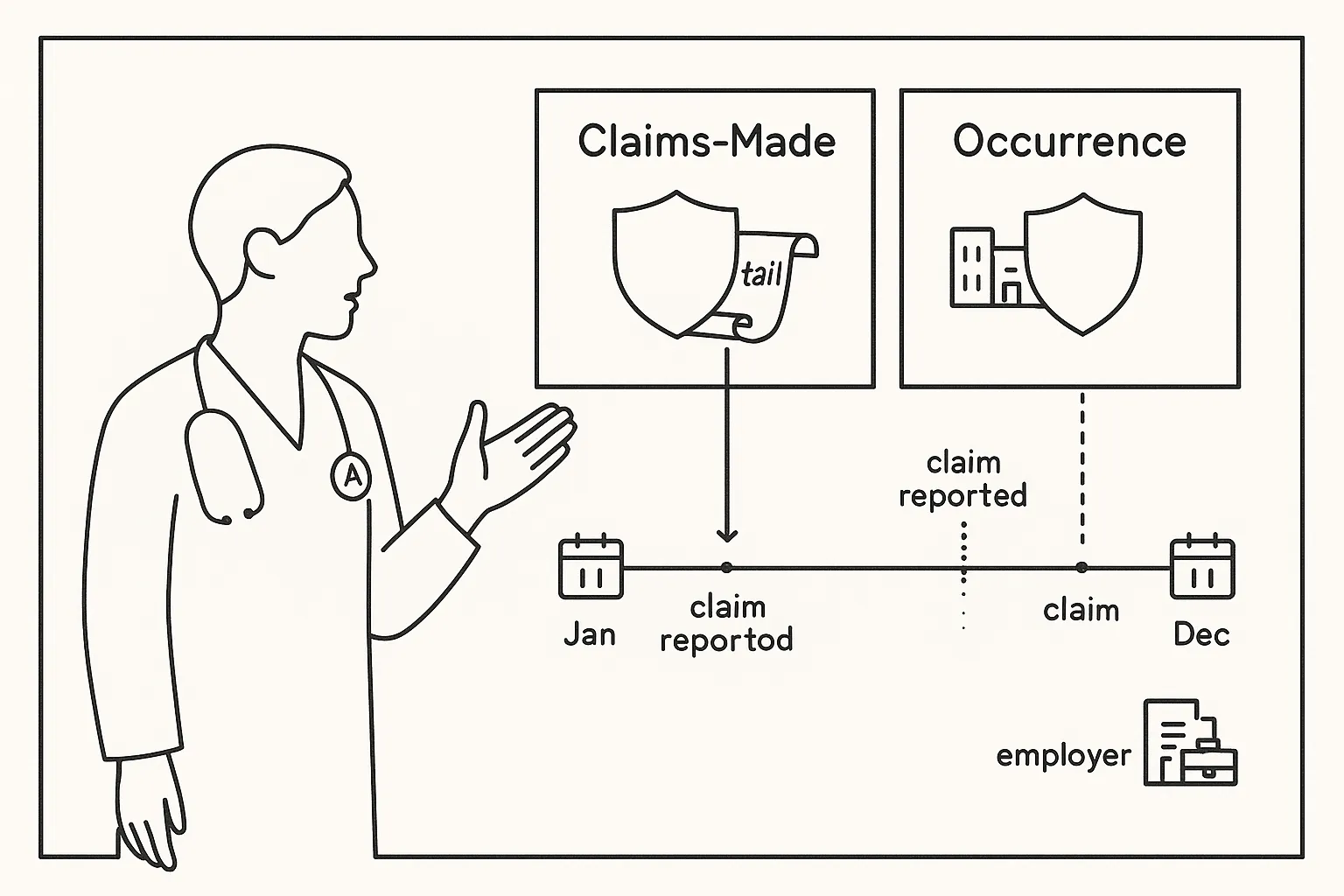
The type of malpractice policy provided by the employer determines whether tail insurance may be required after employment ends. A contract that merely states that malpractice insurance will be provided does not fully explain the PA’s protection or potential post-employment cost.
How Claims-Made Coverage Works
Under a claims-made policy, coverage applies when the policy’s requirements concerning both the incident and the reporting of the claim are satisfied. If the policy is no longer active when a claim is filed, the clinician may not have coverage unless extended reporting coverage has been purchased or another policy provides prior acts protection.
For example, consider a physician assistant who treats a patient in January, leaves employment in July, and learns of a related claim in December. If the employer’s claims-made policy is no longer active for that PA in December, tail coverage may be necessary to address the later-reported claim. The policy terms, retroactive date, and reporting requirements must be reviewed to determine the actual protection available.
How Occurrence Coverage Differs
Occurrence-based malpractice coverage is tied to when the underlying incident occurred rather than when the claim was reported. If the employer maintained occurrence coverage when the PA treated the patient in January, a claim filed after the PA leaves may remain covered as long as the incident falls within the applicable policy terms.
Tail insurance is therefore typically unnecessary for a true occurrence policy. This distinction is why a PA should review the policy type, limits, retroactive date, exclusions, and reporting terms rather than relying on a general promise that the employer provides insurance. A broader guide to malpractice insurance for physician assistants can help place the tail provision in context.
Who Pays for Physician Assistant Tail Insurance?
Responsibility for tail insurance varies among physician assistant agreements and may be negotiated as part of the overall compensation package. Common arrangements include employer-paid coverage, employee-paid coverage, and shared-cost provisions that allocate responsibility according to how or when employment ends.
- Employer-paid tail: The employer purchases extended reporting coverage after separation, sometimes because the employer also benefits from protection related to prior patient care.
- PA-paid tail: The physician assistant must purchase coverage independently or reimburse the employer for the premium.
- Shared or conditional payment: The employer may pay after a termination without cause while requiring the PA to pay after resignation or termination for cause.
Some agreements tie employer-paid tail coverage to continued employment for a specified period or require repayment if the PA resigns early. Those provisions should be reviewed alongside any sign-on bonus repayment terms, relocation obligations, or severance provisions so the cumulative cost of leaving is understood.
Independent contractor arrangements deserve separate attention because the PA may be required to obtain and maintain an individual policy. The agreement should identify the required coverage type and limits, who bears the cost, and whether extended reporting or prior acts coverage is included. These issues are part of a broader review of physician assistant independent contractor agreements.
Tail Insurance Costs and Pricing Factors
The cost of tail insurance varies with the specialty, coverage limits, claims history, retroactive date, and length of the extended reporting period. For some physician assistants, the premium may reach several thousand dollars or more, while clinicians in higher-risk specialties or seeking greater limits and longer reporting periods may face a substantially higher cost.
- Specialty and clinical risk: Insurers consider the procedures performed and the clinical environment when assessing exposure.
- Policy limits: Higher per-claim and aggregate limits generally increase the premium.
- Retroactive date and prior acts: The period of earlier clinical services requiring protection can affect pricing and available coverage.
- Claims history: Prior claims or reportable incidents may influence the insurer’s pricing decision.
- Reporting period: A longer or unlimited reporting period may cost more than a limited extension.
Accurate estimates usually require the declarations page, current policy terms, retroactive date, limits, specialty information, and the insurer’s available extended reporting options. A quoted premium should be considered together with compensation and other exit costs rather than treated as an isolated expense.
Contract Terms That Control Tail Coverage
A physician assistant agreement should identify whether the employer’s coverage is claims-made or occurrence-based and clearly allocate responsibility for tail insurance. It should also define the events that trigger the obligation, including resignation, retirement, termination without cause, termination for cause, or a sale or restructuring of the practice.
Timing and documentation matter as well. If the employer must purchase tail coverage, the agreement should state when it will be secured and whether the PA will receive written proof. If the PA must pay, the contract should explain whether the PA purchases the policy directly or reimburses the employer, along with any deadlines or approval requirements.
Indemnification, hold-harmless, and reimbursement language should be reviewed with the insurance provision. Broad clauses may require the PA to reimburse the employer for claims or legal expenses beyond the cost of tail insurance. The scope of those obligations and their relationship to conduct within the PA’s control should be understood before signing.
When the Employer Will Not Provide Tail Coverage
If an employer declines to provide tail coverage or leaves the obligation unclear, the PA should request the policy declarations page, retroactive date, limits, and available information about prior acts protection. Obtaining a premium estimate before signing can clarify the potential financial exposure and provide a factual basis for negotiating compensation or the allocation of the cost.
Statements about tail coverage should be included in the written agreement rather than left as verbal assurances. Depending on the available policies, a PA may also need to evaluate personal tail coverage or prior acts coverage under a new policy. The right option depends on the actual insurance documents and contract language.
Tail Coverage Checklist Before Signing or Leaving
Before signing an agreement or preparing to leave a position, a physician assistant should review the following malpractice coverage details:
- Confirm whether the policy is claims-made or occurrence coverage and request the declarations page.
- Verify the retroactive date, prior acts protection, exclusions, and limits of liability.
- Determine whether tail coverage is required and who must purchase or reimburse its cost.
- Review the deadline for securing coverage and any requirement to provide written proof.
- Identify indemnification, hold-harmless, and reimbursement provisions that may survive termination.
- Confirm whether responsibility changes after resignation, termination without cause, or termination for cause.
- Evaluate tail costs together with bonus repayment, relocation, notice, and other departure obligations.
- If working as an independent contractor, verify whether a separate policy and extended reporting coverage are required.
Reviewing these issues systematically can reveal financial obligations and coverage gaps that are easy to miss during an initial reading. Chelle Law provides physician assistant contract review focused on clarifying malpractice provisions, tail obligations, termination terms, and related financial risks before a PA signs or leaves a position.
Frequently Asked Questions
Does every physician assistant need tail insurance?
No. Tail insurance is generally associated with claims-made coverage. A PA covered by a true occurrence policy typically does not need tail coverage for incidents that occurred while that policy was active, although the actual policy terms should always be reviewed.
How can a PA determine whether a policy is claims-made or occurrence-based?
The employment agreement may identify the policy type, but the PA should also request the declarations page and relevant policy documents. Those materials can confirm the coverage form, limits, retroactive date, and reporting requirements.
Who usually pays for physician assistant tail coverage?
Payment depends on the contract. The employer may pay, the PA may be responsible, or the parties may divide the cost based on the reason employment ends. The agreement should state the allocation clearly rather than leaving it to a later decision.
Can an employer require a PA to pay for tail insurance after termination?
An agreement may assign the cost to the PA after resignation or certain types of termination. Whether that obligation applies depends on the contract language, the reason for separation, and the underlying policy, so the termination and insurance provisions should be reviewed together.
What is the difference between tail coverage and prior acts coverage?
Tail coverage extends the reporting period under an expiring claims-made policy for earlier services. Prior acts coverage may protect earlier services under a new policy, subject to its retroactive date and other terms. Either option must be verified through the actual insurance documents.
What proof of tail coverage should a physician assistant request?
A PA should request written confirmation that extended reporting coverage was purchased, including the insurer, applicable policy, reporting period, limits, and effective terms. The documentation should be retained with the employment agreement and malpractice records.
Review Your Tail Insurance Obligations Before Signing
Chelle Law reviews physician assistant agreements to identify who pays for tail coverage, when the obligation is triggered, and how malpractice terms interact with termination and repayment provisions.
Contact Chelle LawExplore Physician Assistant Contract Guidance
Review legal services, practical contract resources, and state-specific guidance for physician assistants.