
Starting a first clinical position as a physician assistant often means evaluating a first professional employment agreement. That contract can determine compensation, productivity expectations, supervision requirements, malpractice coverage, scheduling, restrictive covenants, bonus repayment obligations, and termination rights. Because these provisions interact, an attractive salary or signing bonus may be offset by financial risk elsewhere in the agreement.
New graduate PA agreements frequently use standardized employer language that preserves flexibility for the practice while shifting financial or professional risk to the physician assistant. Compensation formulas, claims-made malpractice coverage, signing bonus clawbacks, broad non-compete restrictions, and short termination notice periods can affect both the first year of employment and the PA’s ability to move to another position later.
Chelle Law provides attorney-led contract review services for new graduate physician assistants nationwide. We review the complete agreement, explain how its provisions work together, identify potential financial and professional risks, and help the PA understand which terms may be worth clarifying or negotiating before accepting a first position.
Understanding a First Physician Assistant Employment Agreement

Employment agreements for new graduate physician assistants typically define the legal and financial structure of the position. They commonly address the term of employment or at-will status, compensation and incentives, malpractice insurance, supervision and delegation, restrictive covenants, and termination or repayment obligations. Although formatting varies, many employers use standardized templates designed primarily to protect the organization and preserve operational flexibility.
A thorough review of these PA employment contract terms should account for how separate sections affect one another. New graduates commonly encounter:
- A base salary that may function as an advance against future productivity or collections rather than an unconditional guarantee.
- Productivity compensation based on RVUs, collections, or patient encounters, sometimes with reconciliation or negative accrual provisions.
- Malpractice coverage during employment without clear language assigning responsibility for tail insurance after departure.
- Supervision, delegation, prescribing, scheduling, and call requirements that may be incomplete or subject to employer discretion.
- Non-compete and non-solicitation restrictions that may limit future employment in the same community.
- Signing bonus, relocation, or loan assistance that becomes repayable when employment ends under specified circumstances.
Small drafting choices can shift financial risk, create regulatory concerns, or restrict professional mobility. New physician assistants should understand both the individual clauses and the broader agreement structure, including the concepts discussed in the AAPA’s overview of the anatomy of a PA employment contract.
Compensation, Incentives, and Benefits
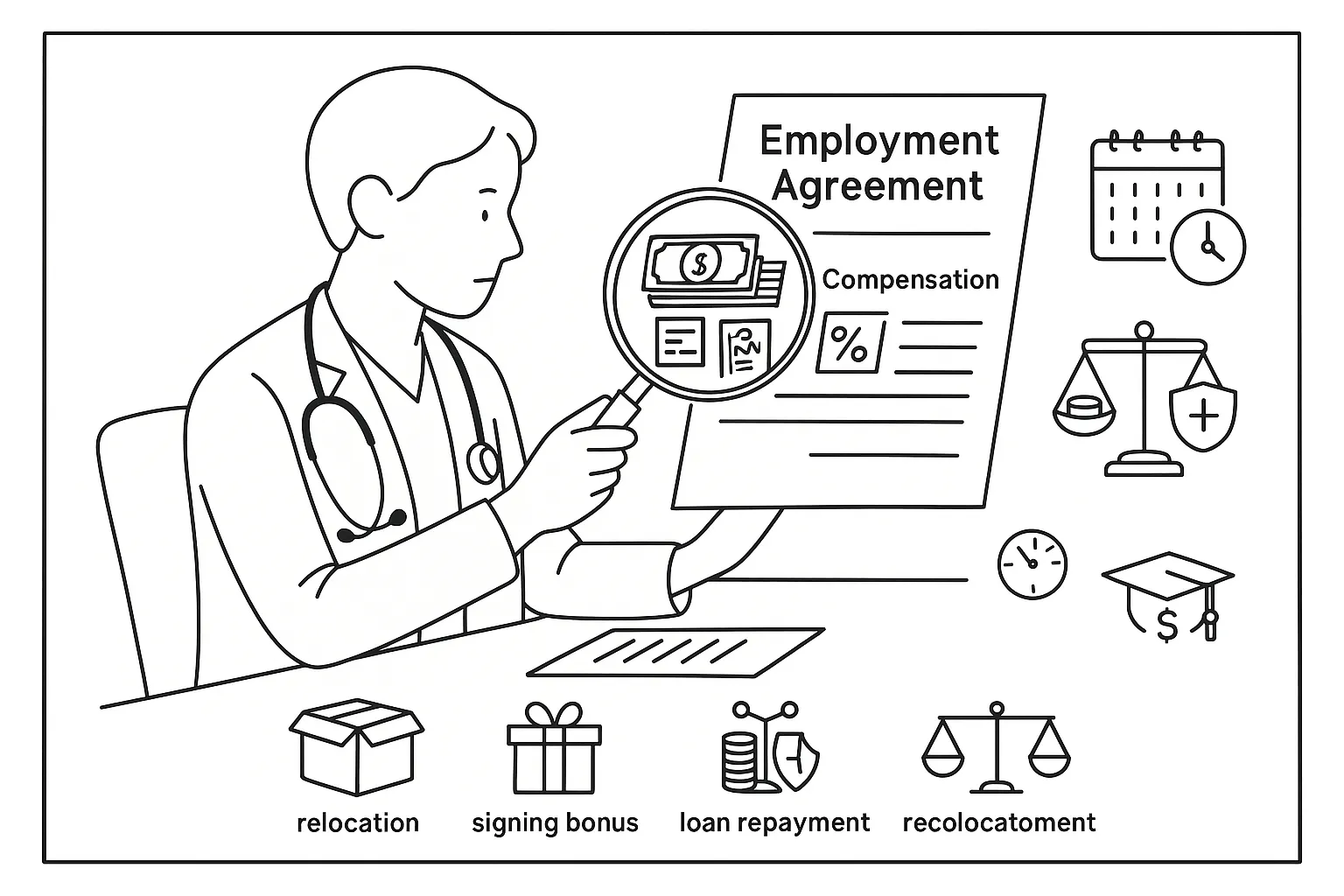
Compensation language is often the most consequential part of a new graduate PA agreement. A careful compensation and productivity review evaluates not only the stated salary but also the formulas, thresholds, payment timing, reconciliation rules, and employer discretion that determine actual earnings.
Base Salary and Productivity Compensation
Base salary is typically presented as an annual amount paid on a biweekly or monthly schedule. The agreement should establish whether that salary is truly guaranteed or functions as an advance against future productivity. Some contracts offset salary against later incentive calculations or permit recoupment when a PA does not meet a stated threshold. Overtime, call coverage, shift differentials, and extra-duty compensation should also be addressed when they are part of the position.
Productivity models commonly rely on collections or relative value units. Collections-based compensation depends on revenue actually received for the PA’s services, which means billing efficiency, payer reimbursement, and collection timing can affect earnings. RVU-based models assign units to clinical services and apply a conversion factor; for example, a rate of $50 per RVU applied to 5,000 RVUs produces $250,000 before thresholds, offsets, bonuses, or other adjustments.
Contracts may also include quality modifiers, reconciliation periods, denied-claim chargebacks, or negative accrual provisions that carry a productivity shortfall into a later period. These mechanics should be defined precisely enough for the PA to calculate when a bonus is earned, when it will be paid, and whether previously paid compensation can be reduced or recouped.
Signing Bonuses, Relocation Assistance, and Benefits
Signing bonuses and relocation payments can provide meaningful support at the beginning of a first job, but they are frequently tied to a service commitment. The agreement should identify the events that trigger repayment, whether the amount decreases on a prorated schedule, the repayment deadline, and whether the obligation applies when the employer terminates the relationship. New graduates should review these bonus repayment terms before treating an incentive as guaranteed compensation.
Health insurance, retirement contributions, disability coverage, paid leave, continuing medical education funds, and loan repayment assistance can materially affect the total value of an offer. The contract and incorporated benefit documents should distinguish guaranteed contractual benefits from policies the employer may change. Employee or independent contractor classification also affects tax responsibilities and eligibility for employer-sponsored benefits.
Malpractice Coverage and Clinical Responsibilities
Malpractice Insurance, Tail Coverage, and Indemnification
Professional liability provisions determine how malpractice claims are handled during and after employment. Occurrence policies cover incidents that take place during the policy period regardless of when a claim is filed. Claims-made policies generally require the policy to be active when the claim is reported, which can create a need for tail coverage after employment ends.
The agreement should identify the policy type, applicable per-claim and aggregate limits, who pays the premium, and who is responsible for post-employment coverage. Because tail insurance obligations can create a substantial departure expense, the contract should also explain whether responsibility changes based on resignation, without-cause termination, or termination for cause.
Indemnification language deserves separate attention. Broad provisions may attempt to assign defense costs, settlements, or losses to the PA beyond ordinary malpractice exposure. The review should also determine whether the employer’s coverage extends to all required duties and whether moonlighting or work outside the defined role is excluded.
Supervision, Scope of Practice, Scheduling, and Call
Supervision and delegation provisions affect day-to-day clinical authority and must operate consistently with the law of the state where the PA practices. The agreement should clarify the supervising or collaborating relationship, availability expectations, delegated duties, prescribing responsibilities, and any employer-imposed limits. Vague language allowing supervision to be determined entirely by the employer can create uncertainty about autonomy, support, and responsibility.
Job descriptions and exhibits may establish clinic hours, weekend work, on-call coverage, productivity benchmarks, and performance standards. These expectations should be sufficiently objective to show what work is required and whether additional coverage is separately compensated. Undefined duties, open-ended multi-site assignments, or subjective performance criteria may affect compensation and increase the risk of discipline or termination.
Post-Employment Restrictions and Contract Termination
Non-Compete and Non-Solicitation Restrictions
Restrictive covenants can significantly affect a new graduate who has not yet settled on a long-term specialty, employer, or community. A non-compete may restrict clinical practice within a stated area for a defined period, while a non-solicitation clause may prohibit contact with patients, referral sources, or employees after departure. Enforceability varies by jurisdiction and circumstance, but the practical effect can still be substantial.
A focused review of PA non-compete terms considers the duration, geographic scope, restricted activities, triggering events, and locations used to calculate the restriction. Language tied to every affiliated facility or future worksite may create a much broader limitation than a radius measured from the PA’s primary practice location. Restrictions should also be reviewed for their effect on telehealth work and the ability to accept another position in the same market.
Termination Rights, Notice Periods, and Repayment Obligations
The agreement should distinguish expiration, termination for cause, and termination without cause. Cause provisions often affect eligibility for severance, incentive compensation, employer-paid tail coverage, and repayment obligations. Any cure period should explain whether the PA has an opportunity to correct an alleged breach before the employer ends the agreement.
Without-cause termination provisions permit one or both parties to end the relationship after providing notice. The notice period affects patient transition, continued scheduling, income, and the timing of a job search. A termination terms review should also determine whether the employer can stop scheduling the PA during notice, pay salary in lieu of continued work, or accelerate the final employment date.
Signing bonuses, relocation assistance, loan support, training expenses, and other incentives may become repayable after resignation, termination for cause, or an alleged breach. Repayment provisions should state whether the amount is full or prorated, which events trigger the obligation, when payment is due, and whether interest, collection costs, or other penalties apply.
New Graduate PA Contract Review Checklist
Before signing, a new graduate should confirm that the agreement clearly addresses the following issues. The goal is not only to identify unfavorable language but also to uncover gaps, conflicting provisions, and employer discretion that may make the practical terms different from what was discussed during recruitment.
- Whether salary is guaranteed or offset against productivity, collections, or later incentive compensation.
- How RVUs, collections, quality measures, thresholds, reconciliation, and negative accrual are calculated.
- The required schedule, call coverage, work locations, performance standards, and compensation for additional duties.
- The malpractice policy type, coverage limits, tail responsibility, and indemnification obligations.
- How supervision, delegation, prescribing, and clinical responsibilities align with state requirements.
- The scope and duration of non-compete, non-solicitation, confidentiality, and other post-employment restrictions.
- The grounds for termination, available cure periods, required notice, and compensation during the notice period.
- Which events trigger repayment of signing bonuses, relocation assistance, training expenses, or other incentives.
Attorney review is most useful before the agreement is signed or the PA begins work. Reviewing the full contract together with incorporated policies, compensation exhibits, bonus documents, and offer materials can reveal inconsistencies and provide time to request clarification. New graduates preparing for that process can also use a broader list of questions to ask before signing.
Frequently Asked Questions
What should a new graduate physician assistant review before signing a contract?
A new graduate PA should review compensation, productivity expectations, scheduling, call responsibilities, supervision requirements, malpractice insurance, tail coverage, restrictive covenants, signing bonuses, repayment obligations, and termination rights before signing an employment agreement.
Can a new graduate physician assistant negotiate an employment contract?
Yes. New graduate status does not necessarily mean the agreement is non-negotiable. Compensation, signing bonuses, repayment terms, scheduling, non-compete provisions, malpractice coverage, termination notice, and other contract terms may be open to discussion depending on the employer and position.
What compensation terms should a new graduate PA watch for?
The agreement should clearly explain base salary or hourly compensation, productivity incentives, RVU or collections formulas, bonus thresholds, payment timing, reconciliation provisions, and whether any compensation can be reduced or recouped if productivity expectations are not met.
Who should pay for malpractice and tail insurance for a new graduate physician assistant?
The contract should state the type of malpractice coverage provided, applicable policy limits, who pays the premium, whether the policy is claims-made or occurrence, and who is responsible for tail coverage if claims-made insurance ends when employment terminates.
Are signing bonuses and relocation payments usually repayable?
They often are. Many agreements require repayment if the physician assistant leaves before completing a specified employment period. The contract should identify the repayment period, whether repayment is prorated, what events trigger repayment, and whether repayment applies if the employer terminates the agreement.
Does Chelle Law review new graduate physician assistant contracts nationwide?
Yes. Chelle Law provides attorney-led new graduate physician assistant contract review services nationwide. The review focuses on compensation, supervision, malpractice coverage, restrictive covenants, repayment obligations, termination rights, and other provisions that may affect the PA’s first employment relationship.
Have Your First PA Contract Reviewed Before You Sign
Your first physician assistant agreement can affect compensation, supervision, malpractice coverage, repayment obligations, future employment options, and your ability to leave the position. Chelle Law provides attorney-led new graduate PA contract review services nationwide.
Request a New Graduate PA Contract ReviewExplore More Physician Assistant Contract Guidance
Browse attorney-led services, detailed contract resources, and state-specific guidance for physician assistant employment agreements.