
Physician assistant employment and independent contractor agreements often contain compensation formulas that determine how clinical activity translates into actual income. A physician assistant compensation and productivity review evaluates guaranteed salary, productivity thresholds, RVU formulas, collections-based pay, bonuses, reconciliation provisions, and other terms that affect how and when compensation is earned.
These provisions may shift financial risk to the physician assistant through negative accrual, repayment obligations, charge-capture rules, collections delays, bonus clawbacks, or productivity guarantees. Small differences in definitions, reporting periods, payment timing, and post-termination accounting can substantially affect total compensation. Benefits, malpractice coverage, restrictive covenants, and scope-of-practice provisions may further influence the overall value of the agreement and the PA’s future professional mobility.
Chelle Law provides attorney-led physician assistant compensation and productivity reviews nationwide. We analyze how the compensation formula works, identify provisions that may reduce or delay payment, evaluate repayment and reconciliation exposure, and explain how related contract terms may affect long-term income. The goal is to help the physician assistant understand both the stated compensation package and the contractual conditions that determine what the PA will actually receive.
Common Physician Assistant Compensation Models

Physician assistant agreements typically rely on guaranteed base salary, productivity-based compensation, collections-based pay, RVU systems, or hybrid arrangements combining several models. Each structure allocates financial and administrative risk differently. A careful review should determine how the model operates in practice rather than focusing only on the headline salary or advertised bonus opportunity. Our guide to PA compensation models provides additional background on these structures.
Guaranteed Salary and Hybrid Compensation
A guaranteed base salary provides predictable gross income and simplifies financial planning. However, salary provisions may contain offset language allowing productivity income or other payments to reduce the stated base amount. Agreements may also prorate salary for part-time schedules, extended leave, or a midyear start date.
Hybrid models commonly combine a base salary with productivity or quality incentives. The agreement should identify whether the salary is a true guarantee, whether a production threshold must be reached before a bonus is earned, and whether a later reconciliation can reduce compensation already paid. Comparing base salary and production pay can help clarify how these arrangements allocate risk.
RVU, Collections, and Visit-Based Pay
RVU compensation converts clinical services into standardized productivity units. Compensation may be calculated by multiplying credited RVUs by a defined conversion factor, sometimes only after the PA reaches a threshold. The contract should specify whether it uses work RVUs, total RVUs, or another measure; which services receive credit; the applicable measurement period; and how non-billable clinical duties are treated. A detailed RVU compensation guide for physician assistants explains the terms that commonly control these calculations.
Collections-based compensation ties earnings to revenue the employer receives for services attributed to the physician assistant. This model makes billing efficiency, payer reimbursement, denied claims, write-offs, refunds, and collection timing relevant to the PA’s income. Visit-based compensation instead assigns a fixed value to patient encounters or specified billing codes, which may not fully account for differences in complexity or time.
Each model should clearly identify how services are attributed to the PA and whether adjustments can be made after payment. Many healthcare productivity frameworks reference RVU-based payment concepts, but the employment agreement controls how an employer translates those concepts into compensation.
Productivity Metrics, Reporting, and Audit Rights
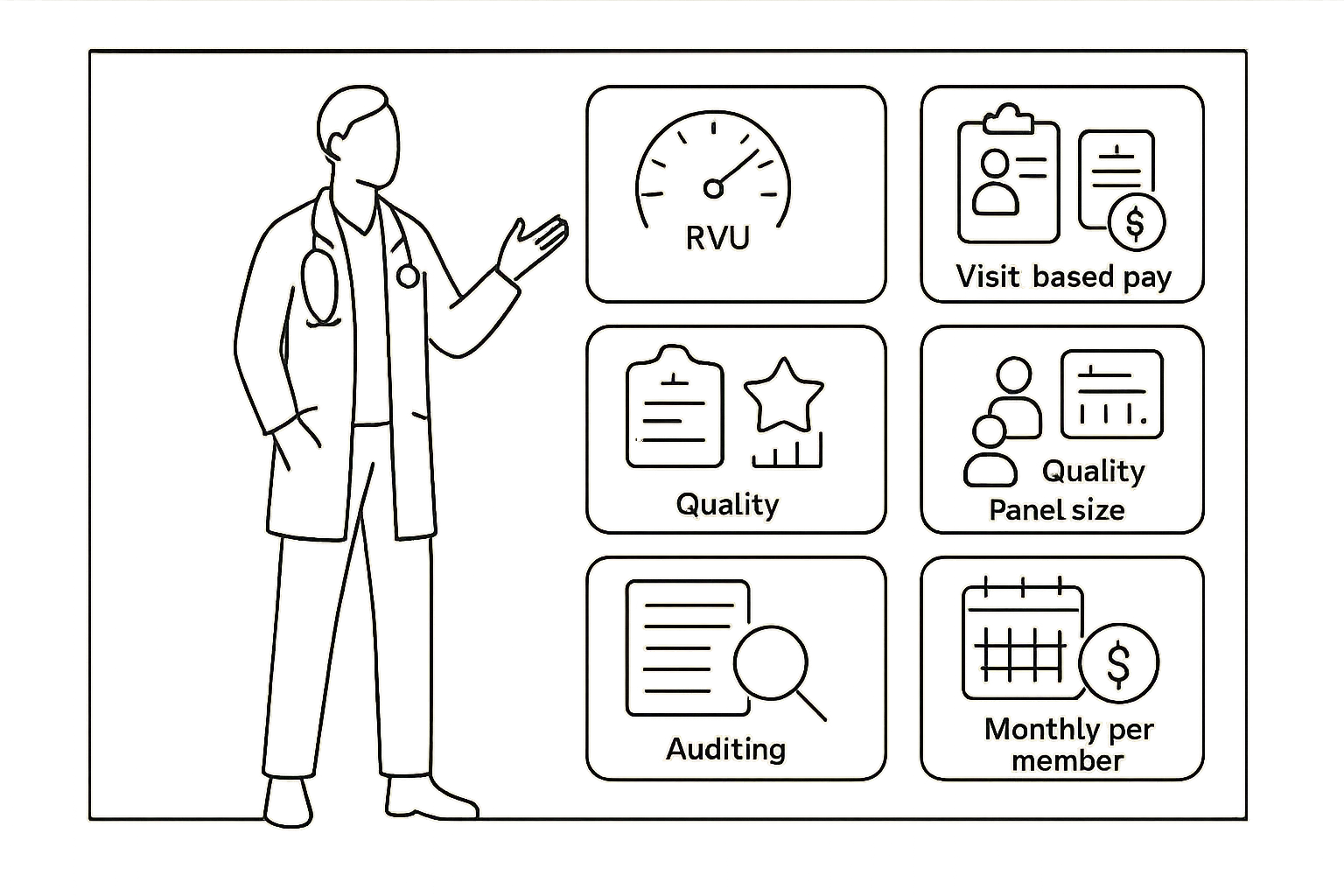
Productivity compensation is only as reliable as the definitions and reporting systems used to measure it. Patient visits, procedures, billing codes, work RVUs, collections, and other metrics may produce significantly different results. The agreement should identify the credited activity, the source of the data, the period over which performance is measured, and the date on which compensation becomes earned and payable.
Some plans also use quality benchmarks, patient-satisfaction scores, panel size, patient retention, or population-health outcomes. Capitation arrangements may involve fixed payments associated with managing a defined patient population. Because these metrics often depend on employer-controlled information or third-party benchmarks, the standards and data sources should be stated clearly, along with any caps or employer rights to modify the program.
Access to Productivity Reports and Supporting Data
Billing reports, internal dashboards, encounter records, and payer statements may all be used to track production. The contract should address who generates the reports, how frequently they are delivered, and whether the physician assistant can review the underlying billing or encounter data. Regular access allows the PA to compare reported productivity with schedules and clinical records before discrepancies become difficult to reconstruct.
Useful supporting information may include the employer’s conversion factor, sample compensation statements, historical productivity information for comparable providers, and written billing or charge-capture policies. The agreement should also explain whether vacation, continuing education, administrative work, or leave affects thresholds and whether the employer may change the formula during the contract term.
Disputing Calculation and Reporting Errors
Many agreements establish deadlines or procedures for disputing compensation calculations. Physician assistants may benefit from retaining schedules, encounter records, productivity statements, and communications concerning billing corrections or denied claims. Reviewing reports promptly and documenting discrepancies can make it easier to identify whether the issue involves attribution, charge capture, a conversion factor, a threshold, or a contractual deduction.
If the employer changes a formula, reporting method, or incentive plan, the amendment should be documented in writing and reviewed against any contractual limits on unilateral changes. A compensation plan that can be modified without notice or objective standards may leave the PA unable to predict future earnings.
Bonuses, Benefits, and Malpractice Coverage
Total compensation includes more than salary and productivity pay. Signing incentives, relocation assistance, retention bonuses, loan repayment, retirement contributions, health insurance, paid leave, continuing medical education allowances, and licensing reimbursements may materially change the value of an offer. These items should be reviewed together because an attractive upfront payment may be offset by repayment exposure or less favorable benefits.
Bonus Conditions and Repayment Obligations
Signing bonuses and relocation payments commonly require continued employment for a defined period. The agreement should identify the events that trigger repayment, whether the obligation is prorated, the repayment deadline, and whether repayment applies when the employer ends the relationship. The same concerns may arise with loan assistance, retention incentives, or guaranteed productivity advances. Reviewing sign-on bonus repayment terms can help reveal obligations that continue after employment ends.
Quality and performance bonuses should state the required benchmark, calculation method, evaluation period, payment date, and effect of termination. If an employer controls the underlying data or may revise the program, the agreement should explain the PA’s reporting rights and whether changes can apply to work already performed.
Benefits, Malpractice Insurance, and Tail Coverage
Benefits can significantly affect the package’s overall value, particularly when the PA must personally pay for licensing, professional dues, continuing education, or insurance-related costs. The contract should identify the offered benefits, eligibility dates, employer contributions, and any conditions that allow benefits to be changed or discontinued.
Malpractice provisions should identify the policy type, coverage limits, and responsibility for coverage after termination. A claims-made policy may require tail coverage for claims reported after employment ends. Because this can create a substantial post-employment expense, the parties should clearly allocate responsibility for the cost. The distinction between ongoing coverage and tail insurance for PAs should be understood before signing.
Compensation Terms That Shift Financial Risk
Compensation language should explain not only how income is calculated but also when it becomes earned, when it is paid, and whether it can later be reduced. Broad references to employer policy may give the employer significant discretion over payment timing or interpretation. The agreement should instead define the calculation period, distribution schedule, applicable deductions, and treatment of advances or guarantees.
Reconciliation, Holdbacks, Clawbacks, and Negative Accrual
Collections-based and productivity models may use reserve accounts or holdbacks to account for anticipated denials, refunds, or billing adjustments. Reconciliation clauses may also allow the employer to reduce future compensation or recover amounts previously paid. The contract should state how adjustments are calculated, how long the reconciliation period remains open, and whether the PA can inspect the supporting data.
Negative accrual may carry a production shortfall or prior overpayment into a later period. This can reduce future bonuses even after productivity improves. The agreement should define whether negative balances carry forward, whether they reset, and what happens to a claimed balance at termination. PAs evaluating this language can review the risks associated with negative accrual provisions.
Termination and Post-Employment Compensation
Termination provisions often determine whether accrued bonuses or productivity payments remain payable after employment ends. The agreement may distinguish between compensation that has been calculated, earned, collected, or actually paid. These distinctions are particularly important when the employer receives payment for the PA’s services weeks or months after the final date of employment.
The contract should address the final accounting period, payment date, treatment of pending collections, administrative deductions, and any forfeiture provision. It should also identify continuing obligations involving bonus repayment, malpractice tail coverage, or other expenses. A broader review of PA contract termination terms can help place final compensation provisions in context.
Restrictive Covenants, Scope, and Future Earning Potential
Non-compete, non-solicitation, and non-interference clauses can affect where a physician assistant works, which patients or referral sources the PA may contact, and how quickly the PA can begin a new position. Their practical effect depends on the restriction’s duration, geographic scope, covered activities, and triggering events. A compensation review should consider these terms because a restrictive covenant can limit future earnings even when the current compensation package appears favorable.
Scope-of-practice, supervision, collaboration, delegation, prescribing, call coverage, and worksite provisions may also affect productivity. Language that expands clinical duties without adjusting compensation or thresholds can alter the economic value of the arrangement. Likewise, administrative responsibilities and non-billable work may reduce the time available to meet production requirements. These obligations should be consistent with applicable state requirements and accurately reflected in the compensation formula.
A complete review should also identify any buyout provision that allows a restriction to be waived in exchange for payment. Physician assistants can learn more about how restrictive covenants affect PA contracts before evaluating the relationship between compensation and post-employment mobility.
Preparing for a PA Compensation Review
A structured review should include the proposed agreement, offer letter, compensation plan, bonus addenda, employer policies incorporated by reference, and any documents explaining productivity calculations. When available, historical productivity reports, sample compensation statements, billing policies, and malpractice insurance information may help clarify how the written terms operate in practice.
Common red flags include unclear productivity definitions, employer-exclusive control over reports, unilateral amendment rights, broad repayment triggers, unexplained holdbacks, indefinite reconciliation periods, and forfeiture of earned compensation at termination. Attorney review may be particularly useful when compensation depends on a complex formula, incentives carry repayment obligations, malpractice responsibilities are unclear, or restrictive covenants could limit future employment.
Chelle Law reviews the interaction among compensation, productivity, termination, malpractice, restrictive covenants, and other provisions rather than treating the formula in isolation. This allows the physician assistant to evaluate both expected income and the contractual risks that may reduce it.
Frequently Asked Questions
How is physician assistant productivity compensation usually calculated?
PA productivity compensation may be based on RVUs, collections, patient encounters, procedures, or another measurable production metric. The agreement should clearly define the productivity unit, conversion factor or percentage, calculation period, thresholds, and when incentive compensation is paid.
What is an RVU-based physician assistant compensation model?
An RVU-based compensation model assigns productivity value to clinical services and typically pays the physician assistant based on the number of RVUs generated multiplied by a defined conversion factor or compensation rate. The contract should specify which RVUs count, how they are reported, and whether thresholds must be met before additional compensation is earned.
What should I look for in a collections-based PA compensation formula?
The agreement should define what counts as collections, how payments are attributed to the physician assistant, whether refunds or write-offs reduce compensation, how long collections remain eligible after services are performed, and what happens to unpaid collections after employment ends.
Can a physician assistant contract include negative accrual or reconciliation?
Yes. Some compensation models allow a productivity shortfall or overpayment to be carried forward or reconciled against future earnings. The agreement should clearly explain whether negative accrual exists, how reconciliation works, and whether compensation already paid can later be recouped.
What happens to earned productivity compensation when a PA leaves the employer?
The contract should address whether the physician assistant receives compensation for services performed before termination but paid or collected afterward. It should also explain final accounting periods, payment timing, deductions, and whether any earned bonuses are forfeited upon termination.
Can Chelle Law review only the compensation portion of a physician assistant contract?
Yes. Chelle Law provides physician assistant compensation and productivity review services nationwide, including analysis of salary, RVU formulas, collections-based compensation, productivity thresholds, bonuses, reconciliation provisions, repayment obligations, and post-termination compensation.
Understand How Your PA Compensation Really Works
Salary, RVU formulas, collections, bonuses, reconciliation provisions, and repayment obligations can significantly affect your actual earnings. Chelle Law provides attorney-led physician assistant compensation and productivity reviews nationwide.
Request a PA Compensation ReviewExplore More Physician Assistant Contract Guidance
Review Chelle Law services, detailed PA contract resources, and state-specific guidance for physician assistant employment agreements.