
Physician assistant contracts often contain termination provisions that determine how employment may end and which financial or professional obligations continue afterward. A physician assistant contract termination review evaluates notice requirements, termination rights, final compensation, malpractice coverage, repayment obligations, restrictive covenants, and other provisions that affect the consequences of leaving a position.
Termination language can create substantial financial exposure. Signing bonuses, relocation assistance, retention payments, or other incentives may become repayable when employment ends. Claims-made malpractice insurance may require tail coverage, while non-compete and non-solicitation provisions can restrict future employment opportunities. Compensation may also be affected if collections, productivity credit, or bonus eligibility ends before the physician assistant completes the required notice period.
Chelle Law provides attorney-led physician assistant contract termination reviews nationwide. We analyze termination triggers, notice-and-cure provisions, repayment obligations, final compensation, malpractice responsibilities, and post-employment restrictions. The objective is to help physician assistants understand the practical consequences before signing an agreement, resigning from a position, or delivering contractual notice.
Why Termination Clauses Matter for Physician Assistants
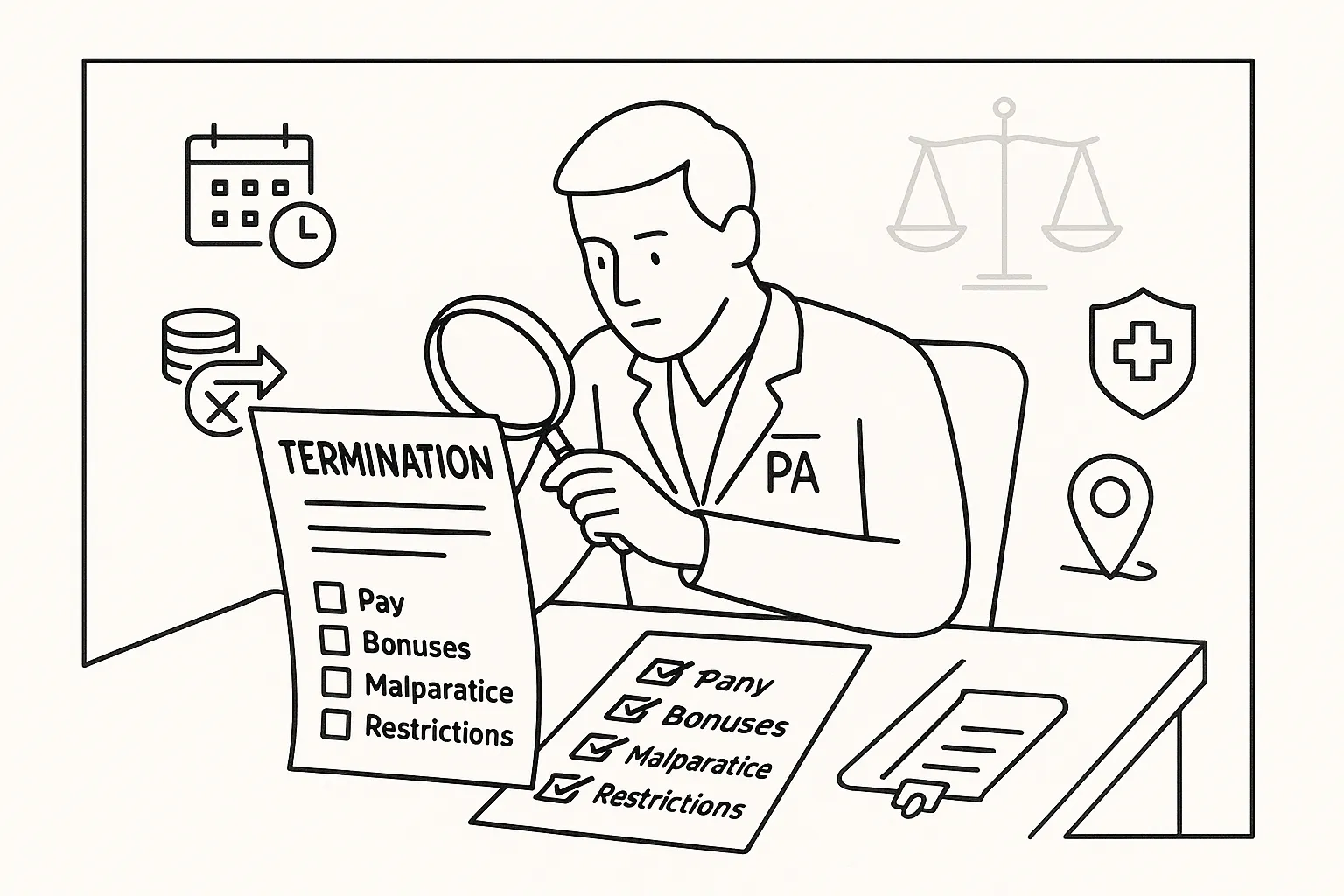
Termination provisions do more than define how an employment relationship ends. These clauses allocate financial and professional risk, determine whether compensation continues during a notice period, and may impose obligations that survive the end of the job. For physician assistants, termination language often interacts with base salary, productivity pay, collections models, RVU compensation, bonuses, malpractice insurance, and restrictive covenants.
A short or poorly defined notice period can interrupt productivity compensation or prevent a bonus from vesting. Termination may also trigger repayment of signing incentives, responsibility for malpractice tail coverage, or restrictions on where the PA may work next. A broader physician assistant contract review can identify how these provisions interact instead of evaluating the termination clause in isolation.
Healthcare agreements commonly distinguish between termination for cause, termination without cause, and specified events that automatically end the contract. These concepts are also discussed in guidance addressing healthcare contract termination provisions. The wording of the individual agreement remains critical because it controls the required procedure and the contractual consequences of separation.
How a Physician Assistant Contract May End
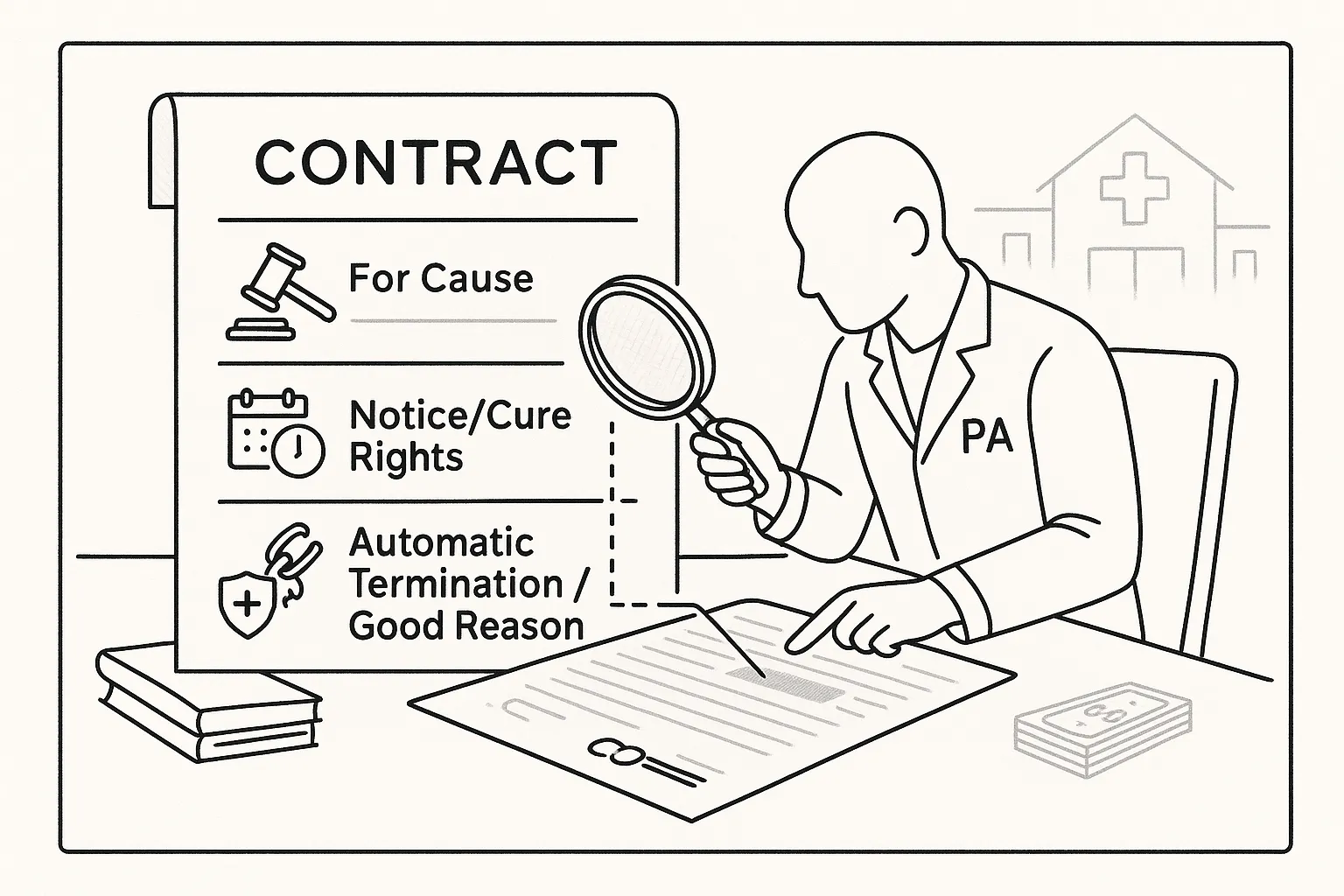
Each available termination mechanism should be reviewed together with the agreement’s compensation, credentialing, malpractice, and post-employment provisions. The stated reason for termination may determine whether notice is required, whether the PA receives an opportunity to cure a breach, and which financial obligations apply.
Termination for Cause and Without Cause
Termination for cause typically applies to events the contract identifies as grounds for immediate or accelerated separation. Examples listed in an agreement may include professional misconduct, violation of employer policies, loss of licensure, or failure to satisfy a contractual obligation. Cause provisions may affect severance, incentive compensation, malpractice obligations, and whether the PA receives pay during a notice period.
Termination without cause generally allows one or both parties to end the relationship without proving misconduct or breach, provided the required advance notice is given. The agreement should explain whether the PA must continue working, whether the employer may remove the PA from the schedule, and whether salary, benefits, collections credit, and bonuses continue throughout the notice period. PAs considering resignation can also review the practical issues involved in terminating a physician assistant contract.
Notice Requirements, Cure Rights, and Documentation
Notice provisions determine how termination must be communicated and when it becomes effective. The contract should identify the required notice period, acceptable delivery methods, and the address or person designated to receive notice. A PA who sends notice informally may create a dispute over whether the contractual notice period actually began.
Cure provisions may allow a physician assistant to correct certain breaches before termination takes effect. The agreement should distinguish curable issues from events permitting immediate termination and explain the time available to respond. Documentation, investigation, or internal review requirements are also important when the employer has discretion to determine whether cause exists.
Automatic Termination Events and Good-Reason Rights
Some contracts automatically terminate upon specified events, such as loss or suspension of professional licensure, loss of required clinical privileges, exclusion from government healthcare programs, or another defined change affecting the practice. Automatic provisions should be reviewed for whether termination occurs immediately, whether notice or a cure opportunity is available, and how compensation is handled through the effective date.
A good-reason provision may permit the PA to terminate while preserving identified contractual rights if the employer materially reduces compensation, changes the work location, or substantially alters another defined employment term. Not every contract includes this protection. When it is present, the PA may be required to provide prompt notice and allow the employer an opportunity to correct the change.
Final Compensation and Repayment Obligations
Termination language should be read alongside every compensation exhibit, bonus plan, and repayment provision. The agreement may use different rules for salary, productivity compensation, collections, accrued benefits, and incentive payments, making it important to determine what is earned before the termination date and what remains payable afterward.
Final Pay, Productivity, and Bonus Reconciliation
The contract should explain how final compensation is calculated and when it will be paid. In a productivity or collections model, the agreement may need to address services performed before departure but billed or collected afterward. It should also clarify whether the PA receives credit for work completed during the notice period and whether an earned bonus is forfeited if its scheduled payment date occurs after separation.
Draw arrangements, advances, or negative accrual provisions can permit the employer to reconcile prior payments against later production. A focused PA compensation and productivity review can help identify whether the formula is objective, when reconciliation occurs, and whether the employer may offset an alleged balance against final pay.
Signing Bonus, Relocation, and Other Clawbacks
Signing bonuses, relocation assistance, retention payments, loan-repayment benefits, and other incentives may become repayable if employment ends within a defined period. The contract should state which termination events trigger repayment, whether the obligation applies when the employer ends the relationship, and whether the amount decreases as the PA completes more service.
The agreement should also explain the repayment deadline and whether the employer may deduct an amount from final compensation. Because the termination section may not contain every clawback term, the PA should compare it with all bonus addenda and exhibits. Additional issues to evaluate are outlined in the guide to PA sign-on bonus repayment terms.
Malpractice Coverage and Post-Employment Restrictions
Some of the most expensive or professionally limiting consequences of termination arise after active employment has ended. Malpractice coverage, restrictive covenants, patient transition duties, and credentialing cooperation requirements should therefore be reviewed before notice is given.
Malpractice Insurance and Tail Coverage
When an employer provides claims-made malpractice insurance, tail coverage may be needed for claims reported after the underlying policy ends. The agreement should identify who obtains and pays for tail coverage, whether responsibility changes based on the reason for termination, and whether any exception applies after the PA completes a stated period of service.
The PA should also confirm whether coverage continues through the final day of clinical work and whether the policy is claims-made or occurrence-based. These distinctions and their potential costs are discussed further in the resource on tail insurance for physician assistants.
Non-Competes, Non-Solicitation, and Transition Duties
Restrictive covenants may limit where a physician assistant can practice, which patients or referral sources may be contacted, and whether former colleagues may be recruited after employment ends. The practical impact depends on the duration, geographic area, restricted activities, applicable state law, and whether the restriction applies after every type of termination. A dedicated PA non-compete review can evaluate the restriction within the context of the complete agreement.
Some agreements also require assistance with patient handoffs, record completion, credentialing requests, or other administrative transitions. These provisions should define the scope and duration of the required cooperation, whether work performed after separation will be compensated, and how the employer may communicate with licensing boards, hospitals, and payers.
What a Contract Termination Review Examines
An attorney-led review connects the termination clause to the rest of the agreement rather than treating it as a standalone provision. Chelle Law evaluates the language that controls how employment ends, how notice must be delivered, what compensation remains payable, and which obligations continue after separation.
- Events permitting termination for cause, without cause, or automatically
- Notice periods, delivery requirements, cure rights, and documentation procedures
- Salary, productivity credit, collections, bonuses, benefits, and final-pay calculations
- Signing bonus, relocation, retention, advance, and other repayment obligations
- Malpractice insurance and responsibility for any required tail coverage
- Non-compete, non-solicitation, confidentiality, and patient-transition requirements
- Dispute-resolution procedures, including any arbitration or internal grievance terms
The review may also identify definitions or cross-references that create uncertainty, such as undefined cause standards, unclear productivity formulas, or conflicting termination terms in an offer letter and employment agreement. Physician assistants who want a broader framework for evaluating the complete document can use the PA employment agreement checklist.
Managing Risk When a PA Contract Ends
Before giving notice, the physician assistant should review the agreement, compensation exhibits, bonus documents, malpractice provisions, and any later amendments. Notice should be delivered using the method required by the contract, and copies of the notice, delivery confirmation, compensation records, schedules, and relevant correspondence should be retained.
After separation, the PA should compare final compensation with the contractual formula and preserve documentation relating to productivity, collections, bonuses, benefits, and claimed offsets. Malpractice coverage and any required tail policy should be confirmed in writing. Credentialing, licensing, clinical privilege, and patient-transition records should also be maintained in case questions arise after employment ends.
If a dispute develops, the agreement may require arbitration, an internal grievance procedure, or another specified process. Reviewing those requirements early can help the PA understand applicable deadlines and avoid actions that conflict with the contract while the disagreement is being evaluated.
Frequently Asked Questions
How much notice does a physician assistant usually have to give before terminating a contract?
The required notice period depends on the agreement. Physician assistant contracts commonly require advance written notice for termination without cause. The contract should identify the exact notice period, how notice must be delivered, and whether the physician assistant must continue working throughout the notice period.
What is the difference between termination for cause and termination without cause?
Termination for cause generally allows the employer to end the agreement because of a specified event or breach, while termination without cause allows either party to terminate the relationship without proving misconduct or breach. The contract should clearly define the events that constitute cause and whether the physician assistant has an opportunity to cure certain violations.
Can a physician assistant have to repay a signing bonus after termination?
Yes. Signing bonuses, relocation payments, retention bonuses, loan repayment benefits, and other incentives may include repayment obligations if employment ends before a specified period. The agreement should explain when repayment is triggered, whether the amount decreases over time, and whether repayment applies regardless of who terminates the relationship.
Who pays for malpractice tail insurance when a PA contract ends?
That depends on the contract and the type of malpractice policy. If the physician assistant is covered under a claims-made policy, tail coverage may be necessary after termination. The agreement should clearly state whether the employer or physician assistant is responsible for purchasing and paying for tail coverage.
Does a non-compete still apply after a physician assistant terminates the contract?
It may. Restrictive covenants are typically designed to apply after employment ends, although enforceability depends on the contract language and applicable state law. The agreement should be reviewed for the duration, geographic scope, restricted activities, and termination events that trigger the restriction.
Can Chelle Law review a physician assistant contract before I resign or give notice?
Yes. Chelle Law provides physician assistant contract termination reviews nationwide. The review can address notice requirements, termination rights, bonus repayment, final compensation, malpractice tail coverage, restrictive covenants, and other obligations that may arise when the employment relationship ends.
Understand Your Obligations Before Ending Your PA Contract
Notice requirements, final compensation, bonus repayment, malpractice tail coverage, and restrictive covenants can create significant obligations when employment ends. Chelle Law provides attorney-led physician assistant contract termination reviews nationwide.
Request a PA Contract Termination ReviewExplore More Physician Assistant Contract Guidance
Browse attorney-led services, detailed resources, and state-specific guidance for physician assistant employment agreements.