
Physician assistant employment contracts establish the terms governing compensation, professional duties, supervision, malpractice coverage, termination rights, and post-employment restrictions. A physician assistant employment contract attorney reviews these provisions before signing to identify legal, financial, and professional risks that may not be apparent from reading individual clauses in isolation.
Employer-drafted agreements may contain complicated productivity formulas, discretionary incentives, bonus repayment obligations, restrictive covenants, malpractice tail requirements, broad termination rights, or supervision provisions that affect both income and clinical practice. These terms should be evaluated together because one section may alter the practical effect of another. For example, a termination clause may determine whether a signing bonus must be repaid, whether earned incentive compensation is paid, or whether the physician assistant becomes responsible for tail coverage.
Chelle Law provides attorney-led review services for physician assistant employment contracts nationwide. We review agreements line by line, explain how important provisions operate, identify potential financial and professional risks, and help physician assistants determine which terms may warrant clarification or negotiation before accepting a position.
Why Physician Assistants Should Have Employment Contracts Reviewed

Physician assistant employment agreements are often drafted in employer-favoring language and may contain provisions that are technical, interconnected, and financially significant. These contracts commonly address compensation structures, supervision requirements, malpractice obligations, restrictive covenants, scheduling expectations, benefits, and repayment provisions tied to signing bonuses or relocation assistance. Understanding how the provisions work together is essential before entering the agreement.
An attorney-led physician assistant contract review focuses on provisions that directly affect income, regulatory compliance, liability exposure, and post-employment obligations. A compensation formula may determine when productivity income is earned, a restrictive covenant may limit future employment opportunities, and a repayment clause may create substantial financial exposure if employment ends earlier than expected. A structured review helps clarify how the agreement allocates those risks.
Contract terms must also be considered within applicable state law and regulatory frameworks. Physician assistant scope-of-practice requirements, supervision or collaboration arrangements, prescribing authority, and the enforceability of restrictive covenants vary by jurisdiction. Legal review can identify language that may create practical compliance concerns or fail to account for the regulatory structure governing the position. It is also helpful to understand the broader framework of healthcare employment contract components when evaluating the agreement as a whole.
Compensation, Productivity, and Repayment Terms
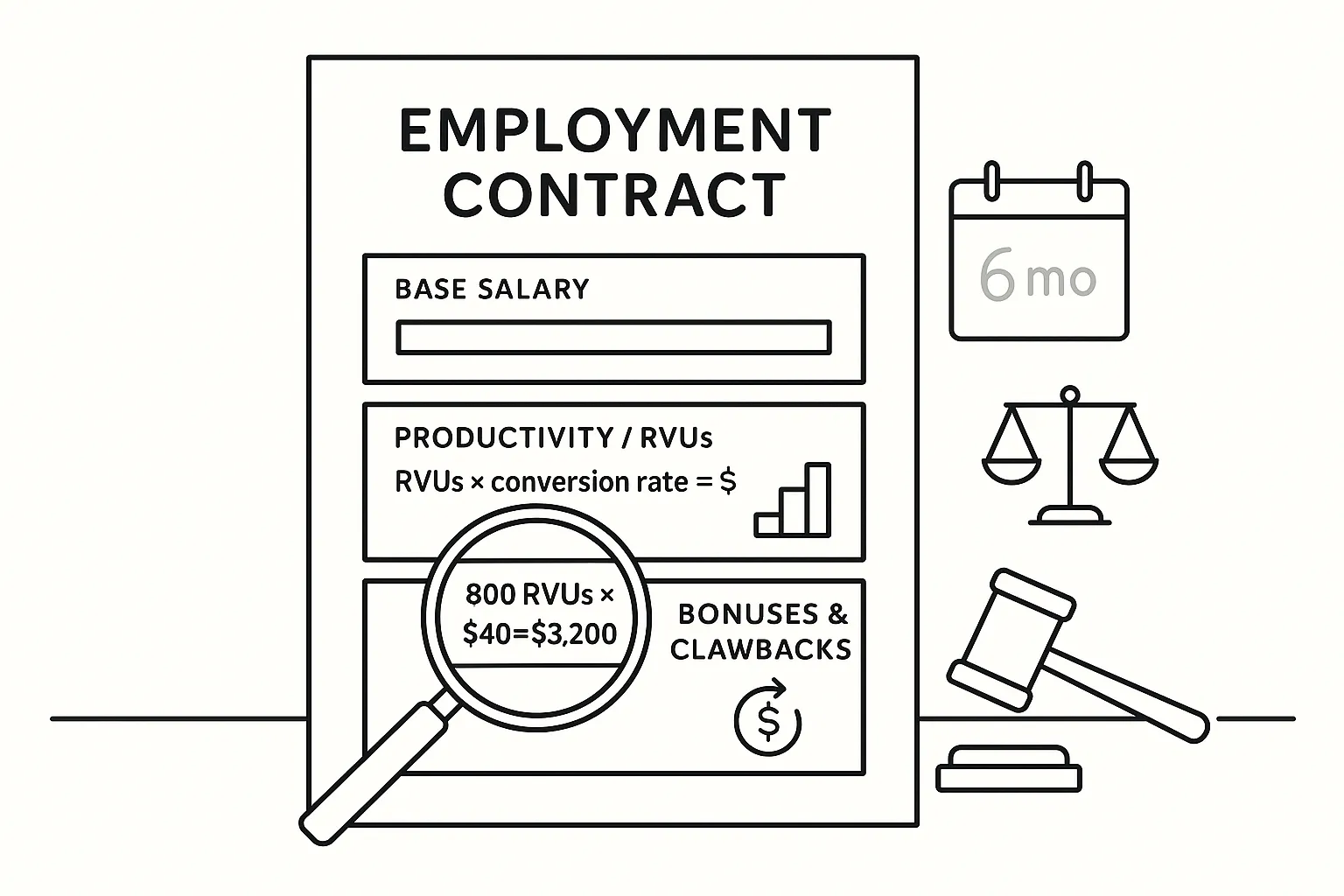
Compensation provisions determine how base salary, productivity metrics, incentives, and other payments translate into actual income. A careful review of PA compensation terms should address not only the stated salary or bonus opportunity but also the formulas, thresholds, attribution rules, reconciliation procedures, and payment timing that control what the physician assistant ultimately receives.
Base Salary and Productivity Compensation
Base salary provides predictable income and is usually paid on a regular payroll schedule. Many contracts, however, combine guaranteed salary with productivity incentives tied to clinical activity, collections, revenue generation, or work relative value units. A higher guaranteed salary with clearly defined productivity thresholds differs materially from a lower base salary that depends heavily on incentive compensation.
The agreement should identify the pay frequency, the duration of any guaranteed period, the point at which productivity compensation begins, and whether the base salary is a true guarantee or a draw against future production. If the contract permits reconciliation, it should explain whether a productivity shortfall can reduce future compensation or create negative accrual.
Collections, RVUs, and Incentive Adjustments
Collections-based compensation generally pays the physician assistant a percentage of revenue collected from services attributed to the PA’s work. The contract should explain how collections are credited, when payments are calculated, what expenses or adjustments may be deducted, and whether later refunds or chargebacks can reduce future compensation.
RVU-based compensation converts clinical productivity into standardized units and applies a contractual conversion factor. For example, a contract providing $40 per RVU would produce $32,000 from 800 RVUs before applying any threshold, reconciliation provision, or quality adjustment. The agreement should identify the applicable RVU methodology, conversion factor, threshold, reporting period, attribution rules, and access to supporting productivity data.
Quality, patient satisfaction, and clinical-outcome incentives require similar detail. The measurement criteria, performance period, payment date, employer discretion, and circumstances permitting later adjustment should be stated clearly enough for the physician assistant to understand how the incentive is earned.
Signing Bonuses, Relocation Assistance, and Clawbacks
Signing bonuses, relocation payments, education assistance, and loan repayment benefits often come with clawback provisions if employment ends before a stated period. The contract should define the events that trigger repayment, the deadline for returning the money, whether the obligation decreases over time, and whether repayment applies when the employer terminates the agreement without cause. These details can materially change the value and risk of an otherwise attractive incentive.
Non-Competes and Other Post-Employment Restrictions
Restrictive covenants can significantly affect professional mobility and long-term earning potential. Although the enforceability and practical effect of a PA non-compete depend on applicable law and the contract language, the restriction’s duration, geographic reach, covered activities, and triggering events should always be reviewed before signing.
A non-compete may define its geographic area by mileage from one or more practice locations, named counties, or an employer service area. The restricted activities may extend beyond the PA’s actual specialty or include clinical practice, telehealth services, management, ownership, or employment with broadly defined competitors. The agreement should also specify whether the restriction applies after resignation, termination without cause, nonrenewal, or every form of separation.
Non-solicitation and confidentiality provisions require separate attention. A non-solicitation clause may limit contact with patients, referral sources, employees, or contractors even when the physician assistant is otherwise permitted to work nearby. Confidentiality language should protect legitimate confidential information without treating the PA’s general professional knowledge or independently developed information as employer property.
Malpractice Coverage and Clinical Practice Obligations
Malpractice, indemnification, supervision, delegation, credentialing, and privileging provisions determine how professional liability and clinical responsibilities are allocated. These clauses should align with the actual position, institutional requirements, and the state regulatory framework governing physician assistant practice.
Malpractice Insurance, Tail Coverage, and Indemnification
Malpractice policies are generally written on an occurrence or claims-made basis. Occurrence coverage applies to incidents occurring during the policy period regardless of when a covered claim is filed. Claims-made coverage generally requires the policy to remain active when the claim is reported, so protection may be needed for claims reported after employment ends.
The contract should state the type of policy, coverage limits, premium responsibility, and whether the physician assistant must purchase extended reporting coverage after termination. Because the potential cost can be significant, responsibility for physician assistant tail insurance should be allocated expressly, including whether the employer pays under particular forms of separation.
Indemnification provisions address responsibility for legal costs and liabilities arising from professional activities. Some agreements require the employer to defend and indemnify the physician assistant for conduct within the scope of employment, while others shift certain obligations back to the PA. The language should be reviewed for scope, exclusions, defense-cost obligations, and consistency with available insurance coverage.
Supervision, Scope of Practice, and Credentialing
The agreement should describe the supervision, collaboration, or delegation structure applicable to the position without creating obligations that conflict with governing law. Depending on the jurisdiction and practice setting, relevant terms may address the supervising physician or group, prescriptive authority, chart review or co-signature requirements, delegation protocols, practice locations, and procedures for handling a change in the supervisory relationship.
Credentialing and hospital privileging requirements may also operate as conditions of employment. Contracts sometimes permit termination if the physician assistant cannot obtain or maintain privileges, payer enrollment, controlled-substance authority, or another required credential. The agreement should identify which credentials are required, who handles the process, how delays are treated, and whether the PA has a reasonable opportunity to address a correctable issue before termination.
Termination, Final Compensation, and Continuing Obligations
Termination provisions determine how employment may end, how much notice is required, and which financial or professional obligations survive separation. Employment agreements commonly distinguish between termination for cause and termination without cause. The definition of cause should be specific because broad or undefined language may allow immediate termination based on discretionary standards, while a cure provision may provide an opportunity to correct certain alleged breaches.
Without-cause termination usually permits one or both parties to end the relationship by providing advance written notice. The contract should state the notice period, required delivery method, whether the employer may remove the PA from the schedule during notice, and whether compensation and benefits continue. A focused review of termination provisions can also identify how separation affects bonuses, productivity compensation, restrictive covenants, malpractice tail coverage, and repayment obligations.
Final compensation language should explain whether the physician assistant receives earned but unpaid bonuses, later collections, accrued paid time off, or productivity payments calculated after departure. The agreement should also clarify whether the employer may offset alleged debts against final compensation and which provisions—including confidentiality, non-solicitation, non-compete, repayment, and indemnification obligations—continue after employment ends.
Working With a Physician Assistant Contract Attorney
Attorney review helps a physician assistant understand the legal and financial implications of an employment agreement before signing. The objective is not simply to identify unfavorable language; it is to explain how the contract operates, how related provisions interact, and which terms may justify clarification or negotiation based on the position and the PA’s priorities.
The Contract Review Process
A typical review begins with submitting the proposed agreement and relevant supporting materials, such as an offer letter, compensation plan, bonus addendum, or restrictive covenant. The attorney evaluates compensation, duties, scheduling, supervision, malpractice coverage, restrictive covenants, repayment obligations, benefits, and termination provisions. Written comments or redlined revisions may identify unclear language and clauses affecting income, liability exposure, regulatory compliance, or career mobility.
A consultation then provides an opportunity to discuss how the provisions operate in practice and prioritize possible changes. The analysis may distinguish between a term that is merely employer-favorable, a provision that creates meaningful financial exposure, and language that is too unclear to evaluate reliably.
Contract Checklist and Red Flags
A physician assistant employment agreement checklist can help organize the review. Important items include compensation methodology, productivity thresholds, payment timing, duties, work locations, call responsibilities, benefits, malpractice coverage, tail responsibility, supervision terms, credentialing requirements, termination rights, restrictive covenants, and repayment obligations.
Potential red flags include undefined productivity metrics, missing RVU conversion factors, discretionary bonuses without objective criteria, negative accrual without clear limits, broad definitions of cause, expensive tail obligations, restrictive covenants covering multiple locations or unrelated activities, and repayment clauses that apply regardless of why employment ends. These provisions do not all have the same legal or financial effect, but each warrants careful analysis before the agreement becomes binding.
Frequently Asked Questions
What does a physician assistant employment contract attorney review?
A physician assistant employment contract attorney may review compensation, productivity formulas, duties and scheduling, supervision requirements, malpractice insurance, restrictive covenants, signing bonuses, repayment obligations, termination provisions, benefits, and other terms affecting the employment relationship.
Should a physician assistant have an employment contract reviewed before signing?
Yes. Reviewing the agreement before signing allows the physician assistant to understand compensation, financial obligations, malpractice responsibilities, post-employment restrictions, and termination rights before those provisions become binding.
Can a physician assistant employment contract be negotiated?
Yes. Depending on the employer and position, provisions involving compensation, bonuses, scheduling, malpractice coverage, restrictive covenants, termination notice, repayment obligations, and other terms may be negotiable.
What are common red flags in a physician assistant employment contract?
Common concerns include unclear compensation formulas, broad non-compete restrictions, expensive malpractice tail obligations, undefined duties or scheduling requirements, lengthy termination notice periods, discretionary bonuses, and repayment provisions that require substantial amounts to be repaid if employment ends.
What should a PA contract say about malpractice insurance?
The agreement should identify the type of malpractice policy, coverage limits, who pays the premiums, and whether tail coverage is required when employment ends. If the policy is claims-made, the contract should clearly allocate responsibility for purchasing and paying for tail coverage.
Does Chelle Law review physician assistant employment contracts nationwide?
Yes. Chelle Law provides attorney-led physician assistant employment contract review services nationwide, including analysis of compensation, malpractice coverage, supervision, restrictive covenants, repayment obligations, termination provisions, and other employment terms.
Have Your PA Employment Contract Reviewed Before You Sign
Compensation, malpractice coverage, supervision requirements, restrictive covenants, repayment obligations, and termination provisions can affect your income and long-term career flexibility. Chelle Law provides attorney-led physician assistant employment contract reviews nationwide.
Request a PA Employment Contract ReviewExplore More Physician Assistant Contract Guidance
Browse attorney-led services, practical contract resources, and state-specific guidance for physician assistant employment agreements.