
Physician assistant sign-on bonuses and relocation payments can provide meaningful upfront compensation, but the repayment terms attached to these incentives may create substantial financial obligations if employment ends early. A physician assistant sign-on bonus and relocation review evaluates payment timing, service requirements, repayment triggers, proration, tax treatment, termination provisions, and other terms that affect the incentive’s true value.
These provisions are often connected to the broader employment agreement. A bonus may require full repayment after resignation, allow the employer to offset amounts against final compensation, or remain repayable when the employer terminates the physician assistant without cause. Relocation assistance may include separate reimbursement requirements, documentation rules, forgiveness schedules, or repayment obligations tied to a specific period of employment.
Chelle Law provides attorney-led physician assistant sign-on bonus and relocation reviews nationwide. We analyze how the incentive is paid, when repayment may be triggered, whether the obligation decreases over time, how termination affects repayment, and how the benefit interacts with compensation, malpractice coverage, restrictive covenants, and the rest of the physician assistant contract.
What Sign-On Bonus and Relocation Agreements Cover
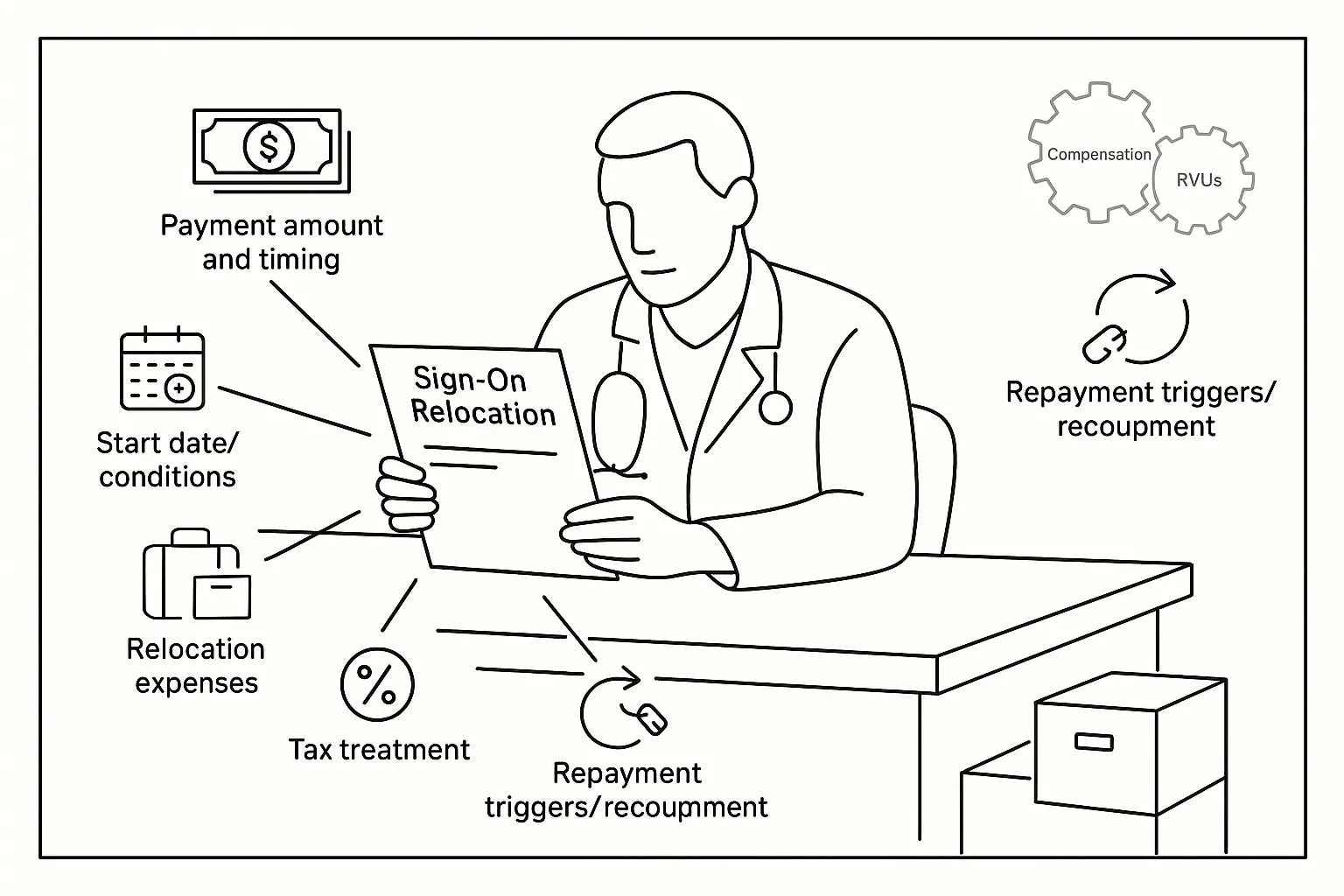
Sign-on bonuses and relocation provisions may appear in a standalone agreement, an offer letter, or the broader employment or independent contractor contract. Regardless of format, the language should explain how and when the payment is received, what the physician assistant must do to earn or retain it, and which events can create a repayment obligation. These healthcare recruitment incentives commonly include service commitments and repayment terms, issues also discussed in guidance on physician assistant contract negotiation.
Payment Terms, Eligibility, and Service Conditions
The agreement should identify the payment amount and timing, including whether the benefit is a lump sum, staged installment, or reimbursement for documented moving expenses, temporary housing, or real estate costs. It may condition payment on credentialing, a successful background check, the start of employment, or completion of an introductory period.
- Payment timing: Determine when the employer must issue the payment and whether a delayed start or credentialing issue changes that deadline.
- Covered relocation expenses: Confirm which expenses qualify, what documentation is required, and whether reimbursement is subject to a cap.
- Service commitment: Identify the period the PA must remain employed and whether the commitment begins on the signing date, start date, or payment date.
- Conditions for receipt: Review any requirements involving credentialing, licensure, background checks, or completion of an initial employment period.
These details determine whether the promised incentive is available when the physician assistant expects it and when the repayment clock begins. The agreement should also distinguish a true bonus from an advance that the employer may later reconcile against compensation.
How the Incentive Interacts With PA Compensation
Sign-on and relocation payments may be connected to base salary guarantees, collections-based pay, productivity bonuses, or RVU compensation. In some agreements, the employer may recoup the incentive against future bonuses or include it within a broader revenue guarantee. A focused PA compensation and productivity review can clarify whether the payment represents additional compensation or merely shifts the timing of earnings.
For example, an agreement may describe a payment as a sign-on bonus while also treating it as an advance against future productivity. If production falls below a target, reconciliation or negative accrual language may permit the employer to reduce later compensation or seek repayment. The contract should state whether the incentive is separate from salary and productivity earnings, whether it can be offset, and how any balance is calculated.
Repayment, Clawbacks, and Tax Treatment
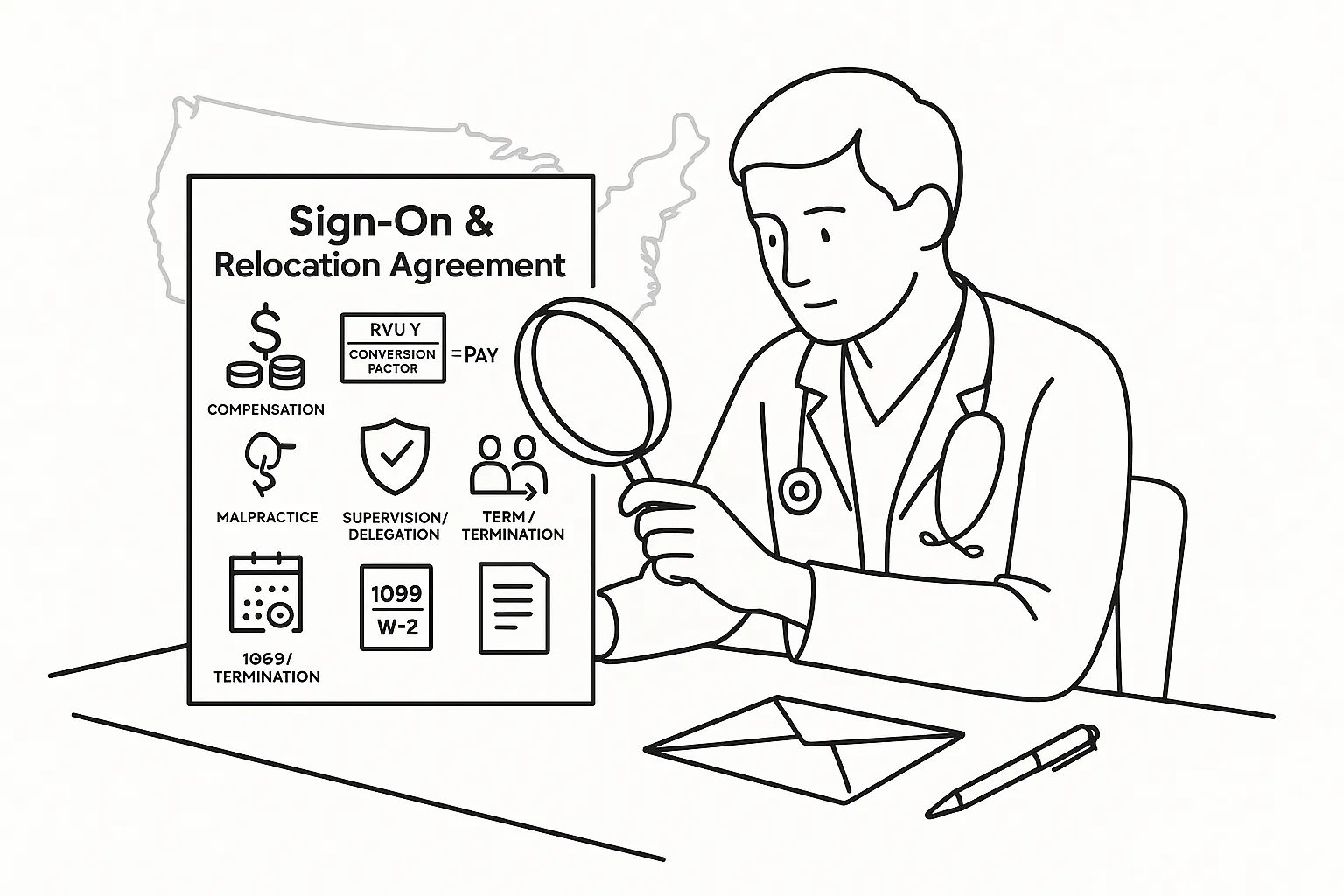
Repayment language determines whether an attractive upfront payment can become a significant debt. The provision should identify the triggering event, the amount owed, the repayment deadline, available offsets, and whether the obligation changes as the physician assistant completes the required service period. Reviewing detailed sign-on bonus repayment terms alongside the complete agreement helps reveal obligations that may not be apparent from the offer summary.
Repayment Triggers and Proration Formulas
Repayment clauses commonly apply if the physician assistant resigns before a specified date, is terminated for cause, fails to complete credentialing, or breaches a material contract requirement. Some provisions also apply after employer-initiated termination without cause, which can leave the PA responsible for repayment even when the decision to end employment was not voluntary.
- Pro rata repayment: The amount owed decreases based on the portion of the service commitment completed.
- Step-down repayment: The obligation declines at defined milestones, such as after each completed year or contract period.
- Full repayment: The entire amount remains due until the physician assistant reaches a specified date.
- Compensation offsets: The employer may attempt to deduct the balance from final compensation, productivity pay, accrued bonuses, or other amounts owed.
The contract should provide a defined formula rather than leaving the repayment amount to the employer’s discretion. It should also explain whether separate sign-on and relocation benefits have different forgiveness schedules and whether repayment is based on the gross payment or the net amount the PA received.
Tax Withholding, Gross Payments, and Cash Flow
Sign-on bonuses and many relocation payments are generally treated as taxable compensation, so payroll withholding can make the net payment lower than the stated amount. Some employers include a tax gross-up, while others place the entire tax burden on the physician assistant. Relocation reimbursements may also require receipts or other documentation, and the employer’s reporting method can affect how the payment is processed.
Tax language becomes particularly important when a repayment obligation is calculated from the original gross payment. A PA may receive a reduced amount after withholding but later face a demand based on the full stated benefit. If the payment is also treated as a draw against collections or productivity, delayed payer reimbursements and compensation reconciliation can further affect monthly cash flow.
Related Employment Contract Terms That Affect the Incentive
A sign-on bonus or relocation agreement should not be reviewed in isolation. Understanding how it fits within the overall physician assistant contract helps determine whether the incentive creates additional exposure through termination, malpractice, restrictive covenant, scope-of-practice, or worker-classification provisions.
Termination, Malpractice Coverage, and Professional Mobility
Termination provisions frequently control whether repayment is triggered. The agreement should distinguish voluntary resignation, termination for cause, employer termination without cause, nonrenewal, and an inability to begin work because of credentialing or licensing delays. A PA contract termination review can evaluate the notice period, for-cause definitions, repayment consequences, and any right to deduct amounts from final compensation.
Malpractice coverage can create a separate post-employment expense. Occurrence coverage generally addresses incidents occurring during the policy period, while claims-made coverage may require extended reporting coverage after employment ends. The agreement should identify who pays for that coverage; the guide to tail insurance for physician assistants explains why that responsibility matters when evaluating the total cost of leaving a position.
Restrictive covenants may further limit the PA’s ability to earn income after separation. Geographic restrictions, non-solicitation language, and triggering events should be read together with repayment obligations because a physician assistant could face both a bonus debt and limits on nearby employment. The practical effect of these provisions depends on the contract language and applicable jurisdiction.
Scope of Practice, Supervision, and Worker Classification
The broader agreement should describe the physician assistant’s duties, practice locations, scheduling expectations, supervision or collaboration structure, and delegation arrangements consistently with applicable state requirements. Broad language allowing unilateral expansion of duties or multi-site assignments can change the professional value of the position even when the upfront incentive appears favorable.
Worker classification also affects the economic analysis. An agreement may label the PA an independent contractor even when the employer controls scheduling, duties, supervision, and other aspects of the relationship. Classification can affect taxes, benefits, malpractice arrangements, and the treatment of incentive payments, making an independent contractor agreement review relevant when a bonus or relocation payment appears in a 1099 arrangement.
Physician assistants in California, like PAs in other states, should evaluate bonus and relocation terms alongside the state-specific rules and contract provisions governing their work. State requirements can affect the broader employment relationship even when the repayment clause itself appears in a separate document.
Sign-On Bonus and Relocation Agreement Red Flags
Employer-drafted agreements may shift substantial financial or professional risk to the physician assistant. The presence of a red flag does not determine the agreement’s outcome by itself, but it identifies language that should be clarified and evaluated within the complete contract.
- Full repayment without proration: The entire benefit remains repayable even after the PA has completed most of the service commitment.
- Repayment after termination without cause: The obligation applies even when the employer initiates separation for reasons unrelated to misconduct.
- Undefined clawbacks: Broad documentation, coding, billing, or chargeback language permits recovery without a clear calculation or dispute process.
- Uncapped negative accrual: A productivity deficit can accumulate and become due when employment ends. This risk is especially important when compensation is tied to production rather than base salary.
- Unclear offset rights: The employer can deduct disputed amounts from final wages, bonuses, or productivity compensation without a defined process.
- Ambiguous tail responsibility: The contract does not clearly state who must purchase extended reporting coverage after termination.
- Broad restrictive covenants: Geographic, duration, or non-solicitation restrictions may limit future opportunities while the PA is also managing repayment.
- Unclear supervision or delegation duties: The agreement shifts regulatory or credentialing responsibility to the PA without clearly defining the employer’s obligations.
When to Request a Sign-On Bonus and Relocation Review
An attorney-led review is most useful before the physician assistant signs the offer letter, bonus agreement, relocation agreement, or employment contract. Reviewing the documents together makes it possible to compare the promised incentive with repayment exposure, compensation offsets, termination rights, malpractice costs, and restrictions on future employment.
- Financial analysis: Review the payment schedule, net value, repayment formula, bonus offsets, and compensation reconciliation terms.
- Termination analysis: Determine which separation events trigger repayment and whether the balance declines as the service period is completed.
- Malpractice assessment: Identify the coverage type and whether the PA may owe for tail insurance after leaving.
- Mobility review: Evaluate how non-compete and non-solicitation provisions may affect nearby hospital, clinic, private practice, or telehealth opportunities.
- Regulatory alignment: Review whether scope, supervision, delegation, credentialing, and practice-location provisions fit the physician assistant’s anticipated role.
Chelle Law’s review process can include document analysis, written comments, and a consultation explaining how key provisions may affect income, liability exposure, repayment obligations, and professional mobility. Reviewing these terms before acceptance gives the physician assistant an opportunity to understand the financial commitment and raise questions while the offer remains under consideration.
Frequently Asked Questions
Do physician assistants usually have to repay a sign-on bonus if they leave early?
Often, yes. Many agreements require repayment if the physician assistant leaves before completing a specified service period. The contract should clearly identify the repayment period, triggering events, amount owed, and whether the repayment obligation decreases over time.
Should a physician assistant sign-on bonus repayment obligation be prorated?
A prorated repayment structure generally reduces the amount owed as the physician assistant completes more of the required service period. Some agreements instead require full repayment until a specific date. The contract should clearly explain whether repayment is prorated and how the remaining balance is calculated.
Does a PA have to repay a bonus if the employer terminates the contract?
That depends on the agreement. Some repayment provisions apply only after voluntary resignation or termination for cause, while others apply after almost any termination. The contract should clearly identify which termination events trigger repayment and whether employer-initiated termination without cause is excluded.
Are physician assistant sign-on bonuses and relocation payments taxable?
Sign-on bonuses and many relocation payments are generally treated as taxable compensation. The agreement should distinguish between the gross amount promised and the net amount received after withholding, particularly because a repayment obligation may be calculated using the original gross payment.
Can an employer deduct a sign-on bonus repayment from a physician assistant’s final compensation?
Some agreements authorize the employer to offset amounts owed against final wages, bonuses, productivity compensation, or other payments. The contract should clearly identify any offset rights and how repayment will be handled when employment ends.
Does Chelle Law review physician assistant sign-on bonus and relocation agreements nationwide?
Yes. Chelle Law provides attorney-led physician assistant sign-on bonus and relocation reviews nationwide, including analysis of repayment triggers, proration, tax treatment, clawback provisions, termination terms, compensation offsets, and other financial obligations.
Understand Your Bonus and Relocation Obligations Before You Sign
Repayment triggers, proration schedules, tax treatment, compensation offsets, and termination provisions can determine whether an upfront incentive becomes a significant financial obligation. Chelle Law provides attorney-led physician assistant sign-on bonus and relocation reviews nationwide.
Request a PA Bonus and Relocation ReviewExplore More Physician Assistant Contract Guidance
Browse attorney-led services, detailed contract resources, and state-specific guidance for physician assistant employment agreements.