
Physician assistants practicing in Alaska work under requirements administered by the Alaska Medical Licensing Board, including state-specific rules affecting licensure, scope of practice, supervision, delegation, and prescribing. Those obligations can shape how an employment or independent contractor agreement assigns clinical duties, documents oversight, and allocates responsibility for maintaining credentials. Contract terms also require practical attention in healthcare markets such as Anchorage and Fairbanks, where location, coverage expectations, and access to alternative positions may influence compensation and mobility. Chelle Law reviews Alaska PA agreements to identify whether supervision language, productivity formulas, malpractice obligations, restrictive covenants, termination rights, and repayment provisions align with the proposed working relationship. A line-by-line physician assistant contract review helps clarify those obligations before the PA signs or relies on employer assurances that do not appear in the written agreement.
Alaska PA Agreements and Practice Requirements

Alaska physician assistant agreements commonly combine compensation guarantees, productivity formulas, benefits, supervision provisions, and post-employment restrictions. Employers may use standardized templates that appear comprehensive but contain clauses shifting economic or professional risk to the PA. Common provisions include:
- An initial contract term and automatic renewal language;
- A base salary or guaranteed draw with a productivity reconciliation;
- Collections, work RVU, quality, or other productivity definitions;
- Malpractice insurance and post-termination coverage obligations;
- Supervision, delegation, prescribing, and facility-policy requirements; and
- Restrictive covenants and repayment duties tied to bonuses, relocation assistance, or loan support.
Contract language that refers broadly to a medical director, facility policy, or future employer rules should be examined against the actual position and Alaska requirements. A provision allowing the employer to change policies unilaterally may alter duties, schedules, or oversight after signing. Guidance from the Alaska Academy of Physician Assistants may also help PAs understand professional issues and clinical practice environments within the state, although outside guidance does not replace careful review of the agreement itself.
Scope of Practice, Supervision, and Workload
Clinical-duty provisions should be consistent with the position described during recruitment and with requirements administered by the Alaska Medical Licensing Board. Supervision, delegation, and prescribing language may track regulatory terminology, but an employer’s contract can also impose additional internal controls. Review should identify who is responsible for documenting required arrangements, maintaining credentials, and addressing changes in the practice setting.
Ambiguous language can create problems if the employer assigns duties beyond the PA’s authorization or fails to maintain the operational support contemplated by the agreement. Clauses allowing unilateral changes to supervision models, policies, locations, or responsibilities may affect professional autonomy and liability exposure. The agreement should also distinguish regulatory requirements from employer preferences so the PA understands which obligations may change during the term.
Patient volume, schedules, call, after-hours work, floating between facilities, and telehealth coverage should be defined with enough detail to evaluate the actual job. Multi-site or remote coverage can affect travel, support, malpractice exposure, and productivity credit. When call responsibilities are part of the role, the contract should state the frequency, response expectations, and whether additional compensation is available rather than leaving those issues entirely to future scheduling policies.
Compensation, Productivity, and Employee Benefits
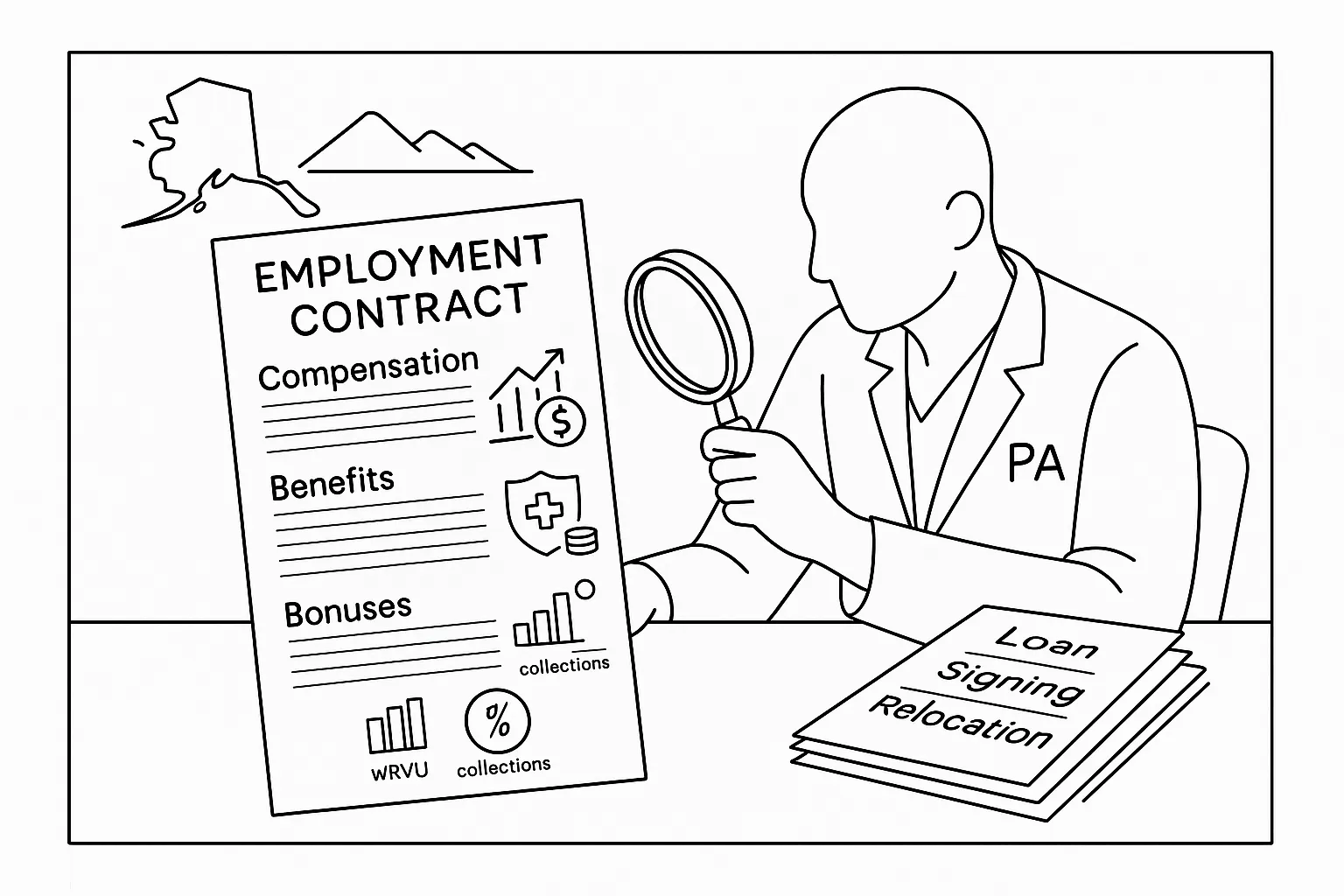
Salary, Collections, and RVU Formulas
Compensation provisions have the most immediate effect on take-home pay, but a stated salary does not reveal the entire economic arrangement. Some employers pay a guaranteed amount subject to later reconciliation against productivity. A focused PA compensation and productivity review examines the formula, measurement period, payment timing, threshold, conversion factor, and employer control over the underlying data.
Collections-based compensation ties pay to money the employer receives rather than simply to services performed. Payer mix, denials, delayed reimbursement, write-offs, refunds, and chargebacks may therefore affect compensation. If an agreement pays 25% of net collections, the definition of “net collections” and the employer’s authority to apply deductions can materially change the result. The contract should also address whether the PA receives post-termination collections attributable to work performed before departure.
Work RVU models convert credited productivity into compensation through a stated formula. For example, a $35 conversion factor applied to 4,000 credited wRVUs produces a $140,000 productivity component before any contractual adjustments. Review should determine how split visits, team-based care, telehealth services, procedures, and facility work are credited, as well as whether a deficit carries forward through negative accrual. Bonus provisions also warrant attention when payment is discretionary, conditioned on continued employment, or subject to later clawback.
Benefits, Bonuses, and Repayment Terms
Benefits language should identify employer contributions for health insurance, retirement plans, paid time off, continuing medical education, licensing costs, and applicable prescribing or controlled-substance registrations. Signing bonuses, relocation assistance, and loan support often carry repayment requirements triggered by early departure. Reviewing sign-on bonus repayment terms is especially important when the agreement does not prorate the balance or distinguishes poorly between resignation and employer-initiated termination.
Repayment clauses may apply to signing bonuses, relocation benefits, loan assistance, training expenses, malpractice costs, or other advances. The agreement should specify the triggering event, whether the amount declines over time, and what happens when the employer terminates without cause. It should also explain whether the employer may deduct an alleged balance from final wages or unpaid incentive compensation, subject to applicable law.
Malpractice Insurance and Liability Allocation
Coverage Type, Tail Insurance, and Indemnification
Malpractice provisions determine the type and limits of coverage, who pays premiums, and what protection remains after employment ends. Occurrence coverage generally protects covered acts occurring during the policy period regardless of when a claim is later filed. Claims-made coverage ordinarily requires the policy to remain active when the claim is made, so tail coverage or another form of continued protection may be necessary after the relationship ends.
An agreement should explain whether the employer purchases tail coverage, whether the PA must obtain it, and whether responsibility changes according to the reason for termination. Specialty, limits, and other policy factors can make this a significant potential expense. A review of the contract’s tail insurance obligations should also consider any reimbursement clause requiring the PA to repay the employer for post-termination coverage.
Indemnification and claims-handling clauses may allocate defense costs, settlement authority, or other liabilities between the parties. Review should determine whether the employer protects the PA for covered acts within the scope of employment and whether that protection is conditioned on compliance with vaguely defined policies. Cooperation requirements should not give the employer unlimited authority over matters that may affect the PA’s license or personal exposure.
Exit Terms, Restrictive Covenants, and Disputes
Non-Compete and Non-Solicitation Restrictions
Post-employment restrictions can affect where a PA may work, which patients or referral sources may be contacted, and whether former colleagues may be recruited. Non-compete language commonly uses a geographic area and restricted period, while non-solicitation clauses may address patients, employees, or business relationships. Because the effect of these provisions depends on the wording, governing law, and circumstances, an Alaska PA should obtain a focused non-compete review before assuming a restriction is either harmless or unenforceable.
The practical impact of a restriction depends on more than its stated radius. The contract may apply the radius to every employer location, define prohibited services broadly, or impose restrictions after both voluntary and involuntary termination. In a market with fewer nearby alternatives, an expansive clause may significantly affect mobility. Confidentiality and non-solicitation provisions should also be reviewed separately rather than treated as identical to the non-compete.
Termination, Notice, and Dispute Procedures
Termination provisions determine how quickly either party may end the relationship and what financial obligations survive. For-cause definitions may include loss of licensure, exclusion from programs, failure to maintain credentials, policy violations, or other conduct. Review should identify whether the PA has an opportunity to cure an alleged breach and whether broadly worded standards allow immediate termination based solely on the employer’s judgment.
Without-cause termination allows a party to end the agreement without proving a breach, usually after giving advance written notice. The notice period affects income continuity, transition planning, patient handoff, and the ability to begin another position. A contract termination review can also determine whether the employer may remove the PA from work during the notice period, stop incentive accrual, accelerate repayment duties, or impose different consequences depending on who initiates separation.
Dispute provisions may select governing law, venue, mediation, or arbitration. Arbitration clauses can affect forum access, procedures, and allocation of costs. The agreement should not purport to prevent lawful reports to the Alaska Medical Licensing Board or cooperation with a regulatory investigation. Severance, when offered, may also require a release of claims, so the payment and release terms should be considered together.
Preparing for an Alaska PA Contract Review
A useful review considers the entire proposed arrangement rather than the agreement in isolation. PAs should gather the offer letter, benefit summary, productivity plan, bonus terms, employer policies incorporated by reference, malpractice information, and any written recruiting promises. Relevant questions include how compensation is calculated, what happens if credentialing delays the start date, who controls scheduling and practice locations, and which financial duties survive termination.
Common red flags include unclear collections definitions, negative accrual, unilateral amendment rights, broad cause provisions, undefined call requirements, responsibility for tail coverage after any departure, expansive restrictive covenants, and repayment obligations that do not decline over time. If the parties agree to changes, those revisions should appear in a signed agreement or addendum. Verbal assurances provide limited protection when the written contract states that it contains the parties’ complete agreement.
Chelle Law provides attorney-led contract review, written comments, and proposed revisions designed to explain how the language affects compensation, compliance, liability, and future mobility. Reviewing the complete agreement before signing gives the PA an opportunity to understand the risks, prioritize negotiation points, and make an informed decision about the Alaska position.
Review Your Alaska PA Contract Before Signing
Understand how the proposed agreement addresses compensation, supervision, malpractice coverage, restrictive covenants, repayment obligations, and termination rights.
Contact Chelle Law