
Arkansas physician assistants reviewing an employment or independent contractor agreement must consider the practice framework administered by the Arkansas State Medical Board. Arkansas requires a PA to be licensed before practicing or using the physician-assistant title, and clinical services must remain consistent with the PA’s license, authorized practice area, and physician delegation agreement. Supervision, prescribing authority, professional identification, and the supervising physician’s availability can therefore affect how duties and employer responsibilities are described. These issues may arise in hospital, specialty, private-practice, and telehealth positions throughout healthcare markets such as Little Rock and Fayetteville. Contract review can evaluate whether the agreement accurately addresses the supervising relationship, authorized services, credentialing support, scheduling, call coverage, compensation, and malpractice protection. It can also identify provisions governing location changes, termination, incentive repayment, and post-employment restrictions that may affect the PA’s income, regulatory exposure, or ability to accept another position.
The financial and exit provisions deserve the same attention as the clinical terms. A favorable salary may be offset by an unclear productivity formula, unpaid call, broad repayment language, responsibility for tail coverage, or restrictions that reach beyond the PA’s actual work location. Chelle Law provides attorney-led physician assistant contract review to explain how these provisions interact and flag language that may warrant clarification or revision before signing.
Who Can Benefit From an Arkansas PA Contract Review?
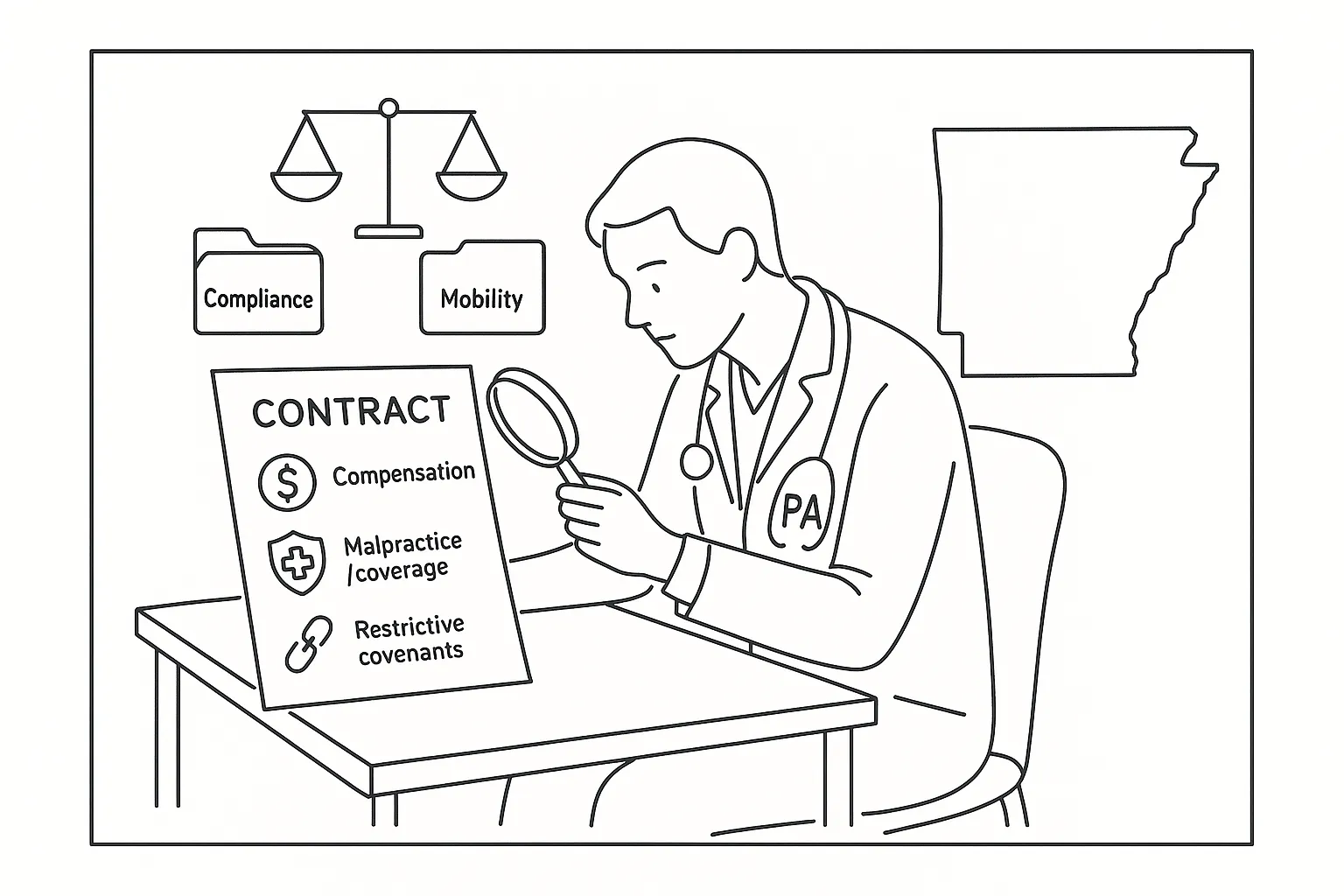
New Graduates and PAs Changing Positions
Contract review can assist new graduates accepting a first position, early-career PAs changing practices, and experienced clinicians moving into hospital, specialty, telehealth, or private-practice roles. A new position may involve unfamiliar compensation measures, call obligations, credentialing conditions, or restrictive covenants that are not fully explained in an offer letter.
Review can compare the written agreement with the role described during recruitment and identify material terms left to employer policy or future discretion. This helps the PA understand the complete offer rather than relying only on salary, schedule, or verbal descriptions of the position.
Renewals, Amendments, and Contractor Agreements
Legal review is also useful when an employer presents a renewal, compensation addendum, revised job description, or amendment affecting practice locations or clinical duties. A short amendment can incorporate the original agreement and extend provisions that would otherwise expire, including repayment obligations or post-employment restrictions.
Independent contractor arrangements require additional attention to compensation, expenses, insurance, benefits, tax classification, and termination rights. Arkansas medical-corporation provisions regulate aspects of medical-practice ownership and control, but the verified provisions do not establish a separate PA-specific employment-contract ownership rule. The structure and practical allocation of responsibilities still require review on the language of the particular agreement.
Arkansas Licensure, Delegation, and Workload Terms
Licensure and Physician Assistant Identification
An Arkansas PA must hold an Arkansas State Medical Board license before practicing or using the physician-assistant title. State requirements also address making the license available for inspection and wearing identification stating “physician assistant” while practicing. Contract language concerning start dates, credentialing, identification, and continued employment should not assume that clinical work may begin before required licensing and approvals are in place.
Review can determine whether the employer will support applications, renewals, credentialing, and prescribing-related requirements and whether employment is conditioned on approval by a particular date. It can also clarify who pays associated expenses and what happens if processing delays prevent the PA from starting as anticipated.
Supervision, Delegation, Scope, and Prescribing
Arkansas treats a PA as a dependent healthcare professional practicing under physician supervision and a physician delegation agreement or protocol approved or filed as required by the Arkansas State Medical Board. The supervising physician must be available for immediate telephone contact while the PA provides services. Contract review can evaluate whether supervision provisions identify the authorized practice area, delegated tasks, coverage arrangements, and employer support needed to maintain a compliant practice structure.
Clinical services must remain consistent with the PA’s license, practice area, and delegation agreement. Prescriptive authority must also be authorized by the supervising physician and documented as required. Arkansas permits qualifying PAs to prescribe legend drugs and, subject to applicable requirements, certain Schedule III-V controlled substances and qualifying hydrocodone combination products. Because prescriptions must contain required information, including identification of the supervising physician, an agreement should not transfer undefined compliance responsibilities to the PA or require services outside the authorized delegation arrangement.
Scheduling, Call Coverage, and Multiple Locations
Workload provisions may address shifts, patient volume, administrative duties, chart completion, call, weekends, holidays, and coverage at additional facilities. Broad language allowing unilateral schedule changes or unrestricted multi-site assignments can affect commuting time, supervision arrangements, compensation, and the PA’s ability to meet other professional obligations.
If call is required, review can identify whether the agreement defines frequency, response time, coverage area, additional compensation, and how call services count toward productivity. The contract can be compared with common physician assistant call and coverage terms to determine whether the written workload matches the position presented.
Compensation, Productivity, and Benefits

Base Salary, RVUs, and Collections
A PA agreement may use a fixed salary, hourly or shift rate, productivity compensation, collections formula, or a combination of these models. Review can determine whether the contract defines guarantee periods, productivity thresholds, measurement intervals, reconciliation dates, credited services, and payment timing. A focused PA compensation and productivity review can also identify provisions allowing an employer to change the formula, conversion factor, or performance standard.
RVU-based compensation requires clear definitions of the credited RVUs, applicable conversion factor, calculation period, and treatment of services performed but not properly attributed to the PA. Collections models instead depend on money the practice receives, making payer denials, refunds, recoupments, chargebacks, billing delays, and post-termination collections important. Any negative-accrual provision deserves particular attention because it may carry a deficit into a later compensation period.
Bonuses, Relocation Assistance, and Benefits
Signing bonuses, relocation payments, retention incentives, and student-loan assistance often include a required service period and repayment triggers. Analysis can determine whether repayment follows resignation, termination for cause, termination without cause, failure to start, or any separation. It can also identify whether the amount is prorated over time and whether the employer may deduct it from final compensation.
Benefits provisions may address health coverage, retirement contributions, paid time off, continuing medical education, professional dues, licensing fees, and prescribing-related expenses. Waiting periods, approval requirements, rollover rules, and the treatment of unused leave can materially affect the offer’s overall value. Independent contractor agreements usually require separate analysis because the PA may be responsible for expenses and protections an employer would otherwise provide.
Malpractice Coverage and Post-Employment Restrictions
Professional Liability Insurance and Tail Coverage
Malpractice provisions may identify the policy type, liability limits, covered services, premium responsibility, consent-to-settle terms, and reporting obligations. An occurrence policy generally covers incidents that occur during the policy period regardless of when a claim is asserted. A claims-made policy generally requires coverage to be active when the claim is made, which may create a need for tail coverage after departure.
No verified Arkansas PA-specific statute or Arkansas State Medical Board rule requires an employer to provide physician assistant tail coverage. Responsibility therefore needs to be evaluated under the agreement and applicable insurance policy. Reviewing tail insurance for physician assistants can clarify who purchases the coverage, when the obligation arises, and whether responsibility changes based on the reason the relationship ends.
Arkansas Non-Compete Provisions
Arkansas generally recognizes employment non-competes that are connected to an employment relationship, protect a qualifying business interest, and are no broader in time or scope than necessary. State law treats two years as presumptively reasonable for duration and permits courts to reform some unreasonable restrictions. However, the statute excludes persons holding professional licenses under Title 17, Subtitle 3, so application to a physician assistant requires careful analysis of the PA’s licensing classification, the contract, and any relevant common-law standards.
A physician assistant non-compete review can assess the restricted activities, duration, geographic reach, covered locations, and triggering events without assuming that the general statute resolves enforceability. Provisions tied to every employer affiliate or facility may have a substantially broader practical effect than a restriction limited to the location where the PA actually works.
Confidentiality and Non-Solicitation Clauses
Confidentiality, nondisclosure, and employee non-solicitation clauses require separate analysis because Arkansas statutory non-compete provisions do not govern agreements that do not restrain competition. Common-law standards and the Arkansas Trade Secrets Act may remain relevant. Review can distinguish legitimate protection of confidential information from language that broadly limits the PA’s use of general professional knowledge or future workplace relationships.
Patient, referral-source, and employee non-solicitation provisions may define solicitation expansively or restrict conduct that is not initiated by the PA. The duration, covered individuals, prohibited communications, and exceptions can affect whether the provision is workable after departure.
Termination, Notice, and Repayment Exposure
For-Cause and Without-Cause Termination
Termination provisions determine how and when either party may end the relationship. For-cause language may address loss or restriction of licensure, exclusion from payor programs, failure to maintain credentials, alleged policy violations, or breach of the agreement. Review can identify subjective definitions, immediate-termination rights, suspension provisions, and whether the PA receives a reasonable opportunity to cure a remediable breach.
A without-cause clause permits termination without proving a breach, usually after written notice. Important details include the notice period, delivery method, whether the employer may remove the PA from the schedule, and whether compensation and benefits continue during the notice period. A physician assistant contract termination review can explain these connected provisions before the PA signs or submits notice.
Final Compensation and Repayment Obligations
The agreement may address unpaid salary, earned bonuses, accrued leave, post-termination collections, expense reimbursement, insurance costs, and restrictive covenants. Compensation language should be read with the termination section because a bonus described as “earned” in one provision may still be forfeited under another.
Signing bonuses, relocation funds, loan assistance, and other incentives may become immediately repayable when the relationship ends. Review can flag repayment triggered even when the employer terminates without cause, identify payroll-offset language, and determine whether the amount declines as the PA completes the required service period.
How Contract Review Identifies Arkansas PA Risks
Line-by-Line Legal and Financial Analysis
A line-by-line review translates contract language into practical financial and professional consequences. Counsel can evaluate compensation calculations, repayment exposure, malpractice obligations, post-employment restrictions, and the relationship between clinical duties and Arkansas supervision or delegation requirements. Written comments and proposed revisions can help the PA identify which issues to raise and make an informed decision about the offer.
Contract review does not guarantee that an employer will accept a requested change or predict how a court or regulator would resolve a future dispute. Its purpose is to explain how the agreement allocates income, liability, regulatory responsibility, and post-employment burdens before the PA becomes bound by those terms.
Common Arkansas Physician Assistant Contract Red Flags
Potential warning signs include:
- Clinical duties that are not tied to the PA’s license, authorized practice area, or delegation agreement.
- Undefined responsibility for supervision, prescribing authority, credentialing, or regulatory documentation.
- RVU, collections, productivity, or bonus calculations that the employer may change unilaterally.
- Claims-made malpractice coverage without a clear allocation of tail responsibility.
- Broad non-compete or non-solicitation language covering numerous facilities, affiliates, or activities.
- Unrestricted changes to schedules, call duties, patient volume, or practice locations.
- Immediate termination provisions without an opportunity to cure a remediable breach.
- Repayment obligations that apply even when the employer ends the agreement without cause.
Speak With an Arkansas Physician Assistant Contract Lawyer Before You Sign
Chelle Law can review your proposed agreement, explain its financial and professional consequences, identify contract risks, and flag provisions that may warrant clarification or revision.
Request a Contract Review