
Arkansas physician assistants evaluating an employment or independent contractor agreement should consider how the contract aligns with the regulatory framework administered by the Arkansas State Medical Board. Scope of practice, licensure, supervision, delegation, and prescribing requirements can affect how clinical duties and employer responsibilities should be described. Those concerns may arise in hospital, specialty, private-practice, and telehealth opportunities across healthcare markets such as Little Rock and Fayetteville. A contract should clearly address the PA’s assigned duties, supervising relationships, scheduling expectations, compensation structure, malpractice protection, and responsibility for maintaining required credentials. It should also explain what happens if the employer changes a practice location, modifies clinical responsibilities, or ends the relationship. Chelle Law reviews these Arkansas-specific practice considerations alongside compensation, restrictive covenants, termination rights, repayment obligations, and other provisions that can affect a PA’s income, liability exposure, and ability to move to another position.
Who Benefits From an Arkansas PA Contract Review
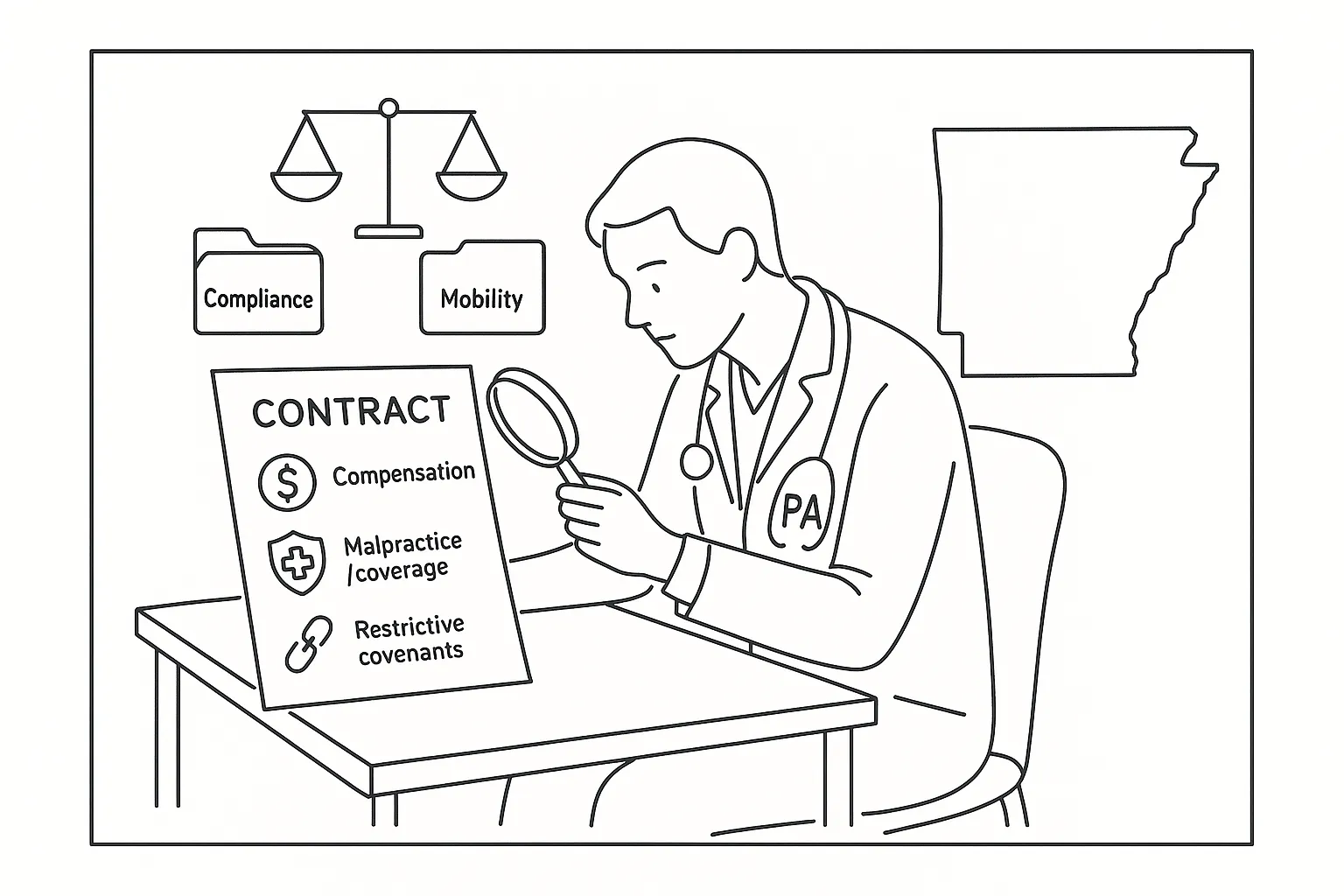
Contract review can assist Arkansas physician assistants at every career stage, including new graduates accepting a first position, early-career PAs changing practices, and experienced clinicians moving into hospital, specialty, telehealth, or private-practice roles. It is also important when a PA is asked to sign an amendment, renewed agreement, compensation addendum, or independent contractor arrangement rather than an entirely new contract.
PA agreements are commonly written to protect the employer. Compensation metrics, supervision provisions, malpractice obligations, restrictive covenants, and repayment clauses can materially affect earnings, regulatory compliance, and career mobility. An attorney-led physician assistant contract review evaluates how the document allocates financial, professional, and post-employment risk before the PA signs.
Arkansas PAs may also consult resources and legislative updates from the Arkansas Academy of Physician Assistants for information about the profession within the state. Those general resources do not replace a legal review of the specific language contained in an individual employment or contractor agreement.
Arkansas Practice Terms, Clinical Duties, and Workload
Supervision, Delegation, and Prescribing Responsibilities
Clinical practice language should be consistent with Arkansas requirements involving supervision, delegation, prescribing, and the PA’s authorized duties. Vague provisions that shift all responsibility for supervisory documentation, credentials, or prescribing authority to the PA may create avoidable licensing and operational risk.
The agreement should identify the employer’s role in maintaining an appropriate practice structure and explain what happens if a supervising relationship becomes unavailable. It should also distinguish the PA’s clinical and administrative responsibilities so that the written duties align with the position the employer described during recruitment.
Scheduling, Call Coverage, and Practice Locations
Workload terms should address expected shifts, patient volume, administrative duties, chart completion, call coverage, and practice locations. Broad language permitting unilateral schedule changes or unrestricted multi-site assignments can affect compensation, commuting obligations, and quality-of-care concerns.
If call is required, the agreement should clearly define frequency, response expectations, additional pay, and whether call work contributes to productivity. PAs can also review common call schedule and coverage terms when evaluating whether the contract accurately describes the position’s workload.
Compensation, Benefits, and Incentive Terms

A PA agreement should explain how compensation is earned, measured, reconciled, and paid. The financial terms must be read together because a favorable headline salary may be offset by uncertain productivity calculations, unpaid call responsibilities, discretionary deductions, or substantial repayment obligations. A focused PA compensation and productivity review can identify unclear formulas and provisions that allow the employer to change important economic terms.
Base Salary, RVUs, and Collections Models
Salary and productivity clauses should define guarantee periods, measurement intervals, reconciliation dates, and the services credited to the PA. In an RVU model, the agreement should identify which RVUs count, the applicable conversion factor, when productivity is calculated, and whether the employer may change the methodology. For example, a formula awarding $40 for each of 1,000 credited RVUs would produce $40,000 in productivity compensation, but that illustration is meaningful only if the contract clearly defines the credited units and calculation period.
Collections-based arrangements tie compensation to money the practice actually receives rather than the amount billed. If a practice bills $100,000, collects 60%, and pays the PA 30% of collections, the compensation calculation is based on $60,000 rather than the original charges. The agreement should address collection timing, payer denials, refunds, recoupments, chargebacks, post-termination collections, and any negative accrual that carries a deficit into a later period.
Bonuses, Relocation Assistance, and Benefits
Signing bonuses, relocation payments, and student loan assistance frequently include service periods and repayment triggers. Review should determine whether repayment follows resignation, termination for cause, termination without cause, or any separation, as well as whether the obligation is prorated. PAs should understand these bonus repayment terms before accepting an upfront payment that could later become immediately due.
Benefits language should specify health insurance eligibility, retirement contributions, paid time off, continuing medical education allowances, and reimbursement for licensing or prescribing-related expenses. The agreement should also identify waiting periods, approval requirements, and whether benefits differ based on W-2 or independent contractor status. These details help reveal the complete value of the offer rather than salary alone.
Malpractice Protection and Post-Employment Restrictions
Malpractice Insurance and Tail Coverage
Malpractice provisions should identify the type of policy, applicable limits, covered services, and the party responsible for premiums. An occurrence policy generally covers incidents occurring during the policy period regardless of when the claim is asserted. A claims-made policy generally requires coverage to be active when the claim is made, which can create a need for tail coverage after the PA leaves.
The contract should state who purchases tail coverage, when that obligation applies, and whether the answer changes based on the reason employment ends. It should also disclose any repayment or offset provision connected to insurance costs. Reviewing tail insurance responsibility before signing can prevent an unexpected post-employment expense and clarify whether the PA remains protected after departure.
Non-Competes and Other Restrictive Covenants
Restrictive covenants may limit where a PA can work, which patients or referral sources the PA may contact, and whether the PA may recruit former colleagues after leaving. A review should consider the duration, geographic reach, restricted activities, covered employer locations, and events that trigger the restriction. Language extending restrictions to every affiliate or location can create broader consequences than a PA expects from the facility where the PA actually works.
Enforceability depends on the agreement’s language and the applicable legal context, so a general overview cannot guarantee how a particular provision will be treated. An Arkansas-focused non-compete review can evaluate the restriction’s practical effect, including whether it applies after termination without cause and how it may affect opportunities in the PA’s local healthcare market.
Termination Rights, Notice, and Repayment Exposure
Termination provisions determine how quickly either party may end the relationship and what financial obligations follow. For-cause clauses should be reviewed for broad or subjective definitions, opportunities to cure an alleged breach, suspension rights, and the effect on earned compensation. Without-cause provisions should clearly state the required notice period and whether the employer may remove the PA from work, stop scheduling shifts, or pay compensation in place of notice.
The agreement should also explain what happens to unpaid bonuses, accrued leave, post-termination collections, malpractice obligations, and restrictive covenants. Signing bonuses, relocation funds, loan assistance, and other incentives may be subject to immediate repayment or payroll offsets. A contract termination review can identify these connected consequences before the PA gives notice or signs an agreement containing unfavorable exit terms.
How Legal Review Identifies Arkansas PA Contract Risks
A line-by-line review translates contract language into practical financial and professional consequences. Counsel can examine how a compensation formula affects projected pay, identify repayment exposure, clarify responsibility for tail coverage, assess post-employment restrictions, and determine whether supervision and clinical-duty provisions warrant clarification. Written comments or proposed revisions can then help the PA decide which issues to raise with the employer.
Common warning signs in an Arkansas PA agreement include:
- Undefined RVU, collections, productivity, or bonus calculations.
- Claims-made malpractice coverage without a clear allocation of tail responsibility.
- Vague supervision, delegation, prescribing, or credentialing obligations.
- Broad non-compete or non-solicitation restrictions covering multiple locations or affiliates.
- Unrestricted schedule, call, workload, or practice-location changes.
- Repayment obligations triggered even when the employer ends the agreement without cause.
Legal review does not promise a particular negotiation outcome. Its purpose is to clarify how the agreement allocates income, liability, regulatory responsibilities, and post-employment burdens so the PA can make a well-informed decision before signing.
Have an Arkansas PA Contract Reviewed Before You Sign
Chelle Law reviews compensation, supervision, malpractice, restrictive covenant, termination, and repayment provisions so you can understand the practical risks in your proposed agreement.
Contact Chelle Law