
California physician assistant contracts operate within a profession-specific framework administered by the Physician Assistant Board of California, a board within the California Department of Consumer Affairs, with related physician-supervision guidance from the Medical Board of California. A PA’s clinical authority depends on a separate written practice agreement addressing authorized services, supervision policies, competency evaluation, and authority to furnish or order drugs and devices. Those requirements can materially affect employment provisions concerning scope, prescribing, compliance, physician oversight, and disciplinary events. Physician assistants evaluating opportunities in Los Angeles, San Diego, San Francisco, and other California healthcare markets may also encounter different productivity formulas, schedules, site assignments, malpractice terms, and repayment obligations. Chelle Law reviews how these regulatory and business terms interact, identifies language that may not match the proposed position, and explains potential financial, professional, and transition risks before the PA signs.
A California PA contract review also examines provisions that may be easy to overlook in an offer summary, including compensation reconciliation, call coverage, credentialing delays, independent-contractor classification, post-employment restrictions, final-pay language, and responsibility for tail insurance. The written agreement—not a recruiter’s description or verbal assurance—usually controls the parties’ contractual obligations.
California PA Practice Agreements and Regulatory Duties

An employment contract addresses the business relationship between the PA and the hiring entity, but it does not replace California’s required practice agreement. A comprehensive physician assistant contract review compares the proposed duties with the agreement’s clinical-authority, supervision, prescribing, compliance, and performance provisions.
The Written Practice Agreement Is a Separate Requirement
California permits a PA to perform medical services authorized by a written practice agreement with one or more supervising physicians. That practice agreement addresses authorized services, supervision policies, methods for evaluating competency, and authority to furnish or order drugs and devices. An employment or independent-contractor agreement therefore should not be read as independently expanding the PA’s lawful clinical authority.
Contract review can identify language that assumes broader authority than the proposed practice agreement supports, assigns undefined compliance duties, or allows material clinical changes without addressing supervision and competency. California also generally limits a physician to supervising no more than eight PAs, subject to statutory exceptions, including specified emergency conditions. Staffing and coverage provisions warrant attention when the anticipated model depends on a particular supervising-physician arrangement.
Scope, Competency, Prescribing, and Clinical Control
A PA’s services must fall within the individual’s education, training, experience, and competency and be authorized by the practice agreement. California also excludes specified optometry- and dentistry-related activities from PA practice. Broad clauses requiring the performance of all services assigned by an employer can create concern if they do not recognize these professional limits.
Prescribing and furnishing provisions merit separate analysis because the practice agreement must specify the PA’s authority to furnish or order drugs and devices. That authority remains subject to California PA requirements, applicable formularies or protocols, and supervising-physician requirements. Review can also flag provisions that give a nonclinical entity excessive control over professional judgment, particularly because California generally restricts artificial entities from practicing medicine or controlling licensed clinicians’ professional judgment, subject to statutory exceptions.
Licensure, Reporting, and Disciplinary Events
Violations of California PA statutes, regulations, or supervision requirements may support professional discipline. Contract terms concerning active licensure, mandatory disclosures, investigations, credentialing actions, suspension, and termination for cause can therefore have consequences beyond the immediate job. Analysis can determine whether an employer may suspend duties or compensation based merely on an allegation, whether the PA has an opportunity to respond, and how the contract treats a temporary licensing or credentialing issue.
Compensation, Referral Rules, and Worker Classification
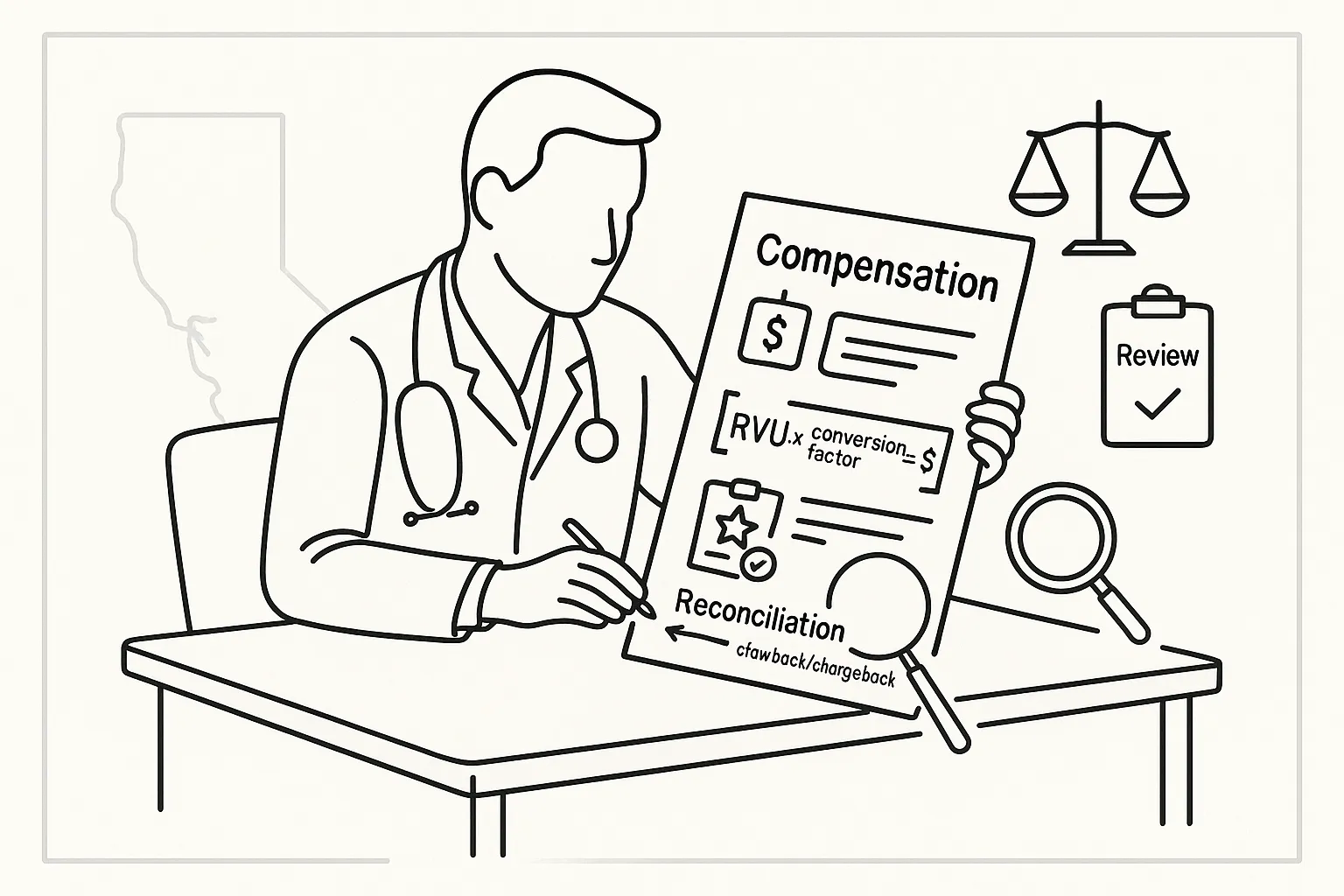
Compensation language determines actual earnings rather than merely stating an advertised salary or percentage. California PAs may encounter guaranteed salary, collections-based pay, RVU formulas, quality incentives, shift differentials, or blended models. A focused PA compensation and productivity review evaluates the definitions, thresholds, timing, reconciliation rules, and employer discretion that control payment.
Base Salary, RVUs, Collections, and Reconciliation
Review can determine how the guaranteed base interacts with productivity compensation, when calculations occur, and which services receive credit. Collections-based pay may transfer the effects of billing delays, payer denials, refunds, and collection performance to the PA. RVU-based compensation depends on the applicable threshold, conversion factor, attribution method, and treatment of services performed with other clinicians.
- Credited work: Which encounters, procedures, modifiers, or services count toward production?
- Calculation period: When is production measured, reported, and paid?
- Reconciliation: Can advances, shortfalls, denials, refunds, or chargebacks reduce later compensation?
- Employer discretion: Can a threshold, conversion factor, metric, or attribution rule change during the contract term?
Draws and deficit-carryforward provisions require particular attention because they may create negative accrual in a physician assistant contract. The agreement may also address whether earned but unpaid productivity compensation remains payable after notice or termination.
Quality Bonuses and Patient-Referral Concerns
Quality incentives may rely on patient satisfaction, documentation, utilization, access, or other stated measures. Useful analysis considers the measurement period, data source, eligibility requirements, payment date, and the employer’s ability to revise the plan. A bonus may have limited value when the underlying targets are unavailable, discretionary, or outside the PA’s control.
California generally prohibits offering or receiving compensation as an inducement for patient referrals. Percentage-based compensation for non-referral services may be permissible only when tied to the value of those services or fair rental value and otherwise lawful. A contract review can flag compensation language that appears to reward referrals rather than personally performed services without assuming that every percentage-based formula is prohibited.
W-2 and Independent-Contractor Terms
California uses a statutory ABC-test framework for worker classification, subject to enumerated exemptions and profession- or industry-specific rules. Calling a PA an independent contractor does not by itself establish the correct classification. The degree of control, nature of the work, business arrangement, and any applicable exception require analysis beyond the contract’s label.
An independent-contractor agreement may shift responsibility for taxes, benefits, insurance, expenses, licensing costs, and business operations to the PA. Comparing the practical consequences of W-2 and 1099 physician assistant arrangements can reveal whether the stated rate adequately reflects those transferred obligations and whether the written level of employer control is consistent with the proposed structure.
Malpractice Insurance and Liability Allocation
California does not appear to impose a profession-specific statutory requirement that PAs purchase tail insurance. Medical Board of California guidance states that PAs are generally covered under the employing physician’s or facility’s malpractice policy, although a PA may carry separate coverage. The contract still needs careful review because policy type, exclusions, covered locations, indemnification, and post-termination protection can create substantial exposure.
Occurrence, Claims-Made, and Tail Coverage
Occurrence coverage generally responds to covered incidents occurring during the policy period regardless of when the claim is filed. Claims-made coverage ordinarily requires coverage to remain active when the claim is made, potentially creating a need for an extended reporting endorsement after the employment relationship ends. A general promise that the employer will provide insurance may not identify which structure applies.
The agreement may allocate tail costs differently depending on resignation, termination, length of service, or the reason employment ends. Review of physician assistant tail insurance terms can clarify who selects the coverage, applicable limits, the deadline for obtaining it, and whether the employer may deduct the cost from final compensation.
Policy Scope, Moonlighting, and Indemnification
Coverage analysis can identify whether the policy applies to every contemplated facility, specialty, procedure, telehealth activity, and assigned duty. Employer-sponsored coverage may exclude outside work or moonlighting, and a separate policy may be necessary for activities outside the employer’s scope. Coverage limits, consent-to-settle terms, defense costs, and the treatment of licensing-board proceedings may also be material.
Indemnification provisions require independent review because they may obligate the PA to defend or reimburse the employer for losses that exceed available insurance. The relevant questions include what triggers indemnification, whether it applies to the employer’s own conduct, whether defense expenses are included, and whether the obligation survives termination.
California Restrictive Covenants and Post-Employment Conduct
California generally voids contracts that restrain a person from engaging in a lawful profession, trade, or business. State law also restricts entering into, enforcing, or attempting to enforce prohibited non-competes, subject to statutory exceptions. That strong policy does not make every post-employment clause irrelevant or eliminate the need to review the complete restrictive-covenant package.
Non-Compete Clauses and Contractual Remedies
A contract may contain geographic restrictions, competitive-activity language, forfeiture provisions, liquidated damages, notice requirements, or repayment obligations connected to future employment. A physician assistant non-compete review can identify language that conflicts with California’s general rule, determine whether the agreement invokes a statutory exception, and explain practical dispute risks without assuming every provision has the same legal effect.
Choice-of-law, venue, and forum clauses also deserve attention, particularly when the employer operates in multiple states. These clauses may affect where a dispute is filed and which state’s law the employer claims applies, although contractual wording does not necessarily override California protections.
Confidentiality, Trade Secrets, and Non-Solicitation
Confidentiality and trade-secret provisions can protect legitimate business information, but definitions drafted too broadly may purport to cover general clinical knowledge, publicly available information, or information the PA already possessed. Review can distinguish these provisions from a direct non-compete and identify duties that continue indefinitely after employment.
Patient, employee, and referral-source non-solicitation clauses may also affect communications during a transition. Analysis can consider the restricted conduct, duration, remedies, record-access rules, patient-notification process, and interaction with privacy and continuity-of-care obligations. These terms should be evaluated based on their wording and practical effect rather than their heading alone.
Schedules, Call, Locations, and Credentialing
A PA agreement governs the day-to-day position as well as compensation. Scheduling authority, call coverage, site assignments, documentation standards, staffing expectations, credentialing, and outside-work restrictions may materially change the value and sustainability of the role.
Work Hours, Call Coverage, and Multi-Site Assignments
Contract review can determine whether work hours are fixed, estimated, or subject to unilateral change. Call provisions may address frequency, response time, in-person coverage, weekend obligations, backup responsibilities, and whether call compensation is included in salary or paid separately. Undefined obligations can make it difficult to evaluate the effective hourly value of the offer.
Location clauses may permit assignment throughout a city, region, health system, or any future facility. The practical impact can include added travel, parking costs, different clinical resources, and changes to supervising-physician relationships. Telehealth terms may raise similar questions about authorized locations, scheduling, technology, licensing, and malpractice coverage.
Credentialing, Start Dates, and Outside Work
Credentialing and privileging provisions may allocate responsibility for applications, fees, licensing renewals, controlled-substance registrations, and facility requirements. The contract can also specify what happens if credentialing delays the start date, prevents work at an assigned site, or remains incomplete by a stated deadline. Review can identify whether compensation begins on the agreed date or only after every approval is obtained.
Moonlighting and outside-work provisions may require prior approval or prohibit other professional activity. Their scope should be considered together with schedules, conflicts of interest, malpractice coverage, fatigue policies, and confidentiality obligations. A broad restriction may reach teaching, volunteer work, consulting, or occasional clinical shifts even when those activities do not compete with the employer.
Termination, Final Compensation, and Repayment
Termination provisions determine how the relationship may end and which obligations continue afterward. They should be read together with compensation, malpractice, restrictive-covenant, credentialing, and repayment clauses because one event may trigger consequences across several sections of the agreement.
For-Cause and Without-Cause Termination
Review can distinguish immediate for-cause termination from termination without cause upon advance notice. Important details include the definition of cause, whether the PA receives notice of an alleged breach, whether the breach can be cured, and whether an investigation or credentialing event permits suspension without pay. A lengthy without-cause notice period may also delay a transition unless the contract allows the employer to waive work duties while continuing compensation.
California imposes timing requirements for payment of earned wages at separation and may impose waiting-time penalties for willful delay. Contract language concerning final wages, earned productivity pay, unused benefits, deductions, and post-termination reconciliation should therefore be evaluated in light of applicable wage rules. A physician assistant contract termination review can clarify notice obligations and the financial consequences tied to each form of separation.
Signing Bonuses, Relocation, and Clawbacks
Signing bonuses, relocation assistance, training payments, and loan-repayment incentives often include repayment obligations if employment ends before a stated date. Analysis can determine whether repayment is prorated, which termination events trigger it, when the balance becomes due, and whether the contract permits an offset against final compensation.
The reason for separation can be decisive. A broadly drafted clawback might apply after resignation, termination without cause, failure to obtain credentials, or a change in job duties. Calculating the maximum exposure before signing helps distinguish compensation that is fully earned from an advance that may become a debt.
Preparing for a California Physician Assistant Contract Review
A useful review begins with the complete proposed agreement and every document incorporated by reference. Relevant materials may include the offer letter, practice agreement, compensation exhibit, bonus plan, job description, benefit summary, malpractice information, restrictive-covenant exhibit, and communications describing schedule, call, or location expectations. Comparing the complete package can reveal conflicts that are not visible when each document is read separately.
- Confirm how the employment agreement interacts with the required California practice agreement.
- Evaluate base pay, productivity credit, thresholds, reconciliation, and post-termination payments.
- Identify the malpractice policy type, covered activities, limits, and responsibility for tail coverage.
- Review schedules, call duties, work locations, credentialing, and outside-work restrictions.
- Examine classification, clinical-control, referral-compensation, and professional-judgment provisions.
- Calculate potential bonus, relocation, training, or other repayment exposure.
- Consider termination, final-pay, confidentiality, and post-employment provisions as an integrated package.
Chelle Law’s review focuses on identifying material risks, explaining how the written terms may operate, and clarifying provisions that may warrant further discussion or revision. The goal is to help the PA understand the agreement’s potential effects on compensation, compliance, liability, daily practice, and future mobility before accepting the position.
Speak With a California Physician Assistant Contract Lawyer Before You Sign
Chelle Law reviews physician assistant agreements, identifies material risks, explains practical consequences, and flags provisions that may warrant clarification or revision.
Request a Contract ReviewExplore Physician Assistant Contract Guidance
Learn more about contract review services, practical PA resources, and state-specific guidance.