
California physician assistant contracts must account for the practice requirements overseen by the Physician Assistant Board of California, including state-specific rules involving PA scope of practice, supervision, delegation, and prescribing. Those requirements can affect how employment duties, clinical authority, compliance responsibilities, and physician relationships are described in an agreement. PAs considering positions in Los Angeles, San Diego, San Francisco, and other California healthcare markets may also encounter materially different compensation formulas, schedules, malpractice provisions, and post-employment restrictions. Chelle Law reviews how these regulatory and market considerations interact with the contract’s practical terms, including productivity credit, clinical-site assignments, professional liability coverage, termination rights, and repayment obligations. A focused review can identify language that does not reflect the anticipated practice arrangement and explain the financial, regulatory, and career consequences before the PA signs.
Why California PA Contract Review Matters

Employment and independent contractor agreements are commonly drafted from the employer’s perspective. For physician assistants, those documents can alter expected pay, impose supervision or delegation responsibilities that do not match the actual practice, create insurance gaps at termination, or restrict professional mobility. A comprehensive physician assistant contract review evaluates how the written terms will operate in daily practice rather than relying on verbal assurances or an offer summary.
- Supervision and delegation language that does not reflect the proposed California practice arrangement or clearly allocate compliance responsibilities.
- Compensation formulas containing reconciliation, chargeback, or negative-accrual provisions that may reduce take-home pay.
- Malpractice provisions that leave the PA responsible for tail coverage or impose broad indemnification obligations.
- Restrictive, confidentiality, or non-solicitation provisions that may complicate a future transition even when a traditional non-compete is limited by California law.
Chelle Law identifies ambiguous language, financial exposure, and regulatory concerns that may have costly real-world consequences. California PAs can also consult the California Academy of Physician Associates for professional information concerning scope-of-practice developments, regulatory trends, and standards affecting PA practice in the state.
Compensation, Productivity, and Bonus Terms
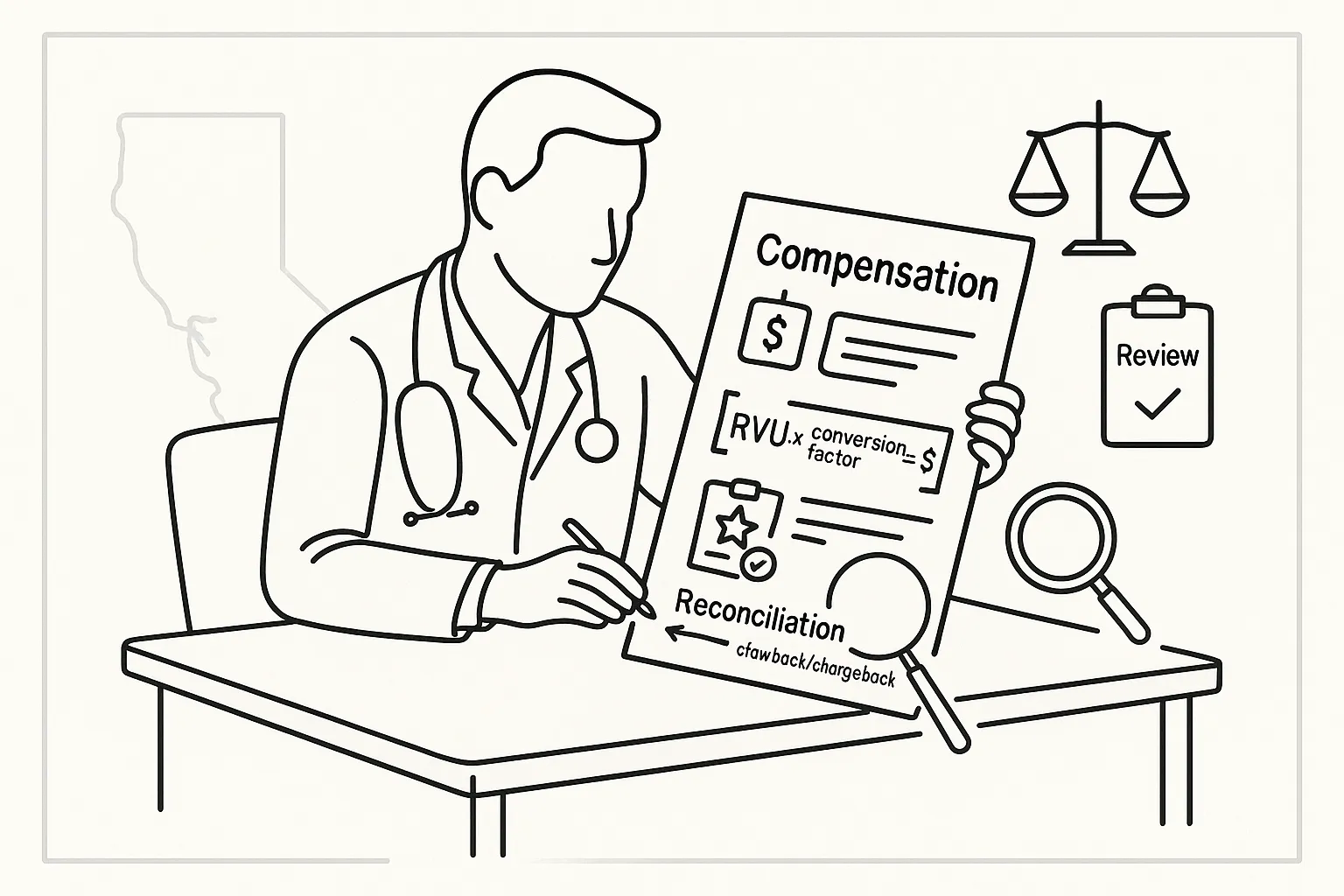
Compensation language determines actual earnings, not merely the salary or percentage stated in an offer. California PAs may encounter guaranteed salary, collections-based compensation, RVU formulas, quality bonuses, or blended models. A focused PA compensation and productivity review examines the definitions, thresholds, timing, and reconciliation provisions that control what the PA ultimately receives.
How the Compensation Formula Works
The agreement should define the guaranteed base, pay periods, production-calculation dates, credited services, and responsibility for billing or collection delays. It should also explain whether the employer deducts practice expenses, adjusts previously credited work, or carries a shortfall into a later period. These details are especially important when the contract includes a draw or negative-accrual provision.
- Definitions: What qualifies as a billable encounter, completed encounter, collection, or credited RVU?
- Timing: When are productivity calculations completed, reported, and paid?
- Reconciliation: Can shortfalls, advances, denials, refunds, or chargebacks reduce later compensation?
- Employer discretion: Can the employer change a conversion factor, threshold, metric, or calculation method unilaterally?
RVU, Collections, and Quality-Based Pay
Collections-based compensation ties pay to money the employer actually receives, which may transfer billing, payer, and collection-delay risk to the PA. RVU compensation instead converts measured work into pay through a stated conversion factor, often after the PA reaches a threshold. For example, a formula using 800 credited RVUs and a $45 conversion factor would calculate $36,000 in production pay before applying any base, threshold, reconciliation, or contractual adjustment.
Quality bonuses may depend on patient satisfaction, utilization, documentation, or other metrics. The agreement should identify the measurement period, data source, eligibility rules, payment date, and any audit or appeal process. Attorney review helps determine whether these formulas are transparent and whether repayment, clawback, or adjustment rights survive termination.
Malpractice Insurance and Liability Exposure
Malpractice provisions directly affect liability during employment and after the relationship ends. The contract should identify the coverage type, policy limits, covered activities, and responsibility for premiums and post-termination protection. A statement that the employer will “provide coverage” may be insufficient if it does not address exclusions, moonlighting, independent contractor services, or tail insurance.
Claims-Made Coverage, Tail Insurance, and Indemnification
Occurrence coverage generally applies to incidents occurring during the policy period regardless of when the claim is filed. Claims-made coverage ordinarily requires an active policy when the claim is made, which can create a need for an extended reporting endorsement after coverage ends. The agreement should clearly allocate responsibility for physician assistant tail insurance and explain whether the obligation changes based on resignation, termination, or length of service.
Indemnification language requires separate attention. An agreement may provide employer-sponsored malpractice insurance while also requiring the PA to defend or reimburse the employer for certain losses. Review should address whether those obligations are broader than the available insurance, whether they continue after termination, and whether the policy covers the clinical activities and locations contemplated by the contract.
Restrictive Covenants and Post-Employment Mobility
California treats non-compete restrictions differently from many other states, but a contract may still contain provisions addressing competition, solicitation, confidentiality, trade secrets, patients, employees, or referral relationships. These terms should not be ignored simply because a traditional non-compete may be unenforceable in many California employment contexts. A careful review considers the complete restrictive-covenant package and its practical effect on the PA’s next position.
The analysis should examine the restricted activities, duration, geographic language, triggering events, and remedies claimed by the employer. It should also consider whether a provision could interfere with telehealth, communications with former patients, recruitment of staff, or work for another practice. Chelle Law’s PA non-compete and restrictive covenant review identifies ambiguous or overbroad language and explains the potential transition and dispute risks.
Clinical Duties, Supervision, and Work Expectations
A PA agreement governs more than compensation. Provisions concerning supervision, delegation, prescribing, documentation, scheduling, call, credentialing, and work locations shape daily practice and compliance exposure. The written agreement should reflect the position the employer actually described and should not assign undefined responsibilities that depend on policies the PA has not received.
Supervision, Delegation, and Documentation
Vague references to “physician supervision” may not explain who handles chart review, prescribing oversight, consultation, coverage, or other responsibilities within the practice. California contract language should be evaluated alongside the practice requirements administered by the Physician Assistant Board of California. The agreement should also avoid shifting undefined regulatory duties to the PA or promising clinical authority that the actual practice arrangement does not support.
Documentation and electronic medical record access can affect both compliance and compensation. If the employer controls coding, claim submission, or later revisions, the contract should explain how those decisions affect credited encounters, collections, and RVUs. Unclear documentation expectations may also create disputes about incomplete records, performance standards, or termination for cause.
Schedules, Call, Locations, and Credentialing
The contract should identify expected work hours, call obligations, clinical locations, multi-site assignments, and the employer’s ability to change them. If call is required, the agreement should address frequency, response expectations, and whether call compensation is included in salary or paid separately. These subjects can be compared with a detailed guide to PA call schedules and coverage requirements.
Credentialing and privileging provisions should allocate responsibility for applications, fees, licensing renewals, and required registrations. The contract should also explain what happens if credentialing delays the start date or if the PA cannot obtain privileges at an assigned facility. Moonlighting restrictions and outside-work approval requirements should be reviewed together with malpractice coverage and schedule obligations.
Termination, Notice, and Repayment Obligations
Termination clauses define how the relationship may end and what financial obligations remain afterward. Review should distinguish termination for cause from termination without cause, identify required notice periods, and determine whether the PA has an opportunity to cure an alleged breach. Broad definitions of cause may permit immediate termination, while a lengthy notice requirement can delay a transition to another opportunity.
A physician assistant termination review also considers final compensation, unused benefits, bonus eligibility, record-completion duties, cooperation requirements, and the timing of insurance coverage. The consequences of termination should be read together rather than as isolated clauses because one triggering event may affect pay, tail insurance, restrictive covenants, and repayment obligations at the same time.
Signing Bonuses, Relocation, and Clawbacks
Signing bonuses, relocation assistance, and loan-repayment incentives often include repayment schedules if employment ends before a stated date. The agreement should clarify whether repayment is prorated, which termination events trigger it, when the balance becomes due, and whether the employer may offset the amount against final wages or other compensation. Reviewing these provisions before signing turns a nominal incentive into a measurable financial obligation rather than an unexpected debt.
Preparing for a California PA Contract Review
A useful attorney review begins with the complete proposed agreement, offer letter, compensation exhibit, and every policy incorporated by reference. Relevant materials may include benefit summaries, malpractice information, bonus plans, restrictive-covenant exhibits, job descriptions, and communications describing schedule or location expectations. Reviewing the full package helps identify conflicts between the contract and the employer’s representations.
- Confirm the compensation formula, thresholds, reconciliation rules, and payment dates.
- Identify the malpractice coverage type and responsibility for tail insurance.
- Compare supervision, delegation, prescribing, and documentation terms with the proposed practice arrangement.
- Review schedules, call, locations, credentialing duties, and outside-work restrictions.
- Calculate potential repayment exposure and examine termination triggers and notice requirements.
- Evaluate confidentiality, non-solicitation, and other post-employment restrictions as a complete package.
Chelle Law’s review focuses on explaining how the agreement affects income, compliance, liability, and future mobility. The objective is to identify material risks and clarify the contract’s practical consequences so the PA can make an informed decision before accepting the position.
Have Your California PA Contract Reviewed
Chelle Law reviews physician assistant agreements for compensation, malpractice, clinical-duty, restrictive-covenant, termination, and repayment risks before you sign.
Contact Chelle LawExplore Physician Assistant Contract Guidance
Learn more about Chelle Law’s review services, practical contract resources, and state-specific guidance for physician assistants.