
Connecticut physician assistants are licensed by the Connecticut Department of Public Health, while the Connecticut Medical Examining Board serves as the statutory board for physician-assistant licensure matters. Connecticut law places PA practice within a collaborative relationship under a licensed physician’s supervision, control, responsibility, and direction. It also requires delegated functions to be documented in a written delegation agreement that addresses authorized services, controlled-substance documentation, and performance review. These requirements can directly affect how an employment agreement describes clinical authority, oversight, prescribing, credentialing, and compliance responsibility. In healthcare markets such as Hartford and New Haven, contract terms may also govern multi-site coverage, call, productivity expectations, and reassignment among facilities. A Connecticut physician assistant contract review can evaluate whether the proposed business terms align with the anticipated practice arrangement and identify provisions that may shift financial, operational, or professional risk to the PA.
Compensation formulas, malpractice coverage, restrictive covenants, termination rights, and repayment obligations often determine the practical value of an offer. Chelle Law provides attorney-led review of PA employment and independent contractor agreements, explaining how the provisions work together and flagging language that may warrant clarification or revision before signing.
Why Connecticut Physician Assistant Contract Review Matters
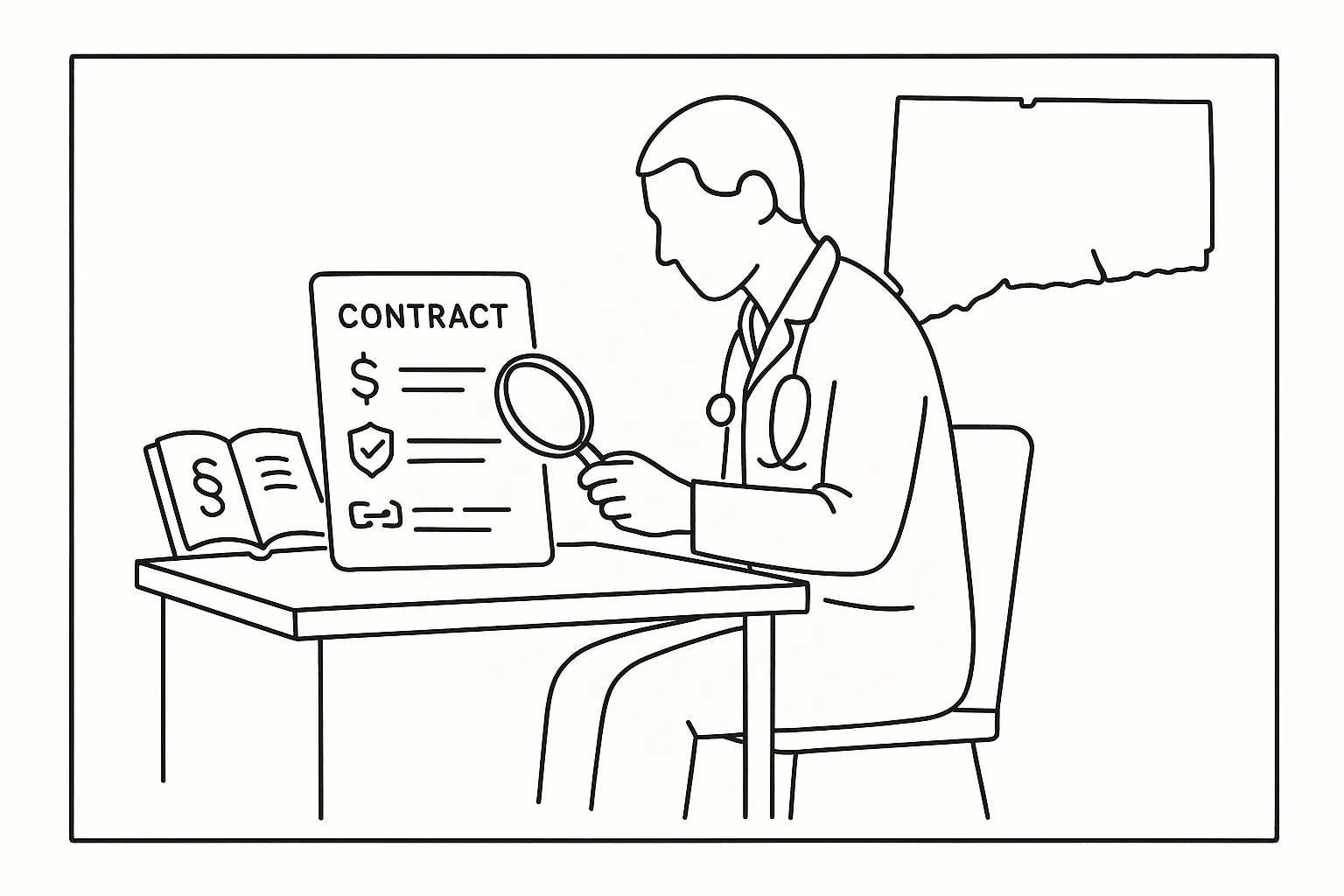
Connecting the Contract to Connecticut Practice Requirements
An employment agreement does not replace the written delegation agreement required by Connecticut law. Contract review can determine whether the employment terms are consistent with the anticipated supervisory relationship, delegated services, prescribing authority, and responsibility for maintaining required documentation. It can also identify language that gives the employer broad authority to change clinical duties without addressing whether those duties fall within the supervising physician’s license, competence, and actual practice.
Connecticut PA licenses renew annually and carry applicable continuing-education and competency requirements, including specified training involving controlled substances, pain management, behavioral health, and suicide prevention. An agreement may allocate responsibility for licensure, credentialing, continuing education, and related expenses, making those provisions relevant to both compliance and compensation.
Identifying Financial and Post-Employment Risk
Employment and independent contractor agreements are often drafted to preserve operational flexibility for the employer. That flexibility may affect compensation calculations, work locations, call coverage, termination timing, or obligations that continue after departure. An attorney-led physician assistant contract review can identify missing definitions, conflicting provisions, discretionary standards, and financial liabilities that may not be apparent from the offer letter alone.
- Income risks involving collections adjustments, negative accrual, chargebacks, and discretionary bonuses.
- Clinical risks involving delegation, prescribing, supervision, site assignments, and expanded duties.
- Separation risks involving notice, bonus repayment, tail coverage, non-competes, and final compensation.
Compensation, Productivity Bonuses, and Payment Terms

Base Salary, Collections, and Bonus Eligibility
A Connecticut PA agreement may provide a guaranteed salary, collections-based compensation, productivity pay, discretionary incentives, or a hybrid model. Review can clarify whether base compensation is genuinely guaranteed or subject to reconciliation, productivity shortfalls, offsets, or clawbacks. For collections-based pay, the analysis should account for billing delays, denials, payer mix, coding procedures, and collection activity that the employer controls.
Bonus language requires the same attention as base pay. The agreement may define quality metrics, eligibility dates, payment timing, active-employment requirements, and the employer’s authority to revise a bonus program. A focused compensation and productivity review can test whether the advertised formula is measurable and whether the PA will receive enough information to verify the calculation.
RVU Credit, Thresholds, and Negative Accrual
An RVU provision may depend on credited services, a productivity threshold, a conversion factor, and a defined measurement period. Review can identify how the agreement treats shared or supervised services, procedures, administrative work, reduced schedules, call coverage, payer denials, and employment ending before the close of a reporting period. Reporting access and a method for questioning errors are also important when compensation depends on employer-maintained data.
For illustration, 4,000 credited RVUs multiplied by a $35 conversion factor equals $140,000 before any threshold, base-pay adjustment, or reconciliation. The apparent value changes if only RVUs above a threshold qualify or if the employer applies negative accrual across measurement periods. Draw and reconciliation provisions may also create repayment exposure when productivity falls short, including at termination.
Malpractice Insurance, Tail Coverage, and Indemnification
Occurrence and Claims-Made Coverage
Malpractice provisions may identify the policy type, coverage limits, named insureds, exclusions, and responsibility for premiums. Occurrence coverage generally responds to covered acts that occur while the policy is active. Claims-made coverage may require continued coverage or tail insurance when a claim is reported after the underlying policy ends.
Review can determine whether the PA is expressly covered, whether outside or prior services are excluded, and whether coverage extends to every assigned location and clinical duty. The contract may also condition insurance on compliance with employer policies or make coverage subject to later changes that are not described in the agreement.
Tail Responsibility and Liability-Shifting Language
Tail coverage can become a substantial separation expense. The agreement may allocate responsibility differently depending on resignation, termination without cause, termination for cause, or completion of a stated service period. Analysis of malpractice insurance for physician assistants can clarify when tail is required, who selects the policy, and whether employer-paid coverage is subject to conditions.
Indemnification and hold-harmless clauses require separate review because they may impose liabilities beyond available insurance. Broad language can shift responsibility for billing disputes, regulatory issues, third-party claims, or employer losses without confirming that the insurer will provide coverage.
Delegation, Prescribing, Scheduling, and Work Locations
Written Delegation and Prescribing Authority
Connecticut requires delegated PA functions to be documented in a written delegation agreement describing the collaborative relationship, authorized services, controlled-substance documentation, and performance-review process. The delegation agreement must be reviewed at least annually. Employment contract language addressing clinical authority should therefore be evaluated alongside, rather than treated as a substitute for, this separate practice document.
Within delegated authority, a Connecticut PA may prescribe and administer drugs, renew Schedule II-V controlled-substance prescriptions, and prescribe or administer Schedule II-III controlled substances subject to documented physician approval. Delegated authority may also include prescribing or approving durable medical equipment. Contract review can flag provisions that describe prescribing or clinical duties more broadly than the documented delegation arrangement.
Call, Administrative Work, and Multi-Site Assignments
Scheduling provisions may address weekends, holidays, overtime, call frequency, response times, and additional compensation. If those details appear only in an employer policy, the agreement may permit significant changes after signing. Review can compare the stated compensation with the time commitment created by call, meetings, chart completion, coding, and other administrative duties.
Broad reassignment language can affect commute time, patient mix, supervising relationships, call responsibilities, and productivity opportunities. A well-defined provision may identify the regular worksite, the geographic range of additional locations, travel expectations, and whether additional duties receive pay or productivity credit. These details are particularly important when a position covers multiple hospitals, clinics, or remote-service locations.
Termination, Notice, and Repayment Obligations
For-Cause and Without-Cause Termination
Termination provisions determine how quickly the relationship can end and whether the PA has an opportunity to correct an alleged breach. Broad or subjective for-cause definitions may permit immediate termination, loss of compensation, accelerated repayment, or other continuing consequences. Review can identify whether specific events include notice and a cure period and whether the employer retains discretion to classify conduct as cause.
Without-cause termination usually depends on written notice, but the operational details matter. A physician assistant contract termination review can evaluate whether notice is mutual, whether compensation and benefits continue, and whether the employer may remove the PA from the schedule during the notice period. It can also clarify credentialing, patient-transition, records, and property-return obligations at departure.
Bonus Repayment and Final Compensation
Signing bonuses, relocation assistance, training expenses, and other advances may become repayable if employment ends before a specified date. Review can determine whether forgiveness is prorated and whether repayment depends on who ends the relationship and why. A provision that applies after every separation may create different risk than one limited to early voluntary resignation or defined misconduct.
Final-pay language may address unpaid salary, earned bonuses, productivity reconciliation, accrued benefits, expense reimbursement, and employer offset rights. Definitions of when compensation is “earned” can determine whether collections or productivity generated before departure remain payable after employment ends.
Connecticut PA Non-Competes and Related Restrictions
Profession-Specific Connecticut Non-Compete Limits
Connecticut has a profession-specific statute governing physician-assistant covenants entered into, amended, extended, or renewed on or after October 1, 2023. Subject to statutory qualifications, enforceability requires protection of a legitimate business interest, reasonable limits in time, geography, and restricted practice, and consistency with law and public policy. A PA non-compete generally may not exceed one year or 15 miles from the mutually defined primary practice site.
The statute also generally makes the covenant unenforceable when the employer terminates the relationship without cause, fails to renew after making a bona fide offer on similar terms, or imposes a material compensation change the PA does not accept before nonrenewal or termination. Because the effective date, contract history, termination circumstances, and exact wording matter, a Connecticut PA non-compete review can identify how the profession-specific rule may apply to the proposed restriction.
Geographic Scope, Non-Solicitation, and Other Covenants
Review should identify the mutually defined primary practice site and determine whether the contract instead measures the restriction from every employer facility or each location where the PA performs services. It should also clarify whether the clause restricts all PA employment or only activities that compete with the employer’s practice.
Patient and employee non-solicitation, confidentiality, patient-contact, liquidated-damages, and return-of-information provisions may create separate obligations. Outside the profession-specific statutory framework, Connecticut generally evaluates employment restrictions through a fact-specific reasonableness analysis that considers duration, geography, fairness, employer protection, and the effect on employment opportunities. Even when enforceability is uncertain, a broadly drafted covenant can create practical barriers to accepting another position.
Review Priorities by Career Stage and Practice Setting
New Graduate Physician Assistant Agreements
New graduates may benefit from additional clarity regarding start dates, licensure, credentialing, supervision, training, salary guarantees, and repayment obligations. An offer may be contingent on licensing or credentialing by a deadline without explaining what happens if processing takes longer than expected. A dedicated new graduate PA contract review can distinguish the headline offer from the provisions that control its practical value.
Hospitals, Private Practices, Telehealth, and Contractor Roles
Hospital and health-system agreements may incorporate credentialing standards, medical-staff rules, call duties, disciplinary procedures, and employer policies. Private and specialty practices may place more emphasis on collections, procedure credit, overhead, restrictive covenants, or potential equity language. In either setting, incorporated documents deserve review when they can alter duties, compensation, or termination rights.
Telehealth and multi-state positions require careful identification of work locations, scheduling control, licensure expectations, malpractice coverage, and responsibility for cross-jurisdiction compliance. Independent contractor agreements may shift expenses, insurance costs, tax responsibilities, indemnification exposure, and administrative obligations to the PA. The label used in the contract does not by itself explain the economic or operational consequences of the arrangement.
Chelle Law offers flat-fee physician assistant contract review focused on explaining compensation, regulatory, insurance, termination, and post-employment provisions. The review can identify hidden repayment or liability terms, compare related clauses, and suggest language or issues for the PA to raise with the employer before deciding whether to sign.
Speak With a Connecticut Physician Assistant Contract Lawyer Before You Sign
Chelle Law can review your proposed agreement, explain how its provisions work together, and identify compensation, malpractice, termination, repayment, or restrictive-covenant terms that may warrant clarification or revision.
Request a Contract Review