
Physician assistants practicing in Connecticut work under requirements administered by the Connecticut Department of Public Health, and employment terms should be read alongside the state’s rules governing PA scope of practice, licensure, supervision, collaboration, delegation, and prescribing. Those requirements can shape how an employer describes clinical authority, physician oversight, site coverage, and responsibility for compliance. In healthcare markets such as Hartford and New Haven, a hospital, group practice, or other employer may also use compensation formulas, multi-site assignment provisions, call obligations, and credentialing conditions that materially affect the value and feasibility of an offer. Chelle Law reviews Connecticut PA employment and independent contractor agreements to connect those state-specific practice concerns with the contract’s compensation, malpractice insurance, restrictive covenant, termination, and repayment provisions. The goal is to identify language that could shift financial or professional risk to the PA before the agreement is signed, not merely summarize what each clause says.
Why Contract Review Matters for Connecticut Physician Assistants
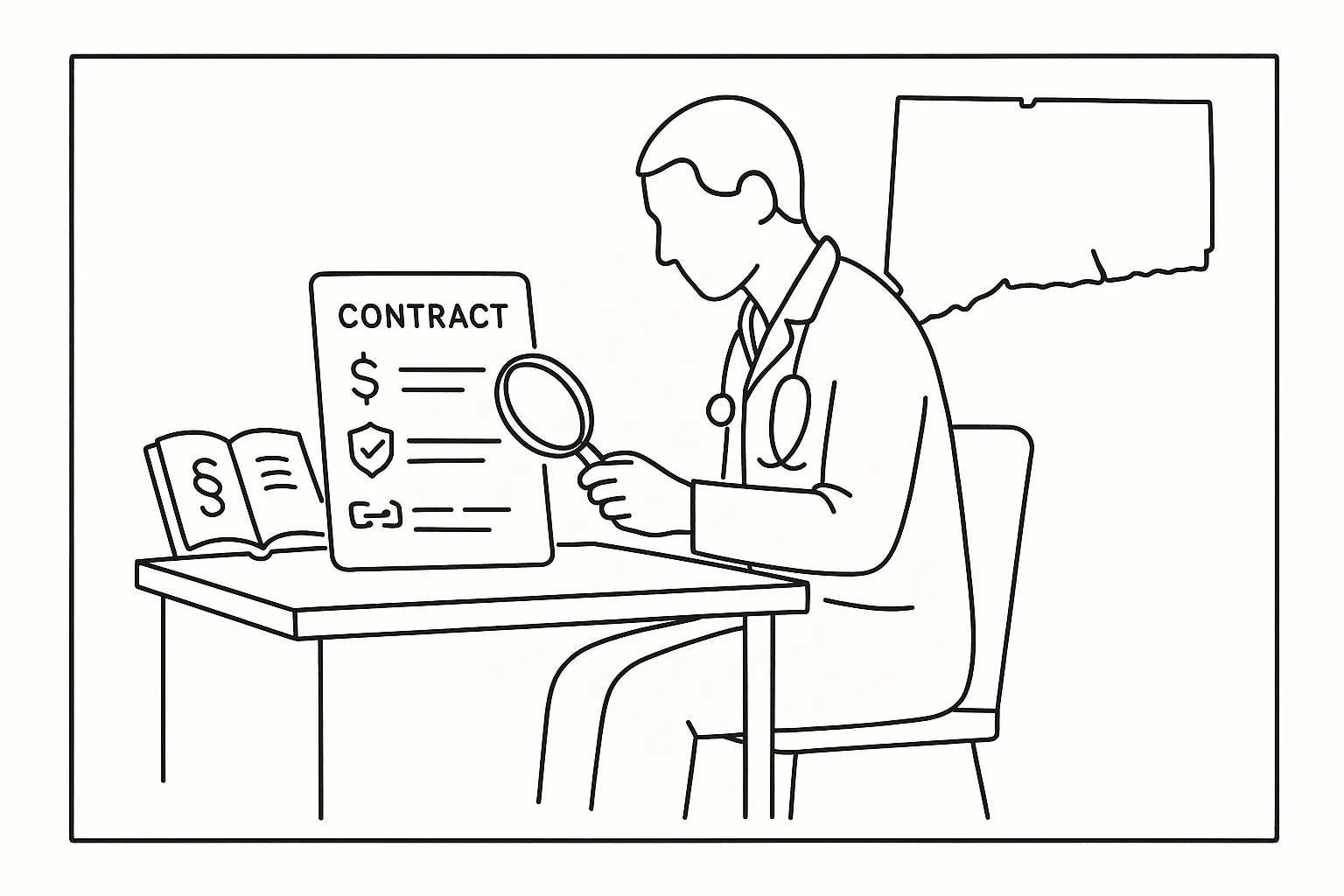
Employment and independent contractor agreements are frequently drafted to preserve employer flexibility. That language may shift financial risk, limit clinical autonomy, or impose post-employment obligations that affect a PA’s income and career mobility. An attorney-led physician assistant contract review can identify how the written terms are likely to operate in practice and whether important protections are missing.
- Identifies direct income risks, including collections adjustments, negative accrual, chargebacks, and discretionary bonuses.
- Examines supervision, delegation, scope, and site-assignment language for professional and compliance concerns.
- Clarifies termination rights, repayment triggers, restrictive covenants, and insurance obligations that may continue after employment.
Professional resources from the Connecticut Academy of Physician Associates may also help PAs understand state practice developments and professional standards. Those resources do not replace reviewing the specific financial, operational, and post-employment obligations contained in an individual agreement.
Compensation, Productivity Bonuses, and Financial Risk

Connecticut PA agreements may use a guaranteed salary, collections-based pay, RVU compensation, bonuses, or a hybrid formula. A thorough compensation and productivity review should determine how the formula works, when compensation is calculated, what information the PA can verify, and whether the employer may change the methodology.
- Base salary: The agreement should state whether the salary is guaranteed or subject to reconciliation, productivity shortfalls, or other clawbacks.
- Collections-based pay: Payment tied to cash received can expose the PA to payer mix, billing delays, denials, coding practices, and collection procedures controlled by the employer.
- RVU compensation: The contract should define credited RVUs, conversion factors, thresholds, reporting periods, audit rights, and the treatment of shared or supervised services.
- Bonuses and quality incentives: Metrics, payment dates, eligibility requirements, and employer discretion determine whether an advertised bonus has reliable value.
- Draws and negative accrual: Reconciliation language may create a repayment obligation when productivity falls, including when employment ends before the end of a measurement period.
For example, an RVU formula using a $35 conversion factor would produce $140,000 from 4,000 credited RVUs before any applicable threshold, base-pay adjustment, or reconciliation. The contract must explain which services receive credit and how administrative duties, reduced schedules, call coverage, payer denials, or termination affect the calculation.
Malpractice Insurance, Tail Coverage, and Indemnification
Malpractice provisions should identify the policy type, coverage limits, named insureds, exclusions, and responsibility for coverage after employment. Occurrence coverage generally protects covered acts that occur while the policy is active, while claims-made coverage may require continued coverage or tail insurance for claims reported after the policy ends.
- Determine whether the employer provides occurrence or claims-made coverage and whether the PA is expressly covered.
- Identify who must purchase tail coverage and whether responsibility changes based on resignation, termination without cause, or termination for cause.
- Review indemnification and hold-harmless language that may require the PA to assume liabilities beyond available insurance.
Tail premiums can create a substantial separation expense, so the obligation should be understood before signing. A focused review of PA malpractice insurance terms can also reveal coverage gaps, conditions for employer-paid tail, and indemnification language that shifts unexpected liability to the clinician.
Scope of Practice, Supervision, Scheduling, and Worksites
Contract language addressing scope, supervision, collaboration, delegation, and prescribing should be consistent with the Connecticut practice framework and the PA’s actual duties. Vague or overly broad provisions may allow an employer to expand responsibilities, impose additional oversight protocols, or assign tasks without clearly allocating responsibility for compliance.
- Supervision and delegation: The agreement should clearly describe expected oversight and avoid open-ended duties that could create professional risk.
- Scheduling and call: Weekend work, overtime, call frequency, response requirements, and additional pay should be defined rather than left entirely to employer policy.
- Billing and administrative work: Documentation, coding, chart review, meetings, and other non-billable duties may reduce productivity without reducing contractual targets.
- Multi-site assignments: Broad reassignment authority can change commute time, patient mix, call responsibilities, and productivity opportunities.
These operational terms often have measurable financial consequences. The contract should explain whether the employer can add locations or duties unilaterally, how travel is handled, and whether administrative or coverage obligations receive compensation or productivity credit.
Termination, Notice Periods, and Repayment Obligations
Termination provisions determine how quickly the employment relationship can end and what financial obligations survive. A PA contract termination review should compare for-cause and without-cause rights, notice periods, cure opportunities, final compensation, benefits, and the employer’s ability to place the PA off schedule during notice.
- For-cause termination: Broad or subjective definitions may permit abrupt termination, loss of income, or immediate repayment obligations.
- Without-cause termination: Notice requirements should be practical and should explain whether compensation and benefits continue throughout the notice period.
- Bonus and relocation repayment: Signing bonuses, relocation assistance, and other advances may be repayable if employment ends before a stated date.
- Final compensation: The agreement should address unpaid salary, accrued benefits, productivity reconciliation, earned bonuses, and any employer offset rights.
Repayment provisions deserve particular attention because the amount owed may depend on who ends the relationship and why. A fair provision may use prorated forgiveness and distinguish voluntary resignation from an employer’s without-cause termination rather than requiring repayment in every separation scenario.
Non-Compete and Non-Solicitation Restrictions
Restrictive covenants can affect where a Connecticut PA works after leaving an employer. A detailed non-compete review considers the restricted activities, geographic area, duration, covered facilities, triggering events, and interaction with patient or employee non-solicitation provisions.
- Determine whether the restriction applies after every type of separation or only after specified events.
- Identify whether the geographic area is measured from one office, every employer facility, or each location where the PA provides services.
- Review whether the clause bars all PA work or only services that compete with the employer’s actual practice.
- Examine related non-solicitation, confidentiality, patient-contact, and liquidated-damages provisions.
Enforceability depends on the governing law, wording, and surrounding facts. Even before a court addresses enforceability, a broadly drafted restriction can create practical barriers to accepting another position in Connecticut or a nearby market, making the clause an important pre-signing issue.
Review Priorities by Career Stage and Practice Setting
The most important provisions vary with the PA’s experience, specialty, and proposed work environment. New graduates may need greater clarity regarding supervision, credentialing, salary guarantees, and bonus repayment, while experienced PAs may place more emphasis on production credit, leadership duties, higher-risk procedures, or post-termination revenue. A dedicated new graduate contract review can help distinguish an attractive headline offer from the obligations that determine its actual value.
- Hospital and health-system employment: Review credentialing conditions, disciplinary procedures, call duties, policy incorporation, EMR access, and RVU attribution.
- Private or specialty practice: Examine collections, overhead allocation, procedure credit, malpractice coverage, restrictive covenants, and any partnership or equity language.
- Telehealth or multi-state work: Confirm work locations, scheduling control, licensure expectations, malpractice coverage, and responsibility for compliance across jurisdictions.
- Independent contractor arrangements: Review payment timing, expenses, insurance, tax classification language, scheduling control, termination, and indemnification.
An attorney review can provide a line-by-line explanation of the agreement, identify hidden repayment or liability provisions, and suggest clearer language for discussion with the employer. Chelle Law offers flat-fee contract review focused on translating compensation, regulatory, insurance, and post-employment terms into practical risks before a PA signs.
Review Your Connecticut PA Contract Before You Sign
Chelle Law can explain how compensation, malpractice coverage, supervision language, termination rights, repayment terms, and restrictive covenants may affect your Connecticut physician assistant position.
Contact Chelle Law