
A Florida physician assistant contract must be evaluated alongside the practice requirements administered by the Florida Department of Health, Board of Medicine and the Florida Department of Health, Board of Osteopathic Medicine, with the Council on Physician Assistants advising both boards. Florida PAs perform delegated medical services under physician supervision rather than through general independent practice authority. State law also addresses physician availability, supervising-physician responsibility, and a limit of 10 currently licensed PAs per supervising physician. These requirements can affect contract terms concerning delegated duties, written protocols, prescribing authority, practice locations, and coverage when a supervising physician is unavailable. In healthcare markets such as Miami, Orlando, and Tampa, review can determine whether an agreement accurately reflects the PA’s specialty, work setting, assigned facilities, and operational support without promising authority beyond Florida law or the supervising physician’s delegation.
Regulatory language is only one part of the analysis. Employment and independent contractor agreements may also contain unclear productivity formulas, claims-made malpractice obligations, broad post-employment restrictions, lengthy notice periods, or repayment terms tied to bonuses and relocation assistance. Attorney-led review can identify how these provisions interact and explain the financial and professional consequences before the PA signs.
Why Florida Physician Assistant Contract Review Matters
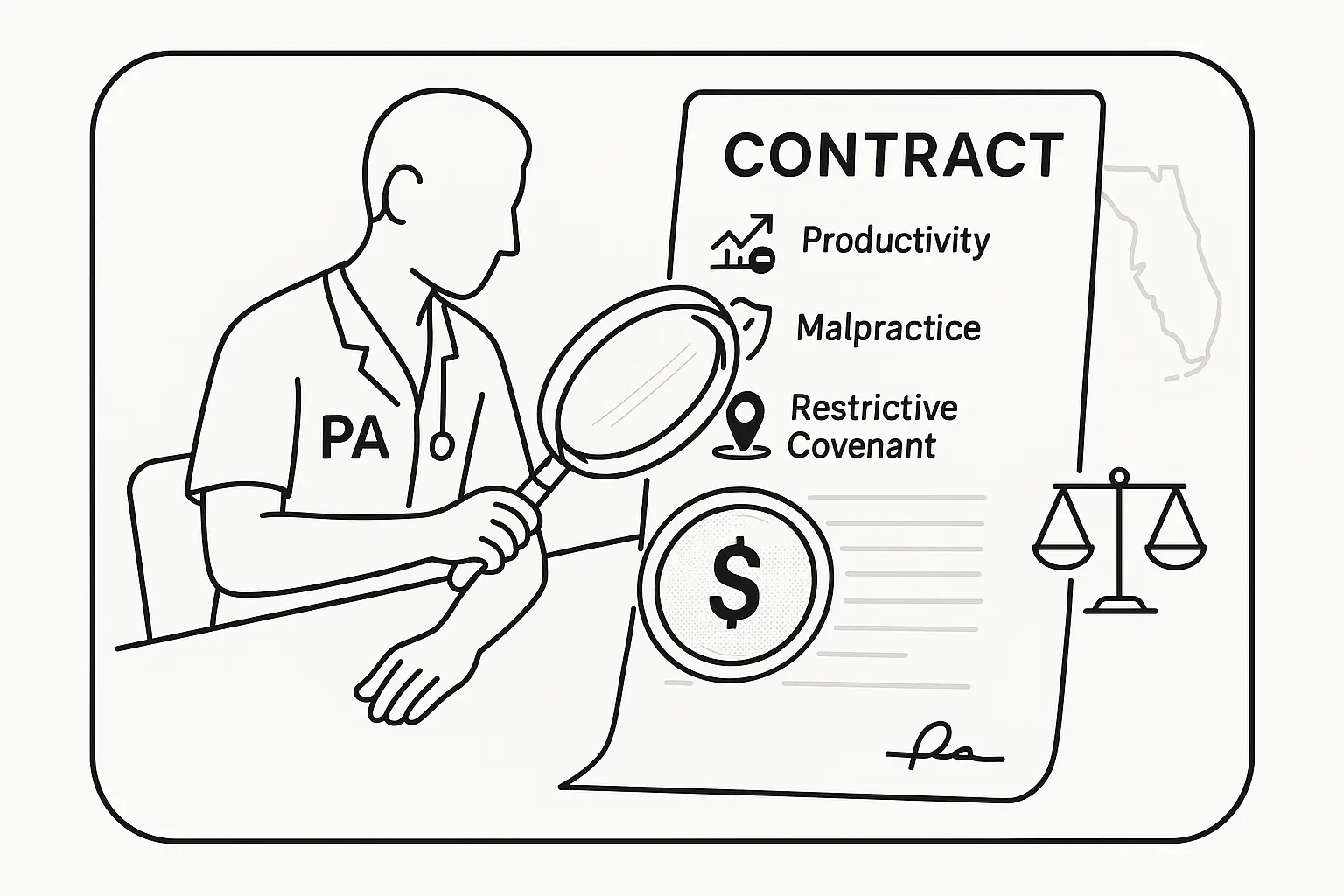
Connecting Contract Language to Daily Practice
A PA agreement governs more than salary and benefits. It can determine who assigns clinical duties, how supervision is structured, where the PA may be scheduled, who pays professional liability expenses, and what happens when employment ends. A line-by-line physician assistant contract review can translate those provisions into practical financial, regulatory, and career consequences.
Review may uncover productivity chargebacks, negative accrual, tail insurance exposure, restrictions tied to multiple facilities, or repayment obligations triggered by an early departure. It can also identify conflicts between the agreement, job description, compensation exhibit, clinical protocols, and other documents incorporated by reference.
Reviewing the Complete Offer Package
The offer letter rarely contains every controlling term. Meaningful analysis generally includes the proposed employment or contractor agreement, job description, bonus plan, compensation exhibits, benefit summaries, confidentiality provisions, restrictive covenants, and documents governing supervision or assigned locations. Verbal promises about schedule, support, compensation, or future partnership opportunities may be difficult to enforce if they never appear in the final documents.
Review is most useful before signing, while there is still time to ask focused questions and request that material clarifications appear in writing. A PA can then compare the offer’s stated value with the obligations and potential costs created by the complete contract.
Florida Supervision, Delegation, and Prescribing Terms
Supervising Physicians and Delegated Services
Florida law authorizes a physician assistant to perform medical services delegated by a supervising physician. Supervision involves responsible supervision and control, including physician availability or physical presence for consultation and direction except in emergencies. Florida also places responsibility and liability on supervising physicians for a PA’s performance and acts or omissions and limits a physician to supervising no more than 10 currently licensed PAs.
Contract analysis can determine whether the agreement identifies the supervising physician, practice setting, delegated services, and applicable written protocols. Vague references to “medical direction” may not explain how consultation will occur, who handles required documentation, or what happens when the designated physician is unavailable. The agreement also merits review if it permits unilateral expansion of duties or assignment to additional facilities without addressing supervision, travel, scheduling, compensation, or liability coverage.
Prescribing and Dispensing Authority
A fully licensed Florida PA may prescribe or dispense medications only when the supervising physician delegates that authority and applicable statutory conditions are satisfied. Those conditions include Department notification, patient identification of the clinician as a PA, continuing-education requirements, and compliance with formulary and controlled-substance restrictions. Dispensing also depends on the supervising physician being registered as a dispensing practitioner.
Contract terms therefore cannot create prescribing or dispensing authority that exceeds the supervising physician’s delegation or current Florida requirements. Review can flag provisions that promise unsupported privileges, impose responsibility for services outside the authorized role, or fail to allocate administrative tasks associated with prescribing compliance.
Licensure and Regulatory Compliance
Florida licensure is required to perform delegated medical services as a PA, and violations of applicable statutes or board rules may create disciplinary exposure. Contractual duties can be evaluated for consistency with active-licensure requirements, supervisory obligations, and the limits of delegated practice. Language characterizing the PA as independently practicing medicine warrants particular attention because Florida law does not establish general independent PA practice authority.
Compliance provisions also deserve scrutiny when they give an employer broad discretion to define misconduct or terminate employment immediately. Analysis can distinguish objective events, such as loss of a required license, from vague standards that may allow termination without notice or an opportunity to cure a correctable issue.
Compensation, Malpractice Coverage, and Employment Status

Salary, Bonuses, and Productivity Formulas
PA compensation may include a guaranteed salary, salary plus a productivity bonus, collections-based compensation, or an RVU formula. Each model allocates financial risk differently. RVU provisions require attention to thresholds, conversion factors, excluded services, reconciliation periods, attribution rules, and the employer’s authority to change its methodology. Collections-based compensation can also depend on billing practices, payer delays, denials, refunds, and how the contract defines net collections.
A focused PA compensation and productivity review can determine whether the formula is transparent and independently calculable. Negative accrual and draw provisions are especially important because they may carry a deficit into a later period or characterize previously paid compensation as an amount owed to the employer.
Malpractice Insurance and Tail Costs
The agreement may identify the professional liability policy type, coverage limits, responsible carrier, premium obligations, and any exclusions. Occurrence coverage generally addresses covered acts occurring while the policy is active, even if a claim is reported later. Claims-made coverage ordinarily requires continuous coverage or an extended-reporting endorsement for qualifying claims reported after the policy ends.
No material Florida PA-specific rule identified in the verified research packet automatically allocates tail costs between an employer and a PA. The contract therefore needs careful analysis of who purchases tail coverage, when it is required, and whether responsibility changes based on resignation, termination without cause, or termination for cause. The guide to tail insurance for physician assistants explains additional issues involving extended-reporting coverage and separation from employment.
W-2 and 1099 Arrangements
Benefits, paid leave, health coverage, retirement contributions, continuing medical education allowances, and reimbursement of licensing expenses affect the total value of a W-2 offer. A 1099 agreement may shift taxes, insurance, benefits, and operating expenses to the PA. The parties’ label alone does not necessarily control classification; the actual relationship and applicable legal tests also matter.
Analysis may consider the employer’s control over schedules, practice sites, duties, equipment, clinical operations, and other aspects of the relationship. PAs comparing offers can review the practical contract distinctions between W-2 and 1099 status, including expenses that can reduce the apparent value of contractor compensation.
Non-Competes, Termination, and Repayment Risk
Florida Restrictive Covenants
Florida restrictive covenants generally must be contained in a signed writing, supported by a legitimate business interest, and reasonable in duration, geographic reach, and line of business. Recognized interests may include confidential information, substantial patient relationships, patient goodwill, trade secrets, and specialized training. Whether a particular provision is enforceable depends on its language and the relevant facts.
Florida also has a statute addressing certain physician restrictive covenants when one entity employs or contracts with all physicians practicing a specialty in a county. That provision expressly addresses physicians licensed under specified chapters, not physician assistants, so its direct application to a PA covenant cannot be assumed. A physician assistant non-compete review can evaluate the restricted activities, duration, geographic area, covered locations, triggering events, and effect on the PA’s expected career plans.
Termination Rights and Notice Periods
Termination language may distinguish expiration, without-cause termination, and termination for cause. Review can identify the required notice period, acceptable delivery methods, cure rights, immediate-termination events, and whether the employer may place the PA on unpaid leave during the notice period. An agreement may also address final compensation, bonus eligibility, unused leave, uncollected services, records, credentialing, and post-termination cooperation.
These terms need to be read together because a termination event may activate a non-compete, malpractice-tail obligation, or repayment clause. A dedicated physician assistant contract termination review can clarify deadlines and the consequences attached to different methods of separation.
Signing Bonuses and Repayment Clauses
Signing bonuses, relocation assistance, educational support, retention payments, and guaranteed compensation may be subject to repayment if the PA leaves before a specified date. Important details include whether repayment is prorated, which events trigger it, when payment becomes due, and whether the obligation remains after an employer-initiated termination without cause.
Repayment provisions can also appear in productivity draws, training-cost clauses, and benefit advances. Contract review can identify terms that may convert compensation into an alleged debt and determine whether multiple repayment obligations could apply to the same departure.
Operational and Boilerplate Contract Risks
Practice Sites, Call, and Credentialing
Location and scheduling clauses may permit assignments throughout a hospital system, practice network, or broad geographic area. Review can determine whether the employer may add facilities, change shifts, impose call coverage, or require travel without additional compensation. These provisions also affect supervision, commuting costs, professional liability coverage, and the practical reach of a location-based restrictive covenant.
Credentialing delays can affect the start date, compensation, bonus eligibility, and termination rights. The agreement may need to distinguish delays outside the PA’s control from failure to provide required information. It can also address what happens if a supervising relationship changes or the PA cannot immediately perform all anticipated services at the proposed location.
Indemnification, Assignment, and Unilateral Changes
Boilerplate provisions can create substantial risk even when they appear near the end of the agreement. Indemnification language may attempt to shift legal expenses or third-party liabilities to the PA. Assignment and change-of-control provisions may allow a successor organization to acquire the agreement together with its compensation terms and restrictive covenants.
Unilateral amendment clauses also merit review when policies incorporated into the contract affect compensation, schedules, duties, or benefits. Definitions of “cause,” “confidential information,” “employer property,” and “material breach” can expand the employer’s rights if drafted too broadly. Analysis can identify which terms are fixed contract obligations and which may be changed through an employer policy.
What an Attorney-Led Florida PA Contract Review Covers
Chelle Law provides attorney-led review of physician assistant employment and independent contractor agreements. Review can evaluate compensation formulas, productivity reconciliation, repayment exposure, professional liability coverage, termination rights, restrictive covenants, supervision language, assigned locations, call requirements, benefits, and ambiguous definitions. It can also identify provisions that may warrant clarification or revision without suggesting that contract review replaces advice from counsel licensed in Florida on a state-law dispute.
Before signing, a Florida PA may benefit from confirming:
- How base pay, productivity credit, bonuses, deductions, and reconciliations are calculated.
- Whether malpractice coverage is occurrence or claims-made and who pays for any required tail coverage.
- Whether supervision, delegation, prescribing, and physician-availability terms reflect the actual Florida practice arrangement.
- Which practice sites, schedules, call duties, and additional assignments may be required.
- What events trigger termination, repayment, a restrictive covenant, or other post-employment obligations.
- Whether signing bonuses, relocation payments, draws, or advances are subject to prorated repayment.
- How final pay, collected revenue, bonuses, unused leave, records, and credentialing matters are handled after separation.
- Whether promises concerning compensation, schedule, location, support, and duties appear in the final written documents.
The PA can retain the fully executed agreement, offer communications, compensation spreadsheets, productivity reports, protocols, and written amendments. If a concern arises after signing, prompt review can help identify contractual notice requirements, deadlines, and provisions relevant to the available options.
Speak With a Florida Physician Assistant Contract Lawyer Before You Sign
Chelle Law can review your proposed agreement, explain compensation and practice terms, identify financial and professional risks, and flag provisions that may warrant clarification or revision.
Request a Contract Review