
A Florida physician assistant agreement must be evaluated alongside the practice requirements overseen by the Florida Board of Medicine. Contract provisions addressing supervision, delegation, prescribing authority, physician availability, and assigned duties should reflect how the PA will actually practice and remain consistent with Florida requirements. These concerns can differ across hospital systems, specialty groups, and private practices in major healthcare markets such as Miami, Orlando, and Tampa. A contract review therefore involves more than comparing salary and benefits. It should determine whether the agreement clearly allocates supervisory responsibilities, defines permitted services, addresses professional liability coverage, and protects the PA when regulatory or operational requirements change. Chelle Law reviews these state-specific practice concerns together with compensation formulas, restrictive covenants, termination rights, repayment obligations, and other provisions that can affect a Florida PA’s income, compliance responsibilities, and career mobility.
Employment and independent contractor agreements often contain employer-favorable language that is difficult to evaluate from the offer summary alone. A detailed review can identify compensation traps, unexpected tail insurance costs, broad post-employment restrictions, and repayment obligations before the PA accepts those risks.
Why Contract Review Matters for Florida Physician Assistants
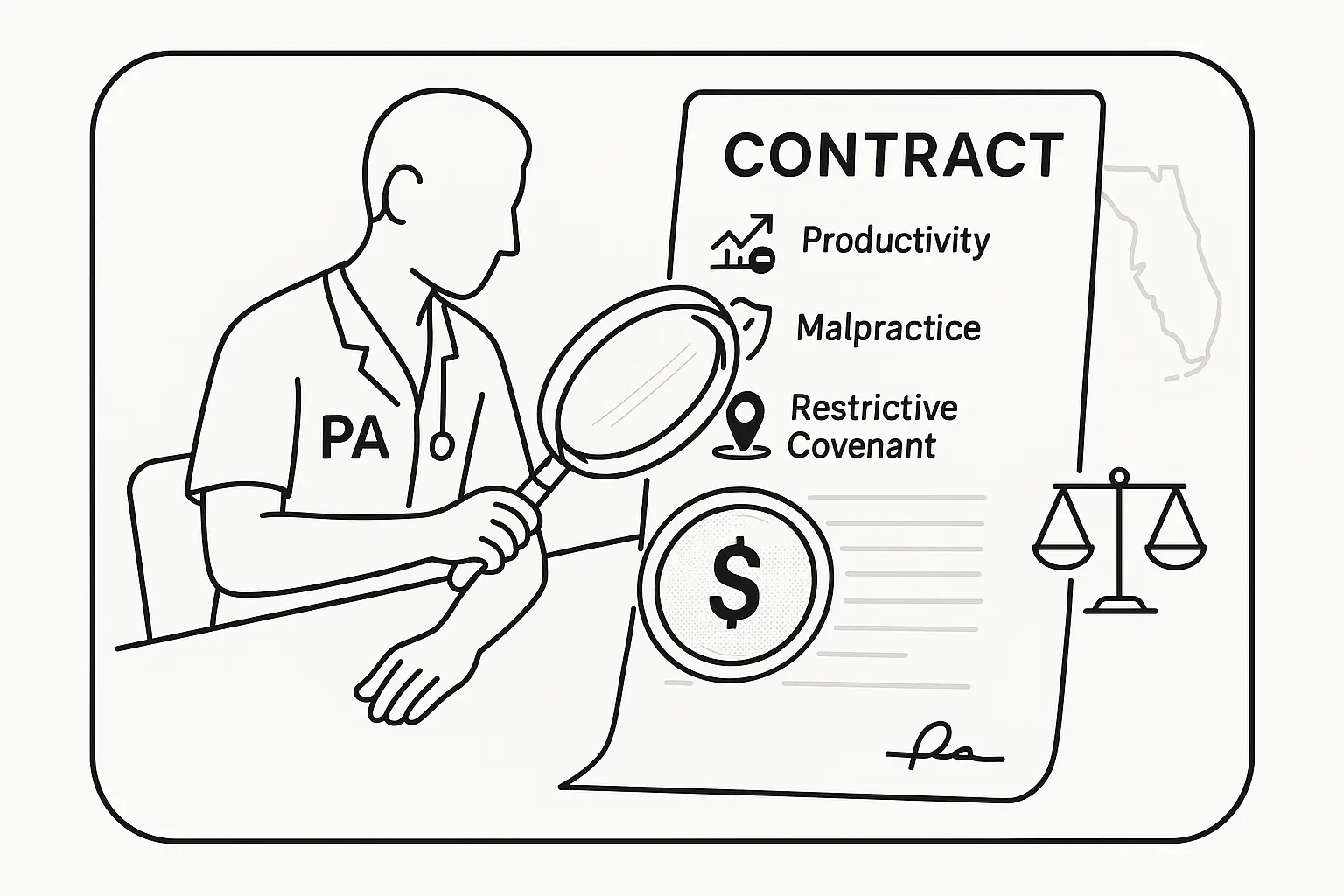
A PA agreement governs more than pay. It can determine how work is assigned, how supervision is documented, who bears liability expenses, what happens when employment ends, and whether the PA may continue practicing in the same community. A line-by-line physician assistant contract review translates those provisions into practical financial, regulatory, and professional consequences.
Common concerns include productivity formulas with chargebacks or negative accruals, claims-made malpractice coverage that shifts tail costs to the PA, restrictive covenants tied to multiple practice locations, and signing-bonus repayment terms triggered by an early departure. Reviewing these terms before signing allows the PA to understand the potential exposure, request clarification where language is ambiguous, and preserve a written record of the final agreement.
Florida PAs may also consult updates and practice resources from the Florida Academy of Physician Assistants regarding supervision, prescribing authority, and legislative developments that may affect professional practice.
Compensation, Malpractice Coverage, and Employment Status

Salary, Bonuses, and Productivity Formulas
Florida PA compensation may consist of a guaranteed salary, salary plus a productivity bonus, collections-based pay, or an RVU formula. Each model allocates financial risk differently. An RVU provision may appear straightforward, but thresholds, conversion factors, excluded services, reconciliation periods, and changes to the employer’s methodology can materially affect actual earnings. Collections-based compensation also depends on billing practices, payer delays, denials, refunds, and the definition of net collections.
A focused PA compensation and productivity review should determine whether the formula is transparent and independently calculable. Negative accrual or draw provisions deserve particular attention because they may permit an employer to carry a deficit forward or seek repayment when productivity falls below a stated target.
Malpractice Insurance and Tail Responsibility
The agreement should identify the policy type, coverage limits, responsible carrier, and party responsible for premiums. Occurrence coverage generally protects covered acts that took place while the policy was active, even if a claim is later reported. Claims-made coverage ordinarily requires continuing coverage or tail protection for claims reported after the policy ends.
Responsibility for tail coverage may depend on whether the PA resigns, is terminated without cause, or is terminated for cause. Because that expense can affect the financial consequences of leaving a position, the allocation should be reviewed together with the termination language. Our guide to tail insurance for physician assistants explains the related contract considerations in more detail.
W-2 and 1099 Contract Terms
Benefits, paid leave, health insurance, retirement contributions, continuing medical education allowances, and reimbursement of licensing or prescribing-related expenses affect total compensation. A 1099 agreement may shift taxes, insurance, benefits, and operating expenses to the PA. The written classification should also be considered alongside the employer’s actual control over schedules, locations, duties, equipment, and clinical operations. PAs comparing these arrangements can review the practical distinctions between W-2 and 1099 status.
Florida Supervision, Delegation, and Scope Terms
Contract language concerning supervision and delegation should reflect the PA’s actual duties, specialty, practice sites, and access to the supervising physician. Vague references to “medical direction” may not explain who is responsible for required documentation, how coverage works when the designated physician is unavailable, or whether the PA may be assigned to additional facilities. The agreement should also avoid obligating the PA to perform services outside the authorized role or without the operational support needed to comply with Florida requirements.
Job descriptions, supervision documents, prescribing provisions, call responsibilities, and clinical protocols should be reviewed with the main agreement rather than treated as unrelated paperwork. If the employer may modify duties or add practice locations unilaterally, the contract should be examined for limits on that authority and for its effect on compensation, travel, scheduling, and professional liability coverage.
Non-Competes, Termination, and Repayment Obligations
Restrictive covenants may limit where and how a PA can practice after the relationship ends. Important details include the restricted activities, duration, geographic area, covered employer locations, triggering events, and treatment of termination without cause. A covenant tied to every facility in a large network may create substantially greater mobility risk than one tied to the PA’s actual work location. A physician assistant non-compete review can identify how the restriction interacts with the PA’s specialty, local market, and anticipated career plans.
Termination provisions should clearly distinguish without-cause termination from termination for cause, identify applicable notice periods, and state whether the PA has an opportunity to cure an alleged breach. They should also explain final compensation, treatment of uncollected services, bonus eligibility, unused leave, patient-record obligations, and malpractice responsibilities after departure. These provisions need to be read together because a termination event may also activate a non-compete, tail obligation, or repayment clause.
Signing bonuses, relocation assistance, educational support, and guaranteed compensation may be subject to repayment if the PA leaves before a specified date. The agreement should state whether repayment is prorated, what events trigger it, and whether repayment is still required after an employer-initiated termination. Similar scrutiny applies to negative accrual reconciliations and other provisions that could convert compensation into an alleged debt.
Florida Regulatory and Boilerplate Contract Risks
Florida contract terms should not assign responsibilities that conflict with the PA’s actual authority or the employer’s regulatory duties. Provisions involving professional conduct, credentialing, supervision records, or required reporting should be reviewed for clarity because ambiguous language can create licensure and employment risk. The contract should also explain what happens if credentialing is delayed, a supervising relationship changes, or the PA cannot begin performing all anticipated services on the proposed start date.
Boilerplate provisions can be equally significant. Assignment and change-of-control clauses may permit the agreement and its restrictive covenants to transfer to a successor. Indemnification language may shift legal expenses or third-party liabilities to the PA, while unilateral amendment clauses may allow the employer to change policies that affect compensation or duties. Definitions of “cause,” “confidential information,” and “employer property” should be sufficiently specific to avoid expanding the employer’s rights through vague language.
What an Attorney-Led Contract Review Covers
Review is most useful before the agreement is signed and while the PA still has time to request clarification. The complete offer package should be provided, including the employment or contractor agreement, offer letter, job description, compensation exhibits, bonus plans, confidentiality or non-solicitation agreements, and any supervision or practice-location documents incorporated by reference.
Chelle Law evaluates whether compensation formulas are understandable, whether repayment or negative accrual provisions create potential indebtedness, who bears malpractice and tail costs, and how termination affects restrictive covenants and final pay. The review also addresses supervision language, assigned locations, schedules, call requirements, benefits, and ambiguous definitions. Written comments or proposed revisions can preserve a record of the issues identified and the language requested.
Chelle Law provides flat-fee, attorney-led contract review services. The value of review should be considered against the potential cost of a compensation shortfall, repayment demand, tail insurance obligation, or restriction that prevents the PA from accepting another position in a preferred Florida market.
Pre-Signing Checklist for Florida PAs
Before signing, a Florida physician assistant should confirm the following terms and ensure that any negotiated changes appear in the final written agreement:
- How base compensation, productivity credit, bonuses, deductions, and reconciliations are calculated.
- Whether the malpractice policy is occurrence or claims-made and who pays for any required tail coverage.
- Whether supervision, delegation, prescribing, and physician-availability terms reflect the actual Florida practice arrangement.
- Which practice sites, schedules, call duties, and additional assignments the employer may require.
- What events trigger termination, repayment, a non-compete, or other post-employment obligations.
- Whether signing bonuses, relocation payments, draws, or other advances are subject to prorated repayment.
- How final compensation, collected revenue, bonuses, unused leave, records, and credentialing matters are handled after separation.
- Whether all promises concerning compensation, schedule, location, support, and duties appear in the executed documents.
The PA should retain the fully executed agreement, offer communications, compensation spreadsheets, productivity reports, and written amendments. If a concern is discovered after signing, prompt legal review can help identify the applicable contractual deadlines, notice requirements, and available options.
Have a Florida PA Contract Reviewed Before You Sign
Chelle Law can identify compensation, supervision, malpractice, restrictive covenant, termination, and repayment provisions that may affect your Florida practice and future options.
Contact Chelle Law