
Physician assistants evaluating an employment or independent contractor agreement in Georgia must consider the contract alongside requirements administered by the Georgia Composite Medical Board. Georgia rules generally require a PA to hold the appropriate license or temporary permit, have Board-approved physician supervision, and practice under a Board-approved job description. Those requirements can affect delegated duties, prescribing authority, worksite changes, call coverage, and the consequences of a disrupted supervisory relationship. Contract terms may operate differently across hospitals, specialty groups, and private practices in Atlanta and Savannah, especially when a position covers multiple facilities or allows duties to change over time. Chelle Law provides physician assistant contract review focused on how Georgia practice requirements interact with compensation, malpractice coverage, restrictive covenants, termination rights, and repayment obligations. Review can identify language that creates regulatory uncertainty, unexpected financial exposure, or limits on future employment.
A PA agreement often distributes important terms among an offer letter, compensation plan, job description, insurance materials, and policy documents. Evaluating the complete package helps clarify expected income, professional responsibilities, scheduling demands, and the financial consequences of leaving the position. It also allows related provisions—such as termination, tail coverage, bonus repayment, and a non-compete—to be considered together rather than in isolation.
Documents and Issues Included in a Georgia PA Contract Review

The Complete Offer and Incorporated Documents
Review is most effective when it covers every document the employer may enforce or incorporate by reference. Compensation mechanics, clinical duties, insurance obligations, and restrictive covenants are not always contained in the primary signature document. Relevant materials commonly include:
- The proposed employment or independent contractor agreement, including exhibits and attachments.
- The offer letter, compensation addendum, productivity formula, and bonus plan.
- The job description and documents addressing supervision, delegation, credentialing, or privileges.
- The malpractice insurance summary, certificate of coverage, or applicable insurance provisions.
- Documents concerning signing bonuses, relocation assistance, loan support, promissory notes, or repayment schedules.
- Policies expressly incorporated into the agreement, including leave, outside activities, and compliance policies.
Collecting the complete offer package makes it possible to compare definitions, payment terms, duties, and post-termination obligations across documents. Review can also flag conflicts between an offer letter and the final agreement or identify a referenced policy that has not been provided.
Financial, Regulatory, and Career-Mobility Risk
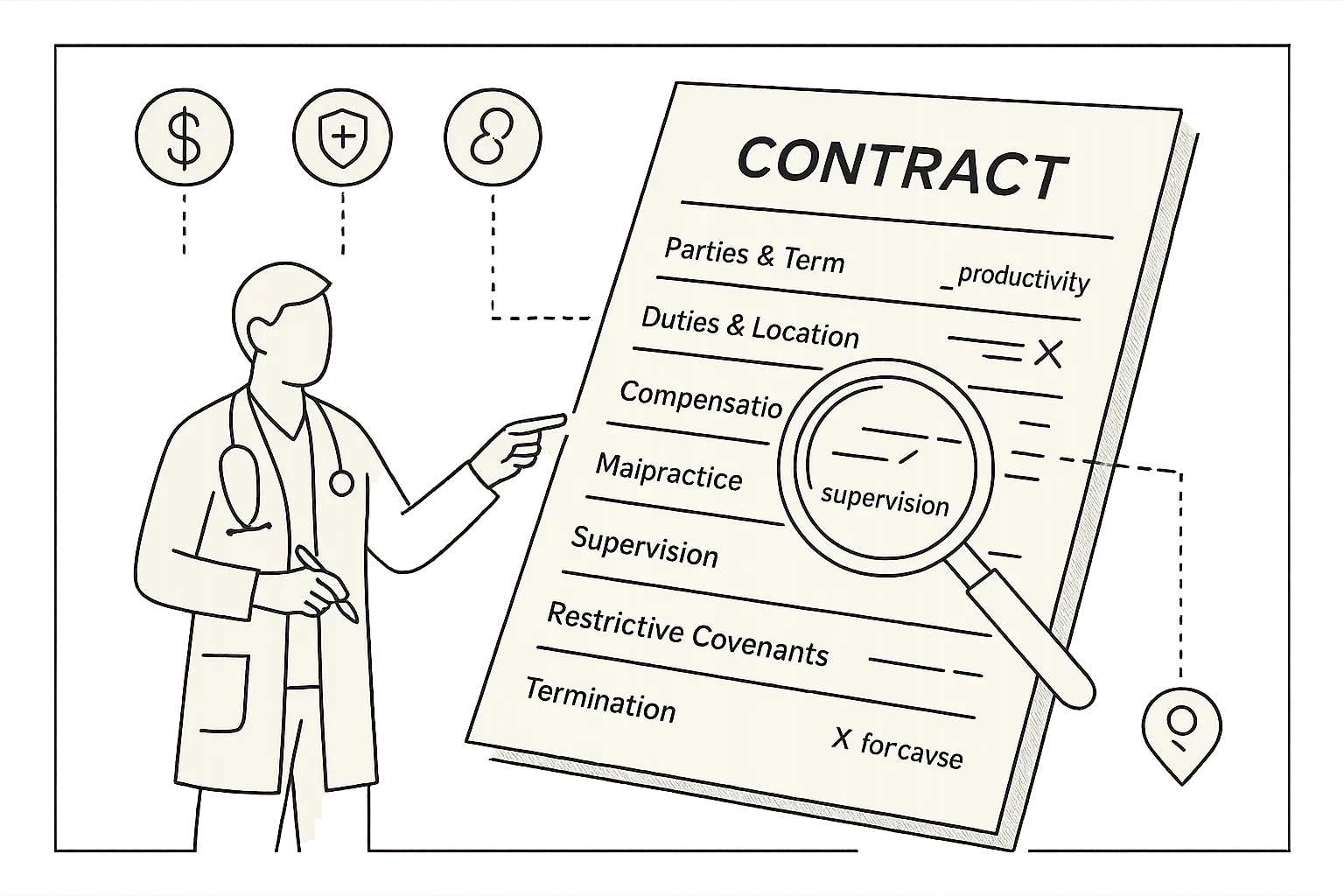
A contract review examines how provisions work together rather than treating each clause as a separate issue. Financial analysis may address guaranteed compensation, productivity calculations, deductions, reconciliation, benefits, and repayment exposure. Regulatory analysis considers whether the stated duties, supervision structure, prescribing provisions, and assigned locations are consistent with the contemplated Georgia practice arrangement.
Career-mobility analysis focuses on termination notice, restrictive covenants, repayment clauses, malpractice obligations, and control over worksites. Definitions such as “cause,” “collections,” “productivity,” “practice location,” and “confidential information” can materially change the effect of these provisions. The practical objective is to translate contract language into expected consequences for income, workload, professional responsibilities, and a future job change.
Georgia Supervision, Job Description, and Prescribing Requirements
Board-Approved Supervision and Clinical Duties
Georgia physician assistant practice generally requires Board-approved physician supervision and a Board-approved job description. The supervising physician must obtain approval before delegating healthcare tasks, and the PA’s duties generally must remain within both the approved job description and the supervising physician’s scope of practice. Contract review can compare these requirements with broad clauses allowing an employer to change duties, specialties, schedules, or practice locations.
The clinical-duty section may address procedures, documentation, patient populations, chart review, quality expectations, and administrative work. Language assigning “other duties” can create uncertainty when it is not tied to the approved role or applicable professional limits. Georgia also generally limits a primary supervising physician to the combined equivalent of eight physician assistants or advanced practice registered nurses at one time, subject to recognized exceptions. That limit may matter when the proposed supervision structure depends on a physician already overseeing multiple clinicians.
Call, weekend coverage, and multi-site assignments can substantially affect workload even when base compensation remains unchanged. Review can determine whether the agreement defines the coverage schedule, response expectations, travel obligations, assigned facilities, and any additional pay or compensatory time. Chelle Law’s guide to physician assistant call and coverage requirements explains additional contract issues associated with these obligations.
Prescriptive Authority and Changes to the Supervisory Relationship
A Georgia PA may issue prescription drug orders when authorized through the approved job description and supervising physician arrangement. Applicable rules address permitted drugs, controlled substances, prescription content, recordkeeping, physician review, DEA registration, and Georgia Prescription Drug Monitoring Program registration. Schedule II prescribing is subject to additional statutory and regulatory limitations. A contract cannot expand prescribing authority beyond what Georgia law and the approved practice arrangement permit.
The agreement may allocate responsibility for maintaining licenses, registrations, records, and credentialing materials, but it cannot eliminate professional obligations. Georgia identifies conduct such as routinely practicing without appropriate Board-approved supervision, working beyond the supervising physician’s scope, using blank or pre-signed prescriptions, and failing to maintain required records as potential disciplinary concerns. Contract language that broadly transfers compliance responsibility to the PA deserves careful analysis, particularly when the employer controls staffing, scheduling, records systems, or the designation of supervising physicians.
Georgia rules also require notice to the Board within 30 days after termination of the physician-PA relationship. The agreement can clarify who handles administrative submissions and what occurs if supervision ends before employment does. Review may identify whether loss of a supervising relationship, credential, or facility privilege permits reassignment, suspension, delayed compensation, or termination.
Compensation, Productivity, Bonuses, and Benefits
Base Salary, Collections, and RVU Compensation
Compensation provisions determine both predictable income and the conditions attached to variable pay. A focused physician assistant compensation and productivity review can evaluate the base guarantee, productivity threshold, conversion factor, payment schedule, reconciliation process, and expenses charged against compensation.
Productivity models may use collections, billed charges, work relative value units, encounters, or a combination of measures. An RVU formula typically depends on credited activity, a conversion factor, and any threshold, quality, or overhead adjustments described in the agreement. Analysis can determine whether the PA receives usable reports, has an opportunity to question calculations, and can understand how leave, call coverage, administrative work, credentialing delays, or termination affect productivity credit.
Collections-based arrangements create additional timing and control issues because the employer generally manages billing and collection activity. Relevant terms include the reporting period, treatment of refunds and chargebacks, allocation of shared services, payment on collections received after departure, and whether a deficit carries into a later period. Negative accrual language can reduce future compensation when one calculation period produces a shortfall.
Incentives, Repayment Terms, and Employee Benefits
Bonus provisions may be discretionary or based on defined productivity, quality, retention, or financial targets. Formula-based incentives are easier to evaluate when the contract identifies the measurement period, data source, payment date, eligibility requirements, and effect of termination before payout. A provision may also permit the employer to revise targets or plans through policy, making the amendment language important.
Signing bonuses, relocation payments, student-loan support, and compensation advances frequently carry repayment obligations. Review can identify the triggering events, commitment period, amortization schedule, repayment deadline, and whether the amount decreases over time. It can also determine whether repayment applies after termination without cause, loss of supervision, disability, or another event outside the PA’s control.
Benefits affect the offer’s effective value. The agreement and incorporated policies may address health coverage, retirement contributions, paid time off, continuing medical education, professional dues, licensing fees, credentialing costs, and controlled-substance registrations. The documents can also clarify whether credentialing delays postpone the start date, reduce guaranteed pay, or prevent the PA from receiving productivity credit.
Malpractice Insurance, Tail Coverage, and Indemnification
Policy Type, Coverage Limits, and Tail Responsibility
Malpractice provisions may identify the insurer, policy type, coverage limits, deductible obligations, covered activities, and control of the defense. An occurrence policy generally covers an act that occurs during the policy period regardless of when the resulting claim is reported. A claims-made policy generally requires coverage to be active when the claim is made, potentially creating a need for an extended reporting endorsement after the relationship ends.
No material Georgia physician-assistant-specific statute or Georgia Composite Medical Board rule was identified as mandating malpractice insurance, tail coverage, or a particular allocation of claims-made tail expense. The contract therefore plays an important role in defining coverage and payment responsibility. Review can compare the agreement with the policy summary or insurance certificate and determine whether tail responsibility changes based on the reason for termination. Additional background is available in Chelle Law’s guide to tail insurance for physician assistants.
Indemnification, Defense Costs, and Reporting Duties
Indemnification provisions require separate analysis because they may extend beyond insured malpractice claims. A clause might require the PA to reimburse the employer for losses, defense costs, billing issues, regulatory penalties, or conduct attributed to a contract breach. Review can identify whether the obligation is limited by fault, insurance coverage, control of the defense, or the employer’s own conduct.
The agreement may also impose deadlines for reporting claims, subpoenas, patient complaints, adverse events, licensing inquiries, or government investigations. Those duties need enough specificity for the PA to understand when notice is required and to whom it must be provided. Coverage language can then be evaluated alongside record-retention, cooperation, and post-employment assistance provisions.
Georgia Non-Competes, Non-Solicitation, and Confidentiality
Restrictive Covenants Under Georgia Law
Post-employment non-competes and customer non-solicitation covenants are governed by the Georgia Restrictive Covenants Act. Relevant considerations include statutory eligibility, the employer’s asserted legitimate business interests, duration, geographic reach, and the activities being restricted. The Act may apply to qualifying employees and independent contractors, but a physician assistant’s eligibility requires analysis of the statutory categories and the PA’s actual duties rather than reliance on the job title alone.
Georgia law permits a court, within statutory limits, to modify an otherwise unreasonable restrictive covenant. That possibility does not make every restriction enforceable or eliminate the need to evaluate the provision before signing. A physician assistant non-compete review can assess the covenant’s text, covered locations, restricted services, trigger events, and interaction with the PA’s expected future employment market.
Location definitions deserve particular attention when the employer operates several facilities or may add worksites. A restriction measured from every location at which the PA provides services can expand during employment. Review may also identify whether the covenant applies after termination without cause, a material employer breach, loss of supervision, or expiration of the agreement.
Non-Solicitation and Confidentiality Restrictions
Patient, employee, and referral-source non-solicitation provisions may create practical limits beyond the clause labeled as a non-compete. Analysis can clarify who is protected, what conduct constitutes solicitation, whether general advertising is excluded, and how the restriction applies to patients who independently seek care from the PA after departure.
Georgia agreements may protect legitimate confidential information and trade secrets, but the protected material and permitted uses need to be understandable. Confidentiality language may be overbroad if it treats general professional knowledge, publicly available information, or information independently developed by the PA as employer property. The contract may also address patient records, return of property, social media, professional contacts, and continuing access to information needed for licensing or claim defense.
Termination, Notice, Final Compensation, and Repayment
For-Cause and Without-Cause Termination
Termination provisions typically distinguish between termination for cause and termination without cause. Review can assess how “cause” is defined, whether the PA receives notice and an opportunity to cure, and whether broadly worded performance or policy violations permit immediate termination. The agreement may also address termination following loss of licensure, supervision, credentialing, privileges, payer enrollment, or required registrations.
A without-cause provision allows one or both parties to end the agreement by providing advance notice. The practical effect depends on the length and form of notice, whether the employer may remove the PA from the schedule, and whether compensation and benefits continue during the notice period. Review can also identify whether the employer may accelerate the final date after the PA gives notice or treat an early departure as a breach.
Final Pay, Bonus Clawbacks, and Post-Termination Duties
The agreement may determine whether the PA receives earned productivity compensation, bonuses, unused leave, and collections received after departure. A formula can become difficult to administer when eligibility depends on employment on the payment date or when the employer retains discretion to finalize data after termination. A dedicated physician assistant contract termination review can evaluate final compensation together with notice, malpractice, restrictive covenant, and repayment provisions.
Clawbacks may apply to signing bonuses, relocation funds, loan assistance, training expenses, or compensation advances. Their financial effect depends on the repayment trigger, remaining commitment period, proration method, and deadline for payment. Review can also clarify whether the employer may deduct an asserted debt from final compensation and whether separate promissory-note terms create additional remedies.
Post-termination responsibilities may include returning property, completing records, cooperating with claims, transferring patient care, and providing notice concerning the end of the supervisory relationship. These provisions are easier to evaluate when they identify reasonable deadlines, access to necessary systems, and whether the PA is compensated for substantial work requested after employment ends.
Classification, Administrative Terms, and Attorney-Led Review
The agreement must accurately identify whether the PA is treated as an employee or independent contractor. Classification affects tax treatment, benefit eligibility, expense responsibility, insurance, and administrative obligations, but the contract label does not by itself determine every legal consequence. Georgia practice requirements concerning licensure, Board-approved supervision, delegated duties, and the approved job description continue to apply regardless of the chosen contract model.
Administrative clauses may govern credentialing milestones, quality metrics, audits, billing cooperation, worksite flexibility, moonlighting, assignment, and policy changes. An unrestricted assignment clause may permit transfer of the agreement to another entity, while broad policy-incorporation language may allow important working conditions to change outside the signed document. Review can identify which provisions the employer may modify unilaterally and how those changes affect compensation, duties, supervision, or termination.
Attorney-led review is most useful before the agreement is signed, while the PA can still request clarification or revisions. Chelle Law reviews physician assistant employment and independent contractor agreements remotely, provides written comments, and explains the practical effect of compensation, malpractice, restrictive covenant, repayment, and termination terms. The service is designed to help the PA understand the offer and identify provisions that may warrant clarification or revision; it does not replace advice from counsel licensed in Georgia when a matter requires Georgia-specific representation.
Request a Georgia Physician Assistant Contract Review
Chelle Law can review your proposed agreement, identify financial and professional risks, explain difficult provisions, and flag terms that may warrant clarification or revision before you sign.
Contact Chelle Law