
Physician assistants considering an employment or independent contractor agreement in Georgia should evaluate the contract alongside the rules administered by the Georgia Composite Medical Board. Georgia requirements concerning PA supervision, delegation, prescribing, and scope of practice can affect how clinical duties are assigned and whether the written agreement accurately reflects the working relationship. Those issues may look different across large health systems, specialty groups, and private practices in Atlanta and Savannah, particularly when a position includes multiple worksites, call coverage, or changing supervisory arrangements. Chelle Law reviews how those state-specific practice requirements interact with compensation formulas, malpractice coverage, restrictive covenants, termination rights, and bonus repayment obligations. A careful review before signing helps a PA identify language that could shift regulatory responsibility, create unexpected financial exposure, or limit the ability to move to another Georgia employer. The goal is to translate the agreement into practical consequences for income, professional obligations, and career mobility.
Documents Needed for a Georgia PA Contract Review

Before submitting a contract for legal review, assemble the complete set of documents the employer will rely on or incorporate by reference. Compensation mechanics, malpractice obligations, clinical duties, and restrictive covenants may be divided among the main agreement and several attachments, so reviewing only the signature document can leave important terms unexamined.
- The proposed employment or independent contractor agreement, including all pages and attachments.
- Any offer letter, compensation addendum, productivity formula, or bonus plan.
- The job description, credentialing or privileging materials, and any separate supervision or delegation agreement.
- The employer’s malpractice policy summary or certificate of insurance.
- Documents addressing signing bonuses, relocation assistance, loan repayment, promissory notes, or repayment schedules.
Providing complete documents reduces ambiguity and makes it possible to compare definitions, payment provisions, and post-termination obligations across the entire offer. Physician assistants may also consult the Georgia Association of Physician Assistants for statewide professional and regulatory information relevant to PA practice.
How a Physician Assistant Agreement Is Evaluated
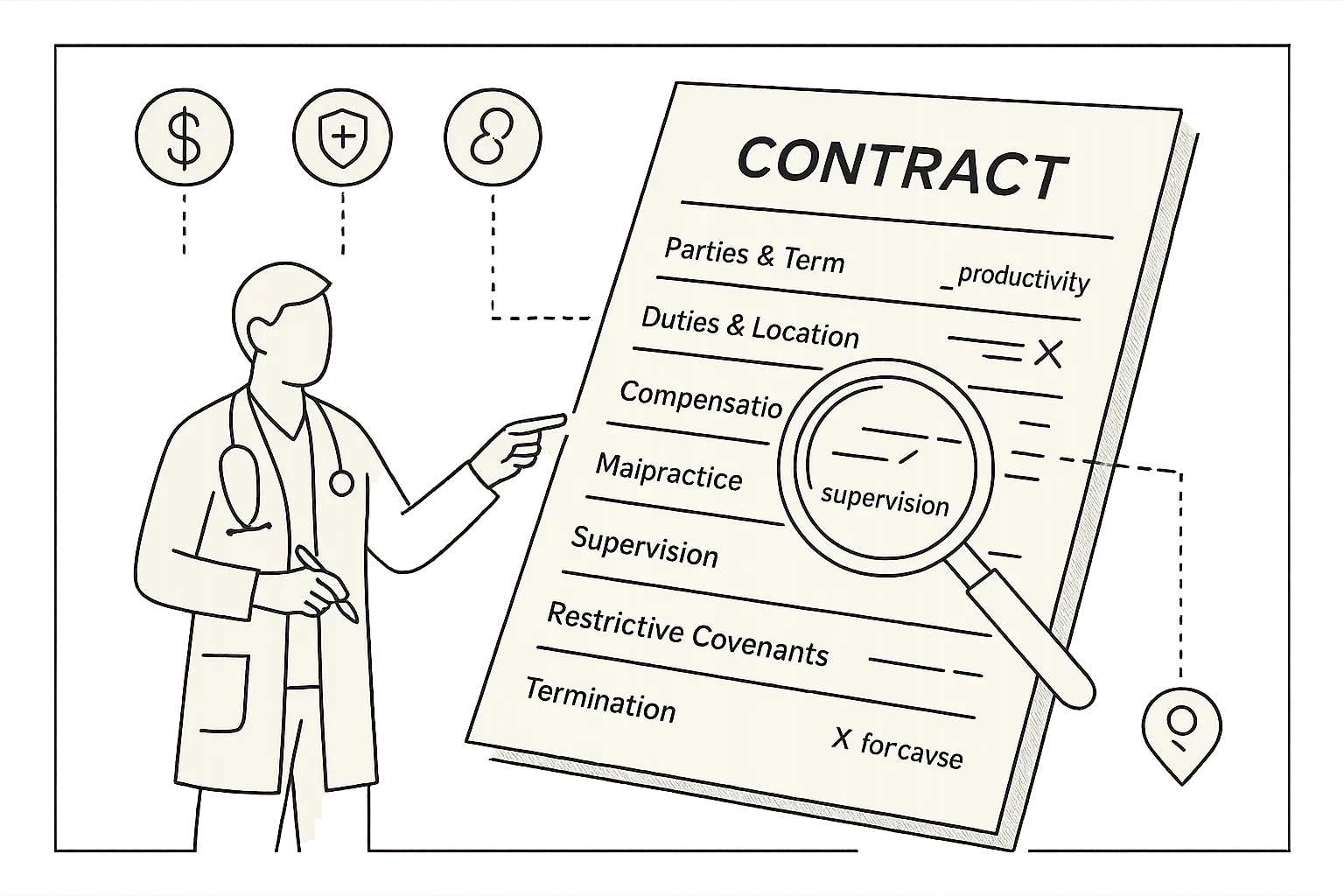
Most PA agreements address the parties and contract term, clinical duties and locations, compensation and benefits, malpractice coverage, supervision, restrictive covenants, and termination. A review should identify how those provisions work together rather than treating each clause in isolation. Definitions such as “productivity,” “collections,” “cause,” and “practice location” should be clear and used consistently throughout the agreement.
- Financial risk: Determine whether guaranteed pay, variable compensation, deductions, reconciliation procedures, and repayment obligations are understandable and administrable.
- Regulatory risk: Confirm that duties, supervision, delegation, and prescribing language do not improperly shift the employer’s responsibilities or conflict with the contemplated Georgia practice arrangement.
- Career and mobility risk: Evaluate whether non-competes, notice requirements, repayment clauses, or multi-site provisions could impede a future job change.
The practical objective is to convert legal language into expected financial and professional outcomes. A broader review of common physician assistant contract red flags can also help PAs recognize provisions that deserve closer attention before signing.
Compensation, Productivity, Bonuses, and Benefits
Compensation language shapes both current income and long-term earning potential. A thorough PA compensation and productivity review examines base guarantees, productivity thresholds, payment timing, reconciliation procedures, bonus eligibility, and the expenses the PA must personally absorb.
Base Salary, Collections, and RVU Formulas
A base salary provides predictable income but may be coupled with productivity targets or later reconciliation. Productivity models commonly rely on collections, billed charges, or work relative value units. An RVU formula generally converts clinical activity into compensation by multiplying credited RVUs by a conversion factor and then applying any quality, threshold, or overhead adjustments stated in the agreement.
Collections-based compensation can create timing risk because the employer typically controls billing and collection activity. The contract should explain the reporting period, access to supporting data, treatment of refunds and chargebacks, and whether unearned draws carry forward. A negative accrual provision may allow a deficit from one period to reduce future compensation, making the reconciliation language particularly important.
Incentives, Repayment Terms, and Employee Benefits
Bonuses may be discretionary or tied to defined thresholds. Formula-based incentives are easier to evaluate when the agreement identifies the measurement period, data source, payment date, and effect of termination before the payout. Signing bonuses, relocation payments, and student loan assistance frequently include repayment obligations, so the triggers and amortization schedule should be reviewed alongside the agreement’s termination provisions. PAs should pay particular attention to sign-on bonus repayment terms that demand the full amount after only part of the commitment period has elapsed.
Benefits also affect the offer’s effective value. The contract or incorporated policies should clarify responsibility for health insurance, retirement contributions, paid time off, continuing medical education, licensing fees, credentialing expenses, and controlled-substance registration costs where applicable. If credentialing delays postpone the start date or prevent productivity credit, the agreement should make the financial consequences understandable.
Georgia Scope of Practice, Supervision, and Clinical Duties
The agreement’s description of clinical duties should be consistent with the anticipated supervision, delegation, prescribing, and practice arrangements. Broad language allowing an employer to assign “other duties” should not obscure the position’s specialty, expected procedures, documentation requirements, or the locations where services will be performed. The contract should also address what happens if a supervising relationship, credential, or privilege necessary for the role becomes unavailable.
Call obligations, weekend coverage, chart review expectations, and multi-site assignments can materially change workload and compensation. These provisions should identify the schedule, coverage area, travel expectations, and whether additional pay or time off applies. Reviewing the employer’s terms against a detailed guide to PA call schedules and coverage requirements can reveal obligations that are not apparent from the stated base salary.
Clinical autonomy should not be confused with contractual ambiguity. A well-drafted agreement can preserve appropriate professional judgment while clearly allocating administrative responsibilities, supervision logistics, credentialing tasks, and employer support. This is especially important when the PA may work across facilities or when the employer can alter schedules and locations without mutual agreement.
Malpractice Insurance, Tail Coverage, and Indemnification
Malpractice provisions should identify the policy type, coverage limits, responsible insurer, deductible obligations, and who controls the defense of a claim. An occurrence policy generally covers acts occurring during the policy period regardless of when a claim is reported. A claims-made policy generally requires coverage to remain active when the claim is made, which may create a need for an extended reporting endorsement after employment ends.
The contract should clearly allocate responsibility for any required tail coverage and explain whether that responsibility changes based on the reason for termination. Because the expense can create significant post-employment exposure, the written terms should be compared with the employer’s insurance certificate and policy summary. The distinction between policy types and payment responsibility is discussed further in the guide to tail insurance for physician assistants.
Indemnification and defense provisions require separate attention. A PA should understand whether the agreement requires reimbursement of the employer’s losses, shifts legal expenses to the PA, or extends beyond conduct covered by malpractice insurance. Reporting duties related to claims, subpoenas, or licensing matters should also be specific enough for the PA to understand the required response.
Non-Competes, Termination Rights, and Repayment Exposure
Restrictive Covenants and Future Employment
Restrictive covenants can affect where a PA may work, which services may be provided, and whether former patients or employees may be contacted after departure. A review should examine the duration, geographic scope, restricted activities, employer interests addressed by the provision, and the events that trigger the restriction. Related non-solicitation and confidentiality clauses may impose additional limitations even when the agreement labels only one section as a non-compete.
Buyout provisions or negotiated limitations may provide alternatives to a broad restriction, but the formula and eligibility conditions must be understandable. A focused physician assistant non-compete review can identify how the covenant interacts with practice locations, termination language, and the PA’s likely future employment market.
Termination, Notice, Final Compensation, and Clawbacks
Termination provisions should distinguish between termination for cause and termination without cause. The agreement should define cause, identify any opportunity to cure a breach, specify the required notice period, and explain whether the employer may remove the PA from the schedule during notice. The timing of final salary, earned bonuses, accrued leave, and post-termination collections should also be clear.
Repayment clauses often apply to signing bonuses, relocation assistance, loan support, training expenses, or compensation advances. Their effect depends on the trigger, the remaining commitment period, and whether the obligation is prorated. A dedicated contract termination review can evaluate those obligations together with notice requirements, malpractice coverage, restrictive covenants, and final compensation rights.
Administrative Terms and Attorney-Led Contract Review
Administrative clauses can carry substantial financial and compliance consequences. Credentialing milestones, quality metrics, performance reviews, and audit rights may determine continued employment or bonus eligibility. The agreement should identify how performance is measured, what data the employer may use, whether the PA can review calculations, and whether retroactive adjustments or chargebacks are permitted.
Worksite flexibility, moonlighting restrictions, assignment rights, and policy-incorporation clauses also deserve attention. An unrestricted assignment clause may permit the employer to transfer the agreement to another entity, while broad policy language may allow important working conditions to change outside the signed contract. These provisions should be considered alongside the duties, compensation, supervision, and termination sections they may affect.
An attorney-led review is most useful before the agreement is signed and while the PA can still request clarification or revisions. Chelle Law reviews employment and independent contractor agreements remotely, provides written comments, and discusses the practical effect of provisions involving compensation, malpractice exposure, restrictive covenants, repayment duties, and termination. Submitting the complete offer package early helps avoid delays and allows related documents to be evaluated together.
Review Your Georgia PA Contract Before You Sign
Chelle Law can identify compensation, supervision, malpractice, non-compete, termination, and repayment terms that may affect your Georgia physician assistant position.
Contact Chelle Law