
Physician assistants considering employment or independent contractor agreements in Hawaii must evaluate how the contract interacts with requirements administered by the Hawaii Medical Board and the Hawaii Department of Commerce and Consumer Affairs, Professional and Vocational Licensing Division. Hawaii requires physician-assistant licensure, and state rules connect PA practice to physician supervision, delegated duties, prescribing authority, and written practice arrangements. These requirements can affect supervision clauses, credentialing conditions, assigned services, work locations, and the consequences of a change in supervising physician. In healthcare markets such as Honolulu and Hilo, the operational details may also vary among hospital systems, group practices, and other employers. Contract review can connect those regulatory obligations to compensation, call coverage, malpractice insurance, restrictive covenants, repayment terms, and termination rights before the PA accepts an offer or begins work.
An offer may appear attractive while leaving important terms undefined. Productivity calculations, discretionary benefits, broad assignment rights, tail insurance obligations, or bonus clawbacks can materially change the financial and professional value of the arrangement. Reviewing the complete agreement and incorporated documents helps identify those risks and determine whether the written terms match the position described during recruitment.
Why Hawaii Physician Assistant Contract Review Matters

Aligning Contract Duties With Hawaii PA Requirements
Hawaii rules define physician-assistant practice through physician supervision and delegated duties. Review can determine whether the agreement or related written practice arrangement identifies the supervising physician, describes the supervision structure, and avoids authorizing services beyond the applicable delegation. This analysis is particularly important when a contract uses broad language allowing the employer to change clinical responsibilities, specialty assignments, or practice sites.
Licensure and credentialing provisions also warrant close attention. The contract may condition employment on maintaining an active Hawaii license, obtaining privileges, completing payer enrollment, or securing required prescribing registrations. Analysis can clarify who controls each process, what happens if approval is delayed, and whether employment or compensation can end before the PA has a reasonable opportunity to satisfy the condition.
Reconciling the Offer With the Complete Agreement
Compensation plans, policy manuals, bonus schedules, and restrictive-covenant exhibits may be incorporated into the contract even when they are not attached to the initial offer. A line-by-line review can identify inconsistencies among those documents, including different start dates, schedules, productivity targets, or repayment obligations. It can also flag terms that permit unilateral changes to compensation, benefits, duties, or workplace policies after signing.
Compensation, Productivity, and Bonus Provisions
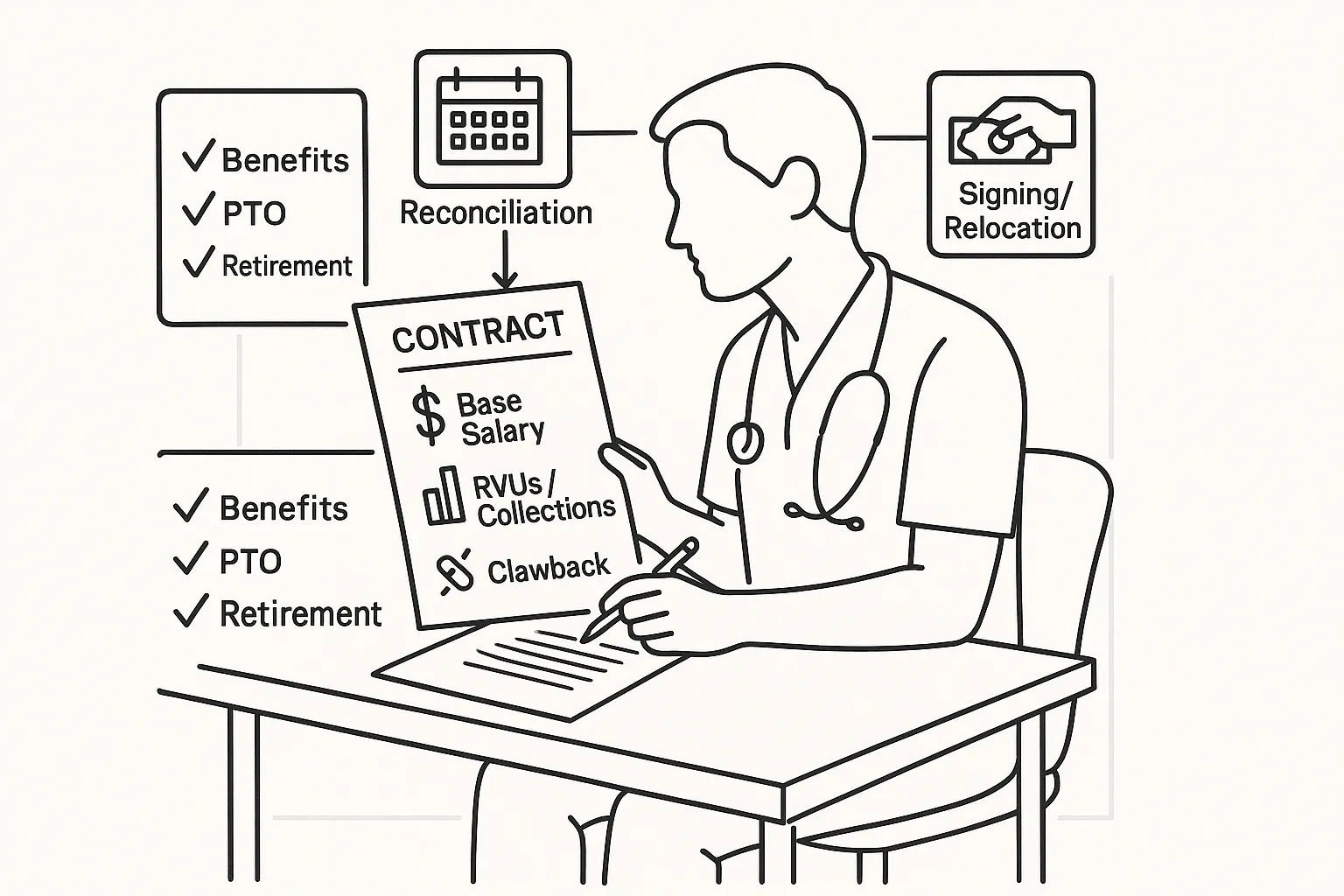
Base Salary and Productivity Formulas
Compensation language determines how earnings are calculated and when they become payable. A base salary may begin on the employment date, after orientation, or only after credentialing is complete. The agreement may also permit salary adjustments based on work status, assigned hours, productivity, or employer policy.
Incentive models may use collections, net collections, relative value units, quality measures, or several metrics together. A focused physician assistant compensation and productivity review can evaluate definitions, thresholds, conversion factors, exclusions, caps, measurement periods, reconciliation timing, and amendment rights. If the formula refers to data controlled exclusively by the employer, review can also identify whether the PA has a meaningful way to verify the calculation.
Bonuses, Benefits, and Repayment Exposure
Signing bonuses, relocation assistance, student-loan support, and training payments can add substantial value, but the repayment language may create a significant post-employment obligation. Review can identify triggering events, proration schedules, repayment deadlines, offsets against final compensation, and whether repayment still applies when the employer terminates the relationship without cause. The analysis should also account for any separate promissory note or repayment agreement.
Benefits require similar attention because summaries may not establish binding eligibility rights. The contract may address paid time off, continuing education funds, licensing expenses, retirement contributions, health coverage, and professional dues while reserving discretion to change those benefits. Eligibility dates, approval requirements, vesting rules, and treatment of unused benefits at termination can affect the offer’s actual value.
Supervision, Scope of Practice, and Work Expectations
Supervision and Delegated Clinical Duties
Under Hawaii’s profession-specific rules, a physician assistant performs duties delegated by a supervising physician, who accepts responsibility for the services rendered and must direct and exercise supervision. Contract review can determine whether the written role is consistent with that structure and whether related documents adequately identify supervision responsibilities. Clauses permitting unrestricted changes to specialty duties, procedures, patient populations, or supervisory arrangements deserve particular scrutiny.
The practical terms of supervision may affect workflow, documentation, chart review, physician availability, and coverage when the primary supervising physician is absent. If the contract assigns responsibilities across multiple facilities or service lines, analysis can identify whether the language clearly addresses the applicable supervision and delegation at each location.
Prescribing, Dispensing, and Credentialing Conditions
Hawaii physician-assistant prescribing, controlled-substance authority, professional samples, and dispensing activities remain subject to physician supervision and applicable state and federal requirements. The contract may condition those activities on active licensure and required registrations or authorizations. Review can flag language that assumes authority the PA does not yet possess or places responsibility for delays entirely on the PA regardless of their cause.
Credentialing provisions may also govern the start date, compensation, continued employment, and eligibility for productivity credit. Clear language can distinguish between delays caused by the PA, the employer, a facility, or a payer and explain what happens during the waiting period. This is important when the PA must relocate or leave another position before all approvals are complete.
Schedules, Call Coverage, and Multiple Worksites
Scheduling provisions may define regular clinic hours, weekend work, holiday coverage, call frequency, response times, and additional compensation. Broad requirements to work “as needed” can leave workload and availability expectations unresolved. The agreement may also address whether call duties affect productivity targets or qualify for separate pay.
Multi-site assignments, telehealth services, and temporary coverage can expand the role beyond the location described in the offer. Reviewing the contract’s call schedule and coverage requirements can help clarify scheduling control, travel expectations, reimbursement, supervision, and whether the employer can add locations without the PA’s consent. Moonlighting restrictions should also be evaluated if the PA expects to maintain outside clinical work.
Malpractice Insurance and Post-Employment Coverage
Occurrence and Claims-Made Policies
Professional liability provisions may identify the policy type, coverage limits, named insureds, exclusions, and the party responsible for premiums. Occurrence coverage generally responds to covered incidents arising during the policy period regardless of when the claim is filed. Claims-made coverage generally requires coverage to remain active when the claim is made, which can create a need for an extended reporting endorsement after employment ends.
A review of the agreement’s physician assistant malpractice insurance terms can clarify what the employer provides and whether the coverage applies to every assigned location and service. It can also identify whether the contract permits the employer to change insurers, limits, or policy types during the relationship.
Tail Coverage, Indemnification, and Cooperation
If claims-made insurance is used, the agreement may allocate responsibility for obtaining and paying for tail coverage. Some provisions make responsibility depend on the reason for termination or length of service, while others assign the entire obligation to the PA. Review can determine whether the clause states the required limits, duration, proof of coverage, and deadline for purchase.
Indemnification, incident-reporting, defense-control, and post-employment cooperation clauses may survive termination. These provisions can affect financial exposure and the PA’s obligations during a later claim or investigation. Their effect should be considered alongside the malpractice policy rather than treated as unrelated boilerplate.
Hawaii Non-Competes and Other Restrictive Covenants
Evaluating a Physician Assistant Non-Compete
Hawaii evaluates restrictive covenants under its restraint-of-trade statute and applicable reasonableness principles. Although statutory prohibitions expressly apply to employees in certain enumerated industries, physician assistants are not expressly included in the profession-specific rules identified for this page. A PA non-compete is therefore not categorically void on that basis, but enforceability remains fact-specific and may depend on its duration, geographic reach, restricted activities, competitive effect, and asserted business interest.
A physician assistant non-compete review can identify vague service definitions, excessive geographic coverage, restrictions tied to every employer location, and obligations that continue after an employer-initiated termination. The practical effect matters: a radius that appears limited may still cover most realistic employment options in a particular island market.
Non-Solicitation, Confidentiality, and Intellectual Property
Non-solicitation clauses can separately restrict contact with patients, employees, referral sources, or business partners. The agreement may define prohibited solicitation broadly enough to include general announcements, responses to unsolicited inquiries, or work for a competing organization. Review can compare those restrictions with the non-compete and determine their combined effect on future practice.
Confidentiality and intellectual-property provisions may extend beyond legitimate business information to clinical materials, educational content, inventions, or work created outside scheduled duties. Analysis can flag definitions, ownership provisions, return-of-property requirements, and post-employment obligations that are broader than the position appears to require.
Termination, Board Notice, and Dispute Terms
For-Cause and Without-Cause Termination
For-cause provisions identify events that may permit immediate termination, such as licensing problems, exclusion, loss of privileges, policy violations, or alleged misconduct. Review can distinguish objective triggers from broadly discretionary standards and determine whether the PA receives notice and an opportunity to cure a correctable issue. Immediate termination provisions should also be compared with compensation, repayment, restrictive-covenant, and malpractice clauses because one event may activate several consequences.
Without-cause termination provisions establish whether either party may end the relationship by providing advance notice. Important details include the length and method of notice, whether the employer may remove the PA from the schedule, whether compensation continues during the notice period, and when earned bonuses are paid. PAs evaluating an exit clause can review additional guidance on terminating a physician assistant contract.
Hawaii rules also require the supervising physician or physicians and the physician assistant to notify the Hawaii Medical Board within ten days after severance of supervision or employment. The agreement can address responsibility for prompt notice, transition of supervised practice, patient handoff, records access, and the effect of a supervisory change on continued work.
Repayment, Dispute Resolution, and Protected Reporting
Post-termination repayment may involve signing bonuses, relocation funds, training expenses, malpractice premiums, or other advances. Review can identify the calculation method, proration, offsets, interest, collection costs, and whether the obligation applies regardless of which party ends the agreement. The survival clause should be examined to determine which obligations remain enforceable after departure.
Governing-law, venue, arbitration, and fee-shifting provisions affect how and where disputes are resolved. Employment terms also should not purport to waive or impair applicable Hawaii whistleblower protections for an employee who reports a suspected legal or regulatory violation or participates in a public-body investigation. Confidentiality, non-disparagement, and internal-reporting provisions warrant review with those protections in mind.
What an Attorney-Led PA Contract Review Covers
An attorney-led physician assistant contract review translates contract language into practical financial, regulatory, and professional consequences. The review can evaluate compensation formulas, benefits, supervision and scope provisions, schedules, malpractice coverage, restrictive covenants, termination rights, repayment exposure, and dispute terms. It can also identify inconsistencies among the employment agreement, offer letter, compensation plan, policy documents, promissory notes, and addenda.
Review is most useful before signature, while undefined terms can still be clarified and the written agreement can be compared with the PA’s understanding of the offer. Chelle Law provides remote, flat-fee contract review to help Hawaii physician assistants identify risks, understand material provisions, and recognize terms that may warrant clarification or revision. Review does not guarantee a particular outcome, but it can support a more informed decision about whether the agreement fits the PA’s financial needs and professional plans.
Speak With a Hawaii Physician Assistant Contract Lawyer Before You Sign
Have your agreement reviewed for compensation, supervision, malpractice coverage, restrictive covenants, repayment exposure, and termination terms that may warrant clarification or revision.
Request a Contract Review