
Physician assistants evaluating employment or independent contractor agreements in Hawaii must consider how contract terms interact with requirements overseen by the Hawaii Medical Board. Hawaii-specific issues involving PA licensure, scope of practice, supervision, delegation, and prescribing can shape the duties an employer may assign and the conditions attached to credentialing or continued employment. Those concerns may arise differently across major healthcare markets such as Honolulu and Hilo, where hospital systems, group practices, and other employers may use different compensation and coverage structures. A careful review connects these regulatory and operational requirements to the agreement’s supervision language, work locations, call expectations, productivity formula, malpractice coverage, restrictive covenants, and termination rights. Chelle Law helps Hawaii PAs understand how those provisions work together before signing, so an attractive offer does not conceal repayment exposure, unclear clinical responsibilities, or limitations on future practice.
Why Hawaii PA Contract Review Matters

Physician assistant agreements are often drafted with employer-favorable language that appears routine but can create significant financial, professional, and regulatory risk. A provision addressing compensation, clinical duties, supervision, or post-employment restrictions may affect whether the PA receives expected income, can perform assigned services under applicable requirements, and remains able to move to another practice.
A line-by-line review explains how the agreement will operate in practice, including whether the employer can change duties, how long a reconciliation may delay incentive pay, and what happens if credentialing is not completed on schedule. Hawaii PAs can also consult professional updates from the Hawaii Academy of Physician Assistants, while relying on legal counsel to evaluate the specific obligations created by an employment or contractor agreement.
Compensation, Productivity, and Bonus Terms
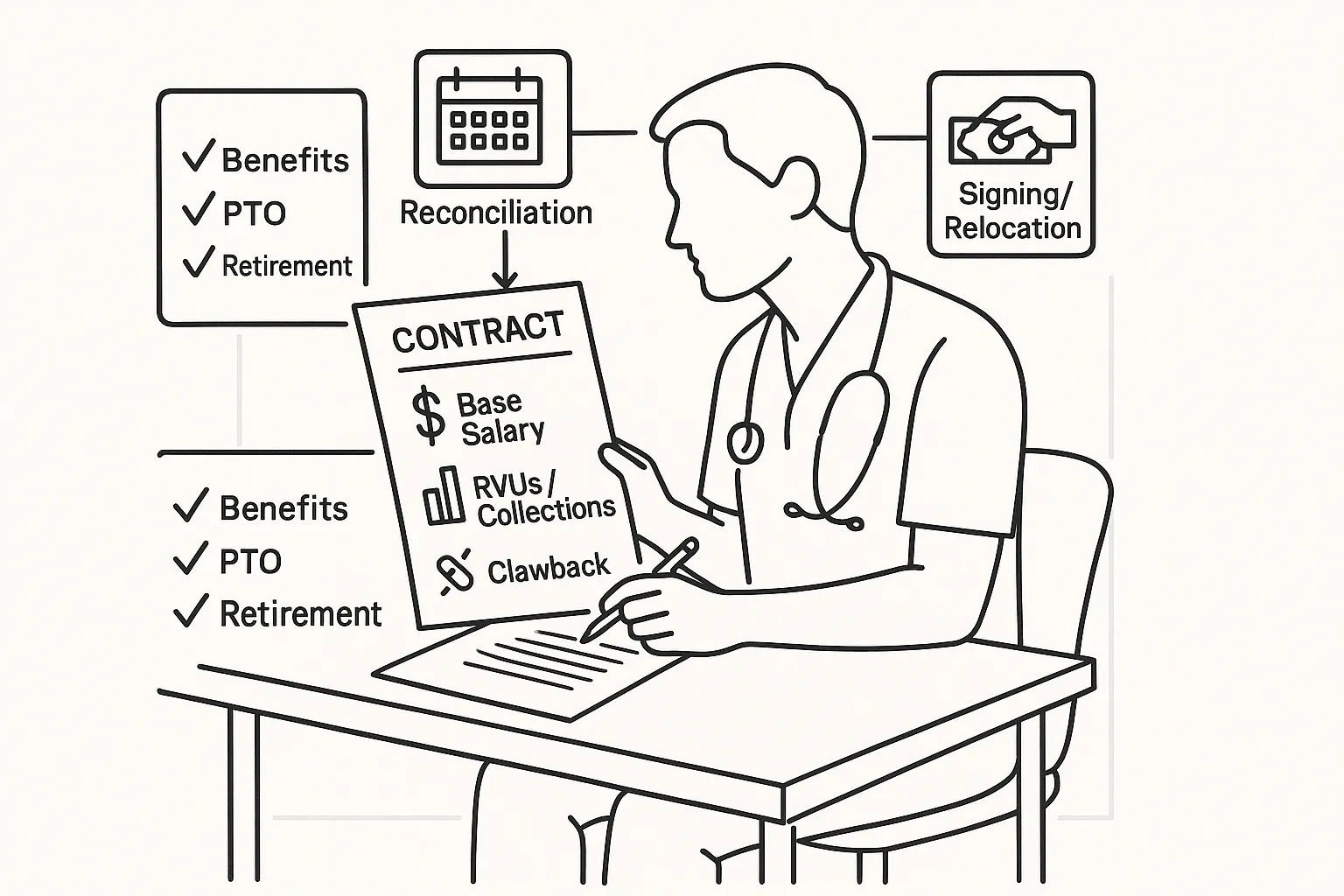
Compensation language determines when and how a PA is paid. A base salary may be conditioned on credentialing, orientation, productivity thresholds, or continued employment on a payment date. Incentive models may use collections, net collections, relative value units, quality measures, or a combination of metrics. A focused PA compensation and productivity review examines definitions, measurement periods, conversion factors, exclusions, caps, reconciliation timing, and whether the employer can change the formula.
Signing bonuses, relocation assistance, and loan repayment can add value to an offer, but their repayment provisions deserve equal attention. The agreement should explain which events trigger repayment, whether the obligation decreases over time, whether termination without cause changes the result, and whether the employer may deduct an amount from final compensation. Reviewing sign-on bonus repayment terms before accepting funds can reveal liabilities that the offer summary does not show. Benefits, paid time off, retirement contributions, and continuing education allowances should likewise be checked for eligibility dates, vesting rules, and employer discretion.
Scope of Practice, Supervision, and Work Expectations
The agreement should describe the expected clinical role, practice locations, specialty duties, credentialing requirements, and any conditions related to prescribing or hospital privileges. Broad clauses allowing unilateral changes to responsibilities may expose a PA to duties that were not reflected in the original offer. Supervision, collaboration, delegation, chart review, and physician availability language should also be evaluated against the role contemplated by the parties and the requirements overseen by the Hawaii Medical Board.
Scheduling provisions should identify regular hours, weekend coverage, call responsibilities, response expectations, and any additional compensation. A contract that simply requires work “as needed” may leave important workload questions unresolved. The same concern applies to moonlighting, telehealth, and multi-site assignments, particularly when restrictions could limit supplemental work or expand responsibilities without additional pay. PAs with coverage obligations should closely review the agreement’s call schedule and coverage requirements.
Malpractice Insurance and Tail Coverage
Professional liability provisions should identify the type of coverage, policy limits, responsible party, and treatment of claims after employment ends. An occurrence policy generally covers incidents arising during the policy period regardless of when a claim is filed. Claims-made coverage generally requires the policy to be active when the claim is made, which can create a need for extended reporting endorsement, commonly called tail coverage. A review of the contract’s malpractice insurance terms helps clarify what protection the employer actually provides.
If tail coverage may be required, the agreement should state who must obtain and pay for it when the relationship ends. Some contracts allocate the entire cost to the PA, while others vary responsibility based on the reason for termination or length of service. Cooperation, incident-reporting, indemnification, and defense-control provisions also deserve review because they may continue after departure and affect how a claim is handled.
Non-Competes and Other Restrictive Covenants
Restrictive covenants may affect where and how a PA can practice after leaving an employer. A non-compete may define prohibited services, geographic limits, restricted facilities, or a specific duration. Non-solicitation provisions can separately restrict contact with patients, referral sources, or employees. Because enforceability depends on the governing law, contract language, and circumstances, the practical effect of the complete restriction should be assessed rather than relying on the clause’s heading alone.
A physician assistant non-compete review can identify vague service definitions, expansive geographic coverage, restrictions tied to every employer location, and provisions that continue even when the employer ends the agreement without cause. Confidentiality, intellectual property, and non-solicitation clauses should be considered alongside the non-compete because the combined restrictions may create a broader limitation on future practice than any single provision suggests.
Termination, Repayment, and Dispute Terms
Termination language determines how the relationship can end and what financial obligations survive. For-cause provisions should clearly describe the events permitting immediate termination and whether the PA has an opportunity to correct a problem. Without-cause provisions should specify the required notice period, whether the employer can remove the PA from the schedule during notice, and when final salary, bonuses, and accrued benefits will be paid. PAs can learn more about terminating a physician assistant agreement before evaluating an exit clause.
Repayment obligations may apply to signing bonuses, relocation funds, training expenses, malpractice premiums, or other advances. The contract should explain triggers, calculation methods, offsets, interest, and whether repayment is prorated. Governing-law, venue, and arbitration provisions also affect where a dispute must be resolved, the procedures available to each party, and the cost of challenging a restrictive covenant or compensation decision.
What an Attorney-Led Review Covers
An attorney-led physician assistant contract review translates legal language into practical financial and professional consequences. The review can address compensation formulas, productivity standards, benefits, malpractice coverage, scope and supervision language, restrictive covenants, termination rights, repayment exposure, and dispute provisions. It can also identify inconsistencies between the agreement, offer letter, bonus plan, and referenced employer policies.
Review is most useful before signature, while there is still time to clarify undefined terms and evaluate whether the written agreement matches the offer. PAs should provide the complete contract and any incorporated compensation plans, policy documents, addenda, or written offer terms. A structured employment agreement checklist can help organize those materials. Chelle Law offers remote, flat-fee contract review designed to help Hawaii physician assistants make informed decisions without assuming that review guarantees a particular negotiation outcome.
Review Your Hawaii PA Contract Before You Sign
Understand how compensation, malpractice coverage, supervision terms, restrictive covenants, and termination provisions may affect your income and career.
Contact Chelle Law