
Physician assistants practicing in Illinois are regulated by the Illinois Department of Financial and Professional Regulation, Division of Professional Regulation and the Illinois Medical Licensing Board. Illinois law generally requires a written collaborative agreement describing the working relationship, categories of care, delegated duties, and procedures requiring the collaborating physician’s presence. These requirements can affect employment terms involving scope of practice, prescriptive authority, credentialing, location assignments, and responsibility for maintaining a compliant collaboration. Whether a PA is considering a health system position in Chicago, a specialty practice in Springfield, or a role elsewhere in Illinois, contract review can identify whether the proposed duties and operational expectations fit the contemplated clinical arrangement. It can also reveal conflicts between the employment agreement, incorporated policies, and the separate documentation governing collaboration.
Regulatory terms are only part of the analysis. Compensation formulas, malpractice insurance, restrictive covenants, termination rights, call obligations, and incentive repayment provisions can materially affect the value and risk of an offer. Chelle Law provides physician assistant contract review that evaluates these provisions together and explains their practical financial and professional consequences before the agreement is signed.
Illinois PA Collaboration and Practice Requirements

Written Collaborative Agreements and Delegated Duties
An Illinois physician assistant generally practices within the specialty of a collaborating physician under a written collaborative agreement. Delegated duties must be consistent with the PA’s education, training, and experience. The collaborative agreement must describe the working relationship, categories of care, treatment or procedures, and any procedures requiring the collaborating physician’s presence; a copy must also be available to IDFPR upon request.
The employment contract and collaborative agreement serve different functions, but inconsistent language can create avoidable uncertainty. Review can compare the offered specialty, clinical duties, supervision provisions, performance standards, and compliance responsibilities to determine whether the documents describe a workable arrangement without shifting institutional obligations beyond the PA’s control.
Collaboration Notices, Locations, and Transitions
The collaborating physician must notify IDFPR of the PA’s employment, discharge, or assumption of collaboration within 60 days, although employment may begin before the notice is filed. Illinois also generally limits a collaborating physician to seven full-time-equivalent physician assistants, subject to statutory exceptions. A PA employed by a practice group or another entity may have a designated collaborating physician at each location, making multi-site assignment language especially important.
Following termination of a required written collaborative agreement, a PA may continue practicing for up to 90 days only if the statutory conditions are met. Those conditions include seeking necessary hospital collaboration and referring matters outside the PA’s training and experience. Contract review can identify how the employer addresses a collaboration change, whether another physician will be designated, and what happens to scheduling, compensation, or employment if collaboration cannot be maintained.
Prescriptive Authority and Professional Responsibility
A collaborating physician may delegate prescriptive authority through the written collaborative agreement, including authority involving legend drugs and Schedule II through V controlled substances, subject to governing law and controlled-substance requirements. The contract can be evaluated for conditions tied to prescribing, registration, credentialing, and institutional approval rather than assuming every anticipated duty is automatically authorized.
Illinois also requires a physician assistant to identify verbally as a physician assistant to each patient and prohibits titles that imply qualification for the general practice of medicine. The PA retains professional and legal responsibility for patient care. Contract language addressing patient identification, documentation, incident reporting, and compliance therefore warrants careful review.
Compensation, Productivity, and Benefits
Base Pay and Productivity Formulas
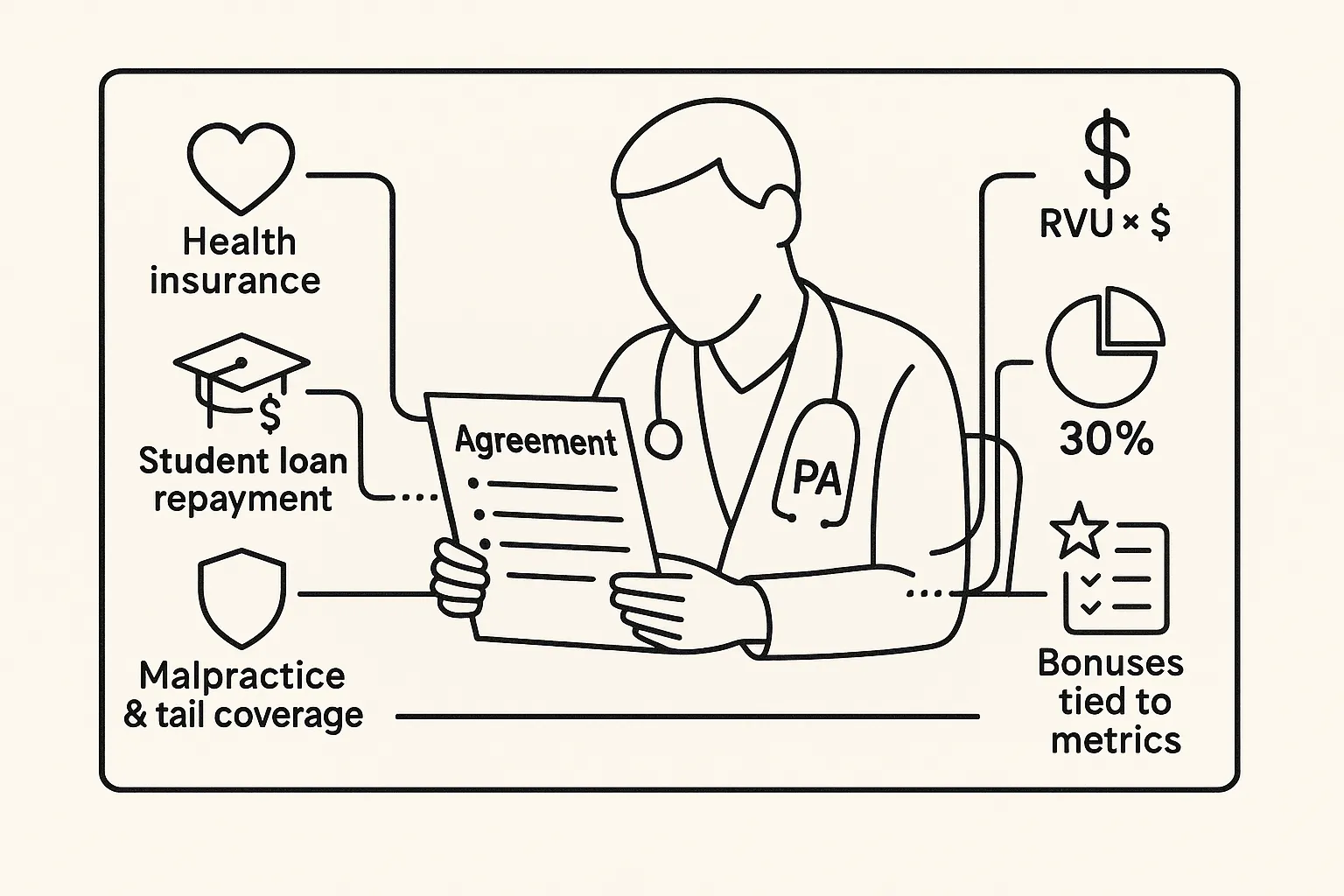
Compensation may consist of a guaranteed salary, collections percentage, RVU formula, quality incentive, or a combination of methods. A PA compensation and productivity review can identify the applicable thresholds, conversion factors, reconciliation dates, exclusions, reporting rights, and conditions for earning or retaining a bonus.
Under an RVU formula, credited RVUs are commonly multiplied by a stated conversion factor. For example, 4,000 RVUs at $40 per RVU produces $160,000 before applying the agreement’s base guarantee, threshold, reconciliation method, exclusions, or negative accrual provisions. Collections-based plans require equal precision because deductions, refunds, chargebacks, payer delays, and the definition of “net collections” can materially change the result.
Quality measures and discretionary bonuses also need objective definitions. Review can determine whether the employer controls the data, may change metrics during the measurement period, or requires active employment on the payment date even when the underlying work has already been completed.
Benefits, Expenses, and Employment Classification
The value of an offer includes health insurance, retirement contributions, paid leave, disability coverage, CME support, professional dues, licensing expenses, and any student loan benefit. Eligibility dates, vesting periods, reimbursement caps, full-time requirements, and prorating rules can reduce the stated value of these benefits.
Classification as a W-2 employee or 1099 independent contractor affects tax withholding, benefits, insurance, professional expenses, equipment, and scheduling control. Comparing offers solely by hourly rate or annual compensation can therefore be misleading. The entire economic arrangement, including expenses transferred to the PA, must be considered.
Clinical Duties, Scheduling, and Credentialing
Duties, Call, and Multi-Site Assignments
The job description can be reviewed for consistency with the offered specialty, anticipated clinical role, licensure, privileges, and collaborative arrangement. Broad provisions allowing the employer to assign any duty or location may create uncertainty about administrative work, procedures, productivity expectations, travel, and whether responsibilities can change without corresponding compensation.
Scheduling terms may address regular hours, weekends, holidays, telehealth, moonlighting, and coverage at multiple facilities. The agreement’s call schedule and coverage requirements should be read with compensation provisions to determine whether call pay, premium pay, travel reimbursement, or post-call time is defined. A separate policy incorporated by reference also deserves review, particularly if the employer may revise it unilaterally.
Credentialing and the Compensation Start Date
Credentialing and privileging provisions may make employment contingent on licensure, hospital approval, payer enrollment, controlled-substance authorization, or other conditions. The agreement can allocate responsibility for applications, documentation, deadlines, fees, and cooperation, but institutional delays outside the PA’s control should not be overlooked.
Review can clarify whether compensation begins on a fixed start date or only after all contingencies are satisfied. It can also identify whether the employer may postpone or withdraw the position, whether the PA remains subject to exclusivity during a delay, and what happens to a signing bonus or relocation payment if credentialing is delayed or denied.
Illinois Restrictive Covenants and Professional Mobility
Illinois Non-Compete and Non-Solicitation Requirements
For agreements covered by the Illinois Freedom to Work Act, an employee non-compete is generally prohibited unless actual or expected annualized earnings exceed $75,000. A non-solicitation covenant is generally prohibited unless earnings exceed $45,000. Meeting an earnings threshold does not by itself establish enforceability; the Act also addresses adequate consideration, a valid employment relationship, legitimate business interests, undue hardship, public injury, and written notice and review-period requirements.
A focused physician assistant non-compete review can assess how the statutory requirements relate to the contract language and surrounding facts. Review should distinguish among non-compete, patient and employee non-solicitation, confidentiality, non-interference, and other post-employment obligations rather than treating every restriction as interchangeable.
Geographic Reach and Restricted Activities
The practical burden of a covenant depends on its duration, geographic scope, triggering events, and definition of restricted activity. Language covering multiple counties, every employer location, or facilities where the PA never worked may significantly limit opportunities in the Chicago metropolitan area or another concentrated healthcare market.
Activity restrictions may extend beyond the PA’s former specialty to telehealth, locum tenens work, administrative positions, or employment with a broadly defined competitor. Review can also determine whether a covenant applies after every form of separation, including an employer-initiated termination without cause, and whether passive responses to patients or former colleagues are treated as solicitation.
Termination, Repayment, and Final Compensation
Notice, Cause, and Cure Rights
Termination provisions determine how either party may end the relationship and which obligations survive. A physician assistant termination review can evaluate without-cause notice, immediate termination events, cure periods, severance, continued work during the notice period, and the effect of separation on compensation and restrictive covenants.
Cause definitions may include fraud, criminal conduct, loss of licensure, exclusion from government programs, or material breach. Broader language based on subjective dissatisfaction, unspecified policy violations, or performance standards controlled solely by the employer can create less predictable risk. When a breach is capable of correction, the availability and length of a notice-and-cure process may be important.
Incentive Repayment and Post-Termination Pay
Signing bonuses, relocation assistance, student loan benefits, training expenses, and other incentives often carry repayment obligations. Analysis can identify each repayment trigger, the applicable period, whether repayment is prorated, and whether interest, collection costs, or payroll deductions may apply. Particular attention is warranted when repayment can be triggered by an employer-initiated termination or circumstances outside the PA’s control.
Final compensation language may govern accrued salary, unused leave, earned productivity pay, and bonuses measured before but paid after separation. A requirement that the PA remain actively employed on the payment date can result in forfeiture even when the underlying services were performed. The timing and calculation method should be understood before expected compensation is treated as guaranteed.
Malpractice Insurance, Indemnification, and Liability
Policy Type and Tail Coverage
Malpractice provisions may identify the policy type, limits, carrier requirements, covered services, and responsibility for post-employment protection. Occurrence coverage generally applies to covered acts occurring during the policy period. Claims-made coverage may require tail insurance after the relationship ends, depending on whether replacement or prior-acts coverage is available.
Review of tail insurance for physician assistants can identify who must obtain and pay for coverage, applicable deadlines, required limits, and whether responsibility changes based on the reason for termination. General language stating that malpractice insurance is provided may not answer these questions.
Indemnification and Claims Cooperation
Indemnification language may require the PA to reimburse the employer or pay defense costs in specified circumstances. Review can assess whether the provision is tied to defined misconduct, whether the employer provides a corresponding defense or indemnity for covered acts within the scope of employment, and how the clause interacts with available insurance.
The agreement may also address incident reporting, cooperation with claims, access to records, selection of counsel, and consent to settlement. Under Illinois law, a physician is not liable for a PA’s conduct solely because the physician signed a collaborative agreement or authorized delegated acts, absent the circumstances specified by law. That rule does not eliminate the need to evaluate the PA’s own insurance, professional responsibility, and contractual indemnification exposure.
How an Illinois Physician Assistant Contract Lawyer Can Help
Attorney review is a form of proactive risk assessment. Chelle Law can analyze the agreement line by line, flag provisions involving collaboration, compensation, malpractice coverage, restrictive covenants, repayment, scheduling, credentialing, and termination, and explain how those provisions interact. Common red flags include undefined productivity formulas, unilateral location changes, conflicting bonus terms, vague performance standards, broad repayment clauses, and policies incorporated by reference but not provided.
Review can also identify targeted points that may warrant clarification or revision, such as objective bonus calculations, access to productivity reports, defined call expectations, clear responsibility for tail coverage, proportionate repayment terms, and predictable termination rights. The purpose is to help the PA understand the proposed relationship, prioritize material concerns, and make an informed decision before signing.
Speak With an Illinois Physician Assistant Contract Lawyer Before You Sign
Chelle Law provides attorney-led contract review to identify risks, explain material provisions, and highlight terms that may warrant clarification or revision.
Request a Contract Review