
Physician assistants practicing in Illinois work under professional requirements administered by the Illinois Department of Financial and Professional Regulation, including rules affecting licensure, scope of practice, supervision, delegation, prescribing, and other clinical responsibilities. Those requirements can influence how an employment or independent contractor agreement allocates authority, credentialing obligations, scheduling responsibilities, and compliance risk. Whether a PA is joining a health system in Chicago, accepting a specialty role in Springfield, or moving between practices elsewhere in the state, the contract should clearly define compensation, malpractice coverage, restrictive covenants, termination rights, and repayment obligations. Chelle Law reviews these provisions together rather than in isolation because a favorable salary can be undermined by unclear productivity calculations, broad post-employment restrictions, expensive tail obligations, or unilateral employer rights. A line-by-line review helps an Illinois PA understand the practical financial and professional consequences before signing.
Key Illinois PA Contract Terms to Identify First

At the beginning of an Illinois PA contract review, we identify the provisions that most directly affect income, liability, clinical responsibilities, and professional mobility. Reviewing these terms together helps reveal when one provision shifts risk that is not apparent from the compensation figure alone.
- Compensation mechanics: Is pay based on a guaranteed salary, productivity formula, collections percentage, RVUs, or a combination of methods? How and when is compensation reconciled?
- Malpractice coverage: Does the employer provide claims-made or occurrence coverage, and who is responsible for tail insurance after employment ends?
- Restrictive covenants: Do non-compete, non-solicitation, confidentiality, or related provisions restrict the PA’s future practice?
- Scope and supervision: Do the duties, delegation terms, and supervisory structure align with the position and applicable Illinois requirements?
- Termination and repayment: What notice is required, how is cause defined, and which events trigger repayment of bonuses, relocation expenses, or other incentives?
Many agreements are drafted primarily to protect the employer. A focused review identifies where financial, regulatory, or professional risk has been transferred to the PA and whether important obligations remain undefined. Physician assistants may also consult the Illinois Academy of Physician Associates for legislative and professional updates affecting PA practice in the state.
Compensation, Productivity, and Benefits
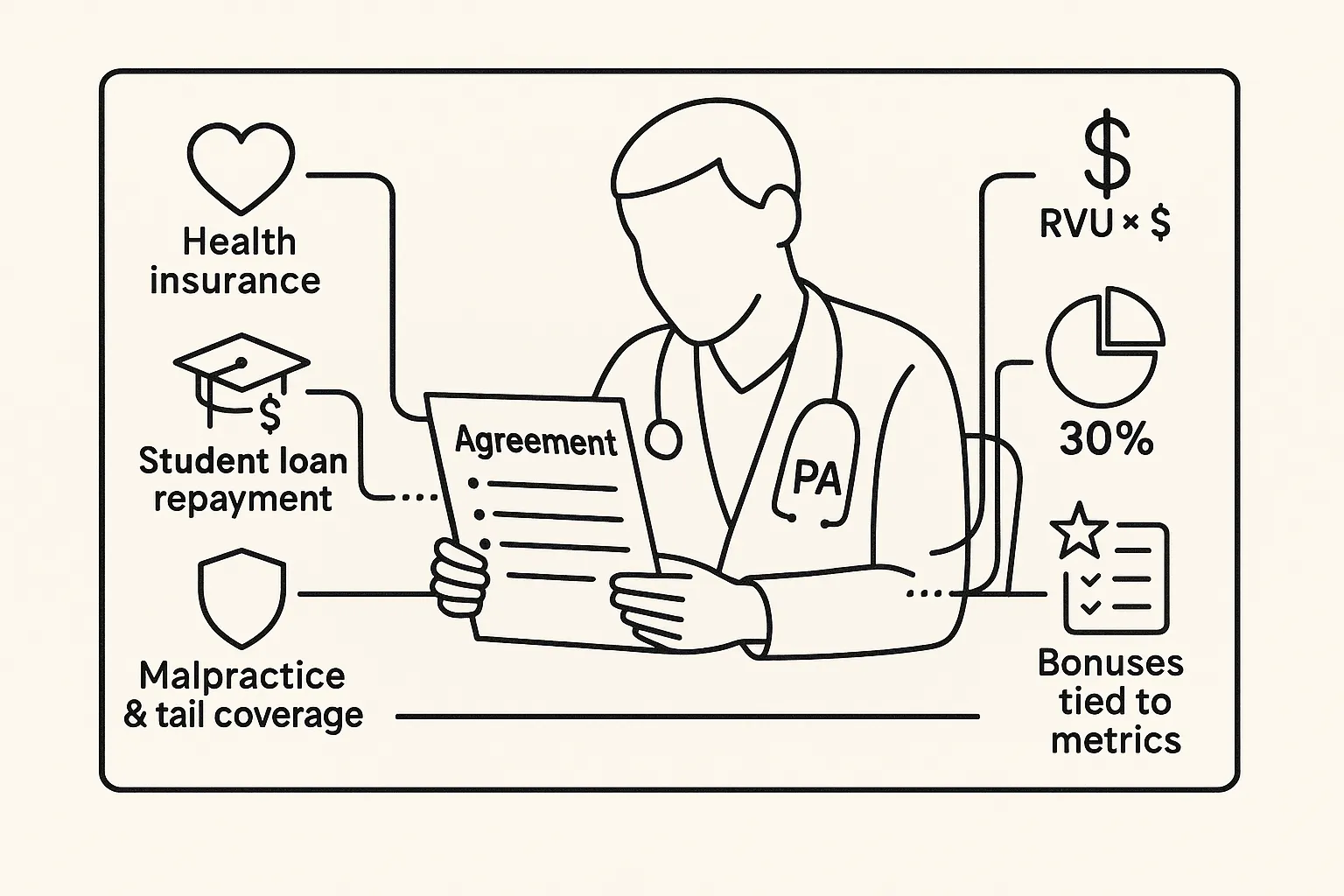
Compensation provisions determine take-home pay and whether the PA may face later reconciliations, negative accruals, or clawbacks. Our PA compensation and productivity review examines the complete pay structure, including the base salary, bonus formulas, quality metrics, benefits, and expenses the clinician must personally cover.
A contract may combine a base salary with an RVU or collections-based incentive. Under an RVU formula, productivity compensation is generally calculated by multiplying credited RVUs by a conversion factor. For example, 4,000 RVUs at $40 per RVU would produce $160,000 in productivity compensation, subject to the agreement’s treatment of any base guarantee, reconciliation, exclusions, and negative accrual. PAs evaluating this structure should understand the contract’s precise RVU compensation terms, including when productivity is measured and paid.
Collections-based plans depend on money actually received rather than charges billed, so definitions and timing materially affect income. A percentage of “net collections” is not meaningful unless the agreement explains permitted deductions, payment timing, refunds, chargebacks, and access to supporting reports. Bonus provisions tied to quality measures, panel growth, or other thresholds should likewise use objective formulas rather than discretionary or undefined standards.
Benefits and expense terms also deserve review. The agreement should clarify eligibility for health insurance, retirement contributions, disability coverage, paid leave, CME allowances, professional dues, licensing costs, and student loan benefits. Vesting periods, reimbursement caps, full-time requirements, and prorating rules can substantially change the value of the overall offer.
Scope of Practice, Supervision, and Work Expectations
A PA’s job description should align with the offered specialty, anticipated clinical role, licensure, privileges, and applicable Illinois practice requirements. Broad language allowing the employer to assign any duties can create uncertainty about clinical responsibilities, administrative work, locations, and performance expectations. We review whether the employer may unilaterally change duties or add responsibilities without adjusting compensation.
Supervision, collaboration, delegation, prescribing, and privileging provisions should accurately reflect how the position will operate. The contract should identify responsibility for required documentation, onboarding, credentialing, and clinical approvals without improperly shifting institutional compliance failures to the PA. Language imposing disciplinary or financial responsibility on a PA for matters outside the PA’s control warrants particular attention.
Scheduling terms should address expected hours, call coverage, weekends, holidays, telehealth, moonlighting, and assignments at multiple facilities. Undefined call or location requirements can expand the workload without corresponding pay. The agreement should also explain whether call compensation, premium pay, travel reimbursement, or schedule changes are governed by the contract or by a separate policy the employer may revise.
Restrictive Covenants and Professional Mobility
Restrictive covenants can affect where and how an Illinois PA works after employment ends. A non-compete may restrict practice within a geographic area, while a non-solicitation clause may limit contact with former patients, referral sources, or employees. Confidentiality and non-interference provisions can impose additional obligations. Because enforceability depends on the governing law, contract language, and surrounding facts, each restriction should be reviewed in context through a focused non-compete and restrictive covenant review.
The practical effect depends on the restriction’s duration, geographic reach, triggering events, and definition of prohibited activity. A covenant covering multiple counties or all employer locations may substantially limit opportunities in a metropolitan market. Broad activity definitions may also reach telehealth, locum tenens work, administrative roles, or specialties unrelated to the PA’s former position.
We also examine whether a restriction applies after every type of separation, including employer-initiated termination without cause. Patient and employee non-solicitation language should distinguish active solicitation from ordinary professional relationships or passive responses. These details determine whether the clause presents a limited compliance obligation or a significant threat to future income and mobility.
Termination, Bonus Repayment, and Final Compensation
Termination provisions control how quickly either party may end the relationship and what happens to compensation afterward. A careful contract termination review examines without-cause notice, for-cause events, cure periods, immediate termination rights, severance, and the effect of termination on unpaid wages or earned incentives.
Cause definitions should be objective enough for the PA to understand which events permit immediate termination. Agreements may include fraud, criminal conduct, loss of licensure, exclusion from government programs, or material breach, but some also use subjective performance standards. If a breach can be corrected, the contract should be reviewed for a meaningful notice-and-cure process rather than automatic termination.
Signing bonuses, relocation assistance, student loan benefits, and other incentives commonly carry repayment obligations. The agreement should identify each trigger, the repayment period, whether the amount is prorated, and whether interest, collection costs, or payroll withholding may apply. Reviewing sign-on bonus repayment terms is especially important when repayment can be triggered even if the employer ends the relationship.
Final compensation provisions should explain when accrued salary, earned productivity pay, unused leave, and pending bonuses are calculated and paid. A bonus that is earned during employment but paid after separation may be forfeited if the contract requires active employment on the payment date. That condition should be identified before the PA relies on the expected compensation.
Malpractice Coverage, Indemnification, and Liability
Malpractice language should identify the policy type, coverage limits, covered services, carrier requirements, and responsibility for coverage after employment. Occurrence coverage generally applies to covered acts occurring during the policy period, while claims-made coverage may require tail protection when the relationship ends. Our review of tail insurance obligations for PAs focuses on who must obtain and pay for that protection and whether the obligation changes based on the reason for termination.
Indemnification provisions require separate attention because they may obligate the PA to reimburse the employer or pay defense costs in specified circumstances. We assess whether the employer agrees to defend and indemnify the PA for covered acts within the scope of employment, whether exclusions are clearly defined, and whether the PA must follow notice or consent-to-settle requirements.
The agreement should also address incident reporting, cooperation with claims, access to records, and coverage during transitions between employers. Unclear allocation of defense costs or gaps between employment dates can create significant personal exposure even when the employer states generally that malpractice insurance is provided.
Classification, Credentialing, and Contract Red Flags
The agreement’s classification of the PA as a W-2 employee or 1099 independent contractor affects tax withholding, benefits, expense responsibility, and the overall economics of the position. A true comparison requires more than looking at the stated rate. PAs considering contract work should obtain an independent contractor agreement review that evaluates compensation alongside insurance, taxes, scheduling control, equipment, professional expenses, and termination rights.
Credentialing and privileging provisions should state whether employment is contingent on approval, who manages the process, and what happens if approval is delayed or denied. The contract should also clarify whether compensation begins on the stated start date or only after privileges, payer enrollment, or another condition is satisfied. Undefined contingencies can leave a PA committed to the employer without a reliable income start date.
Recurring red flags include undefined productivity formulas, conflicting bonus provisions, unilateral schedule or location changes, vague performance standards, broad repayment clauses, and policies incorporated by reference but not supplied for review. A provision described as discretionary in one section may conflict with language elsewhere that appears to guarantee payment. These inconsistencies should be resolved in writing before the agreement is signed.
How an Illinois PA Contract Attorney Can Help
Attorney review is a form of proactive risk management. Chelle Law performs a line-by-line assessment of the agreement, identifies priority concerns involving compensation, malpractice coverage, restrictive covenants, repayment, termination, and clinical obligations, and explains how those provisions interact. The objective is to translate legal language into practical consequences for the PA’s income, liability, and career flexibility.
A review can also identify targeted requests for clarification or revision. Common priorities include objective compensation formulas, defined productivity reporting, clear responsibility for tail coverage, reasonable repayment terms, appropriate limits on restrictive covenants, and predictable termination rights. Addressing those issues before signing gives the PA a clearer understanding of the offer and a written agreement that more accurately reflects the expected working relationship.
Have an Illinois PA Contract Reviewed Before You Sign
Chelle Law reviews compensation, malpractice coverage, restrictive covenants, termination rights, repayment obligations, and other terms that can affect your Illinois physician assistant career.
Contact Chelle Law