
Physician assistants practicing in Iowa must account for requirements involving the Iowa Board of Physician Assistants, the Iowa Board of Medicine, and the Iowa Department of Inspections, Appeals, and Licensing. Iowa law addresses PA licensure, scope of practice, prescribing authority, and the circumstances in which supervision or practice-level collaboration applies. For example, a PA with less than two years of qualifying prior practice in an independent-practice arrangement must be supervised by an eligible physician, while other collaboration may be determined at the practice level. These requirements can directly affect contract provisions covering clinical duties, supervising relationships, credentialing, prescribing, chart review, and responsibility for regulatory compliance. PAs evaluating opportunities with hospitals, clinics, specialty practices, or telehealth organizations in Des Moines, Cedar Rapids, and other Iowa markets can benefit from reviewing whether the proposed duties and operational structure align with the contemplated practice arrangement.
The regulatory provisions are only part of the analysis. Compensation formulas, malpractice insurance, restrictive covenants, repayment obligations, call coverage, multi-site assignments, and termination rights can create substantial financial or career consequences. Chelle Law provides physician assistant contract review to identify unclear terms, explain how provisions interact, and flag language that may warrant clarification or revision before signing.
Iowa Employment and Independent Contractor Agreements

W-2 Employment Terms
A W-2 employment agreement commonly addresses salary, payroll withholding, benefits, schedules, leave, employer policies, and control over the working relationship. Review can determine whether the written agreement accurately reflects recruiting discussions about clinical hours, administrative time, call, remote work, work locations, and outside professional activities. It can also identify provisions allowing the employer to revise policies or duties without a corresponding right for the PA to end the agreement.
Referenced handbooks, compensation plans, supervision documents, and exhibits may be as important as the primary contract. If those materials can be changed unilaterally, the PA may have less certainty about compensation, schedules, or benefits than the signature document initially suggests.
1099, PRN, Locum Tenens, and Multi-Site Arrangements
An independent contractor agreement may shift taxes, insurance expenses, licensing costs, and other business obligations to the PA. The practical allocation of control, expenses, scheduling, credentialing, and compliance responsibilities matters more than the agreement’s title. Chelle Law’s guide to W-2 and 1099 arrangements for physician assistants explains several financial and operational distinctions that may affect the offer.
PRN and locum tenens contracts may provide no guaranteed hours while imposing availability, call, or cancellation requirements. Multi-site provisions require similar attention because they may permit assignments across a broad territory, tie restrictions to every employer location, or leave travel time and expenses unaddressed. Review can clarify who controls assignments, whether minimum work is guaranteed, and how cancellation or credentialing delays affect payment.
Compensation, Productivity, and Benefits
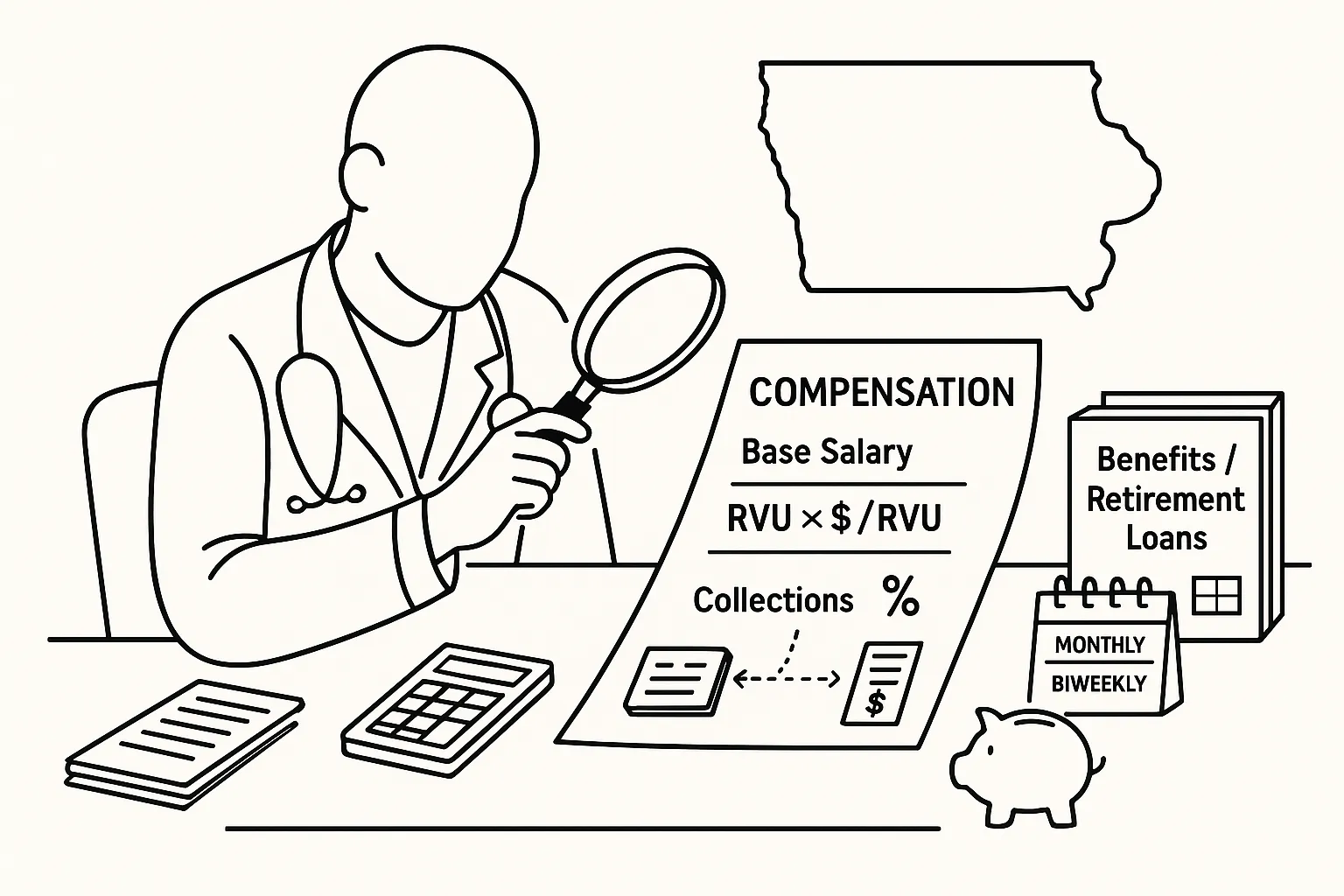
Base Salary, Guarantees, and Reconciliation
Base salary language establishes immediate income expectations, but the surrounding provisions determine whether the amount is truly guaranteed. A compensation plan may characterize payments as an advance or draw subject to later reconciliation. Negative accrual can carry a shortfall into a future period, reduce later bonuses, or create a repayment issue when employment ends.
Analysis can identify the pay period, conditions attached to a guarantee, reconciliation schedule, deficit treatment, and employer access to final compensation. It can also determine whether the PA receives reports needed to verify calculations and whether compensation may be changed during the contract term.
RVUs, Collections, Bonuses, and Benefits
Productivity compensation may use work relative value units, collections, encounters, quality measures, or a blended formula. An RVU calculation may depend on thresholds, conversion factors, attribution rules, caps, exclusions, and payment timing. Collections-based compensation can also expose the PA to delayed payments, denials, refunds, chargebacks, and billing activity outside the PA’s control. A detailed PA compensation and productivity review can test how these variables affect expected earnings.
Benefit terms may address eligibility dates, paid leave, retirement-plan vesting, continuing education, licensing expenses, professional dues, student loan assistance, signing bonuses, and relocation support. Review can distinguish objective bonus formulas from discretionary awards and identify whether leave, administrative work, call, or onboarding delays affect productivity thresholds. Repayment language also matters because some agreements require reimbursement if employment ends before a stated date, including after an employer-initiated termination.
Malpractice Coverage and Liability Allocation
Claims-Made, Occurrence, and Tail Coverage
No material Iowa PA-specific rule governing malpractice insurance or tail coverage was identified in the reviewed official sources, making the contract language particularly important. The agreement may specify a claims-made or occurrence policy, coverage limits, premium responsibility, prior-acts coverage, and procedures for reporting claims. Claims-made coverage can create a need for extended reporting, commonly called tail coverage, after the policy or employment ends.
If the PA must purchase tail coverage, the obligation may become a significant departure expense. Review can identify which termination events trigger that responsibility, whether the cost shifts after a stated period of service, and whether the employer may satisfy the obligation through prior-acts coverage. The resource on tail insurance for physician assistants provides additional background on these provisions.
Indemnification and Post-Termination Duties
Indemnification provisions allocate responsibility for claims, losses, defense costs, and other liabilities. Broad or one-sided language may extend beyond the PA’s own conduct or require reimbursement for matters controlled by the employer. Analysis can compare the PA’s obligations with any employer commitment to provide a defense or indemnification for services performed within the scope of the role.
The contract may also impose duties to cooperate with claims, preserve records, attend proceedings, or remain available after departure. Those obligations can survive termination, so the agreement may need to address expense reimbursement, lost time, access to counsel, and the employer’s continuing control over the defense.
Iowa Scope of Practice, Supervision, and Credentialing
Supervision, Collaboration, and Clinical Duties
Iowa requires a physician assistant to hold the license required under Iowa Code chapter 148C. Contract duties therefore may be conditioned on maintaining licensure, credentialing, privileges, prescribing authority, and other qualifications applicable to the position. The agreement can allocate responsibility for applications, renewals, fees, continuing education, and notice of an event that may affect a credential.
Iowa’s framework distinguishes supervision from collaboration and recognizes independent practice organized through a professional corporation or professional limited liability company. A PA with less than two years of qualifying prior practice in an independent-practice arrangement must be supervised by a physician; otherwise, collaboration may be determined at the practice level. Where supervision applies, the supervising physician must meet Iowa eligibility requirements, the relationship requires board notification, and applicable supervision standards remain relevant. Contract review can determine whether the agreement identifies required relationships, communication methods, chart-review expectations, and responsibility for maintaining a compliant arrangement.
Entity structure does not expand professional scope. Clinical services must remain consistent with the PA’s education, training, experience, competence, and applicable practice arrangement, while delegated services must remain within the relevant scope of both the PA and supervising physician. Prescribing duties likewise cannot exceed the PA’s license, competence, practice arrangement, or applicable controlled-substance requirements.
Credentialing, Privileges, and Start-Date Risk
Credentialing and privileging provisions affect when the PA can begin working and receiving compensation. Delays by a hospital, payer, clinic, or other third party may postpone the start date even when the PA has completed the required submissions. The contract may also allow termination if approval is delayed or denied, without addressing compensation for the resulting waiting period.
Review can clarify who prepares and pays for applications, whether compensation begins before credentialing is complete, and what happens if a site-specific issue arises. It can also identify whether loss or suspension of privileges at one location permits termination across an entire organization and whether the PA receives notice and an opportunity to address a correctable issue.
Iowa Non-Competes, Non-Solicitation, and Repayment
Institution-Specific and General Restrictive Covenant Issues
Iowa law contains an institution-specific restriction relevant to physician assistants. The University of Iowa Hospitals and Clinics must adopt a policy prohibiting non-compete clauses in PA employment contracts entered into, extended, or renewed on or after the applicable Act’s effective date. This requirement is limited to that institution and does not create a statewide statutory ban covering every Iowa PA employer.
Outside that institution-specific rule, no generally applicable statewide statutory prohibition on PA non-competes was identified in the reviewed official sources. Other restrictions remain subject to applicable Iowa contract law and judicial precedent. A physician assistant non-compete review can identify the restricted period, geographic area, covered services, triggering events, and locations used to calculate the restriction. Non-solicitation and confidentiality provisions may separately affect contact with patients, employees, referral sources, or business relationships.
Repayment, Clawbacks, and Final Deductions
Repayment clauses may cover signing bonuses, relocation assistance, student loan payments, training expenses, compensation guarantees, or alleged productivity overpayments. The financial effect depends on the triggering event, service period, prorated schedule, and treatment of employer-initiated termination. A provision requiring full repayment near the end of a service commitment may be materially different from one that reduces the balance monthly.
Post-termination reconciliation language can create additional exposure if the employer may recalculate productivity, apply chargebacks, or deduct amounts from final compensation. Review can determine whether the PA has access to supporting records, a process for disputing the calculation, and clear limits on the amounts claimed.
Termination, Notice, and Dispute Terms
For-Cause and Without-Cause Termination
For-cause termination provisions may address loss of licensure, credentialing or privileging problems, policy violations, exclusion from government programs, performance concerns, or misconduct. Vague standards can permit an abrupt departure with limited opportunity to respond. A cure period may allow time to correct certain breaches, although some events may be treated as grounds for immediate termination.
Without-cause termination permits one or both parties to end the relationship after advance notice. Analysis can identify whether notice rights are mutual, whether the PA must continue working throughout the notice period, and whether the employer may remove the PA from the schedule without continuing compensation. It can also clarify how notice affects bonuses, benefits, repayment, malpractice coverage, and restrictive covenants.
Departure Obligations and Dispute Resolution
A focused review of physician assistant termination terms can evaluate final compensation, severance, benefit continuation, patient-transition duties, property return, record access, tail coverage, and repayment exposure. The analysis can also determine whether a non-compete or non-solicitation clause applies after an employer-initiated termination.
Arbitration, governing-law, venue, attorney-fee, and dispute-notice provisions determine how and where a disagreement may proceed. These clauses may affect cost, access to court, available procedures, and the time allowed to raise a claim. Unilateral amendment provisions warrant similar attention when they permit changes to compensation, schedules, duties, or policies during the term.
Preparing for an Iowa PA Contract Review
A complete review extends beyond the signature document. Relevant materials may include the offer letter, exhibits, compensation plans, bonus formulas, RVU conversion tables, job description, handbook provisions, supervision documents, call schedules, malpractice summaries, and repayment addenda. Recruiting statements about schedules, remote work, administrative time, future compensation, or advancement can also be compared with the written terms.
- Confirm how salary, productivity compensation, bonuses, and final compensation are calculated.
- Identify malpractice coverage, tail responsibility, indemnification, and post-termination cooperation duties.
- Evaluate Iowa licensure, scope, supervision or collaboration, prescribing, and credentialing provisions.
- Clarify call, scheduling, outside-work, travel, and multi-site requirements.
- Measure the practical effect of non-compete and non-solicitation restrictions.
- Calculate potential repayment obligations, chargebacks, and final deductions.
- Review notice periods, termination triggers, cure rights, severance, and dispute procedures.
Potential warning signs include discretionary bonus language without objective metrics, unexplained negative accrual, broad authority to change compensation, tail insurance assigned to the PA after any departure, expansive restrictive covenants, full bonus repayment after an employer-initiated termination, and vague immediate-termination standards. Reviewing these terms before signing allows the PA to understand the offer as a whole and identify provisions that may warrant clarification or revision.
Speak With an Iowa Physician Assistant Contract Lawyer Before You Sign
Chelle Law can review the proposed agreement, explain its compensation and practice terms, identify financial and departure risks, and flag provisions that may warrant clarification or revision.
Request a PA Contract Review