
Physician assistants practicing in Iowa work under state-specific requirements overseen by the Iowa Board of Medicine, including rules affecting scope of practice, supervision, collaboration, delegation, and prescribing. Those regulatory obligations can intersect directly with an employment or independent contractor agreement, especially when the contract assigns responsibility for licensure, credentialing, supervising relationships, multi-site coverage, or compliance with employer protocols. PAs considering positions with hospital systems, clinics, telehealth groups, or specialty practices in Des Moines and Cedar Rapids should also examine how compensation, malpractice coverage, restrictive covenants, repayment duties, and termination rights operate together. Chelle Law reviews these provisions line by line so Iowa PAs can understand both the financial consequences and the state-specific practice issues tied to the proposed role before signing.
Employment and Independent Contractor Agreements in Iowa

Iowa PAs commonly receive either W-2 employment agreements or 1099 independent contractor agreements. Employment agreements typically address payroll withholding, benefits, scheduling, employer policies, and the employer’s control over the working relationship. Independent contractor agreements may emphasize autonomy and separate billing or expense arrangements, but they can also shift tax obligations, insurance costs, and compliance responsibilities to the PA. Understanding the practical differences between W-2 and 1099 PA arrangements is therefore more important than relying on the agreement’s title.
During review, we examine whether the compensation, scheduling, expense, supervision, and facility requirements are consistent with the relationship described in the contract. Control over hours, required protocols, credentialing mandates, and restrictions on outside work may create concerns when an agreement labels the PA as an independent contractor while imposing employment-like controls.
Locum tenens, PRN, and shared-provider agreements introduce additional payment and scheduling issues. Locum contracts may use daily or hourly rates and separately allocate travel, expenses, and malpractice obligations. PRN arrangements may provide no guaranteed hours while still imposing call or availability requirements. Agreements covering multiple clinics can also include payer-allocation rules, chargebacks, and restrictive covenants triggered across every assigned site.
Compensation, Productivity, and Benefit Terms
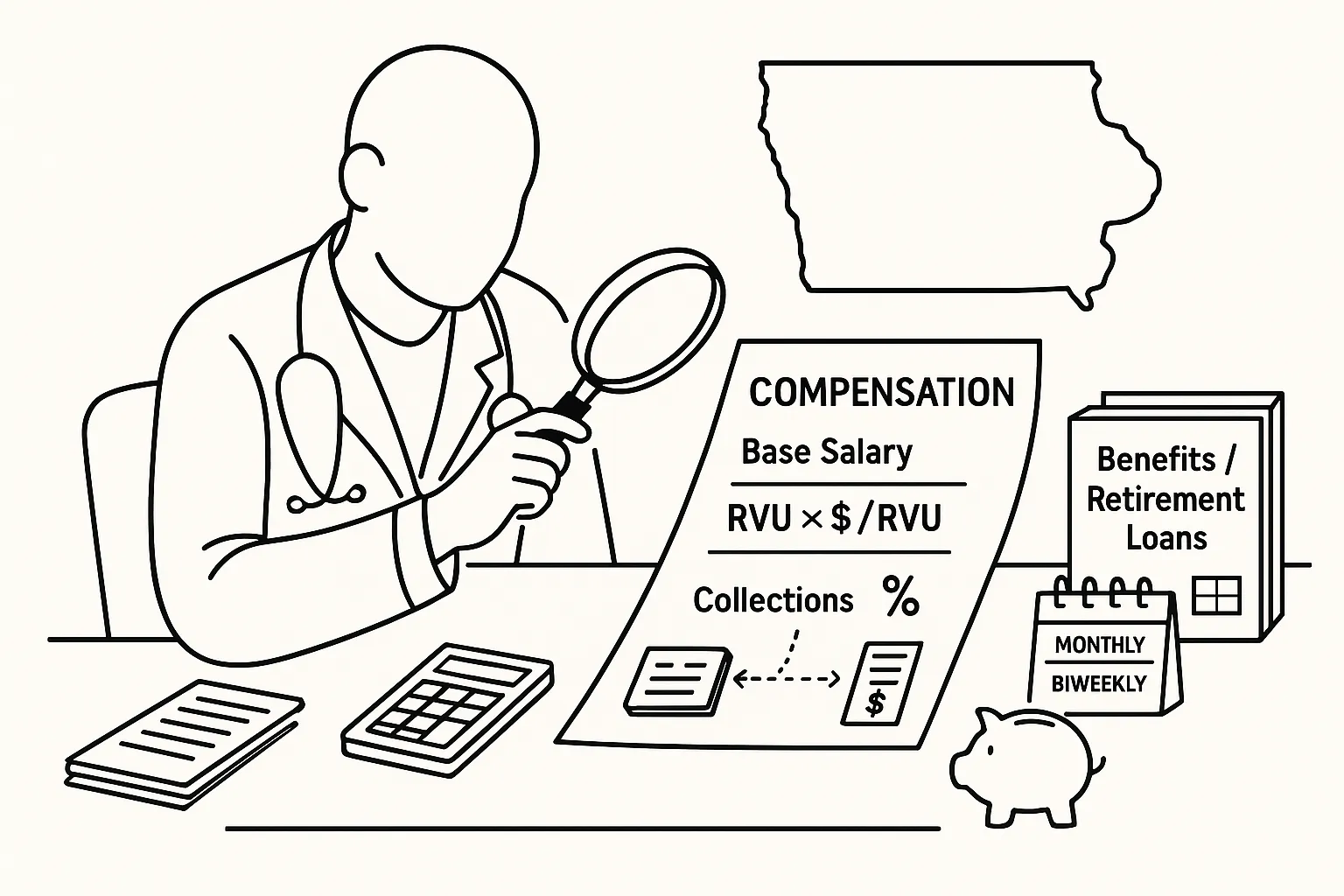
Base salary and guaranteed stipend language establish the PA’s immediate income expectations. A review should determine whether the stated amount is truly guaranteed, how frequently it is paid, and whether the employer may reconcile it against future productivity. Negative accrual or frequent reconciliation provisions can turn what appears to be guaranteed compensation into a temporary draw that the PA may later have to repay or offset through additional production.
Productivity compensation may use work relative value units, collections, quality measures, or a combination of formulas. An RVU model generally multiplies credited RVUs by a conversion rate after applying thresholds, caps, or other adjustments, but the payment cycle and attribution rules determine what the PA actually receives. Our guide to RVU compensation for PAs explains why the conversion factor alone does not provide a complete picture.
Collections-based models delay compensation until the employer receives payment, potentially exposing the PA to denied claims, delayed payer remittances, chargebacks, and billing practices outside the PA’s control. Bonus provisions also require close attention because objective formulas differ significantly from discretionary language that allows the employer to change metrics or withhold an award. A comprehensive compensation review examines thresholds, attribution, reconciliation, payment timing, and access to the underlying productivity data.
Benefits should identify eligibility dates, retirement-plan vesting, paid leave, continuing education support, and any conditions attached to student loan, signing, or relocation payments. Bonus repayment provisions may require reimbursement when employment ends before a stated date, including in circumstances the PA did not initiate. Reviewing sign-on bonus repayment terms helps clarify whether the obligation is prorated, what events trigger it, and whether the employer can demand the full amount after termination without cause.
Malpractice Coverage and Liability Allocation
Malpractice provisions should identify the type of policy, coverage limits, premium responsibility, and what happens when the agreement ends. Claims-made coverage generally requires an active policy when a claim is reported, which can create a need for extended reporting, or tail, coverage after departure. Occurrence coverage generally applies based on when the underlying event occurred and ordinarily does not create the same tail requirement.
If an employer provides claims-made insurance during employment but assigns tail responsibility to the PA at termination, the PA may face a significant expense precisely when changing jobs. The wording should explain who purchases the policy, which termination events shift the cost, and whether the obligation changes based on length of service. Our resource on tail insurance for physician assistants discusses the contract provisions that should be reviewed before accepting that responsibility.
The agreement may also allocate control of the defense, indemnification obligations, and liability for conduct performed within the scope of employment. We examine whether the employer agrees to defend and indemnify the PA, whether those protections survive termination, and whether broad indemnification language could make the PA responsible for losses beyond the PA’s own conduct. Unilateral rights to change coverage or premiums can create additional financial uncertainty.
Iowa Scope of Practice, Supervision, and Credentialing
Contract provisions governing clinical duties should be evaluated alongside Iowa requirements administered by the Iowa Board of Medicine. Scope, delegation, supervision, collaboration, and prescribing language can affect which services the PA may perform, how responsibilities are documented, and whether the employer expects duties beyond the contemplated role. Broad clauses permitting the employer to expand responsibilities without corresponding changes to compensation, support, or insurance deserve particular attention.
We assess whether the agreement clearly describes the supervising or collaborative structure, preserves appropriate clinical authority, and identifies any separate protocols or agreements the PA must follow. Iowa PAs may also consult the Iowa Physician Assistant Society for professional information and legislative updates that may affect practice requirements.
Credentialing and privileging clauses determine when the PA can begin working and what happens if a hospital, payer, or clinic delays or denies approval. The contract should identify who prepares and pays for applications, whether compensation begins before credentialing is complete, and whether a delay allows either party to terminate. It should also address the employer’s ability to suspend privileges and whether a site-specific credentialing problem affects employment across an entire health system.
Non-Competes, Non-Solicitation, and Repayment Duties
Restrictive covenants can limit where and how an Iowa PA works after the contract ends. Non-compete provisions typically define a restricted period, geographic area, and category of prohibited work, while non-solicitation clauses may address patients, employees, referral sources, or business relationships. The practical effect depends on the precise wording, the locations included, and the event that triggers the restriction.
Restrictive covenants in Iowa are evaluated in light of reasonableness and public-interest considerations, but broad language can still create immediate career and relocation concerns even when enforceability is disputed. A focused PA non-compete review can identify whether the restriction applies to every employer location, follows the PA after termination without cause, or extends beyond the services the PA actually performed.
Repayment and clawback clauses create separate post-employment exposure. They may cover signing bonuses, relocation assistance, student loan payments, training costs, compensation guarantees, or alleged productivity overpayments. We assess the triggering events, any prorated repayment schedule, the employer’s deduction rights, and whether a post-termination reconciliation could leave the PA owing money after departure.
Termination, Notice, and Dispute Resolution
Termination provisions define how the relationship ends and what each party owes at departure. For-cause definitions may include loss of licensure, credentialing problems, policy violations, performance concerns, or other events, but vague standards can permit abrupt termination with limited opportunity to respond. Without-cause termination language establishes whether either party may end the agreement after notice and whether the PA must continue working throughout the notice period.
A review of PA termination terms should also address severance, payment of earned compensation, benefit continuation, tail insurance, bonus repayment, and the effect of termination on a non-compete. Arbitration, governing-law, and venue clauses determine where disputes are heard and how costs may be allocated. Unilateral amendment provisions deserve similar scrutiny because they may allow an employer to change compensation, duties, schedules, or policies during the contract term.
Preparing for an Iowa PA Contract Review
A complete review requires more than the signature document. PAs should gather the agreement, offer letter, exhibits, referenced policies, compensation plans, bonus formulas, RVU conversion tables, supervision documents, and any addenda. Oral recruiting promises concerning schedules, call, remote work, partnership opportunities, or future compensation should also be identified so the written agreement can be checked for consistency.
- Confirm how base pay, productivity compensation, bonuses, and final compensation are calculated.
- Identify malpractice coverage, tail responsibility, and indemnification obligations.
- Review scope, supervision, credentialing, call, and multi-site requirements.
- Measure the practical effect of non-compete and non-solicitation restrictions.
- Calculate potential repayment obligations and post-termination deductions.
- Clarify notice periods, termination triggers, severance, and dispute procedures.
Common warning signs include discretionary bonus language without objective metrics, ambiguous negative accrual, tail insurance assigned to the PA, broad restrictive covenants, unilateral amendment rights, and vague termination-for-cause definitions. Reviewing the entire agreement before signing provides an opportunity to understand which provisions are negotiable and which risks must be weighed as part of the employment decision.
Review Your Iowa PA Contract Before You Sign
Chelle Law reviews compensation, malpractice coverage, Iowa practice obligations, restrictive covenants, repayment provisions, and termination rights so you can evaluate the complete agreement.
Contact Chelle Law