
Louisiana physician assistants practice within a regulatory framework overseen by the Louisiana State Board of Medical Examiners, while the Louisiana Board of Pharmacy is relevant to state controlled-substance credentialing. Louisiana requires PA licensure, documented supervision, delegated clinical duties, and practice protocols; prescribing controlled substances also depends on the required state and federal registrations. These requirements can affect how an agreement describes the supervising physician, practice sites, credentialing, prescribing authority, and responsibility for maintaining approvals. Opportunities with hospitals, clinics, and specialty groups in New Orleans and Baton Rouge may also involve call coverage, multiple facilities, productivity compensation, or delayed credentialing. A Louisiana physician assistant contract review can compare those expectations with the written terms and identify provisions affecting compensation, malpractice coverage, restrictive covenants, termination rights, repayment obligations, and professional mobility before the agreement is signed.
The provisions must also be read together. A credentialing delay may affect the start date and salary guarantee, while a termination event may simultaneously trigger bonus repayment, tail insurance costs, forfeited incentive compensation, and a post-employment restriction. Attorney-led review helps clarify those connections and highlights terms that may warrant questions, revisions, or additional documentation.
Louisiana PA Regulation and Contract Language

Licensure, Supervision, and Delegated Duties
A person must hold a Louisiana State Board of Medical Examiners license before practicing as a physician assistant. Louisiana’s framework also requires a PA to provide medical services under a supervising physician and within the PA’s education, training, experience, and delegated duties. Supervision generally does not require the physician’s physical presence, but it must be documented and reviewed annually.
Contract review can determine whether the agreement accurately identifies the clinical role, supervisory structure, and limits of delegated authority. Broad clauses allowing an employer to add any duty or change the role unilaterally may create uncertainty about whether future assignments fit the expected position and applicable practice requirements. Language addressing professional standards, policies, and regulatory compliance should not obscure which responsibilities belong to the PA, supervising physician, or employing entity.
Supervising Physicians, Practice Sites, and Protocols
Louisiana permits qualified supervising physicians to supervise up to eight physician assistants. PAs may work for physician group practices, partnerships, professional medical corporations, hospitals, and other healthcare organizations when supervised by a qualified physician. Applicable documentation may include supervising-physician registration, clinical practice guidelines or protocols, practice notices, and notices addressing the end of supervision.
The agreement can be evaluated for consistency with that framework, including whether it identifies the supervising physician, principal practice site, additional locations, delegated services, and governing protocols. It should also explain what happens if the supervising physician leaves, supervision ends, or the employer transfers the PA to another facility. Those events may affect the PA’s ability to continue working even when the employment agreement remains in effect.
Prescribing Authority and Credentialing Conditions
A Louisiana PA may prescribe, order, and administer legend drugs and Schedule II-V controlled substances to the extent delegated by the supervising physician. Controlled-substance prescribing requires a current PA license, delegated authority, a Louisiana controlled-dangerous-substance license, and DEA registration. Contract terms addressing prescribing therefore need to align with the authority actually delegated and the credentials maintained for the position.
Licensing, credentialing, payer enrollment, DEA registration, and hospital privileges can determine when clinical work and compensation begin. Review can identify who handles each process, who pays the associated expenses, and whether a delayed approval permits the employer to postpone pay or terminate the agreement. The start date, salary guarantee, relocation commitments, and credentialing contingencies should be analyzed together, particularly if the PA must leave another position before all approvals are complete.
Compensation and Productivity Provisions
Base Salary, Collections, and RVU Formulas
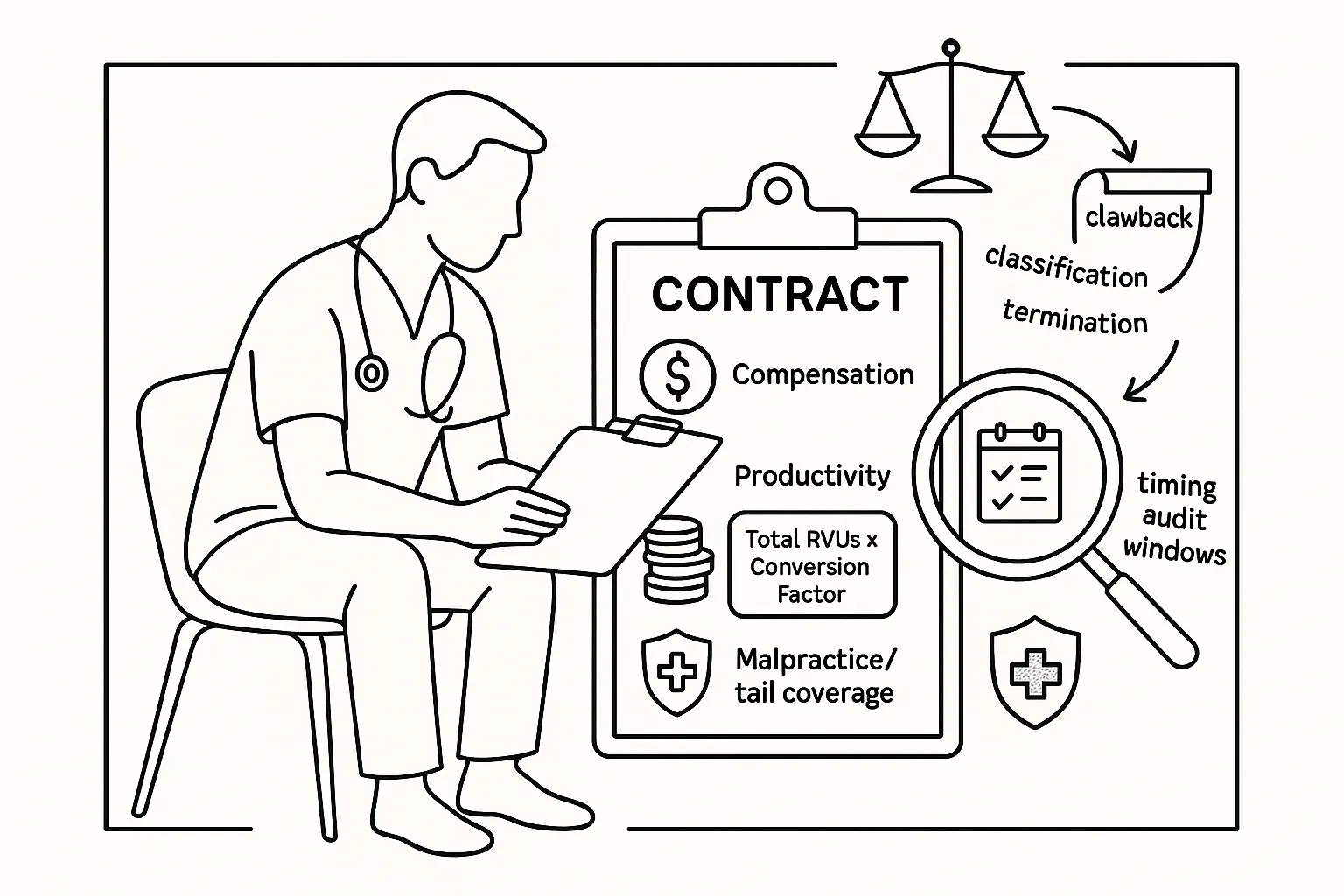
PA compensation may include a base salary, collections, relative value units, quality incentives, or a combination of those components. A collections model depends on money received rather than services performed, so billing delays, denials, write-offs, and adjustments can affect payment. An RVU formula may also remain incomplete unless it defines eligible services, attribution rules, thresholds, exclusions, the conversion factor, and treatment of shared visits.
A focused physician assistant compensation and productivity review can test whether the formula is detailed enough to calculate potential earnings. Base guarantees should be examined for duration, reduction rights, and conditions tied to schedules, credentialing, or productivity. Recruitment projections and sample calculations are useful comparison points, but they may not control payment unless incorporated into the signed agreement.
Bonuses, Audits, and Final Reconciliation
Bonus provisions may define when compensation is earned, when it is paid, whether a cap or threshold applies, and how quality or productivity data are measured. Review can also identify whether the employer may modify targets during the measurement period or exclude services from credit. If a bonus depends on discretionary determinations, the agreement may provide less certainty than a formula based on defined data.
Audit, withholding, and reconciliation clauses deserve particular attention. Broad language may allow retrospective deductions, recoupment, or negative accrual without a deadline or meaningful dispute process. Analysis should address access to supporting records, the time allowed to challenge an adjustment, and whether earned compensation remains payable after termination.
Malpractice Coverage and Liability Allocation
Occurrence, Claims-Made, and Tail Coverage
The agreement may identify whether the employer provides occurrence or claims-made malpractice insurance, the applicable policy limits, and the locations and services covered. Occurrence coverage generally applies to incidents during the policy period regardless of when a claim is made. Claims-made coverage generally requires coverage to remain in effect when a claim is reported, potentially creating a need for extended reporting, or tail, coverage after employment ends.
The Louisiana PA authorities reviewed do not establish a specific statutory requirement for occurrence coverage, claims-made coverage, or a particular party to purchase tail insurance. Those obligations therefore require careful contractual analysis and coordination with the employer’s policy. Reviewing tail insurance terms for physician assistants can clarify who pays, when coverage is required, and whether responsibility changes based on the reason for departure.
Indemnification, Defense, and Reporting Duties
Louisiana’s profession-specific framework places legal responsibility for a supervised PA’s patient-care activities with the supervising physician and applicable employing or practice entity. Contract terms still matter because they may address insurance, claim reporting, cooperation, consent to settlement, defense obligations, and responsibility for uninsured expenses. A one-sided indemnification clause may also attempt to shift exposure arising from employer systems, billing practices, or supervisory conduct.
Malpractice, indemnity, and termination provisions should be read together. Review can identify whether coverage continues through the last day of clinical work, whether all practice sites and assigned services are included, and what obligations survive termination. The analysis can also distinguish professional liability coverage from separate issues such as licensing defense, employment disputes, or cyber liability.
Restrictive Covenants, Termination, and Repayment
Louisiana Non-Compete and Non-Solicitation Terms
Louisiana generally treats agreements restraining a lawful profession, trade, or business as void unless a statutory exception applies and its requirements are satisfied. The state has a specific noncompetition provision for physicians, but that physician-specific exception does not expressly extend to physician assistants. A PA restriction should therefore be analyzed under Louisiana’s general statutory framework rather than assumed to receive the treatment applicable to physicians.
A physician assistant non-compete review can evaluate the stated duration, geographic scope, restricted activities, named parishes, covered facilities, and triggering events. Non-solicitation clauses may separately restrict contact with patients, employees, referral sources, or business relationships. The practical effect depends on the PA’s specialty, actual work locations, local employment options, and plans after departure.
Termination Rights and Notice Requirements
Termination provisions determine whether either party may end the relationship without cause, how much notice is required, and which events permit immediate termination. For-cause definitions may address licensure, credentialing, exclusion from healthcare programs, misconduct, performance, policy violations, or loss of supervision. Vague standards can become especially consequential when a for-cause termination also affects repayment, malpractice coverage, or unpaid bonuses.
Review can compare notice periods, cure opportunities, compensation through the termination date, and the treatment of accrued leave and incentive pay. The agreement’s termination mechanics should also account for the notices or documentation required when supervision ends. Chelle Law’s resource on terminating a physician assistant contract explains additional issues to consider when planning a departure.
Bonus Repayment, Choice of Law, and Forum
Signing bonuses, relocation payments, loan assistance, and income guarantees may be repayable if employment ends during a stated period. Analysis can identify whether repayment is prorated, which termination events trigger it, whether interest or collection costs apply, and when the balance becomes due. These obligations should be compared with without-cause termination rights so that an employer-initiated departure does not create an overlooked repayment demand.
Choice-of-law and forum provisions also warrant review. Under Louisiana’s general employment statute, such provisions are generally void in an employee dispute unless expressly, knowingly, and voluntarily agreed to and ratified by the employee after the incident giving rise to the dispute. A contract’s advance designation of another state’s law or courts should not simply be assumed to control every future employment dispute.
Duties, Scheduling, and Worker Classification
Call, Multi-Site Coverage, and Schedule Changes
The duties section should reflect the position described during recruitment. Broad language permitting unilateral changes to locations, shifts, call, administrative work, or clinical responsibilities can create obligations beyond the original offer. Review can clarify regular hours, weekend coverage, call frequency, response expectations, additional facilities, travel, mileage, and whether extra coverage is included in base compensation.
Multi-site assignments also need to remain consistent with the documented supervisory structure, practice protocols, credentialing, and malpractice coverage. If the employer may add facilities, the agreement may need to address reasonable distance, advance notice, reimbursement, and required approvals. Material recruitment statements about a predictable schedule, limited call, or a primary location are more reliable when included in the signed contract or an amendment.
W-2 Employment and Independent Contractor Agreements
An agreement labeled “independent contractor” requires practical review rather than reliance on its title. Scheduling control, mandatory policies, required facilities, equipment, taxes, benefits, expenses, professional liability, and authority over the manner of work all affect the economic arrangement. The contract may also place licensing, insurance, billing, and administrative costs on the PA that an employer would otherwise cover.
Comparing the proposed terms with the differences between W-2 and 1099 physician assistant work can clarify responsibility for taxes, benefits, insurance, and business expenses. Classification language should also be evaluated alongside the actual supervision, delegation, and operational control contemplated by the relationship.
Contract Red Flags to Address Before Signing
- Compensation formulas that omit conversion factors, attribution rules, payment timing, or reconciliation procedures.
- Open-ended audit, withholding, or recoupment rights without deadlines or a dispute process.
- Undefined supervision, delegated duties, prescribing authority, practice sites, or protocols.
- Credentialing conditions that allow an indefinite unpaid start-date delay.
- Non-compete or non-solicitation provisions with unclear geography, activities, facilities, or triggering events.
- Claims-made malpractice coverage that assigns tail costs without defining when the obligation applies.
- Indemnification provisions that attempt to shift broad employer, billing, or supervisory risks to the PA.
- Termination definitions based on vague performance standards without a reasonable opportunity to cure.
- Bonus, relocation, or guarantee repayment provisions that are not prorated or clearly triggered.
- Unilateral authority to change schedules, call duties, work locations, or compensation plans.
These provisions often create greater risk in combination than they do individually. For example, a broadly drafted for-cause termination clause may trigger repayment, end tail assistance, and eliminate unpaid incentive compensation at the same time. Likewise, an incomplete productivity formula combined with broad audit rights may produce a post-termination balance the PA did not anticipate. A complete review considers how the agreement allocates regulatory, financial, and professional risk across the entire relationship.
Preparing for a Louisiana Physician Assistant Contract Review
A useful review begins with the complete proposed agreement and every document incorporated by reference. Relevant materials may include the offer letter, job description, compensation plan, productivity examples, malpractice declarations, credentialing documents, practice protocols, handbook provisions, and any side letter or amendment. The physician assistant employment agreement checklist can help identify the records and terms to collect.
Priorities may differ by career stage and opportunity. New graduates may need additional clarity about orientation, supervision, credentialing, base guarantees, and early termination exposure. Experienced PAs may focus more heavily on productivity methodology, restrictive covenants, call obligations, leadership duties, or multi-site assignments. Any material promise concerning schedule, compensation, location, tail coverage, or credentialing support is more dependable when documented in a signed agreement.
Chelle Law provides attorney-led contract review with written commentary addressing compensation, supervision, malpractice obligations, termination, repayment, and post-employment restrictions. The review is designed to explain the agreement, identify risks, and flag provisions that may warrant clarification or revision before signing.
Speak With a Louisiana Physician Assistant Contract Lawyer Before You Sign
Get attorney-led review of the compensation, supervision, malpractice, termination, repayment, and restrictive-covenant terms that may affect your practice and finances.
Request a Contract Review