
Louisiana physician assistants practice under requirements overseen by the Louisiana State Board of Medical Examiners, so an employment or independent contractor agreement should be read alongside state rules governing PA licensure, supervision, delegation, prescribing, and scope of practice. Those issues can affect how duties are assigned, whether physician availability is described accurately, and who is responsible for maintaining credentials. Agreements offered by hospitals, clinics, and specialty groups in New Orleans and Baton Rouge may also address multi-site coverage, call, credentialing, and productivity in ways that differ by employer and practice setting. Chelle Law reviews whether the written terms align with the role the PA expects to perform and identifies contract risks involving compensation formulas, malpractice insurance, restrictive covenants, termination rights, and bonus repayment. A state-specific review helps connect Louisiana practice requirements to the provisions that control day-to-day work, financial exposure, and future mobility before the agreement is signed.
Louisiana PA Practice Rules and Contract Terms

Louisiana’s PA practice framework makes clear supervision, delegation, and scope language important parts of an employment agreement. Vague provisions may leave physician availability, delegated services, prescribing responsibilities, or performance expectations undefined. They can also permit an employer to assign additional duties without explaining whether those duties fit the expected position or applicable practice requirements. Contract language should accurately describe the clinical role instead of shifting regulatory responsibility to the PA through broad representations or indemnification terms.
Licensing, credentialing, DEA registration, and hospital privileges can also affect when work and compensation begin. An agreement should identify who handles each process, who pays the associated costs, and what happens if credentialing takes longer than anticipated. Terms that condition pay or continued employment on an uncertain approval date can create financial risk, particularly when the PA has already resigned from another position or relocated. Any termination right tied to credentialing should be evaluated together with the proposed start date and compensation guarantee.
Louisiana PAs may consult the Louisiana Academy of Physician Assistants for professional and regulatory updates. Those resources do not replace a review of the specific agreement, which should connect the proposed clinical responsibilities to compensation, insurance, scheduling, and termination provisions.
Compensation and Productivity Provisions
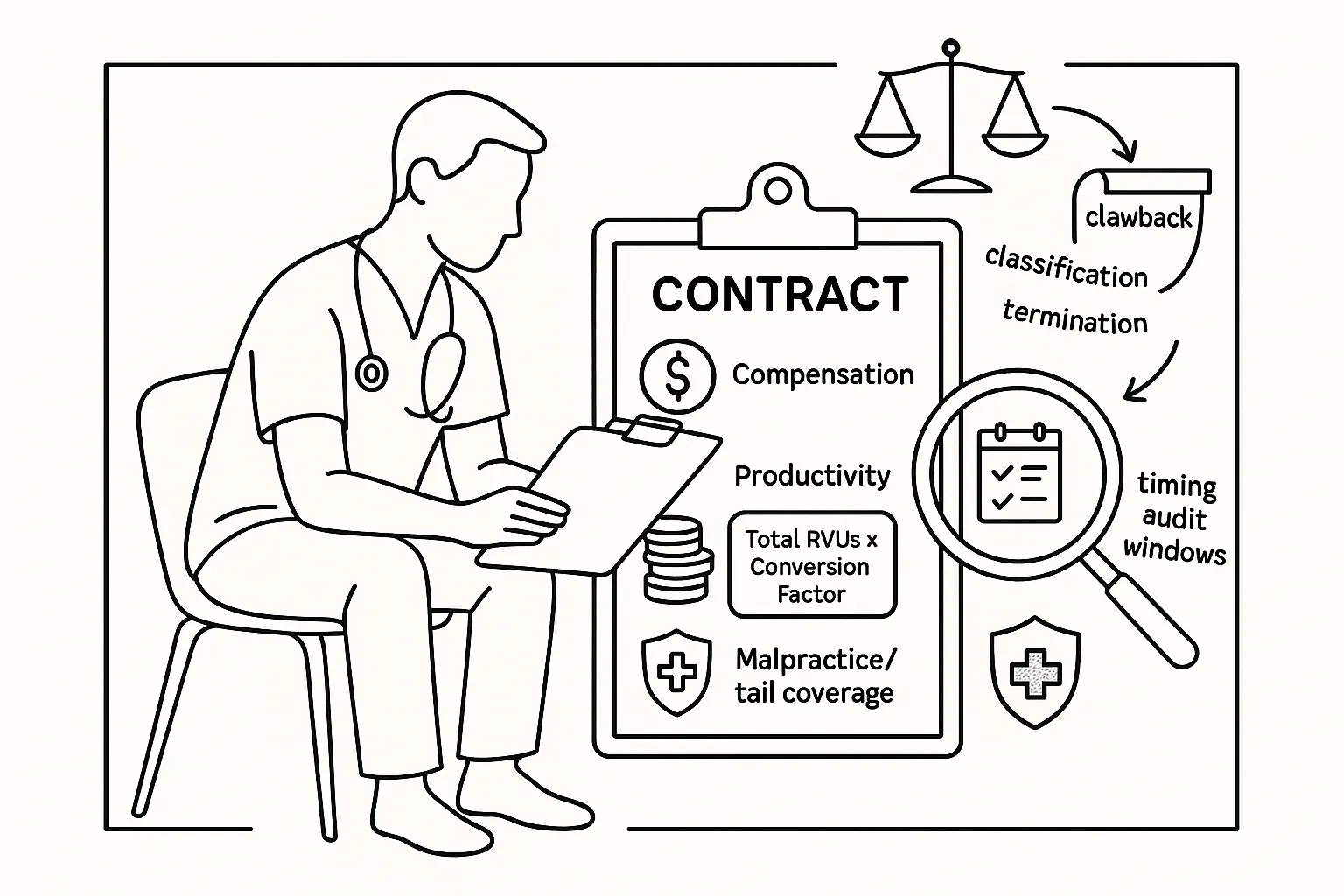
PA compensation may consist of a base salary, collections, relative value units (RVUs), quality incentives, or a combination of these components. A collections model ties compensation to cash received rather than services performed, so billing delays, denials, and adjustments can postpone or reduce payment. An RVU formula may appear straightforward—total RVUs multiplied by a conversion factor—but projected income remains uncertain unless the contract defines eligible services, attribution rules, thresholds, exclusions, and the applicable conversion factor. A focused PA compensation and productivity review can test whether the written formula is complete enough to calculate expected earnings.
Base guarantees should state their duration and any events that permit reduction. Bonus provisions should explain when compensation is earned, when it is paid, whether a threshold or cap applies, and how shared visits or physician adjustments affect credit. If sample calculations or historical productivity figures were provided during recruitment, they should be compared with the contract’s actual formula rather than treated as binding unless incorporated into the agreement.
Quality incentives and audit provisions require similar detail. The agreement should identify the measurement period, data source, applicable standards, and process for challenging an adjustment. Broad audit or withholding rights may permit retrospective deductions, recoupments, or negative accrual without a meaningful deadline or dispute procedure. These terms should also be reviewed for their effect on final compensation after termination.
Malpractice Insurance and Liability Allocation
The agreement should identify whether the employer provides occurrence or claims-made malpractice insurance, the applicable limits, and whether the coverage applies to every location and service included in the PA’s duties. Occurrence coverage generally applies to incidents during the policy period regardless of when a claim is made. Claims-made coverage generally requires the policy to remain active when the claim is reported, which may create a need for extended reporting coverage after the relationship ends.
If tail coverage may be required, the contract should state who purchases it and whether responsibility changes based on the reason for termination. Reviewing the agreement’s tail insurance obligations before signing can reveal a significant post-employment expense. Indemnification provisions also deserve attention because a one-sided clause may attempt to shift responsibility for employer negligence, billing systems, or supervisory failures to the PA. Insurance, indemnity, and termination language should therefore be read together rather than as isolated provisions.
Restrictive Covenants, Termination, and Repayment
Non-compete and non-solicitation provisions can affect where a Louisiana PA may work and which professional relationships may continue after departure. Duration, geographic scope, restricted activities, covered facilities, and triggering events should all be defined. A restriction covering multiple parishes, telehealth services, referral sources, or every patient of a large health system may have a broader practical effect than the clause’s label suggests. A physician assistant non-compete review evaluates that language in the context of the PA’s specialty, work locations, and anticipated career plans without assuming that every restriction will be treated the same way.
Termination provisions determine how the relationship can end, how much notice is required, and which events permit immediate termination. For-cause definitions should not rely solely on vague references to misconduct, performance, or policy violations, particularly when a for-cause termination also triggers repayment or forfeiture. Without-cause termination rights, cure periods, compensation through the termination date, and treatment of earned bonuses should be evaluated as part of planning for contract termination.
Signing bonuses, relocation payments, loan assistance, and income guarantees may be subject to repayment if employment ends during a stated period. The agreement should specify whether repayment is prorated, what events trigger it, whether interest applies, and when the balance becomes due. Reconciliation clauses can create additional exposure when advances or guarantees are compared with later collections or RVU production. These obligations should be assessed against the PA’s termination rights so that leaving the position does not produce an unexpected combination of repayment, tail, and lost compensation costs.
Duties, Scheduling, and Employment Classification
A contract’s duties section should reflect the position described during recruitment. Broad language allowing unilateral changes to clinical duties, locations, shifts, or administrative responsibilities can create obligations that were not included in the original offer. Work hours, call frequency, weekend coverage, additional facilities, travel, and call compensation should be stated clearly enough to distinguish ordinary expectations from additional work. The assignment provisions should also remain consistent with Louisiana scope, supervision, and delegation requirements.
An agreement labeled “independent contractor” requires a practical review of control, scheduling, taxes, benefits, expenses, and professional liability rather than reliance on the title alone. Employer-directed hours, required facilities, close performance control, and mandatory policies may affect the real-world arrangement. Comparing the proposed terms with the financial and operational differences between W-2 and 1099 PA work can clarify responsibility for taxes, insurance, benefits, and business expenses.
Multi-site and call obligations can also affect classification and compensation. The contract should explain whether travel time or mileage is addressed, whether call is included in base pay, and whether the employer may add facilities without the PA’s consent. Oral statements about a predictable schedule or limited coverage area should be placed in the written agreement or a signed amendment if they are material to accepting the position.
Contract Red Flags to Resolve Before Signing
- Compensation formulas that omit conversion factors, attribution rules, payment timing, or reconciliation procedures.
- Audit and withholding clauses that permit open-ended retroactive deductions without a dispute process.
- Undefined supervision, delegation, prescribing, or “additional duties” language.
- Non-compete or non-solicitation terms with unclear geography, activities, facilities, or triggering events.
- Claims-made malpractice coverage that assigns tail costs without explaining when the obligation applies.
- One-sided indemnification for employer conduct, billing errors, or supervisory failures.
- Termination definitions that use vague performance standards or eliminate reasonable cure rights.
- Bonus, relocation, or guarantee repayment provisions that are not prorated or clearly triggered.
These provisions often interact. For example, a broadly drafted termination-for-cause clause may activate bonus repayment, eliminate tail assistance, and affect unpaid incentive compensation at the same time. Likewise, an undefined productivity formula combined with broad audit rights may create a post-termination balance the PA did not anticipate. The agreement should be evaluated as a complete allocation of financial, regulatory, and professional risk.
Preparing for a Louisiana PA Contract Review
A useful review begins with the complete proposed agreement and every document incorporated by reference. Relevant materials may include the offer letter, job description, compensation plan, sample calculations, malpractice declarations, credentialing forms, handbook provisions, and any side letter or amendment. The PA employment agreement checklist can help identify documents and terms that should be collected before the review begins.
Priorities may differ by career stage and opportunity. New graduates often need clarity about training, supervision, credentialing, base guarantees, and early termination exposure. Experienced PAs may place greater emphasis on productivity methodology, restrictive covenants, call, leadership duties, or multi-site assignments. Any oral promise concerning schedule, compensation, location, tail coverage, or credentialing support should be documented in a signed agreement rather than left outside the contract.
Chelle Law’s attorney-led review examines the agreement line by line and provides written commentary addressing compensation, supervision, malpractice obligations, termination, repayment, and post-employment restrictions. Reviewing these provisions before signing allows the PA to understand the legal and financial consequences while there is still an opportunity to seek clarification or written changes.
Get Your Louisiana PA Contract Reviewed
Before signing an employment or independent contractor agreement, understand how its compensation, supervision, insurance, termination, and repayment provisions may affect your practice and finances.
Contact Chelle Law