
Physician assistants practicing in Maine enter employment and independent contractor agreements within a regulatory framework overseen by the Maine Board of Licensure in Medicine. Maine requirements involving PA licensure, supervision, collaboration, delegation, prescribing, and scope of practice can affect how clinical duties and compliance responsibilities should be described in a contract. Those concerns arise across hospital systems, private practices, specialty groups, urgent care centers, and telehealth arrangements serving healthcare markets such as Portland and Bangor. A Maine PA contract review should therefore consider more than salary alone. The agreement should clearly allocate supervision and credentialing responsibilities, define workload and call expectations, explain malpractice coverage, and establish what happens when employment ends. Chelle Law reviews these provisions together so physician assistants can understand how state-specific practice obligations interact with compensation formulas, repayment clauses, restrictive covenants, termination rights, and future career mobility before they sign.
PA Contract Types and Practice Settings in Maine

Employment agreements and independent contractor agreements differ in tax treatment, benefits, business expenses, and the employer’s control over the working relationship. A W-2 agreement commonly includes health insurance, retirement contributions, paid time off, and employer-defined scheduling. A 1099 agreement may shift benefit costs, malpractice obligations, taxes, and other expenses to the PA. The agreement’s label does not resolve every classification issue, so PAs should examine both the written terms and the practical working relationship. Our guide to W-2 versus 1099 arrangements for PAs explains these structural differences in greater detail.
Locum tenens agreements are usually time-limited and emphasize coverage periods, fee schedules, travel expenses, and credentialing responsibilities. Telehealth contracts may address technology, documentation, patient location, and interstate practice considerations. Hospital privileges and medical staff bylaws can create separate obligations involving credentialing, peer review, suspension, termination, and appeal rights. The contract should identify who handles and pays for initial applications, renewals, enrollment, and credentialing problems.
Practice setting also shapes compensation and clinical expectations. Hospital systems may combine salary guarantees with productivity incentives and detailed administrative requirements, while private practices or telehealth companies may rely more heavily on collections-based compensation. Surgical and procedural positions may include call stipends, case-volume incentives, or professional-fee allocations. Maine PAs may also consult the Maine Academy of Physician Assistants for professional information concerning practice authority and legislative initiatives.
Compensation, Bonuses, Benefits, and Repayment Terms
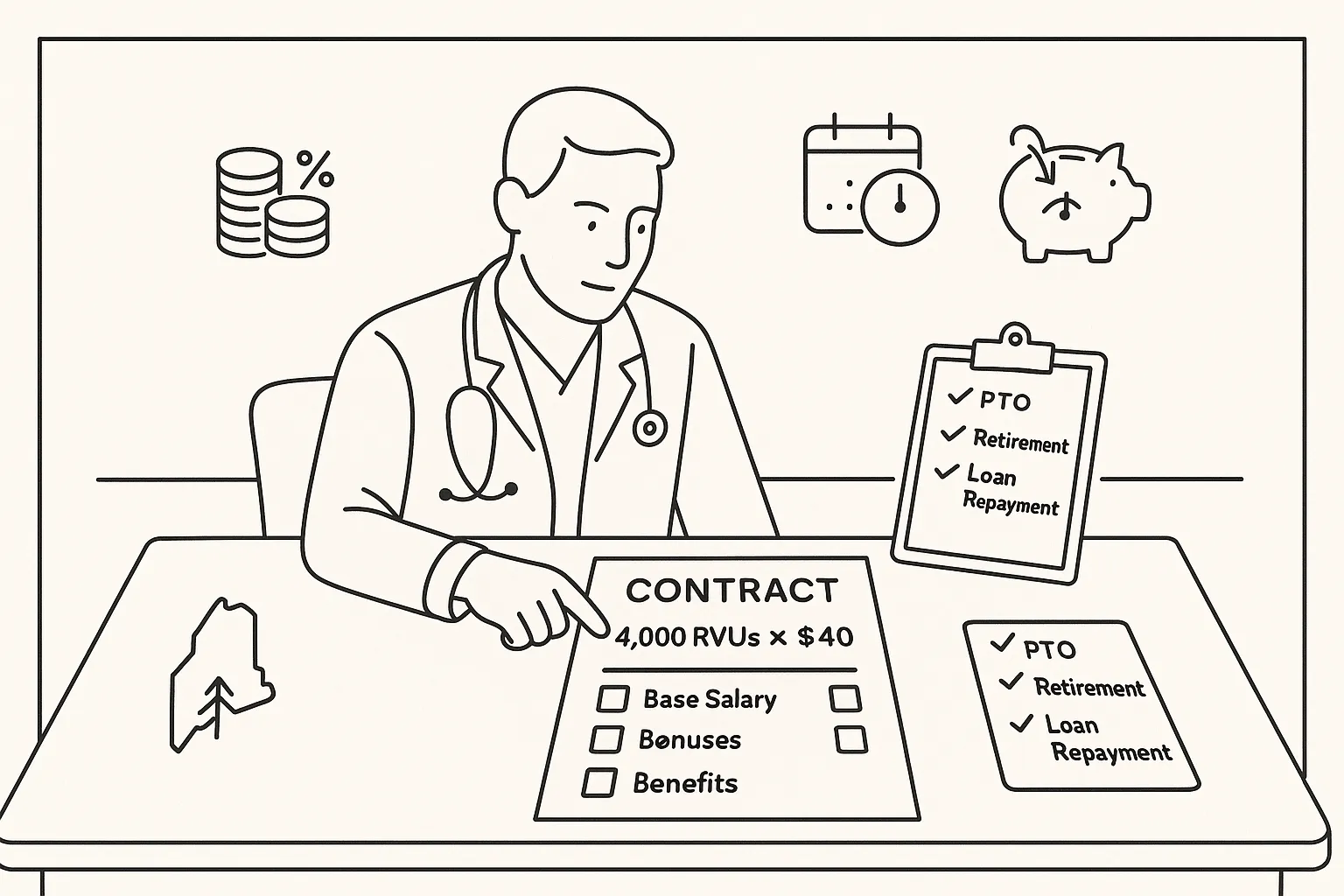
Base salary provides predictable income, while productivity compensation shifts some earning potential to measured output. RVU formulas typically apply a conversion factor to credited work, while collections models pay a percentage of revenue received by the practice. Important details include whether calculations use gross or net figures, how shared visits are credited, which payers or services are excluded, when reconciliations occur, and whether negative accrual carries into a later period. A focused PA compensation and productivity review can identify formulas that are incomplete, discretionary, or difficult to verify.
Bonus provisions may be based on production thresholds, quality measures, collections, or employer discretion. Signing and relocation payments frequently include repayment obligations if employment ends within a specified period, and the contract should explain whether repayment is prorated and which types of termination trigger it. Draws, advances, clawbacks, and later accounting adjustments can also create unexpected repayment exposure if productivity does not reach the employer’s assumptions.
Benefits should be reviewed with the same care as salary. Relevant terms include retirement contributions and vesting, paid-time-off accrual, health coverage, student loan assistance, continuing medical education, licensing fees, DEA registration expenses, and professional dues. PAs should confirm when benefits begin, whether a probationary period delays eligibility, and whether the employer may change benefit programs without adjusting compensation.
Maine Scope of Practice, Supervision, and Clinical Duties
Supervision, collaboration, and delegation clauses should align with the PA’s actual position and Maine’s regulatory framework. Contracts sometimes give an employer broad discretion to change supervising physicians, clinical sites, documentation requirements, or oversight procedures. Unclear language can create administrative burdens and uncertainty about responsibility for regulatory compliance. The agreement should also address what happens if a required clinical relationship changes or cannot be maintained.
Prescribing, credentialing, and privileging provisions should identify required registrations, responsibility for fees, and any restrictions on formularies or procedures. Employment may be conditioned on continuous licensure, payer enrollment, or hospital privileges, but the contract should distinguish between problems within the PA’s control and delays caused by the employer or credentialing process. Automatic suspension or termination language deserves particular attention when there is no notice or opportunity to address a curable issue.
Workload terms may include expected patient volumes, encounter targets, procedural duties, administrative work, and assignments at multiple locations. The agreement should explain whether nonclinical time is credited toward productivity and how additional sites or schedule changes are assigned. On-call responsibilities should also define frequency, response expectations, coverage arrangements, and compensation. PAs evaluating these provisions can review common call schedule and coverage requirements before accepting an open-ended obligation.
Malpractice Coverage, Tail Insurance, and Liability
Occurrence malpractice policies generally cover qualifying events that take place during the policy period, even if a claim is reported later. Claims-made policies generally require continuing coverage or tail insurance for claims reported after the underlying policy ends. A contract may place the full tail cost on the PA, require reimbursement of employer-purchased coverage, or divide the expense based on the reason employment ends. Because this obligation can create significant post-employment exposure, the policy type and payment responsibility should be stated clearly. Our resource on tail insurance for physician assistants discusses these distinctions.
Indemnification and duty-to-defend clauses require separate review because they may extend beyond ordinary malpractice coverage. The agreement should distinguish claims arising from the PA’s conduct from those caused by the employer, another clinician, defective systems, or duties outside the PA’s authorized role. Reporting and cooperation requirements should also be specific enough for the PA to understand when notice is required and what assistance must be provided after a claim or investigation.
Termination Rights and Post-Employment Restrictions
Termination provisions determine whether either party may end the agreement without cause, how much notice is required, and which events permit immediate termination. Broad for-cause definitions can affect final compensation, bonus eligibility, malpractice obligations, and repayment clauses. Cure periods may provide an opportunity to correct certain performance or administrative issues before termination. A review of PA termination terms should also address final pay timing, earned productivity compensation, severance, and obligations that survive departure.
Non-compete clauses can restrict where and for whom a PA may work after employment ends. Their practical impact depends on the wording, geographic reach, duration, covered services, and circumstances of termination, as well as applicable Maine law. A restriction tied to broad territories, entire counties, or every employer location may limit opportunities beyond the PA’s actual practice area. Chelle Law’s physician assistant non-compete review evaluates the clause together with the position, practice sites, and likely career impact.
Non-solicitation, confidentiality, patient-access, buyout, and liquidated-damages provisions can create additional post-employment limits. The contract should distinguish legitimate confidential information from a PA’s general professional knowledge and should define which patients, employees, and referral sources are covered. Buyout and repayment language should identify specific triggers, calculation methods, and time limits rather than allowing automatic or uncapped charges after termination.
Contract Negotiation Priorities for Maine PAs
Common high-impact concerns include ambiguous compensation formulas, unilateral reconciliation rights, uncapped clawbacks, PA-paid tail insurance, vague supervision requirements, open-ended call duties, and broad restrictive covenants. Effective revisions focus on measurable definitions, realistic notice and cure periods, clear allocation of malpractice expenses, repayment caps, and written limits on an employer’s ability to change material terms.
Negotiation priorities should reflect the financial and professional consequences of each provision. A modest salary increase may be less valuable than removing an uncapped repayment obligation, clarifying productivity credit, limiting a non-compete, or securing without-cause termination rights. Reviewing the agreement as a whole helps reveal how otherwise separate clauses interact when compensation is reconciled or employment ends.
An attorney review is most useful before the agreement is signed or an offer deadline expires. Chelle Law’s review identifies income risks, regulatory responsibilities, repayment exposure, liability allocation, and post-employment restrictions. The goal is to provide a practical understanding of the proposed terms so the PA can prioritize questions and negotiate from an informed position.
Review Your Maine PA Contract Before You Sign
Chelle Law reviews compensation, supervision, malpractice, termination, repayment, and restrictive covenant terms so you can understand the practical risks in your proposed agreement.
Contact Chelle Law