
Physician assistants practicing in Massachusetts must account for requirements administered by the Massachusetts Board of Registration of Physician Assistants, the Massachusetts Board of Registration in Medicine, and, when prescribing controlled substances, the Massachusetts Department of Public Health Drug Control Program. These requirements affect registration, physician supervision, delegated services, prescription-practice guidelines, written protocols, and the clinical activities a PA may perform. Whether a position is with a hospital system in Boston, a specialty practice in Worcester, or an employer serving the Springfield market, the contract should be evaluated against the PA’s actual supervision structure, prescribing responsibilities, locations, and coverage expectations. Chelle Law reviews Massachusetts physician assistant employment and independent contractor agreements to identify compensation, malpractice, restrictive-covenant, termination, and repayment language that may affect income, liability exposure, or career mobility before the PA signs.
Why Massachusetts Physician Assistant Contracts Require Focused Review

Connecting Contract Duties to Massachusetts Practice Rules
Massachusetts rules address authorized practice settings, physician supervision, delegated services, written protocols for major invasive procedures, prescribing authority, and responsibility for PA acts or omissions. Review can determine whether the agreement identifies the relevant supervising physician or structure, accounts for required protocols, and limits clinical duties to services the PA is authorized and competent to perform.
The agreement may also condition employment on maintaining Massachusetts registration, credentialing, prescribing authority, or other professional approvals. Those conditions require careful attention when the employer controls part of the credentialing or onboarding process, because an avoidable delay can affect the start date, compensation, or termination rights.
Financial, Insurance, and Career Risks
Contract language determines more than the stated salary. It may control when compensation is earned, whether money can be withheld or reclaimed, who pays for malpractice protection, and what restrictions apply after employment. A focused review can identify three recurring categories of risk:
- Income risk: Unclear productivity formulas, negative accrual, collections delays, deductions, and reconciliation provisions can reduce the compensation actually paid.
- Career mobility risk: Noncompete and non-solicitation language may affect where a PA can work, which services remain available, and whether a future position could lead to a dispute.
- Insurance and liability risk: Missing policy details or unclear tail obligations can create post-employment expense and potential coverage gaps.
These provisions operate together. For example, a PA who resigns because of an unworkable schedule could face bonus repayment, tail-insurance expense, and a post-employment restriction at the same time.
Compensation, Incentives, and Employment Classification
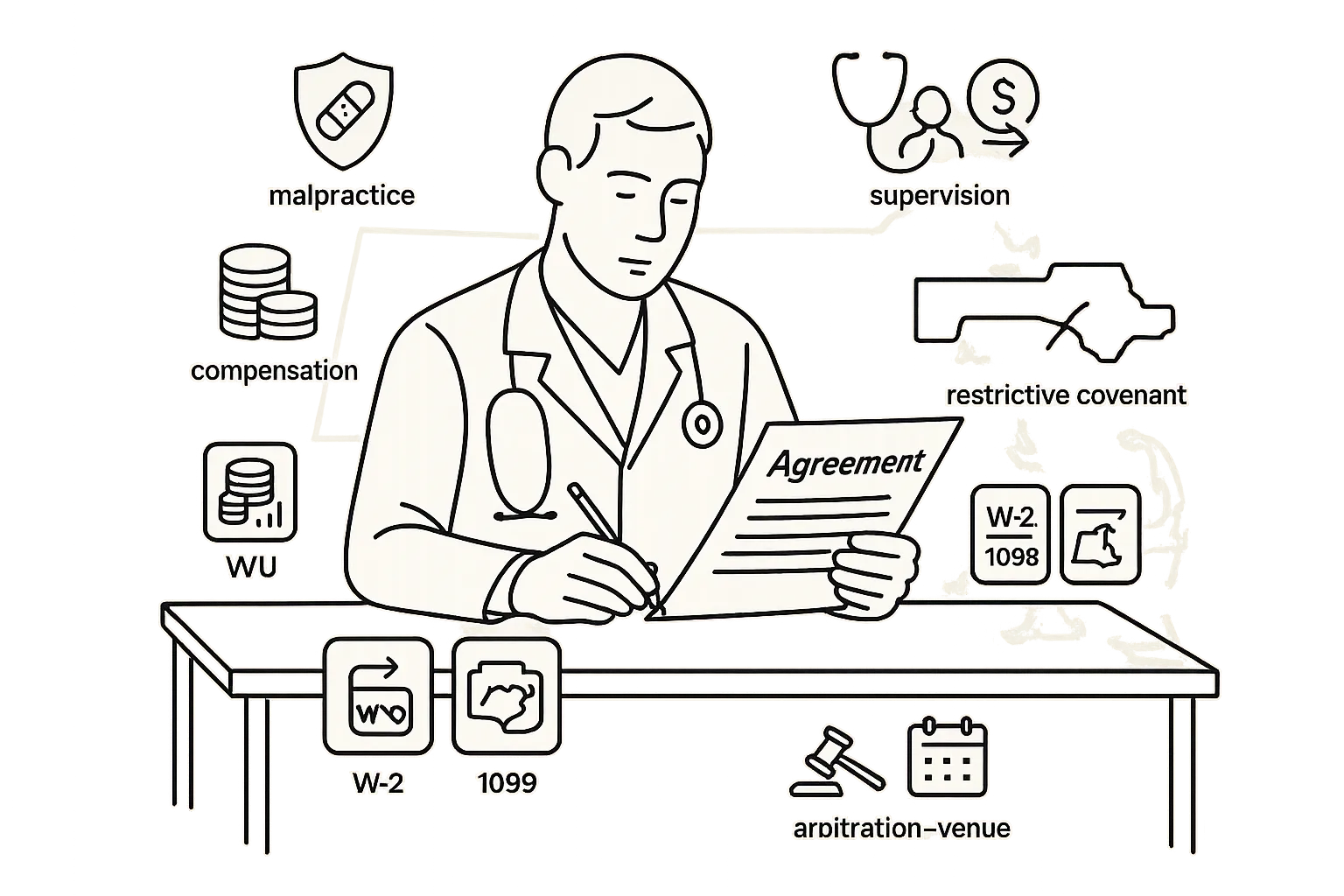
Base Salary and Productivity Compensation
Base salary can provide predictable income, but the guarantee may last only for an initial period or remain subject to schedule, location, or productivity conditions. RVU and other productivity formulas may incorporate thresholds, conversion factors, tiers, draws, negative accrual, expense deductions, or year-end reconciliation. Multiplying 5,000 RVUs by a $40 conversion factor produces $200,000, but that figure can change once the agreement applies a threshold, base-credit calculation, deduction, or carryforward.
Collections-based compensation presents different concerns because payment depends on amounts the employer receives. Billing delays, payer denials, refunds, chargebacks, and post-termination collections can affect whether the PA receives credit. A physician assistant compensation and productivity review can evaluate the complete formula, reporting rights, measurement period, payment date, and treatment of earned compensation after departure.
Bonuses, Repayment Terms, and W-2 or 1099 Status
Signing bonuses, relocation assistance, and loan-repayment benefits frequently include repayment obligations if employment ends within a stated period. Analysis can clarify which events trigger repayment, whether the obligation decreases over time, whether termination without cause produces the same result as resignation, and whether repayment is based on the gross or net amount. PAs can also review common sign-on bonus repayment terms before treating an incentive as guaranteed compensation.
Classification affects taxes, benefits, insurance, expenses, and contractual liability. A W-2 employee generally has employer tax withholding and may receive benefits, while an independent contractor may be responsible for taxes, professional expenses, and insurance. Contractor agreements may also contain broad indemnification language or employer-like controls over scheduling, exclusivity, and work methods. Comparing W-2 and 1099 physician assistant arrangements can help identify financial and legal issues requiring closer review.
Clinical Duties, Prescribing, and Malpractice Coverage
Supervision, Delegation, Protocols, and Work Locations
Massachusetts physician assistants practice within a regulatory structure involving physician supervision and delegated medical services. A supervising physician may delegate services within the physician’s authority and the PA’s competence when adequate supervision is available. Temporary supervisory arrangements and written protocols may also become relevant, particularly for major invasive procedures.
The contract can be reviewed for consistency with the actual position, including supervising physicians, clinical services, protocols, practice locations, schedules, call coverage, administrative work, and cross-coverage expectations. Language allowing unlimited changes to duties or reassignment among facilities can materially alter the job after signing. Clear limits are particularly important when additional duties could require different training, supervision, credentialing, or malpractice coverage.
Prescribing Responsibilities and Professional Liability Insurance
A Massachusetts PA may prescribe only when properly registered and authorized under applicable requirements, including mutually developed prescription-practice guidelines with the supervising physician. Supervising-physician oversight may include periodic review and continuing direction. Contract review can identify who is responsible for establishing and maintaining those guidelines, obtaining required controlled-substance authority, and addressing prescribing-related compliance duties.
Malpractice provisions require separate analysis. The reviewed Massachusetts profession-specific authorities address allocation of liability for PA acts or omissions but do not establish a general rule assigning the cost of professional-liability insurance or tail coverage to one party. The agreement therefore needs to identify policy type, limits, named insureds, defense obligations, premium responsibility, and any coverage exclusions.
Occurrence coverage generally applies to incidents occurring during the policy period regardless of when a claim is asserted. Claims-made coverage ordinarily must remain active when the claim is made, potentially creating a need for tail coverage after employment. A review of tail-insurance provisions for physician assistants can clarify who bears that expense and whether responsibility changes based on how the relationship ends.
Massachusetts Noncompete and Non-Solicitation Provisions
The Physician and Physician Assistant Distinction
Massachusetts has a statutory prohibition addressing certain post-termination geographic practice restrictions for physicians, but the official authorities reviewed do not establish an equivalent enacted prohibition for physician assistants. A proposed PA-specific measure is not controlling law. Physician assistants should therefore not assume that a restriction is invalid merely because a similar provision may be prohibited in a physician agreement.
For covered employees, the Massachusetts Noncompetition Agreement Act generally imposes requirements involving writing and signature, timing, notice of the right to consult counsel, legitimate business interests, consideration, and reasonable duration, geography, and scope. It also limits enforcement in specified circumstances, including against employees terminated without cause or laid off. Application remains fact-specific, so a Massachusetts PA noncompete review can evaluate the actual language and employment circumstances.
Non-Solicitation, Confidentiality, and Protected Relationships
The Massachusetts noncompetition statute does not itself prohibit every non-solicitation, confidentiality, or nondisclosure provision. These clauses may restrict contact with patients, employees, referral sources, vendors, or other business relationships even when no traditional geographic noncompete appears in the contract.
Review should consider the restriction’s duration, covered services, geographic reach, employer locations, protected relationships, and triggering events. Language extending to every employer site, affiliate, patient, or undefined referral source may create substantially more uncertainty than a restriction tied to the PA’s actual practice and relationships.
Termination, Notice, and Post-Employment Obligations
Without-Cause Notice and Immediate Termination
Termination provisions determine how each party may end the relationship and what happens during the notice period. Relevant terms include without-cause notice, definitions of cause, cure opportunities, immediate-termination events, final compensation, unused leave, malpractice obligations, and post-employment cooperation. A long notice period may delay a new position, while a clause permitting the employer to remove the PA from the schedule without continuing full compensation can reduce the practical value of notice.
Licensure, credentialing, supervision, prescribing authority, or alleged policy violations may appear among the immediate-termination triggers. Analysis can determine whether those provisions distinguish a temporary or curable administrative issue from conduct warranting immediate discharge and whether the employer retains overly broad discretion to characterize an event as cause.
Repayment, Offsets, Insurance, and Restrictive Covenants
Termination language must be read alongside bonus repayment, relocation clawbacks, negative accrual, tail coverage, and employer offset rights. A provision may produce different consequences depending on whether the PA resigns, is terminated without cause, is terminated for cause, becomes disabled, or cannot begin work because credentialing remains incomplete.
Post-employment restrictions may also be triggered by the manner of termination. A physician assistant contract termination review can explain how notice, final compensation, repayment, insurance, and restrictive covenants interact rather than evaluating each clause in isolation.
Benefits, Professional Expenses, and Dispute Terms
Benefits and Incorporated Employer Policies
Benefits and professional-expense provisions contribute to total compensation. The agreement or incorporated policies may address health and retirement benefits, disability coverage, paid leave, continuing medical education, professional dues, licensing fees, credentialing costs, and paid CME days. Review can determine whether the employer may change these items through policy and whether important recruiting promises appear in the final contract.
Offer letters, compensation plans, job descriptions, handbooks, and policy manuals may supplement or conflict with the employment agreement. A merger clause can provide that the final written contract replaces earlier statements, making it important to resolve inconsistencies before signing.
Arbitration, Choice of Law, Venue, and Amendment Rights
Administrative provisions can significantly affect a later dispute. Arbitration clauses, choice-of-law terms, venue requirements, notice procedures, attorney-fee provisions, merger clauses, and amendment rights determine which rules apply, where a claim may proceed, and which documents control.
A clause selecting another jurisdiction or requiring proceedings far from Massachusetts may increase the cost and difficulty of asserting contractual rights. Unilateral amendment provisions also deserve attention when they allow the employer to change compensation formulas, schedules, locations, or other material terms without the PA’s written agreement.
Preparing for Massachusetts PA Contract Review
Documents and Contract Red Flags to Gather
Before review, gather the proposed agreement, offer letter, job description, compensation and bonus plans, restrictive-covenant documents, malpractice information, benefit summaries, and every policy incorporated by reference. Prior agreements may also matter if they contain continuing confidentiality, non-solicitation, repayment, or insurance obligations.
Common warning signs include compensation metrics the employer can change unilaterally, undefined deductions, broad territorial restrictions, repayment without proration, open-ended call or location requirements, personal indemnification, missing malpractice details, and essential policies that have not been provided. The physician assistant contract red-flag guide provides additional context for an initial review.
How an Attorney-Led Contract Review Helps
An attorney-led review translates contract language into practical financial, regulatory, and professional consequences. Chelle Law evaluates compensation mechanics, clinical duties, supervision language, malpractice obligations, restrictive covenants, termination rights, and repayment exposure clause by clause. The review can identify unclear or unfavorable terms, explain their potential effect, and flag provisions that may warrant clarification or revision.
The cost of review can be weighed against the potential effect of a harmful provision. Ambiguous productivity language may reduce income, a tail obligation may create an unexpected expense, and a broad restriction may complicate the next job search. Reviewing the complete agreement before signing gives the PA an opportunity to understand those risks while changes remain possible.
Speak With a Massachusetts Physician Assistant Contract Lawyer Before You Sign
Chelle Law can review your compensation, clinical duties, malpractice coverage, restrictive covenants, termination rights, and repayment obligations and identify terms that may warrant clarification or revision.
Request a Contract ReviewExplore Physician Assistant Contract Guidance
Review related services, practical resources, and state-specific guidance for physician assistant agreements.