
Physician assistants practicing in Massachusetts work under requirements overseen by the Massachusetts Board of Registration in Physician Assistants, including state rules affecting licensure, scope of practice, supervision, collaboration, delegation, and prescribing. Those obligations matter whether a PA is joining a hospital system in Boston, a specialty group in Worcester, or an employer serving the Springfield market because an agreement can assign clinical duties or oversight expectations that do not match the practical role. Massachusetts contract review should therefore connect regulatory requirements to the employment terms governing compensation, malpractice coverage, restrictive covenants, termination, and repayment obligations. Chelle Law reviews those provisions together rather than in isolation, helping PAs identify language that may affect income, liability exposure, and career mobility before signing an employment or independent contractor agreement.
Why Massachusetts Physician Assistants Need a Focused Contract Review

Contract language establishes the rules that determine how a PA is paid, when compensation may be withheld or reclaimed, who pays for malpractice protection, and how post-employment restrictions may limit future practice. A productivity clause without clear metrics can turn predictable compensation into a volatile income stream. A broad non-solicitation provision tied to vague patient, employee, or referral-source definitions can also restrict movement between practices, while ambiguous supervision or delegation language may create regulatory and liability concerns.
Overlooked provisions commonly create three forms of practical harm:
- Income risk: Unclear productivity formulas, negative accrual, delayed collections-based payments, and year-end reconciliations can reduce the compensation a PA actually receives.
- Career mobility risk: Broad non-compete or non-solicitation language may affect where a PA can work, which specialties remain available, and whether accepting another position could lead to a dispute.
- Insurance and liability gaps: An agreement that does not clearly identify the malpractice policy type or responsibility for tail coverage can expose a PA to substantial post-employment expense and potential coverage gaps.
Massachusetts PAs can also consult the Massachusetts Association of Physician Assistants for professional advocacy and updates that may affect PA practice. Those materials can provide useful professional context, but the employment agreement still requires an individualized review of the PA’s duties, compensation, insurance, and exit rights.
Compensation and Employment Classification
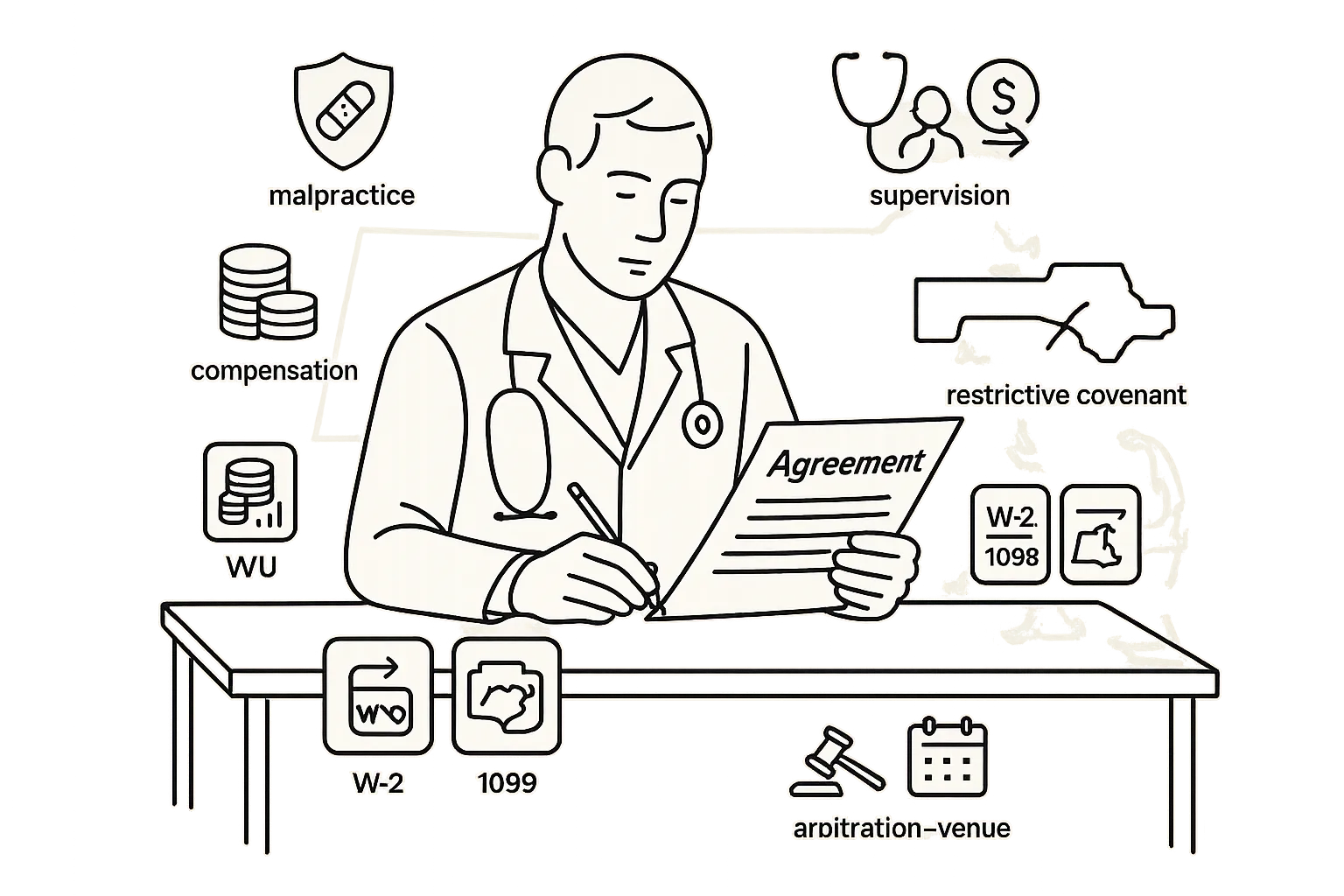
Compensation clauses require more than a review of the stated salary. Base compensation may offer predictability but can be guaranteed for only a limited period. Productivity and RVU formulas may apply thresholds, conversion factors, tiers, draws, or reconciliation provisions that materially change the result. For example, multiplying 5,000 RVUs by a $40 conversion factor produces $200,000 before the agreement applies any threshold, base-credit calculation, expense deduction, or reconciliation. A thorough PA compensation and productivity review examines the complete formula rather than the headline rate.
Collections-based compensation creates different risks because payment depends on what the employer actually collects. Payer denials, billing delays, chargebacks, and post-termination collection periods can affect when or whether a PA receives credit. Quality bonuses and other incentives should identify the measurement period, objective criteria, reporting method, payout date, and treatment of earned compensation after employment ends.
Signing bonuses, relocation assistance, and loan-repayment benefits often include repayment obligations if employment ends within a stated period. The agreement should explain which events trigger repayment, whether the obligation decreases over time, and whether the PA must repay the gross or net amount. PAs receiving these incentives should closely examine the associated bonus repayment terms before treating the payment as guaranteed compensation.
Employment classification also affects taxes, benefits, insurance, and contractual risk. A W-2 employee generally receives employer tax withholding and may qualify for benefits, while an independent contractor may be responsible for taxes, professional expenses, and insurance. Some contractor agreements also contain broad indemnification provisions or employer-like controls over schedules, exclusivity, and work methods. Comparing the practical differences between W-2 and 1099 PA arrangements can help identify terms that require closer legal and financial review.
Malpractice Coverage, Scope of Practice, and Clinical Duties
Malpractice provisions should identify the policy type, limits, named insureds, defense obligations, and responsibility for premiums. Occurrence coverage generally applies to incidents that occur during the policy period regardless of when a claim is asserted. Claims-made coverage ordinarily requires coverage to remain active when a claim is made, which can create a need for tail insurance after the PA leaves.
If an employer provides claims-made coverage during employment but requires the PA to purchase tail coverage at termination, the PA may face a significant unanticipated expense. The contract should state who pays for tail coverage, whether responsibility changes based on the reason employment ends, and whether another form of extended reporting protection will be provided. A PA can use a detailed guide to tail insurance obligations to understand why the policy type and termination language must be read together.
Clinical-duty provisions also deserve careful attention. The agreement should accurately describe the PA’s services, practice locations, schedule, call duties, administrative work, and applicable supervision or collaboration structure. Language granting the employer unlimited authority to expand duties, move the PA among facilities, or impose additional coverage without defined limits can materially change the position after signing.
Massachusetts agreements should be evaluated against the regulatory framework administered by the Massachusetts Board of Registration in Physician Assistants. Contractual expectations concerning delegation, prescribing, documentation, and oversight should be workable within the PA’s actual role and state requirements. An employer’s internal policy does not eliminate the need for contract language that clearly allocates duties and avoids placing open-ended regulatory responsibility on the PA.
Restrictive Covenants, Termination, and Repayment Risk
Restrictive covenants can include non-compete, non-solicitation, confidentiality, and non-interference provisions. Their practical effect depends on the wording, surrounding facts, and applicable law. A PA should examine the restriction’s duration, geographic reach, covered services, employer locations, protected relationships, and triggering events. Language extending to every employer site or undefined referral source can create greater uncertainty than a provision tied to the PA’s actual practice.
Massachusetts law and public policy can affect restrictive-covenant analysis, but enforceability should not be assumed from a clause’s presence or absence alone. Even a disputed restriction can affect future job searches and create litigation risk. A focused review of PA non-compete terms can identify overbroad definitions, problematic triggers, and possible negotiation points before the agreement is signed.
Termination provisions determine how either party may end the relationship and what happens afterward. Important terms include without-cause notice, definitions of cause, cure opportunities, immediate-termination events, final compensation, unused leave, malpractice obligations, and post-employment cooperation. A long notice period may delay a new position, while a clause allowing the employer to remove the PA from the schedule without continuing full compensation can undermine the value of the notice requirement.
Termination language must also be read alongside bonus repayment, relocation clawbacks, negative accrual, and other offset rights. The agreement should distinguish resignation, termination without cause, termination for cause, disability, and other events rather than imposing the same repayment result in every circumstance. A contract termination review can clarify how notice, repayment, insurance, and restrictive covenants operate together.
Benefits, Expenses, and Dispute-Resolution Terms
Benefits and professional-expense provisions contribute to total compensation. The agreement or incorporated policies may address health and retirement benefits, disability coverage, paid leave, continuing medical education, licensing fees, professional memberships, credentialing costs, and paid CME days. If important benefits appear only in an offer letter or recruiting email, the PA should determine whether the final agreement preserves them or permits the employer to change them through policy.
Administrative clauses can also have significant consequences. Arbitration provisions, choice-of-law clauses, venue requirements, notice procedures, merger clauses, and employer amendment rights influence how a dispute will be handled and which documents control. A choice-of-law provision selecting another jurisdiction or a mandatory venue far from Massachusetts may increase the practical cost of enforcing the PA’s rights.
How to Prepare for Contract Review and Negotiation
Before review, gather the complete proposed agreement, offer letter, job description, compensation or bonus plan, restrictive-covenant documents, malpractice information, benefit summaries, and any policy manual incorporated by reference. Prior agreements may also matter if they contain continuing confidentiality, non-solicitation, or repayment obligations. Reviewing the complete set of documents helps reveal inconsistencies between the promised position and the employer’s binding terms.
During an initial read, look for compensation metrics the employer can change unilaterally, undefined deductions, broad territorial restrictions, unclear repayment triggers, and immediate termination rights without a meaningful cure period. Other warning signs include open-ended call or location requirements, personal responsibility for business liabilities, missing malpractice details, and policies that control essential terms but have not been provided.
Negotiation priorities should reflect the risks most important to the particular PA. Common requests include measurable compensation criteria, access to productivity reports, defined practice locations, reasonable notice provisions, prorated repayment obligations, clear tail coverage allocation, and narrower restrictive covenants. The goal is not simply to request more favorable language; it is to make the agreement sufficiently clear that both sides understand how compensation, duties, and separation will work.
How a Physician Assistant Contract Attorney Can Help
An attorney-led review translates contract language into practical financial, regulatory, and professional consequences. Chelle Law evaluates compensation mechanics, clinical-duty language, malpractice obligations, restrictive covenants, termination rights, and repayment exposure on a clause-by-clause basis. Where appropriate, the review can identify proposed revisions and provide objective negotiation points tailored to the agreement.
The cost of legal review should be considered against the potential effect of a harmful provision. Ambiguous productivity language may reduce income, a tail obligation may create an unexpected post-employment expense, and an expansive restriction may limit the next job search. Counsel familiar with PA employment agreements should be able to explain RVUs, collections, insurance, repayment, and termination terms in plain language and provide written, actionable observations before the PA signs.
Review Your Massachusetts PA Contract Before You Sign
Chelle Law can evaluate your compensation, malpractice coverage, clinical duties, restrictive covenants, termination rights, and repayment obligations so you understand the agreement’s practical consequences.
Contact Chelle LawExplore Physician Assistant Contract Guidance
Review related services, practical contract resources, and state-specific guidance for physician assistants.