
Physician assistants considering Nebraska employment or independent contractor work must evaluate the proposed agreement alongside requirements administered by the Nebraska Department of Health and Human Services, Division of Public Health, Licensure Unit, the Nebraska Board of Medicine and Surgery, and the Nebraska Physician Assistant Committee. Nebraska law connects a PA’s permitted services to physician delegation, supervision, the PA’s training and competence, and the supervising physician’s scope. It also requires a supervising physician for each employer, with additional supervision considerations in multispecialty practices. These rules can affect whether promised duties, prescribing authority, multi-site assignments, and coverage expectations are workable in Omaha, Lincoln, and other Nebraska healthcare markets. Contract review can identify inconsistencies among the employment agreement, collaborative agreement, credentialing documents, job description, and actual clinical arrangement before those inconsistencies create compensation, compliance, or termination problems.
The financial and exit provisions require equal attention. A favorable salary may be offset by an uncertain productivity formula, bonus repayment obligation, tail-insurance expense, broad indemnification clause, or restrictive covenant. Chelle Law provides attorney-led physician assistant contract review to explain how these terms operate together, identify material risks, and flag language that may warrant clarification or revision before signing.
Who Benefits From a Nebraska PA Contract Review?

New Graduates and PAs Changing Positions
Review is valuable for new graduates accepting their first position, experienced PAs changing employers or specialties, and clinicians moving into leadership or multi-site roles. A first contract may contain unfamiliar provisions involving credentialing, supervision, productivity thresholds, professional expenses, call, or repayment. A specialty change can create different scheduling, prescribing, privileging, and malpractice considerations even when the compensation appears similar.
The complete offer matters, not only the document titled “employment agreement.” Offer letters, compensation plans, collaborative agreements, policy manuals, bonus documents, and credentialing addenda may contain obligations incorporated into the final contract. A new graduate PA contract review can help distinguish firm contractual commitments from benefits or expectations described only in recruiting materials.
W-2 and Independent Contractor Arrangements
PAs moving from W-2 employment to a 1099 arrangement should determine which taxes, insurance costs, licensing expenses, equipment charges, and administrative duties shift to them. Classification language alone does not explain the arrangement’s economic effect. Review can compare compensation against expenses and identify provisions concerning scheduling control, billing, professional liability, indemnification, termination, and ownership of records or work product.
An independent contractor agreement review is particularly useful when the contract includes collections-based pay, broad expense deductions, no employee benefits, or responsibility for securing coverage. Equity or ownership opportunities also warrant separate examination of the governing business documents rather than reliance on a brief reference in the clinical services agreement.
Nebraska Scope, Supervision, and Collaborative Agreement Terms
Delegated Services and Scope of Practice
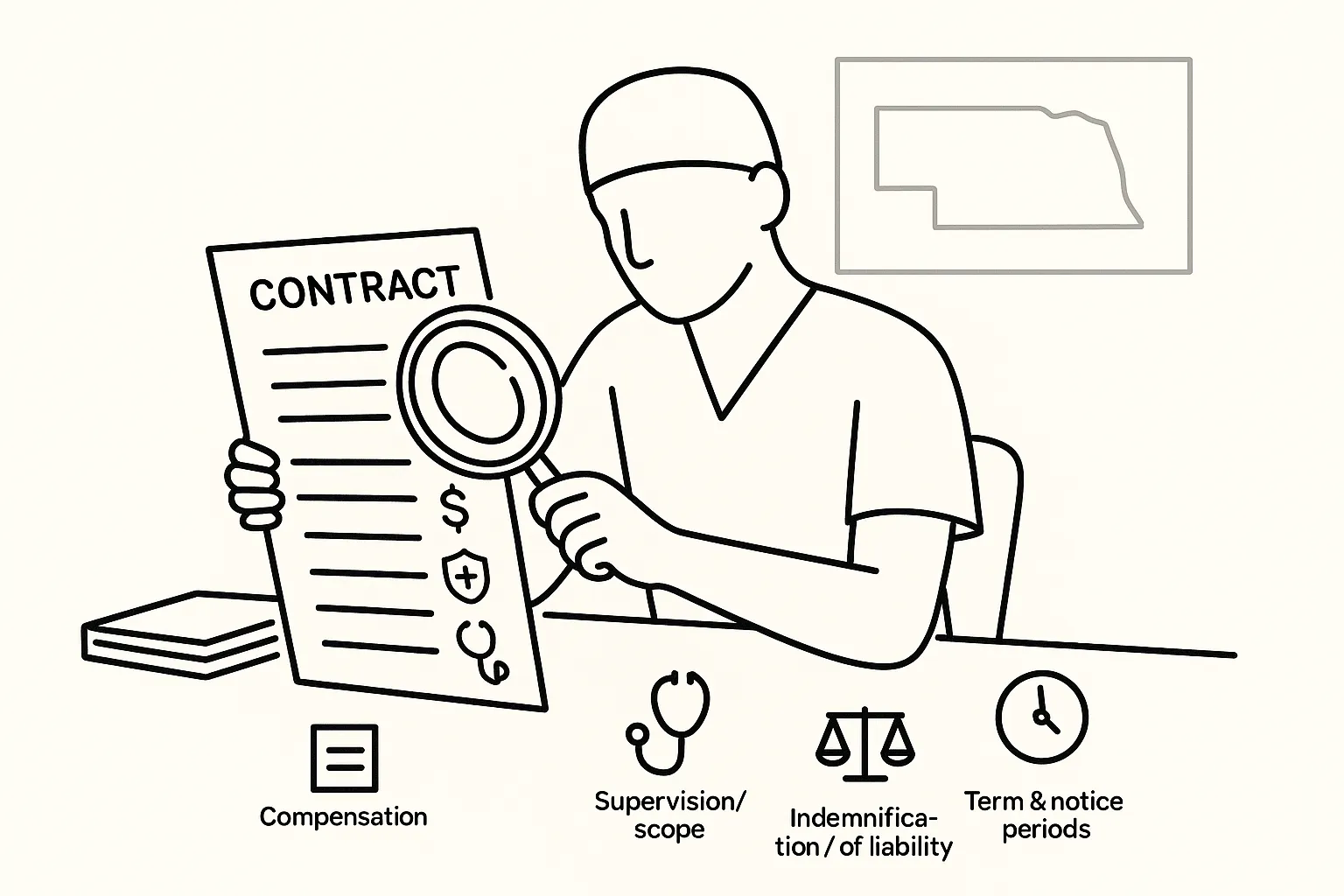
Nebraska permits a PA to perform medical services delegated by and provided under the supervision of a qualified physician when the services are appropriate to the PA’s education, experience, training, and competence and fall within the physician’s scope. Each PA must have at least one supervising physician for each employer. A multispecialty practice requires supervision for each specialty area, making broad cross-coverage or floating language particularly important to analyze.
The PA and supervising physician must identify matters that include scope, delegation, access, and performance-evaluation processes. Contract language allowing unilateral expansion of clinical duties, reassignment to another specialty, or work at any affiliated location may not provide enough information to assess operational feasibility. Review can flag when the employment agreement describes responsibilities more broadly than the associated clinical or supervisory documents.
Supervision, Prescribing, and Practice Sites
A Nebraska supervising physician must hold the required license, remain unrestricted in the ability to supervise or collaborate, and participate in a collaborative agreement. That agreement must be maintained at the primary practice site and each additional practice site. Supervision is continuous but does not necessarily require the physician’s physical presence. Nebraska generally limits a physician to supervising four PAs unless an approved waiver applies.
Under a collaborative agreement, a PA may prescribe drugs and devices and plan or initiate specified therapeutic regimens. Controlled-substance prescribing also requires the applicable federal DEA registration, and prescriptions and labels must bear the PA’s name. The contract can be evaluated for who pays licensing and DEA expenses, how supervising-physician changes are handled, and what occurs if the employer cannot maintain an arrangement necessary for the PA’s assigned duties.
Compensation, Benefits, and Repayment Exposure
Salary, RVUs, Collections, and Bonus Formulas
PA compensation may combine guaranteed salary with RVU incentives, collections-based pay, quality bonuses, call compensation, or discretionary awards. A focused compensation and productivity review can determine how production is credited, when bonuses are calculated, which deductions apply, and whether the employer retains authority to modify the formula.
Even apparently simple arithmetic may depend on undefined operational terms. An RVU formula may not explain shared visits, split services, chart completion, attribution, reconciliation dates, or access to production reports. Collections-based compensation can depend on cash received rather than services billed, exposing the PA’s income to payer denials, billing delays, refunds, and collection processes outside the PA’s control.
Draws, Negative Accrual, and Deductions
A draw against future production may create a negative balance that carries into later periods or becomes payable when employment ends. Analysis can identify whether a deficit is capped, forgiven, amortized, or immediately due. It can also determine whether overhead, payer recoupments, refunds, chargebacks, or other deductions may reduce compensation after an initial calculation.
Reconciliation provisions deserve close attention when the employer controls the records used to calculate compensation. The agreement may address reporting frequency, access to supporting data, correction of errors, and the treatment of work performed before termination but collected afterward. Without those details, a headline salary or productivity rate may not provide a reliable picture of expected earnings.
Benefits, Sign-On Bonuses, and Clawbacks
Benefits can materially affect the total offer. Relevant items may include health coverage, retirement contributions, paid leave, continuing medical education funds, licensing fees, DEA renewal costs, professional memberships, relocation assistance, and student-loan support. Review can distinguish guaranteed benefits from programs that remain subject to eligibility rules or unilateral policy changes.
Sign-on bonuses, relocation payments, education stipends, and loan assistance frequently include repayment provisions tied to resignation or early termination. The triggering event, forgiveness schedule, repayment deadline, and treatment of employer-initiated termination can change the practical risk. Chelle Law’s guidance on PA sign-on bonus repayment terms explains issues to examine before accepting an incentive payment.
Scheduling, Credentialing, and Operational Duties
Hours, Call, and Multi-Site Assignments
Work hours, full-time-equivalent definitions, call coverage, weekends, holidays, administrative time, and location assignments affect both workload and compensation. A nonstandard FTE definition may influence benefit eligibility or productivity expectations. Open-ended scheduling language may also permit substantial changes without addressing additional travel, call pay, or minimum notice.
Multi-site provisions require particular attention when the collaborative agreement, credentialing, malpractice coverage, or supervising-physician arrangement differs by location. Review can identify whether the employer may add sites, how far the PA may be required to travel, whether travel time is compensated, and whether duties can expand across specialties. Moonlighting and outside-practice restrictions should also be compared with the anticipated schedule.
Credentialing and Delayed Start Dates
Credentialing and privileging delays can affect the start date, guaranteed salary, bonus eligibility, and the time available to satisfy repayment-forgiveness requirements. The contract may condition employment on licensure, payer enrollment, hospital privileges, or other approvals without explaining what happens if processing extends beyond the anticipated start date.
Analysis can clarify whether the employer may postpone or cancel the position, whether compensation begins during a delay, and whether either party has a termination right. Similar concerns arise when privileges are later restricted or a supervising physician becomes unavailable. The agreement’s termination and cure provisions should be read together with these operational contingencies.
Malpractice Insurance and Liability Allocation
Policy Type, Limits, and Tail Coverage
Malpractice provisions may identify the policy type, coverage limits, premium responsibility, covered locations, and whether all required services fall within the policy. Occurrence coverage generally responds to covered acts occurring during the policy period even if a claim is filed later. Claims-made coverage ordinarily depends on the policy being active when the claim is reported, which may create a need for extended reporting coverage after the relationship ends.
The reviewed Nebraska PA statutes do not impose a profession-specific tail-insurance requirement. Responsibility therefore depends on the applicable policy and contractual language. An agreement may require the PA to buy tail coverage or reimburse the employer following specified termination events. Reviewing the payment deadline, available exceptions, coverage duration, and required limits can expose a significant post-employment expense before it arises. Additional background is available in Chelle Law’s resource on tail insurance for physician assistants.
Indemnification, Defense, and Nebraska Claims Procedures
Indemnification and defense provisions can shift liability beyond what the malpractice policy covers. Some clauses require the PA to reimburse the employer for claims, regulatory matters, or losses associated with broadly defined misconduct. These terms can be compared with policy exclusions, defense rights, settlement authority, and duties involving timely notice and cooperation.
Nebraska’s PA statute cross-references the Nebraska Hospital-Medical Liability Act. For covered healthcare providers under that Act, a medical-review-panel process generally precedes filing a malpractice action in Nebraska court. Contract analysis can identify the parties’ stated insurance and claims-handling obligations without assuming that every PA, employer, or claim receives identical statutory treatment.
Restrictive Covenants and Contract Termination
Nebraska Non-Compete and Non-Solicitation Clauses
Restrictive covenants may include non-compete, patient or employee non-solicitation, confidentiality, non-disparagement, referral, and patient-contact provisions. Their practical impact depends on the restricted activities, duration, geographic reach, covered facilities, exceptions, and events that trigger the restriction. No broad statutory prohibition specific to ordinary Nebraska PA employer non-competes was identified in the reviewed Nebraska statutes, so enforceability may depend on Nebraska common law, the employment relationship, the covenant’s language, and the surrounding facts.
A separate rule applies to healthcare staffing agencies beginning July 1, 2027. That provision bars a healthcare staffing agency from including a non-compete clause that restricts a worker’s employment opportunities and makes a violating clause void. It does not establish a universal prohibition for all PA employment agreements. A physician assistant non-compete review can evaluate the proposed covenant under the type of arrangement actually presented.
Notice, Termination, and Final Compensation
Termination terms often include expiration, renewal, for-cause termination, immediate termination, and termination without cause after written notice. The notice period cannot be evaluated in isolation. Tail obligations, bonus clawbacks, negative balances, restrictive covenants, and repayment duties may survive even when the employer ends the relationship or cannot maintain the clinical arrangement.
Review can also determine how the contract treats compensation earned before departure. Relevant questions include whether productivity pay will be calculated after termination, whether later collections remain payable, when final compensation is due, and which deductions may apply. Cure periods, liquidated damages, return-of-property duties, record access, and confidentiality requirements may further affect the exit process.
Preparing for Attorney Review
Attorney review is most useful after the complete proposed agreement is available but before it is signed or the acceptance deadline expires. Documents and information that may assist the review include:
- The employment or independent contractor agreement and every appendix or exhibit
- The offer letter, job description, collaborative agreement, and proposed call schedule
- Written productivity formulas and available historical RVU or collections information
- Bonus, relocation, education-stipend, and loan-repayment documents
- Malpractice policy summaries identifying the policy type and coverage limits
- Questions about locations, schedules, credentialing, outside work, prescribing, or expected clinical duties
Chelle Law offers fixed-fee, attorney-led reviews that include written commentary and a consultation call. The review can explain the agreement’s operation, identify income and repayment exposure, evaluate malpractice and supervisory language, and highlight provisions that may warrant clarification or revision. Supplying all incorporated documents helps prevent a favorable provision in one document from being undermined by conflicting language elsewhere.
Speak With a Nebraska Physician Assistant Contract Lawyer Before You Sign
Chelle Law can review your proposed compensation, supervision, malpractice, termination, repayment, and restrictive covenant terms, identify material risks, and explain provisions that may warrant clarification or revision.
Request a Contract Review