
Physician assistants considering employment or independent contractor work in Nebraska should assess the agreement in light of both its financial terms and the practice requirements overseen by the Nebraska Board of Medicine and Surgery. Nebraska-specific questions involving PA scope of practice, supervision, collaboration, delegation, prescribing, credentialing, and privileging can affect whether the duties promised in a contract are workable in the actual clinical setting. Those concerns may arise differently across health systems and practices in Omaha and Lincoln, particularly when an agreement permits multi-site assignments, changes in supervising physicians, or broad scheduling obligations. Chelle Law reviews how those operational provisions interact with compensation formulas, malpractice coverage, termination rights, repayment duties, and post-employment restrictions. A careful review before signature helps a Nebraska PA identify unclear expectations, employer-controlled financial terms, and provisions that could create compliance exposure or limit future career options.
Physician assistant employment and independent contractor agreements often contain language that materially affects income, clinical responsibilities, liability exposure, and career mobility. An attorney-led physician assistant contract review can identify financial risks, repayment obligations, regulatory concerns, and post-employment constraints before the PA accepts the position.
Who Should Have a Nebraska PA Agreement Reviewed?

Every physician assistant offered employment or an independent contractor engagement should consider having the complete agreement reviewed before signing. This includes new graduates accepting their first positions, PAs changing specialties or employers, clinicians moving from W-2 employment to a 1099 arrangement, and PAs assuming leadership roles or considering equity opportunities. An independent contractor agreement review is particularly important when the arrangement shifts tax, insurance, expense, or liability obligations to the PA.
Common concerns include collections-based compensation, negative accrual, broad bonus clawbacks, restrictive covenants, and unclear ownership or control of patient relationships. For Nebraska PAs, early review is also valuable when supervision, delegation, credentialing, or privileging terms affect whether the proposed duties can be performed as described. Information from the Nebraska Academy of Physician Assistants may also help PAs follow developments involving practice authority and professional advocacy.
Key Terms in a Nebraska Physician Assistant Contract
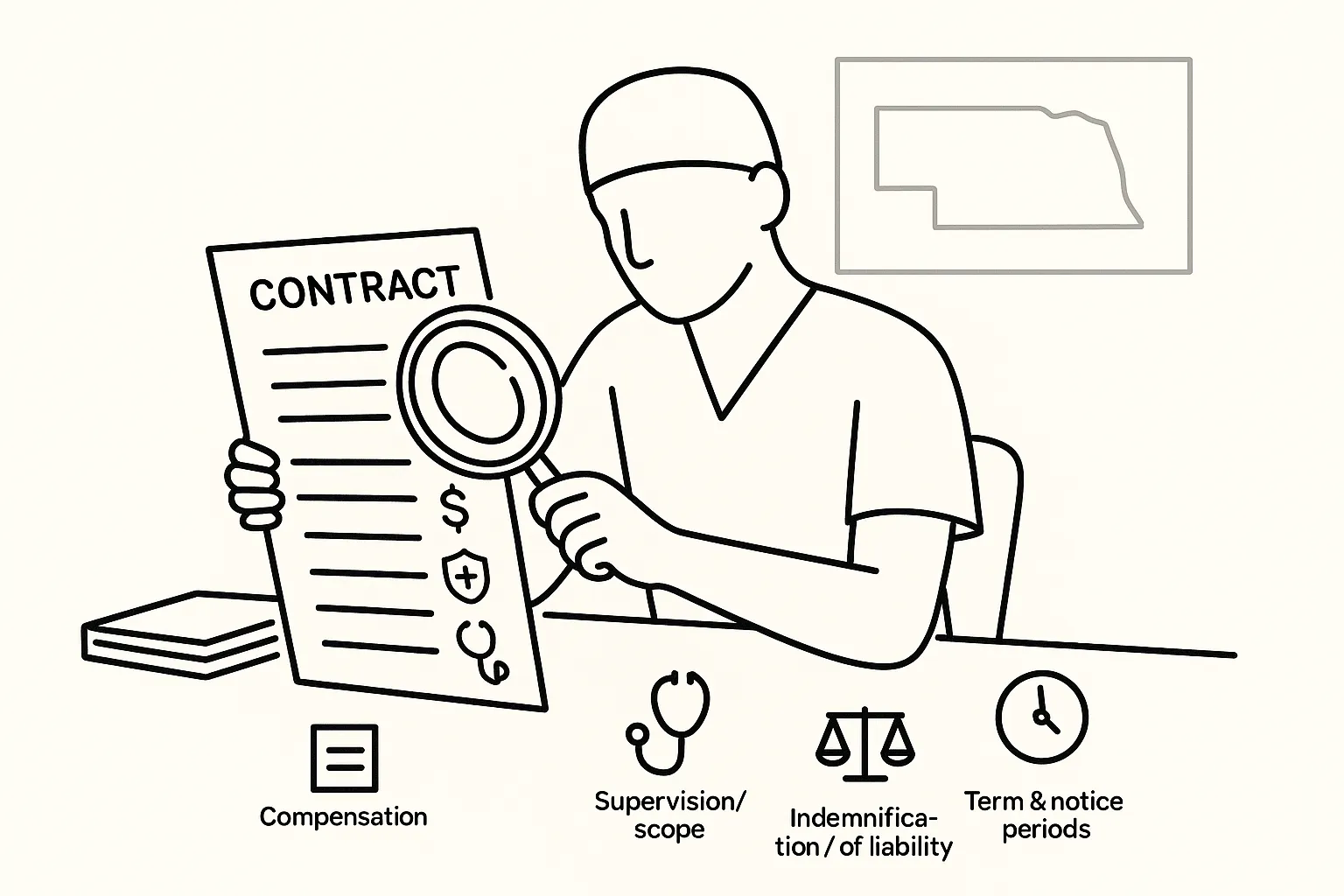
A complete review should address the provisions most likely to affect the PA’s income, day-to-day practice, liability, and ability to leave the position. Important terms commonly include:
- Base salary, productivity incentives, RVUs, collections, bonuses, and reconciliation formulas
- Negative accrual, draws, deductions, withholding, and repayment language
- Malpractice policy type, coverage limits, defense obligations, and tail insurance
- Supervision, collaboration, delegation, scope of practice, credentialing, and privileging
- Non-compete, non-solicitation, confidentiality, and non-disparagement clauses
- Contract term, renewal, for-cause termination, without-cause termination, and notice periods
- Indemnification, liquidated damages, bonus clawbacks, and other post-employment obligations
Each provision should be read together with the rest of the agreement. A favorable salary can be undermined by an unclear productivity formula, while a reasonable termination clause may still leave the PA responsible for tail coverage, bonus repayment, or unpaid negative balances.
Compensation, Benefits, and Repayment Terms
PA compensation may consist of a guaranteed base salary, productivity incentives, RVU-based pay, collections-based compensation, or a combination of these models. A focused compensation and productivity review examines how production is credited, when bonuses are calculated, which deductions apply, and whether the employer may change the formula.
For example, a contract that guarantees $50,000 plus $40 per RVU and credits 1.2 work RVUs per patient encounter appears to provide straightforward math. The projected income may still be unreliable unless the agreement explains how RVUs are attributed, how shared visits are handled, whether denied claims affect credit, and when production data becomes final. Collections-based compensation presents similar concerns because payment depends on cash received rather than the amount billed, potentially exposing the PA to billing delays, payer denials, and employer-controlled collection practices.
Draws and negative accrual provisions require close attention. A draw against future production may create a balance that carries forward or becomes due when employment ends. The contract should explain whether negative balances are capped, forgiven, amortized, or immediately repayable and whether payer recoupments, chargebacks, or overhead allocations may reduce compensation after it has been calculated.
Benefits should also be valued as part of the complete offer, including health coverage, retirement contributions, continuing medical education allowances, licensing fees, DEA renewal costs, relocation assistance, and loan repayment. Sign-on bonuses and relocation payments frequently include clawbacks triggered by resignation or early termination, making the exact repayment schedule and triggering events important. PAs can review additional guidance on sign-on bonus repayment terms before accepting an incentive payment.
Scope of Practice, Supervision, and Clinical Duties
The agreement should reflect the Nebraska practice setting and describe the PA’s clinical responsibilities without creating vague or impractical obligations. Provisions addressing supervision, collaboration, delegation, prescribing, credentialing, and privileging should be consistent with the actual position and the arrangements the employer expects to maintain. Language requiring particular oversight, documentation, or approval can create operational problems if the employer has not established a workable process.
Supervisory or collaborative documents should identify responsibilities clearly and explain how changes in physicians, facilities, or clinical assignments will be handled. The contract should also address what happens if credentialing is delayed, privileges are restricted, or the employer cannot maintain an arrangement necessary for the PA to work. Vague language that gives the employer broad control without explaining the PA’s duties can increase compliance and termination risk.
Work hours, full-time-equivalent definitions, call coverage, location assignments, and moonlighting restrictions are equally important. A nonstandard FTE definition may affect benefits eligibility, while an open-ended call or multi-site provision can materially expand the workload. The agreement should provide enough detail for the PA to understand expected schedules, coverage duties, outside-practice restrictions, and the circumstances under which those obligations may change.
Malpractice Insurance and Liability Allocation
Malpractice provisions should identify the policy type, applicable limits, who pays the premiums, and whether coverage extends to all duties and locations required by the agreement. Occurrence coverage generally applies to acts occurring during the policy period even when a claim is filed later. Claims-made coverage ordinarily requires the policy to remain active when the claim is reported, which may create a need for extended reporting, commonly called tail coverage, after the relationship ends.
A contract may state that the employer provides malpractice insurance while requiring the PA to purchase tail coverage or reimburse the employer following certain types of termination. Because those obligations can create significant post-employment expense, the agreement should define the policy type, tail responsibility, payment deadline, and any exceptions. Additional information about tail insurance for physician assistants can help clarify why the policy language matters.
Indemnification and defense clauses also deserve careful review. Some agreements require the PA to indemnify the employer or limit the employer’s duty to defend claims arising from work performed within the scope of the position. These provisions should be evaluated alongside the malpractice policy so the PA can identify uninsured obligations or liability that the contract attempts to shift away from the employer.
Non-Competes, Termination, and Post-Employment Risk
Restrictive covenants may include non-compete, non-solicitation, confidentiality, non-disparagement, referral, and patient-contact restrictions. Their practical effect depends on the restricted activities, duration, geographic reach, covered locations, and triggering events. A PA non-compete review can identify whether the language applies to multiple facilities, follows the PA after employer-initiated termination, or interferes with realistic employment options in the relevant market.
Termination provisions often contain interconnected risks. A short without-cause notice period may permit either party to end the relationship, but the contract may separately preserve bonus clawbacks, tail obligations, restrictive covenants, or negative balances. For example, a sign-on bonus repayment clause may apply after a resignation within a specified period even when other circumstances contributed to the departure.
The agreement should also explain final compensation, including whether earned productivity pay will be calculated after termination and how outstanding balances will be handled. Breach and liquidated-damages provisions should be reviewed for broad triggers involving confidentiality, notice, or restrictive covenants. Understanding the complete exit process is the focus of a contract termination review, not merely the length of the notice period.
How to Prepare for an Attorney Contract Review
Legal review should occur after the PA receives the proposed agreement but before signing or allowing an acceptance deadline to expire. Counsel should receive the complete set of documents because important terms may appear in an offer letter, compensation plan, supervision document, policy manual, credentialing addendum, or separate bonus agreement.
Useful documents and information include:
- The complete employment or independent contractor agreement and all appendices
- The offer letter, job description, supervision documents, and proposed call schedule
- Written productivity formulas and available historical RVU or collections information
- Bonus, relocation, education stipend, and loan repayment documents
- Malpractice policy summaries and information identifying the policy type
- Questions about schedule, locations, credentialing, outside work, or expected clinical duties
Chelle Law offers fixed-fee, attorney-led reviews that include written commentary and a consultation call. The review explains how provisions operate, identifies income and repayment exposure, evaluates malpractice and supervision language, and highlights post-employment restrictions. Turnaround may be available within the same week when schedules permit, although complex arrangements or agreements with multiple addenda may require additional time.
Have Your Nebraska PA Contract Reviewed Before You Sign
Chelle Law can review your compensation, supervision, malpractice, termination, repayment, and restrictive covenant terms so you can evaluate the complete agreement with greater clarity.
Contact Chelle Law