
Physician assistants practicing in New Hampshire are regulated by the New Hampshire Board of Medicine under a statutory framework that now uses the term “physician associate.” Contract review must account for state requirements governing licensure, scope of practice, prescribing authority, professional liability insurance, and clinical collaboration. For example, a PA with fewer than 8,000 post-graduate clinical practice hours generally needs a written collaboration agreement when practicing without at least one licensed New Hampshire physician in the group, practice, or health system. These rules can affect agreements for positions in Manchester, Nashua, and other New Hampshire healthcare markets, particularly when an employer defines credentialing conditions, clinical duties, prescribing responsibilities, or assignments across multiple locations. Chelle Law reviews physician assistant employment and independent contractor agreements to identify financial, professional, and post-employment terms that may affect the proposed practice before the contract is signed.
A focused review extends beyond the salary stated in an offer letter. Productivity formulas, malpractice coverage, collaboration terms, restrictive covenants, termination rights, and repayment clauses may substantially change an agreement’s value and risk. Evaluating these provisions together helps a New Hampshire PA understand the immediate economics of the offer, the conditions attached to clinical practice, and the obligations that may continue after the relationship ends.
Why New Hampshire PA Contract Review Matters

Regulatory Fit and Collaboration Terms
A PA contract cannot authorize practice beyond New Hampshire law, Board rules, the clinician’s education and experience, or any required collaboration agreement. Practicing outside a required collaboration agreement may create disciplinary exposure, so provisions addressing clinical authority, physician availability, prescribing, documentation, and delegated responsibilities need to match the intended practice structure.
PAs with more than 8,000 post-graduate clinical practice hours may seek a Board-approved waiver from the collaboration-agreement requirement in qualifying circumstances. The possibility of a waiver does not make the employment contract irrelevant; review can determine whether the agreement accurately allocates responsibility for obtaining approvals, maintaining credentials, and responding to changes in regulatory status.
Written Terms, Policies, and Verbal Representations
PA agreements often incorporate compensation plans, handbooks, credentialing policies, or clinical protocols by reference. A favorable provision in the main contract may be limited by an exhibit or policy, while broad employer discretion may permit later changes to duties, schedules, locations, or productivity requirements. A comprehensive physician assistant contract review can identify ambiguous language, explain how separate documents interact, and flag verbal promises that do not appear in the written agreement.
Compensation, Benefits, and Productivity Terms
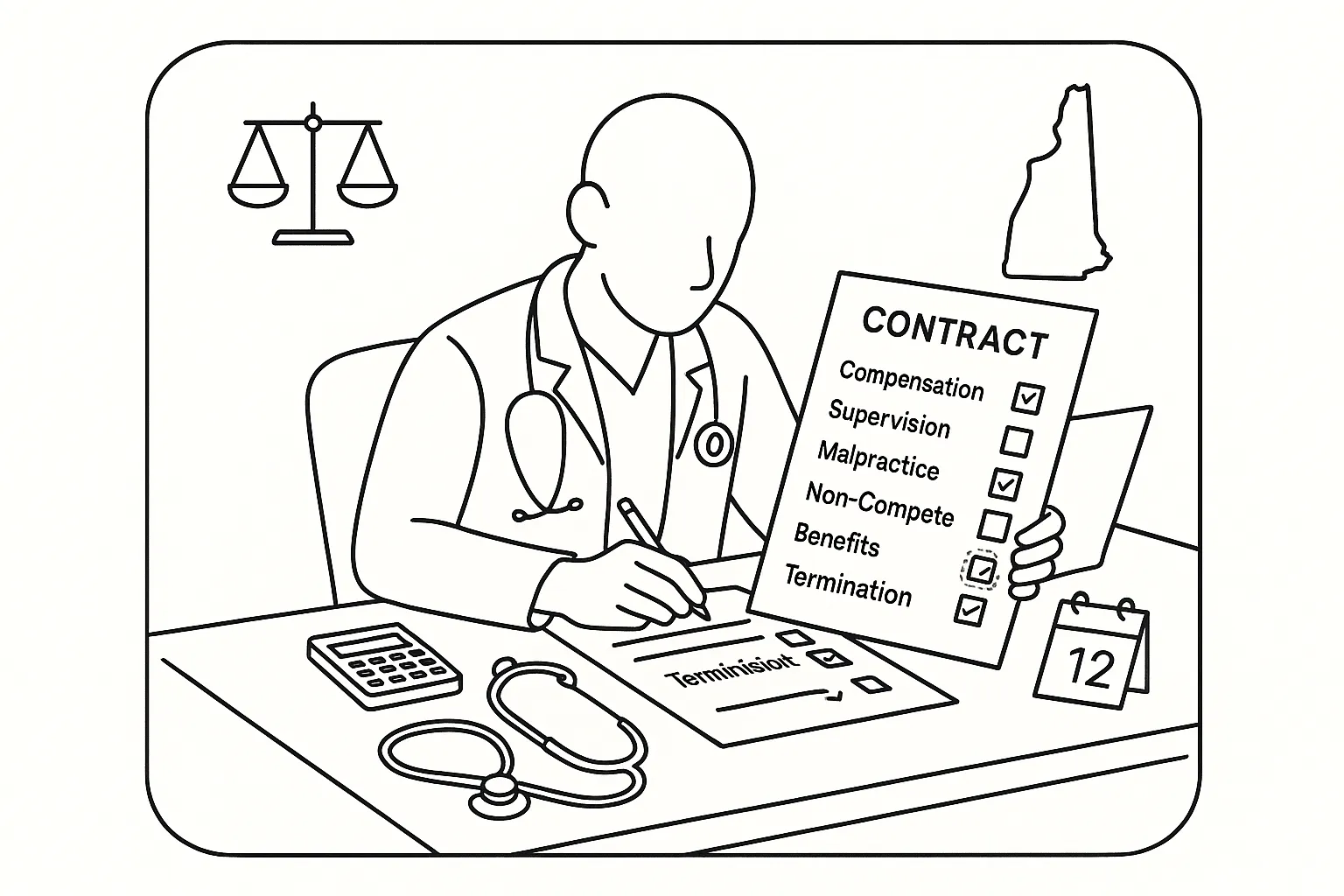
Salary, RVU, and Collections-Based Compensation
PA compensation may consist of guaranteed salary, base pay plus incentives, collections-based compensation, or an RVU formula. Analysis can determine whether the agreement defines the performance period, conversion factor, included services, payment schedule, reconciliation process, and permitted deductions. A PA compensation and productivity review can also reveal whether the employer retains discretion to alter thresholds or other important inputs.
An RVU formula may remain uncertain if the agreement permits deductions for overhead, benefits, chargebacks, or excluded services. Collections-based models raise different questions because payer delays, denials, write-offs, and receipt timing may postpone or reduce compensation. New Hampshire law permits PAs to bill for and receive direct payment for medically necessary services they provide, subject to federal law and carrier requirements, but the employment agreement still controls how the parties allocate receipts and calculate the PA’s compensation.
Benefits, Bonuses, and Repayment Obligations
Benefits affect the offer’s total value. The agreement and incorporated policies may address health insurance cost-sharing, retirement vesting, paid time off, continuing education allowances, professional dues, licensure fees, and controlled-substance registration expenses. Review can clarify when coverage begins, whether unused leave is paid at separation, and which benefits remain subject to policies the employer may amend.
Signing bonuses, relocation assistance, and student loan contributions may carry repayment obligations that survive termination. The relevant provisions can be evaluated for when a benefit is earned, which events trigger repayment, whether the amount is prorated, and whether the full balance becomes due after termination without cause, an unsuccessful credentialing process, or another event outside the PA’s control.
Malpractice Coverage, Clinical Duties, and Work Expectations
Professional Liability Insurance and Tail Coverage
New Hampshire requires a physician associate actively providing medical care to maintain adequate, current, and valid professional liability insurance. A contract can allocate the cost of that required coverage, define applicable limits, and state what happens after employment ends. The state requirement does not establish a profession-specific obligation for one party to purchase malpractice tail coverage, making the contract language particularly important.
An occurrence policy generally addresses covered incidents occurring during the policy period, while claims-made coverage may require post-employment protection. If the agreement shifts tail expense to the PA, the financial consequences can continue beyond the final day of work. The policy type, termination provisions, and responsibility for tail coverage should therefore be read together. Additional background is available in Chelle Law’s guide to tail insurance for physician assistants.
Scope of Practice, Prescribing, and Credentialing
Clinical-duty provisions need to reflect services within the PA’s education, training, experience, applicable standards of care, and any required collaboration agreement. Prescribing authority remains subject to New Hampshire licensure, collaboration, controlled-substance, prescription-monitoring, and federal requirements. Broad language such as “all duties assigned” cannot expand lawful authority, but it may create uncertainty about the employer’s operational expectations.
Credentialing clauses may condition employment on hospital privileges, payer enrollment, controlled-substance authority, or other approvals. Review can identify who is responsible for applications and fees, whether compensation begins before credentialing is complete, and what termination or repayment consequences follow if approval is delayed or denied.
Schedules, Call Coverage, and Multiple Locations
An unrestricted right to change shifts, add call coverage, or assign a PA among multiple sites may affect travel, compensation, and work-life balance. The contract may address minimum or maximum hours, weekend and holiday responsibilities, administrative time, remote work, call frequency, response requirements, and separate call pay. Location language also matters when it interacts with mileage reimbursement, credentialing requirements, or a post-employment restriction measured from every assigned facility.
Restrictive Covenants, Termination, and Repayment Risk
New Hampshire Non-Compete Requirements
A New Hampshire employer requiring a non-compete as a condition of employment must provide it to the prospective employee before the offer is accepted. A non-compete that was not disclosed as required is unenforceable under that disclosure rule, although the remaining provisions of the agreement may continue to apply. New Hampshire also prohibits non-competes for statutorily defined low-wage employees, a category that should be assessed against the individual’s actual compensation even though it is unlikely to cover most PA positions.
No PA-specific New Hampshire prohibition on non-competes was identified. Enforceability otherwise generally depends on common-law considerations such as legitimate business interests, reasonable geographic and temporal limits, and public policy. A physician assistant non-compete review can evaluate the stated territory, duration, restricted activities, covered facilities, and events that trigger the restriction without assuming that every covenant will be enforced as written.
Termination Rights and Post-Employment Obligations
Termination provisions determine how either party may end the relationship and what follows. Review can distinguish without-cause termination from termination for cause, identify the required notice period, evaluate any opportunity to cure an alleged breach, and clarify the treatment of earned compensation. Immediate termination triggers involving licensure, collaboration, credentialing, insurance, or professional discipline warrant close attention because the consequences may extend beyond loss of employment.
Post-termination terms may address final productivity payments, unpaid bonuses, outstanding draws, records, tail coverage, return of property, and repayment of incentives. A focused PA contract termination review can identify forfeiture language, accelerated repayment obligations, and restrictions that continue during the notice period or after separation.
Contract Priorities by Career Stage and Practice Setting
New Graduates and Early-Career PAs
New graduates often need additional clarity concerning guaranteed compensation, onboarding, collaboration, training, credentialing, malpractice coverage, and signing incentives. Because a PA with fewer than 8,000 post-graduate clinical practice hours may be subject to New Hampshire’s written collaboration requirement in specified practice structures, the agreement should accurately describe the employer’s model rather than rely on general assurances. A new graduate PA contract review can connect these operational terms with probationary periods, repayment obligations, and early termination rights.
Experienced, Specialty, and Hospital-Based PAs
Experienced PAs changing practices may place greater emphasis on restrictive covenants, bonus portability, non-solicitation language, waiver eligibility, credentialing contingencies, and whether a productivity model reflects expected volume. Specialty, hospital, and procedural roles may also use different malpractice limits, call arrangements, procedure-based formulas, and facility requirements. Analysis can determine whether the written terms match expected case volume and clearly allocate scheduling, coverage, and compliance responsibilities.
Employee and Independent Contractor Agreements
Whether a PA is engaged as a W-2 employee or a 1099 independent contractor affects taxes, benefits, insurance, expenses, indemnity, and contractual responsibility. A contractor agreement may require the PA to fund professional liability coverage, payroll taxes, retirement contributions, health insurance, licensure costs, equipment, and other expenses that an employer might otherwise provide. Those costs should be considered when comparing a contractor rate with an employee salary.
Calling a PA an independent contractor does not by itself determine legal status. The written classification should be considered alongside provisions governing control, payment, scheduling, records, insurance, systems, exclusivity, and responsibility for compliance. Reviewing the complete physician assistant independent contractor agreement can identify financial obligations and working conditions attached to the proposed classification.
Contract Red Flags and Review Preparation
Common New Hampshire PA Contract Red Flags
Contract risk often arises from ambiguity or from several provisions operating together rather than from one obviously unfavorable sentence. Terms warranting careful review include:
- Undefined terms such as “collections,” “net collections,” or “adjusted RVUs” in a compensation formula.
- Draws or negative accrual balances without a cap, reconciliation schedule, or clear treatment at termination.
- Employer discretion to change productivity thresholds, conversion factors, duties, schedules, or locations.
- Clinical duties or prescribing expectations that do not account for applicable scope and collaboration requirements.
- Malpractice provisions that do not identify the policy type, coverage limits, or responsibility for tail insurance.
- A non-compete presented only after the PA accepted the offer.
- Broad restrictions measured from every employer facility, worksite, market, or service line.
- Immediate forfeiture of earned compensation or accelerated repayment of signing, relocation, or loan benefits.
- Expansive for-cause termination language without an opportunity to correct a curable issue.
- Verbal promises concerning compensation, autonomy, schedule, location, or loan repayment that do not appear in the written agreement.
Preparing for Attorney Contract Review
Provide the complete agreement, offer letter, exhibits, compensation plans, addenda, and policies expressly incorporated into the contract. When available, include sample productivity calculations, benefit summaries, call schedules, location lists, and relevant credentialing materials. Reviewing the entire package is important because an exhibit or policy may qualify language in the main agreement.
Document representations concerning expected RVUs, schedule, equipment, clinical responsibilities, remote work, collaboration, loan repayment, or bonus opportunities. Identifying priorities such as tail responsibility, a proposed non-compete, multi-site assignments, or repayment exposure helps focus the review on provisions most likely to affect the decision. Chelle Law can explain compensation mechanics, evaluate malpractice allocation, identify regulatory and contractual inconsistencies, and flag terms that may warrant clarification or revision before signing.
Speak With a New Hampshire Physician Assistant Contract Lawyer Before You Sign
Chelle Law can review your proposed agreement, explain compensation and malpractice terms, identify post-employment risks, and flag provisions that may warrant clarification or revision.
Request a Contract ReviewExplore Physician Assistant Contract Guidance
Learn more about Chelle Law’s physician assistant review services, practical contract resources, and state-specific guidance.