
Physician assistants practicing in New Hampshire work within a regulatory framework overseen by the New Hampshire Board of Medicine, including state-specific requirements involving PA licensure, scope of practice, supervision, delegation, and prescribing. Those rules matter when an employment or independent contractor agreement defines clinical duties, supervising relationships, credentialing conditions, or authority across locations. In Manchester and Nashua, where PAs may consider opportunities with hospitals, private practices, urgent care groups, or telehealth organizations, employer templates can also allocate compensation risk, malpractice costs, call coverage, and post-employment restrictions in very different ways. Chelle Law reviews New Hampshire PA contracts line by line to identify whether the written terms fit the intended practice model and to explain how provisions concerning pay, benefits, liability, restrictive covenants, termination, and repayment obligations may affect income, compliance responsibilities, and future career flexibility before the agreement is signed.
A focused review should address more than the salary printed in an offer letter. Productivity formulas, malpractice coverage, restrictive covenants, termination rights, and repayment clauses can materially change the value and risk of an agreement. Reviewing these provisions together helps a New Hampshire PA understand both the immediate economics of the offer and the obligations that may continue after employment ends.
Why New Hampshire PA Contract Review Matters

PA agreements often use employer-favorable language to allocate reimbursement risk, define clinical responsibilities, and limit post-employment mobility. Collections-based compensation, negative accrual provisions, undefined supervision terms, or an obligation to purchase tail insurance can reduce take-home pay or create expenses that are not apparent when the offer is first presented.
An attorney review identifies ambiguous provisions, explains how separate clauses interact, and highlights terms that may not fit the proposed practice setting. New Hampshire clinicians may also consult the New Hampshire Academy of Physician Assistants for professional guidance concerning scope-of-practice developments and legislative initiatives, while relying on the written agreement to determine the specific financial and employment obligations accepted in a particular position.
Compensation, Benefits, and Productivity Terms
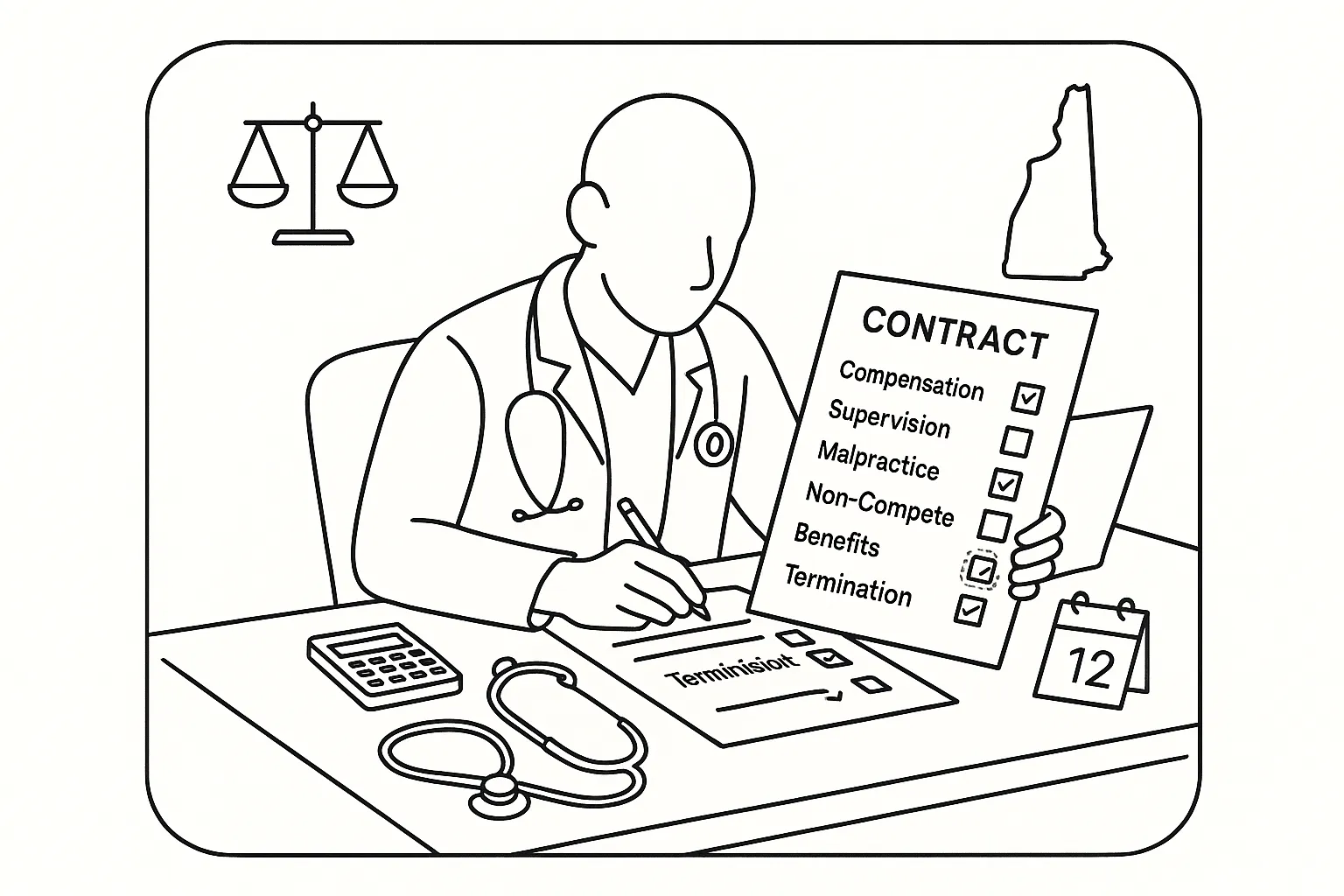
PA compensation may consist of a guaranteed salary, base pay plus incentives, collections-based compensation, or an RVU formula. Each structure should define the performance period, conversion factor, included services, payment schedule, reconciliation process, and employer deductions. A thorough PA compensation and productivity review can reveal whether the formula is measurable and whether the employer has retained discretion to change important inputs.
For example, a formula stated as total RVUs multiplied by a conversion factor may still produce an uncertain result if the agreement permits deductions for overhead, benefits, chargebacks, or uncollected services. Collections-based models create different concerns because payer delays, denials, write-offs, and the timing of receipts may defer compensation. Draws and negative accrual provisions require particular attention because an advance may become a repayment obligation if future productivity does not offset the balance.
Benefits also affect total compensation. The agreement and incorporated policies should be reviewed for health insurance cost-sharing, retirement vesting, paid time off, CME allowances, professional dues, licensure fees, and DEA-related expenses. Signing bonuses, relocation assistance, and student loan contributions should state when the benefit is earned, what events trigger repayment, whether repayment is prorated, and whether an employer may demand the full balance after termination.
Malpractice Coverage, Clinical Duties, and Work Expectations
Malpractice provisions should identify the type and limits of coverage, who pays the premium, and who is responsible for post-employment protection. An occurrence policy generally addresses incidents occurring during the policy period, while claims-made coverage may require tail protection after the relationship ends. If the contract shifts that expense to the PA, the financial consequences can continue well beyond the final day of work. Our guide to tail insurance for physician assistants explains why the policy type and separation terms must be read together.
Clinical-duty provisions should accurately describe the intended services, locations, supervision structure, delegation arrangements, and credentialing requirements. Vague language such as “other duties as assigned” or “supervision as required” may leave important operational questions unanswered. The agreement should be evaluated against the actual model, whether the PA expects to work in private practice, a hospital, urgent care, a procedural specialty, or a telehealth setting.
Schedule and assignment language also deserves scrutiny. An unrestricted right to change shifts, add call coverage, or assign the PA among multiple sites can affect work-life balance, travel, compensation, and the practical scope of the role. Call frequency, weekend responsibilities, administrative time, coverage obligations, and any separate call pay should be defined sufficiently to reduce future disputes.
Restrictive Covenants, Termination, and Repayment Risk
Restrictive covenants may include non-compete, non-solicitation, confidentiality, and patient or employee restrictions. A review should consider the geographic area, duration, restricted activities, covered facilities, and events that trigger the restriction. Even when enforceability depends on applicable law and specific facts, broad language can affect where a PA is able to work and whether a future employer is willing to proceed. The practical scope of these provisions is addressed further in our guide to restrictive covenants in PA contracts.
Termination provisions determine how either party may end the relationship and what happens next. The contract should distinguish without-cause termination from termination for cause, state the required notice period, identify any opportunity to cure an alleged breach, and explain the treatment of earned compensation. Immediate termination triggers tied to licensure, credentialing, or other professional events should be clear enough for the PA to understand the potential consequences.
Post-termination provisions may address final productivity payments, unpaid bonuses, outstanding draws, patient records, tail coverage, return of property, and repayment of incentives. A focused contract termination review can identify whether the agreement permits forfeiture of earned compensation or accelerates bonus, relocation, or loan-repayment obligations after separation.
Contract Priorities by Career Stage and Practice Setting
New graduates often need greater clarity concerning guaranteed compensation, onboarding, supervision, training, credentialing, malpractice coverage, and signing incentives. A first agreement may also contain a probationary period or repayment obligation that is easy to overlook. A new graduate PA contract review can help connect those provisions to the realities of beginning clinical practice.
Experienced PAs changing practices should focus on restrictive covenants, bonus portability, non-solicitation language, credentialing contingencies, and whether a productivity model reflects expected volume. A clinician moving from private practice to a health system may also encounter broader assignment rights, standardized compensation policies, or privileges that are conditions of continued employment.
Specialty, hospital, and procedural roles may use different productivity metrics, malpractice limits, call arrangements, and procedure-based compensation formulas. The written terms should match expected case volume and should make clear whether coverage, scheduling, and facility requirements shift costs or responsibilities to the PA.
Employee and Independent Contractor Agreements
Whether a PA is engaged as a W-2 employee or a 1099 independent contractor affects taxes, benefits, insurance, expenses, and contractual responsibility. A contractor agreement may require the PA to fund malpractice coverage, payroll taxes, retirement contributions, health insurance, licensing costs, and other expenses that an employer might otherwise provide. Those costs should be considered when comparing the stated rate with an employee offer.
The written classification should also be considered alongside the control described in the agreement. A contract that imposes a fixed schedule, exclusivity, employer-directed protocols, mandatory systems, and extensive operational control may create practical concerns even when the document labels the PA an independent contractor. Reviewing the complete independent contractor agreement helps identify the financial obligations, restrictions, and working conditions attached to that classification.
Common New Hampshire PA Contract Red Flags
Contract risk often arises from ambiguity rather than a single obviously unfavorable sentence. The following provisions warrant careful review because they can create unpredictable compensation, post-employment expense, or limits on professional mobility:
- Undefined terms such as “collections,” “net collections,” or “adjusted RVUs” in a compensation formula.
- Draws or negative accrual balances without a cap, reconciliation schedule, or clear treatment at termination.
- Employer discretion to change productivity thresholds, conversion factors, duties, schedules, or locations.
- Malpractice provisions that do not identify the policy type or responsibility for tail coverage.
- Broad non-compete or non-solicitation language covering multiple facilities, markets, or service lines.
- Immediate forfeiture of earned bonuses or accelerated repayment of signing and relocation benefits.
- Expansive for-cause termination language without a reasonable opportunity to correct a curable issue.
- Verbal promises concerning compensation, autonomy, schedule, or loan repayment that do not appear in the written agreement.
Preparing for an Attorney Contract Review
Provide the complete agreement, offer letter, exhibits, compensation plans, addenda, and any policies expressly incorporated into the contract. If available, include productivity data, sample calculations, benefit summaries, call schedules, or historical collections information. Reviewing the complete package is important because a favorable sentence in the main agreement may be limited by an exhibit or employer policy.
Document verbal representations concerning expected RVUs, schedule, equipment, clinical autonomy, remote work, loan repayment, or bonus opportunities. Identify the issues that matter most to you, such as tail responsibility, a proposed non-compete, multi-site assignments, or repayment exposure. This allows counsel to prioritize the financial and professional terms most likely to affect the decision.
Chelle Law performs a line-by-line review to explain compensation mechanics, identify hidden repayment obligations, evaluate malpractice allocation, assess clinical-duty language, and flag restrictions that may impede future employment. Obtaining that review before signing makes it possible to seek clarification or revised language while the offer is still under consideration.
Review Your New Hampshire PA Contract Before Signing
Chelle Law can identify compensation, malpractice, restrictive covenant, termination, and repayment terms that may affect your income and career flexibility.
Contact Chelle LawExplore Physician Assistant Contract Guidance
Learn more about Chelle Law’s review services, practical contract resources, and state-specific guidance for physician assistants.