
New Jersey physician assistant contracts operate within a regulatory framework administered through the New Jersey Physician Assistant Advisory Committee, the New Jersey State Board of Medical Examiners, and the New Jersey Division of Consumer Affairs. A PA must hold a current New Jersey license and practice under physician supervision, with delegated services generally documented in a written delegation agreement addressing the PA’s role, consultation, chart review or countersignature requirements, and authorized locations. That agreement is generally signed and dated annually and updated when necessary. These requirements can affect employment terms involving supervision, prescribing, credentialing, clinical duties, and multi-site assignments. Physician assistants considering opportunities in Newark, Jersey City, or elsewhere in New Jersey also benefit from reviewing how the contract handles compensation, call, malpractice coverage, restrictive covenants, termination, and repayment obligations. Chelle Law evaluates these interconnected provisions so the PA can understand the proposed position and identify terms that may warrant clarification or revision before signing.
A contract may shift substantial professional or financial risk through a few lines addressing productivity reconciliation, tail insurance, indemnification, bonus repayment, or post-employment restrictions. Reviewing the complete document package helps determine whether the written terms match the offer, fit the anticipated practice arrangement, and provide a workable path if employment ends.
Why New Jersey PA Contract Review Matters
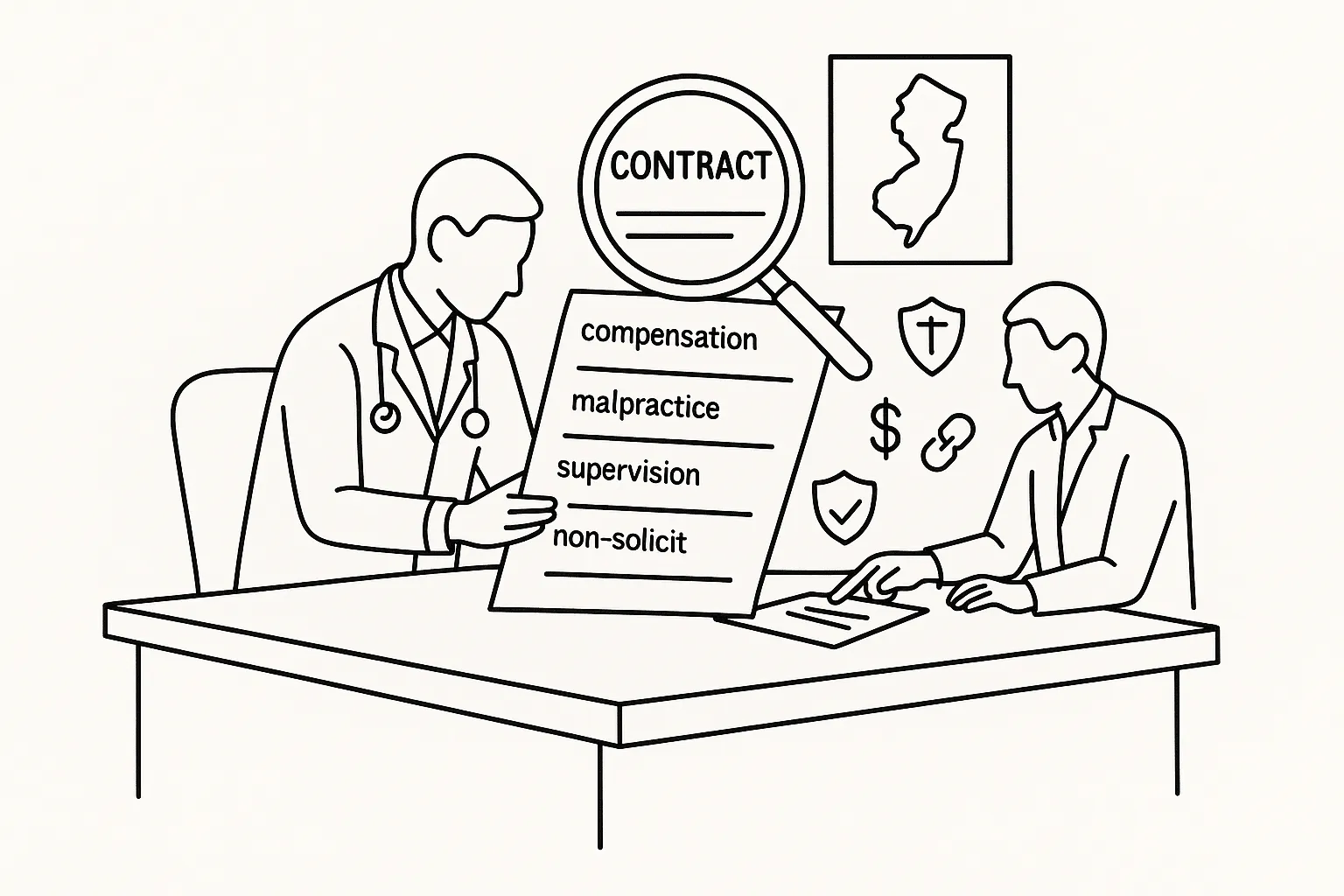
Connecting Contract Terms to New Jersey Practice Rules
Employment language concerning clinical authority cannot be evaluated separately from New Jersey’s supervision and delegation requirements. Review can determine whether the described duties fall within the PA’s education, training, experience, and competence and whether delegated procedures are consistent with the supervising physician’s specialty and the required practice arrangement. Prescribing provisions also need to reflect physician delegation, supervision, and applicable controlled-substance requirements rather than granting vague or unlimited authority.
The supervisory structure matters as well. New Jersey rules provide that a supervising physician may supervise no more than four physician assistants at one time, subject to applicable statutory and regulatory requirements. Contract analysis can flag staffing language, coverage expectations, or unilateral duty changes that may not align with the proposed supervisory model.
Reviewing the Entire Offer Package
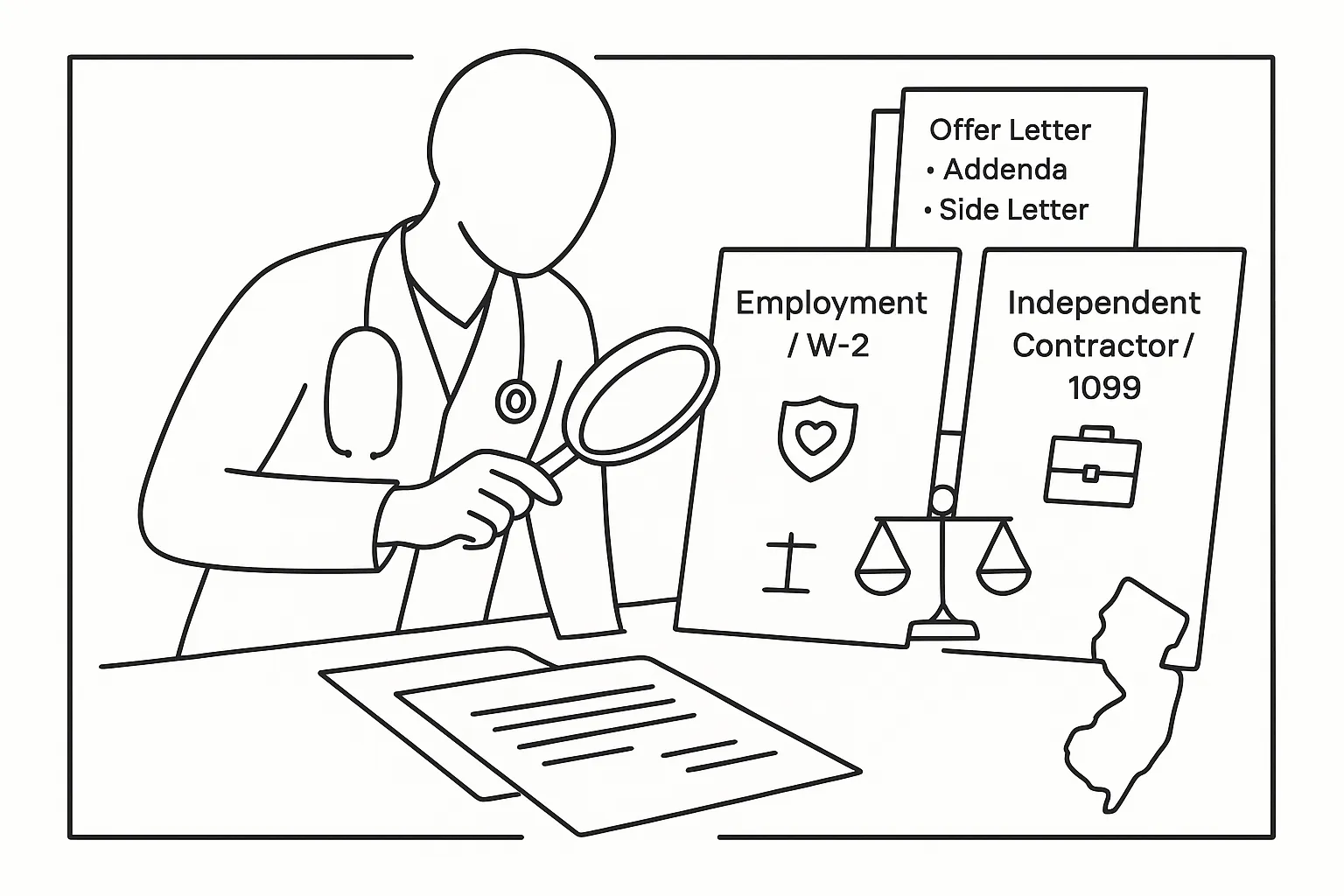
The operative terms may be divided among an offer letter, employment agreement, compensation plan, bonus addendum, relocation agreement, handbook, or loan-repayment document. These materials need to be read together because one may modify another or place a significant term in an employer policy that can later change. A comprehensive physician assistant contract review can identify inconsistent promises, discretionary language, omitted offer terms, and obligations that continue after employment.
Employment Agreements and Independent Contractor Terms
W-2 Employment Terms
A W-2 employment agreement commonly addresses employer control over scheduling and work locations, eligibility for benefits, tax withholding, malpractice coverage, and reimbursement of professional expenses. Review can clarify the start date, expected term, regular schedule, paid time off, retirement contributions, health coverage, continuing medical education allowance, licensing expenses, and conditions attached to each benefit.
The agreement may also incorporate policies that are not attached or allow the employer to modify duties, compensation, or benefits. Analysis can distinguish fixed contractual commitments from discretionary policies and identify whether the employer’s amendment authority materially changes the value of the offer.
New Jersey Classification and 1099 Risk
An independent contractor agreement may shift responsibility for taxes, benefits, insurance, business expenses, and indemnification to the PA. The contract’s 1099 label does not resolve classification. For covered New Jersey employment laws, a worker is presumed to be an employee unless the hiring party establishes all three parts of the state’s ABC test, including freedom from control, service outside the usual course or places of business, and an independently established business.
Contract review can compare the proposed label with the actual working relationship, including schedule control, required locations, exclusivity, equipment, billing, supervision, and integration into the practice. A focused PA independent contractor agreement review also evaluates tax allocation, insurance responsibilities, payment timing, termination rights, and provisions that may create unexpected personal liability.
Compensation, Benefits, and Productivity Pay
Base Salary and Benefits
Base salary offers relative predictability, but the agreement still needs clear payment periods, a compensation start date, conditions for adjustment, and treatment of salary earned before termination. Review can also determine whether scheduled call, weekend coverage, administrative work, chart completion, or work at additional facilities is included in salary or compensated separately.
Benefits can materially affect the value of an offer. Health insurance, retirement contributions, paid leave, licensing fees, professional dues, and CME allowances may be subject to waiting periods, reimbursement conditions, or forfeiture upon departure. The written terms can be compared with the offer letter and benefit summaries to identify gaps or conflicts.
RVU and Collections-Based Formulas
Productivity compensation may use work RVUs, total RVUs, collections, encounters, procedures, quality measures, or a combination of metrics. An RVU formula might multiply credited RVUs by a conversion factor and then apply a threshold or percentage. For illustration, 5,000 RVUs multiplied by $40 and a 50% productivity share equals $100,000, but the actual payment depends on definitions, thresholds, exclusions, reconciliation rules, and whether the PA receives credit for services performed, billed, or collected.
Collections-based compensation can place payer delays, denials, chargebacks, and patient nonpayment on the PA. A physician assistant compensation and productivity review can evaluate reporting access, calculation periods, attribution rules, negative accrual, post-termination collections, and the employer’s authority to change the formula.
Bonuses, Relocation, and Repayment Obligations
Signing bonuses, relocation assistance, loan support, compensation advances, and retention payments frequently include repayment conditions. Analysis can identify the triggering events, repayment deadline, proration method, and whether repayment applies when the employer terminates the PA without cause. The effect of these provisions becomes clearer when they are reviewed alongside the notice and termination sections.
Repayment language may also authorize payroll deductions or require the PA to reimburse taxes, collection costs, or legal fees. A review can calculate the potential exposure and flag language that does not distinguish voluntary resignation from an employer-initiated separation.
Malpractice Insurance, Indemnification, and Credentialing
Policy Type, Tail Coverage, and Indemnification
Malpractice provisions may identify occurrence or claims-made coverage, policy limits, premium responsibility, prior-acts coverage, exclusions, and the treatment of claims after termination. Occurrence coverage generally applies to covered acts occurring during the policy period. Claims-made coverage may require extended reporting, commonly called tail coverage, after the underlying policy ends. The verified New Jersey sources do not establish a profession-specific statutory allocation of PA tail responsibility, making the contract language especially important.
Indemnification requires separate attention. Broad language may obligate the PA to reimburse the employer for third-party claims, legal expenses, billing disputes, or regulatory matters beyond losses caused by the PA’s conduct. Review can determine whether the obligation is limited, coordinated with available insurance, and consistent with other liability provisions. Chelle Law’s guide to malpractice insurance for physician assistants explains additional coverage issues that may appear in an agreement.
Credentialing, Enrollment, and Delayed Start Dates
Credentialing and payer-enrollment terms can affect when the PA begins clinical work and receives compensation. The agreement may allocate responsibility for applications, supporting documents, fees, hospital privileges, payer enrollment, and updates involving supervising physicians. New Jersey’s framework also requires supervising-physician notifications and timely reporting of changes; an agreement containing the required physician information may satisfy the applicable notification requirement.
If the start date or compensation depends on credentialing, analysis can identify what happens during a delay or denial. Material questions include whether the start date moves automatically, whether temporary duties are available, whether either party may terminate, and whether a failed or delayed start triggers bonus or relocation repayment.
Scope of Practice, Supervision, and Work Expectations
Delegation Agreements and Supervisory Structure
A New Jersey PA must practice under physician supervision. Delegated services generally require a written delegation agreement identifying the PA’s role, consultation requirements, chart review or countersignature expectations, and authorized practice locations. The delegation agreement is generally signed and dated annually and updated as necessary, so the employment contract needs to work alongside that document rather than create conflicting clinical obligations.
Review can compare the stated duties with the PA’s qualifications, the supervising physician’s specialty, and the proposed practice model. It can also identify provisions that permit unrestricted changes to duties, supervising physicians, prescribing responsibilities, or locations without considering regulatory and credentialing consequences.
Call, Scheduling, Locations, and Outside Work
Schedule terms may address regular hours, nights, weekends, call, cross-coverage, administrative time, and assignments at additional facilities. Broad language requiring services whenever or wherever requested can permit substantial workload changes without corresponding compensation. Review can clarify whether call is included in salary, paid separately, or governed by a policy the employer may later revise. Additional considerations appear in the resource on PA call schedules and coverage requirements.
Multi-site language deserves particular attention because the authorized practice locations may also appear in the delegation agreement and credentialing materials. Moonlighting restrictions can be evaluated for their effect on outside clinical work, conflicts of interest, scheduling, insurance, and credentialing. An approval process is easier to apply when it uses clear standards rather than unlimited discretion.
Restrictive Covenants, Termination, and Financial Exposure
New Jersey Non-Compete and Non-Solicitation Terms
New Jersey generally evaluates restrictive covenants case by case. The analysis considers whether a restriction protects a legitimate business interest, imposes undue hardship, or injures the public. Duration, geography, and prohibited activities also matter, and the verified sources do not identify an enacted physician-assistant-specific New Jersey non-compete rule.
A contract review can map the restriction against realistic future opportunities and determine whether it extends from one location or every employer site. It can also examine whether the covenant applies after every type of termination, reaches services the PA never performed, or combines with non-solicitation and confidentiality provisions to create broader limits. A focused physician assistant non-compete review helps explain these practical effects without assuming that a clause is automatically enforceable or unenforceable.
Termination Rights, Notice, and Repayment
Termination provisions usually distinguish termination for cause from termination without cause. Review can evaluate notice periods, opportunities to cure an alleged breach, immediate termination events, final compensation, accrued benefits, patient-transition duties, and access to information needed for billing or professional defense. If the PA must give lengthy notice, the agreement also needs to be examined for the employer’s ability to remove the PA from the schedule, reduce duties, or stop productivity accrual during that period.
Termination may activate obligations involving tail insurance, bonus repayment, relocation costs, loan support, negative productivity balances, or post-employment restrictions. A PA contract termination review can analyze these provisions together and explain the financial consequences associated with different separation scenarios.
New Jersey Physician Assistant Contract Red Flags
Warning signs often involve unclear definitions or excessive employer discretion rather than a single obviously unfavorable sentence. A line-by-line review can identify provisions that appear routine but materially affect compensation, clinical responsibilities, liability, or the ability to accept another position.
- Compensation formulas that do not define credited services, RVUs, collections, thresholds, or reconciliation periods.
- Authority to change pay, duties, schedules, supervising physicians, or work locations unilaterally.
- Clinical duties or prescribing terms that do not align with the anticipated New Jersey delegation and supervision arrangement.
- Claims-made malpractice coverage without an express allocation of tail or extended-reporting responsibility.
- Broad indemnification extending beyond the PA’s conduct or available insurance.
- Call, weekend, cross-coverage, or multi-site obligations without defined limits or compensation.
- Non-compete restrictions tied to every employer location or services the PA did not perform.
- Repayment triggered by any separation, without proration or an exception for employer-initiated termination.
- Credentialing delays that suspend compensation while preserving the PA’s repayment obligations.
- Termination language that permits immediate separation without a reasonable opportunity to cure a correctable issue.
Chelle Law’s review process focuses on the complete agreement and the provisions most likely to affect the individual PA. The attorney reviews material terms, identifies contract risks, explains practical consequences, and helps the PA understand questions or proposed revisions worth raising before signing. The purpose is to provide clarity about compensation, responsibilities, liability allocation, and exit terms—not to promise a particular outcome or directly negotiate with the employer.
Speak With a New Jersey Physician Assistant Contract Lawyer Before You Sign
Chelle Law can review your proposed employment or independent contractor agreement, identify material risks, and explain provisions involving compensation, supervision, malpractice coverage, restrictive covenants, termination, and repayment.
Request a Contract Review