
New Jersey physician assistant contracts must account for rules administered by the New Jersey State Board of Medical Examiners, including requirements affecting PA scope of practice, supervision, delegation, and prescribing. Those regulatory considerations can shape how an employment agreement assigns clinical duties, identifies supervising physicians, addresses credentialing, and permits work at multiple locations. PAs evaluating positions in Newark, Jersey City, and other New Jersey healthcare markets should also examine whether the contract clearly defines compensation, call coverage, malpractice insurance, restrictive covenants, and termination rights. Chelle Law reviews these provisions together because state practice requirements and contract terms can create overlapping professional and financial risks. A line-by-line review helps a PA understand whether the proposed agreement accurately reflects the position, allocates liability fairly, and provides workable terms if the employment relationship ends.
Why New Jersey PA Contract Review Matters
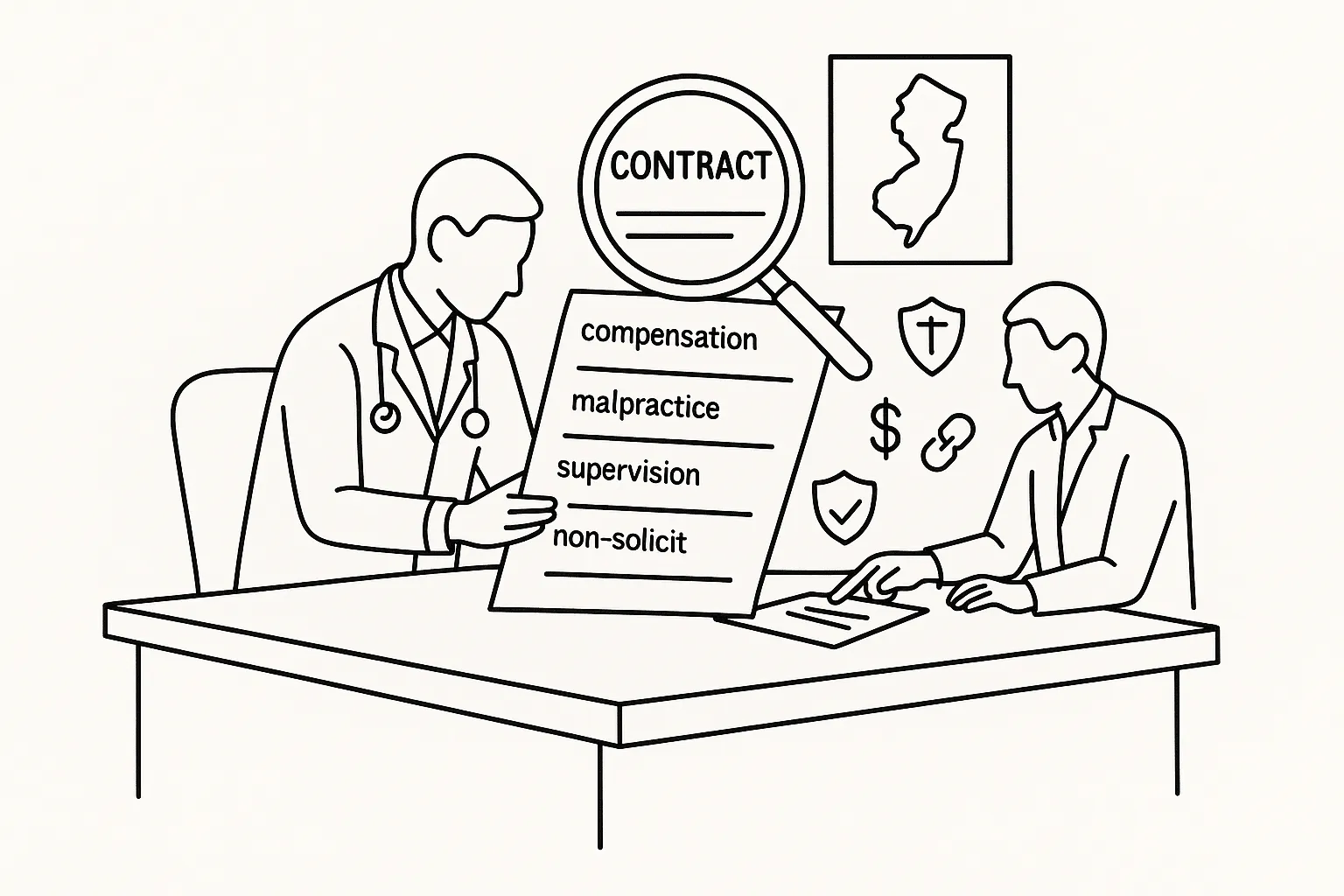
Physician assistant agreements frequently combine compensation, malpractice coverage, supervision, benefits, and post-employment restrictions in dense legal language. A provision that initially appears routine—such as a productivity reconciliation, repayment clause, or broad non-solicitation restriction—can reduce expected earnings, create debt after termination, or limit future employment opportunities.
Attorney review is a form of proactive risk management. A careful physician assistant contract review identifies income-related definitions, evaluates how regulatory responsibilities are allocated, and explains contingent liabilities such as tail insurance or bonus repayment. The objective is to translate contract language into practical financial and professional consequences before the PA signs.
Physician assistants considering New Jersey opportunities may also consult advocacy resources from the New Jersey State Society of Physician Assistants for information concerning statewide professional and practice issues.
Employment Agreements, Contractor Terms, and Related Documents

An employment agreement typically contemplates W-2 status, employer control over scheduling, benefits eligibility, and employer-provided malpractice coverage. A 1099 agreement generally shifts tax, benefit, and insurance responsibilities to the PA and may contain different indemnification provisions. The label used in the contract does not resolve every classification issue, so the document should be evaluated alongside the proposed working relationship. PAs considering this arrangement may benefit from a focused independent contractor agreement review.
The complete contract package may include an offer letter, employment agreement, compensation plan, bonus addendum, relocation agreement, or loan-repayment document. These materials should be reviewed together because one document may modify another or place important terms within an employer policy that can change. The review should identify inconsistent promises, discretionary language, repayment triggers, and any material term mentioned in the offer but omitted from the final agreement.
Compensation, Benefits, and Productivity Pay
PA compensation may combine base salary with RVU production, collections, quality incentives, or discretionary bonuses. Base salary provides relative predictability, but the agreement should still state the pay period, start date, conditions for salary adjustments, and treatment of compensation earned before termination. Benefits such as health insurance, retirement contributions, paid time off, and CME allowances should also identify eligibility, employer obligations, and any required employee cost sharing.
Productivity formulas require particular attention. An RVU model may multiply generated RVUs by a conversion factor, apply a threshold, and then determine a percentage payable to the PA. For example, 5,000 RVUs multiplied by $40 per RVU and a 50% productivity share would equal $100,000, but the actual result depends on whether the formula uses billed, performed, credited, or collected services. A PA compensation and productivity review should examine the definitions, reporting rights, reconciliation periods, exclusions, and employer authority to change the formula.
Collections-based compensation can shift payer delays, denials, and patient nonpayment to the PA. The contract should explain when collections receive credit, whether later denials produce chargebacks, and how outstanding accounts are handled after departure. Signing bonuses, relocation assistance, and loan-repayment benefits also warrant review because they frequently include prorated or lump-sum repayment obligations if employment ends before a specified date.
Malpractice Insurance, Indemnification, and Credentialing
Malpractice provisions should identify the policy type, coverage limits, premium responsibility, and treatment of coverage after termination. Occurrence coverage generally applies to covered acts occurring during the policy period, while claims-made coverage may require extended reporting coverage after the underlying policy ends. If the agreement assigns that responsibility to the PA, the potential cost and timing should be understood before signing. Our guide to malpractice insurance for physician assistants explains the contract issues that commonly accompany these policies.
Indemnification language also deserves scrutiny. A broadly drafted clause may require the PA to reimburse the employer for legal expenses, regulatory matters, or third-party claims beyond losses caused by the PA’s own conduct. The agreement should be read to determine whether indemnification is limited, reciprocal where appropriate, and coordinated with available insurance.
Credentialing and payer-enrollment provisions should clarify who initiates the process, supplies documentation, pays associated fees, and bears the consequences of delay or denial. If compensation or the employment start date depends on credentialing, the contract should address what happens during the waiting period and whether either party may terminate without creating an unexpected repayment obligation.
Scope of Practice, Supervision, and Work Expectations
The agreement should align the PA’s duties and supervisory structure with New Jersey requirements and the employer’s actual practice model. It should accurately identify clinical responsibilities, delegated services, documentation expectations, prescribing duties, and any conditions attached to maintaining licensure, privileges, or other professional qualifications. Vague language allowing material changes to duties or supervision can create practical and regulatory problems after the PA begins work.
Schedule provisions should address regular hours, weekend work, call, cross-coverage, and assignments at additional facilities. Broad language requiring services whenever or wherever requested may permit substantial workload changes without corresponding compensation. PAs should determine whether call responsibilities are included in salary, paid separately, or subject to later scheduling policies. The same concerns are discussed in greater detail in the resource addressing PA call schedules and coverage requirements.
Moonlighting restrictions should also be evaluated in context. An employer may have legitimate scheduling, conflict-of-interest, credentialing, or insurance concerns, but the contract should not unnecessarily prohibit outside work that does not interfere with the PA’s obligations. Any approval requirement should explain the process and avoid giving the employer unlimited discretion without a clear standard.
Restrictive Covenants, Termination, and Repayment
Non-compete and non-solicitation clauses can affect where a PA works and which professional or patient relationships may continue after separation. In New Jersey, the practical risk depends on the contract language, applicable law, and the surrounding facts. The review should examine the restricted duration, geographic area, covered services, practice locations used to calculate the restriction, and whether the covenant applies after every type of termination. A focused non-compete review for physician assistants can help explain how the proposed language may affect future opportunities.
Termination provisions should clearly distinguish termination for cause from termination without cause. Important issues include notice periods, opportunities to cure an alleged breach, immediate termination events, final compensation, accrued benefits, patient-transition duties, and access to records needed for billing or professional defense. If the PA must provide lengthy notice, the agreement should also be evaluated for whether the employer can remove the PA from the schedule or stop productivity accrual during that period.
Repayment obligations may apply to signing bonuses, relocation assistance, loan support, CME expenses, compensation advances, or negative productivity balances. The contract should define each trigger and state whether repayment is prorated. These obligations should be reviewed alongside the termination language because a repayment clause may apply even when the employer ends the relationship. A contract termination review can assess notice requirements, post-employment compensation, and related financial exposure together.
Contract Red Flags and the Review Process
Common warning signs include vague compensation definitions, collections-based pay without clear accounting rights, claims-made malpractice coverage without an express allocation of tail responsibility, and restrictions tied to every employer location. Other concerns include unilateral authority to change compensation, undefined call duties, broad indemnification, repayment triggered by any separation, and supervision terms that do not match the proposed New Jersey practice arrangement.
- Confirm what services, RVUs, or collections receive compensation credit.
- Identify employer discretion to modify pay, duties, locations, or schedules.
- Determine the type of malpractice policy and responsibility for tail coverage.
- Measure non-compete and non-solicitation restrictions against realistic future jobs.
- Review every termination event, notice obligation, and opportunity to cure.
- Calculate potential bonus, relocation, loan, and productivity repayments.
Chelle Law’s review process focuses on the complete agreement and the issues most likely to affect the individual PA. The attorney identifies material terms, explains their practical consequences, and discusses possible questions or revisions before the agreement is signed. The purpose is not to promise a particular negotiation result, but to give the PA a clearer understanding of the proposed compensation, responsibilities, liability allocation, and exit terms.
Have a New Jersey PA Contract Reviewed
Before signing an employment or independent contractor agreement, speak with Chelle Law about the compensation, malpractice, supervision, restrictive covenant, and termination provisions that may affect your practice.
Contact Chelle Law