
Physician assistants evaluating an employment agreement or independent contractor arrangement in New Mexico must consider how the contract interacts with requirements administered by the New Mexico Medical Board. State rules address licensure, physician supervision and collaboration, prescribing authority, and notice following certain employment terminations. For example, a supervising physician may supervise and collaborate with no more than three physician assistants, and the supervising physician must submit the required notice of intent to supervise. These requirements can affect how a proposed role is structured at a hospital, private practice, or healthcare organization in Albuquerque, Santa Fe, and other New Mexico communities. Contract review can determine whether the written supervision arrangements, clinical duties, prescribing responsibilities, credentialing conditions, and assigned locations accurately reflect the anticipated position while remaining consistent with the PA’s professional obligations.
The rest of the agreement may create equally significant financial and career consequences. Compensation formulas, call coverage, malpractice insurance, restrictive covenants, termination rights, incentive repayment, and post-employment obligations often interact. Attorney-led physician assistant contract review can identify ambiguous language, explain how provisions operate together, and flag terms that may warrant clarification or revision before the PA signs.
New Mexico PA Licensing and Practice Requirements
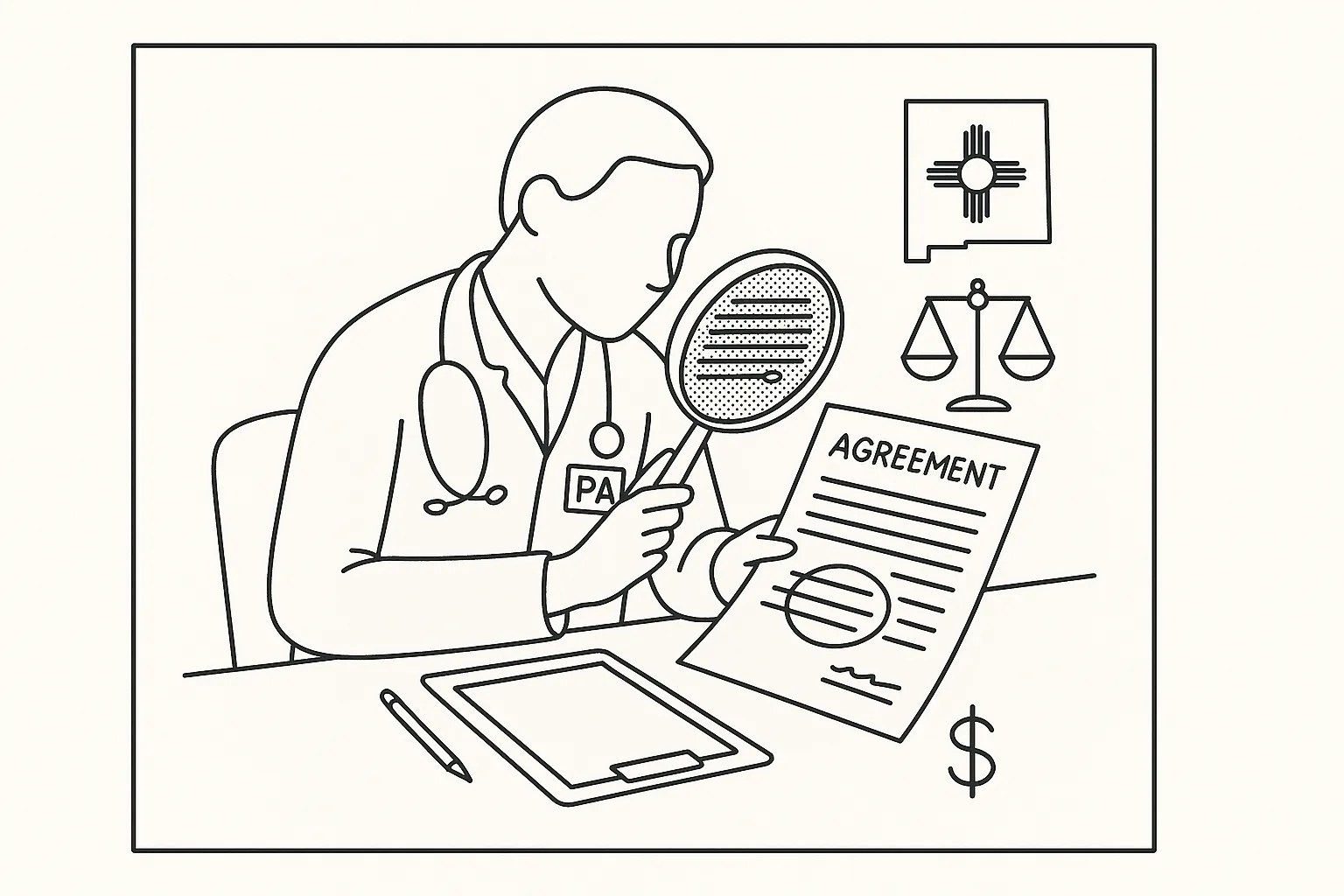
New Mexico physician assistant contracts should be evaluated against the professional framework governing the proposed position. Vague provisions concerning supervision, delegation, prescribing, documentation, or locations can create uncertainty about who controls clinical operations and whether the duties discussed during recruitment match the written agreement.
Supervision and Collaboration Arrangements
New Mexico defines a physician assistant as a Board-licensed health professional who provides services under the supervision and direction of a licensed physician. State rules limit a supervising physician to supervising and collaborating with no more than three physician assistants and require written notice of the intent to supervise on Board forms. Contract analysis can determine whether the agreement identifies the supervising physician, describes the operational relationship, and addresses what happens if that physician becomes unavailable or the arrangement changes.
Broad language allowing unilateral reassignment may affect more than scheduling. A change in specialty, supervising physician, facility, or clinical responsibility can implicate training, credentialing, support, and compensation. The document may also need to distinguish the employer’s administrative authority from the professional supervision and direction required for the PA’s clinical role.
Prescribing, Credentialing, and Board Notice
New Mexico rules govern the administration, prescribing, and distribution of dangerous drugs by physician assistants and supervising physicians. A PA’s formulary may include Schedule II through V controlled substances when the required patient relationship, supervision, and prescribing conditions are satisfied. The contract can be reviewed for consistency between the expected prescribing duties, available supervision, credentialing, and the authority associated with the position.
Credentialing, payer enrollment, and facility privileges can also determine when the PA may begin providing compensated services. The agreement may address whether salary starts before credentialing is complete, who controls the application process, and what occurs if approval is delayed or denied. If an employer terminates a PA’s employment, New Mexico rules require the supervising physician or physician assistant to notify the Board in writing within 30 days of the termination date and reason, making the contract’s transition provisions particularly relevant.
Compensation, Productivity, and Incentive Terms
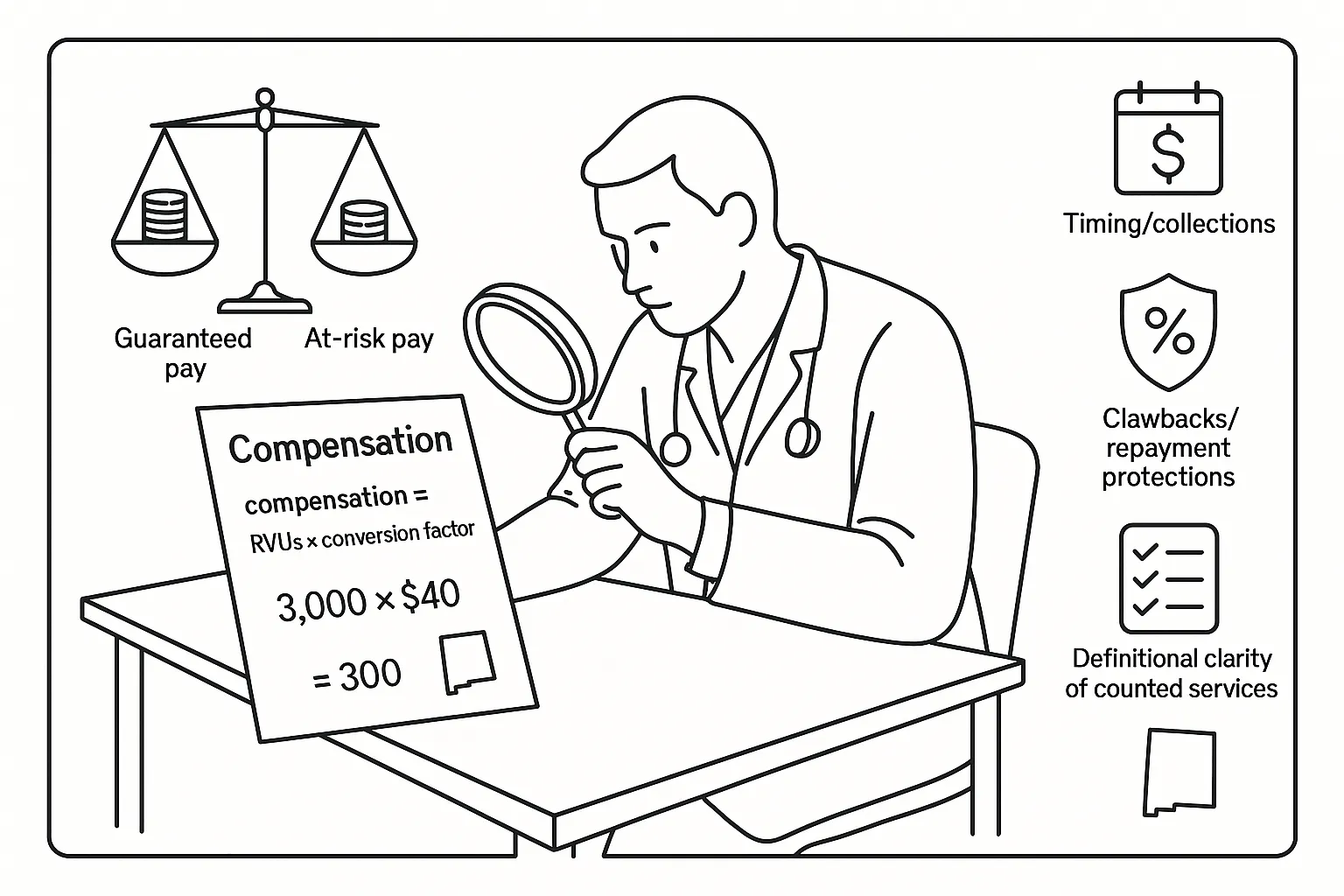
Compensation language can appear straightforward while leaving key variables under the employer’s control. A focused PA compensation and productivity review can evaluate the relationship among guaranteed pay, productivity thresholds, bonus calculations, reconciliation rights, and post-termination payments.
Base Salary, RVUs, and Collections-Based Pay
A guaranteed salary offers predictable income, but the contract may condition future pay on productivity, quality, schedule, or other metrics. Under an RVU model, compensation may be calculated by multiplying credited RVUs by a conversion factor. A $40 conversion factor applied to 3,000 credited RVUs equals $120,000, but that calculation is meaningful only if the agreement explains which services receive credit, when RVUs are recorded, whether a threshold applies, and whether negative accrual or quality adjustments can reduce compensation.
Collections-based models depend on money the employer actually receives and therefore create different timing and verification concerns. Review can distinguish charges, allowed amounts, and net collections while identifying how denials, refunds, billing delays, payer adjustments, and post-termination collections are treated. Access to reports and a process for questioning calculations may be important when the employer exclusively controls the underlying data.
Bonuses, Relocation Benefits, and Repayment
Signing bonuses, relocation assistance, loan-related benefits, and other incentives may be tied to a service period. The repayment provision may specify whether the obligation is prorated, which termination events trigger repayment, when the balance becomes due, and whether the employer may deduct an asserted debt from final compensation. Careful review of physician assistant sign-on bonus repayment terms can reveal whether an early departure could convert an incentive into a substantial immediate liability.
Repayment language may extend beyond cash bonuses to recruiting costs, credentialing expenses, continuing education, or malpractice coverage. Analysis can identify whether different obligations overlap, whether repayment decreases as service is completed, and whether termination by the employer produces the same result as a voluntary resignation.
Malpractice Coverage and Work Expectations
Insurance obligations and day-to-day work terms affect both the cost and practicality of a New Mexico PA position. Because no material physician-assistant-specific New Mexico rule allocates malpractice premiums or tail coverage between the parties, the contract’s written allocation is especially important.
Claims-Made Coverage, Tail Insurance, and Liability
Malpractice provisions may identify the policy type, coverage limits, covered services, premium responsibility, and protection after the relationship ends. Occurrence coverage generally applies to covered professional services performed during the policy period even if a claim is made later. Claims-made coverage ordinarily requires the policy to remain effective when the claim is reported, which may make an extended reporting endorsement relevant after employment.
The agreement can expressly allocate responsibility for physician assistant tail insurance and state whether that allocation changes based on the reason for termination. Review should also consider defense costs, exclusions, consent-to-settle terms, claim-reporting duties, and indemnification or hold-harmless language. Broad liability provisions can shift responsibility for employer-controlled billing, staffing, facilities, or administrative operations to the PA.
Schedule, Call, Locations, and Changing Duties
The clinical section may define the specialty, patient population, shifts, administrative time, call coverage, weekends, holidays, and expected work locations. Open-ended phrases such as “other duties as assigned” can permit material changes without addressing additional compensation, training, supervision, or professional support. Contract review can compare that discretion with the schedule and responsibilities represented during recruitment.
Multi-site assignments may affect travel time, mileage, call response expectations, and the geographic reach of later restrictions. Telehealth terms may raise additional questions about scheduling, approved locations, technology, documentation, and credentials. Clear language about who controls assignments and how material changes are handled can reduce uncertainty after employment begins.
New Mexico Restrictive Covenants and Confidentiality Terms
New Mexico does not apply a categorical statutory ban to physician assistant non-competes. State courts have recognized employment restrictive covenants when the restraints are reasonable, with enforceability depending on the facts, the interest being protected, and the scope of the temporal, geographic, and activity limitations. A contract review can assess practical exposure without assuming that every restriction will be enforced or disregarded.
Non-Compete Scope and Reasonableness
A non-compete may restrict particular services, specialties, facilities, employer affiliates, geographic areas, or categories of healthcare work. The definition of the restricted territory deserves close attention when the PA may rotate among several locations, because language tied to every employer site can reach farther than language based on the PA’s actual practice location. A physician assistant non-compete review can compare the duration, territory, prohibited activities, exceptions, and triggering events.
The circumstances of departure may also affect the practical impact of the restriction. The document may preserve the covenant after employer-initiated termination, a facility closure, loss of supervision, or a material reduction in compensation. Review can identify whether a release, waiver, buyout, or other exception is written into the agreement.
Non-Solicitation, Confidentiality, and Separation Language
Patient, referral-source, and employee non-solicitation provisions can independently limit future activity even when a non-compete appears narrow. Confidentiality clauses may protect legitimate confidential information and trade secrets, but broad definitions can extend to information the PA already knew, developed independently, or may need for legally protected reporting. The agreement can also be evaluated for continuing obligations involving records, property, public statements, and cooperation after departure.
New Mexico separately restricts private employers from requiring certain nondisclosure or nondisparagement provisions in settlement agreements concerning workplace sexual harassment, discrimination, or retaliation claims. That rule is more specific than an ordinary confidentiality clause in an initial employment agreement, but it may become material if the contract incorporates separation, release, or settlement terms.
Termination, Notice, and Post-Employment Obligations
Termination language determines how quickly either party may end the relationship and what financial or professional obligations survive. Because New Mexico generally treats employment as at will absent an express or implied agreement altering that relationship, provisions addressing term, cause, notice, and renewal deserve precise review.
For-Cause and Without-Cause Termination
Without-cause termination ordinarily permits departure after a specified notice period without proving misconduct or breach. Review can compare the notice required from each party, determine whether the employer may remove the PA from the schedule during notice, and identify whether compensation and benefits continue. A lengthy notice period can delay another position, while a very short employer notice period may offer limited financial protection.
For-cause provisions may permit immediate termination for specified events, including license or credentialing problems, policy violations, exclusion from a payer program, or alleged professional misconduct. The wording matters because a broad cause definition may also trigger bonus repayment, forfeiture, restrictive covenants, or PA-funded tail coverage. A cure period may distinguish remediable contract breaches from conduct that permits immediate termination.
Final Compensation and Continuing Duties
A focused PA contract termination review can evaluate unpaid salary, earned bonuses, post-termination collections, benefit continuation, expense reimbursement, repayment demands, malpractice obligations, and restrictive covenants. Productivity compensation deserves particular attention when collections or final calculations occur after the PA’s last day.
The agreement may also require patient-transition assistance, completion of records, return of property, cooperation with audits or claims, and confidentiality after departure. These obligations should be read alongside the New Mexico Board-notice requirement applicable when an employer terminates the PA’s employment. Contract language cannot eliminate regulatory responsibilities, but it can clarify who handles operational steps and records needed for an orderly transition.
What a New Mexico Physician Assistant Contract Lawyer Reviews
An attorney-led review considers the entire agreement rather than treating each clause in isolation. Compensation, duties, supervision, malpractice insurance, termination, and restrictive covenants can produce overlapping consequences that are difficult to identify from a single provision.
Contract Red Flags and Priority Issues
Terms that often warrant closer analysis include an undefined productivity formula, negative accrual, extensive repayment language, an open-ended schedule, assignment to any employer location, PA-funded tail coverage, broad indemnification, or a restrictive covenant that could limit another New Mexico position. Unclear supervision, prescribing, or scope language may also be significant when the written duties differ from the position discussed during recruitment.
Review can separate material risks from routine contract language and explain which provisions may justify clarification or proposed revision. The objective is to help the PA understand the financial and professional consequences of signing, not merely summarize the document.
Employment and Independent Contractor Agreements
Chelle Law reviews physician assistant employment contracts and independent contractor agreements for compensation mechanics, insurance obligations, work expectations, termination rights, restrictive terms, and repayment exposure. Independent contractor language may raise different questions involving benefits, tax treatment, scheduling control, professional expenses, insurance, and responsibility for business operations. The document should be assessed according to the actual proposed relationship rather than its title alone.
A review can also compare the written contract with the offer letter and related policies incorporated by reference. Identifying inconsistent terms before signing helps the PA determine what is guaranteed, what remains discretionary, and what information should be clarified in writing.
Request a New Mexico Physician Assistant Contract Review
Chelle Law can evaluate compensation, supervision and scope language, malpractice coverage, restrictive covenants, repayment obligations, and termination rights before you sign. The review identifies risks, explains how the provisions work together, and highlights terms that may warrant clarification or revision.
Contact Chelle LawExplore Physician Assistant Contract Guidance
Review attorney-led services, practical contract resources, and state-specific guidance for physician assistants.