
Physician assistants evaluating an employment agreement or independent contractor contract in New Mexico must consider how the document interacts with requirements overseen by the New Mexico Medical Board, including physician assistant licensure, scope of practice, supervision, delegation, and prescribing responsibilities. Those issues can affect how a PA works for a hospital, private practice, or healthcare organization in Albuquerque, Santa Fe, and other New Mexico communities. A contract may also determine compensation, scheduling, assigned locations, malpractice obligations, termination rights, and the PA’s ability to accept another position. Chelle Law reviews these provisions together because seemingly separate clauses can create overlapping financial, regulatory, and career risks. An attorney-led review helps the PA understand whether the written duties reflect the anticipated role, whether pay formulas are adequately defined, and what liabilities or repayment obligations may continue after the relationship ends.
Why New Mexico PA Contract Review Matters
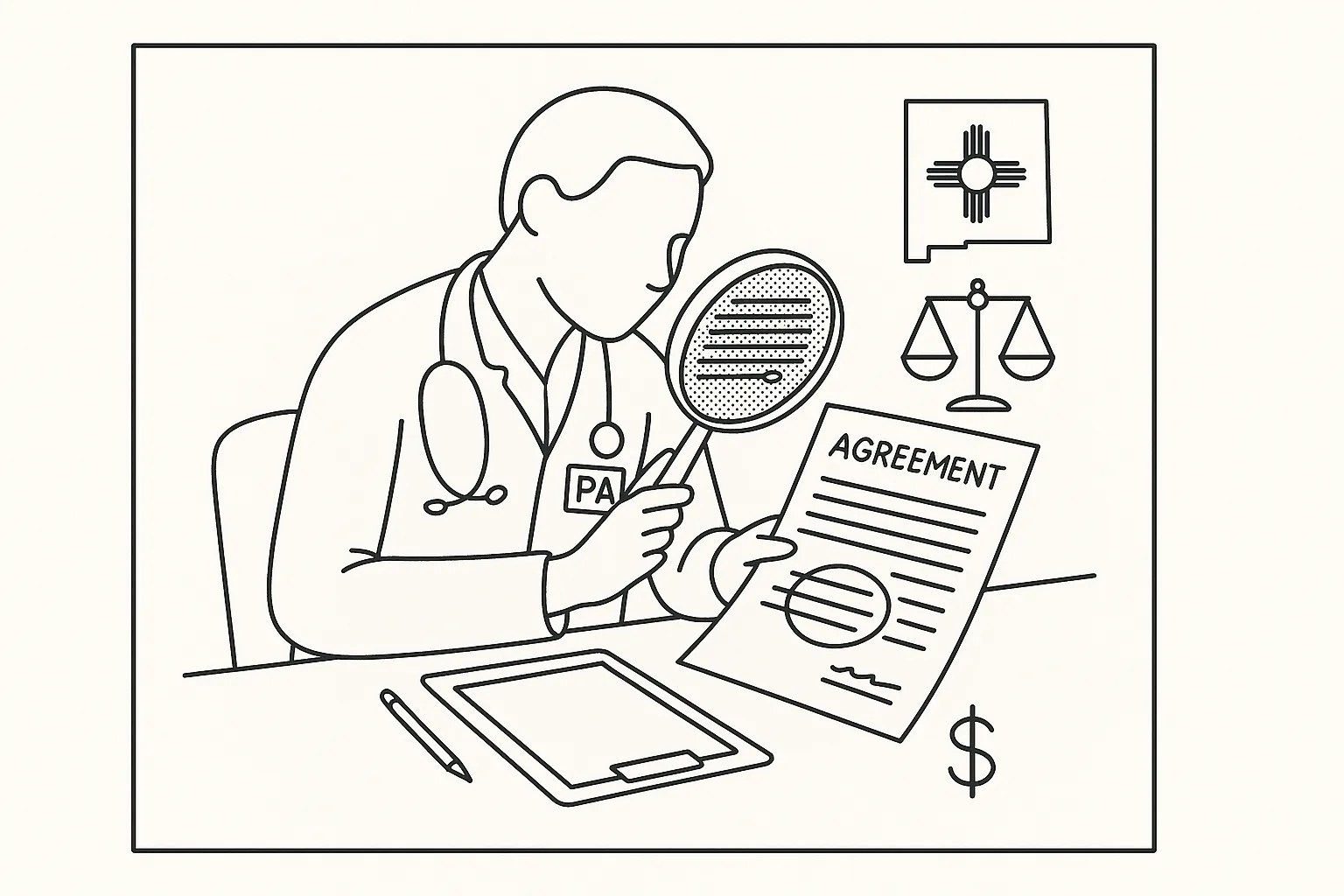
Many standard PA agreements are drafted primarily to protect the employer’s operational and financial interests. In New Mexico, contract language addressing duties, supervision, delegation, prescribing, documentation, credentialing, and work locations should be evaluated alongside applicable professional requirements. Vague or overbroad terms may create operational friction, shift responsibility to the PA, or permit the employer to expand duties without clearly addressing compensation and support.
The agreement should also be reviewed as a whole. Compensation formulas, restrictive covenants, repayment provisions, liability allocation, and post-termination benefits can collectively affect income and professional mobility. PAs can monitor professional advocacy and regulatory developments through the New Mexico Society of Physician Assistants, but individual contract terms still require careful analysis based on the proposed position.
Compensation, Productivity, and Incentive Terms
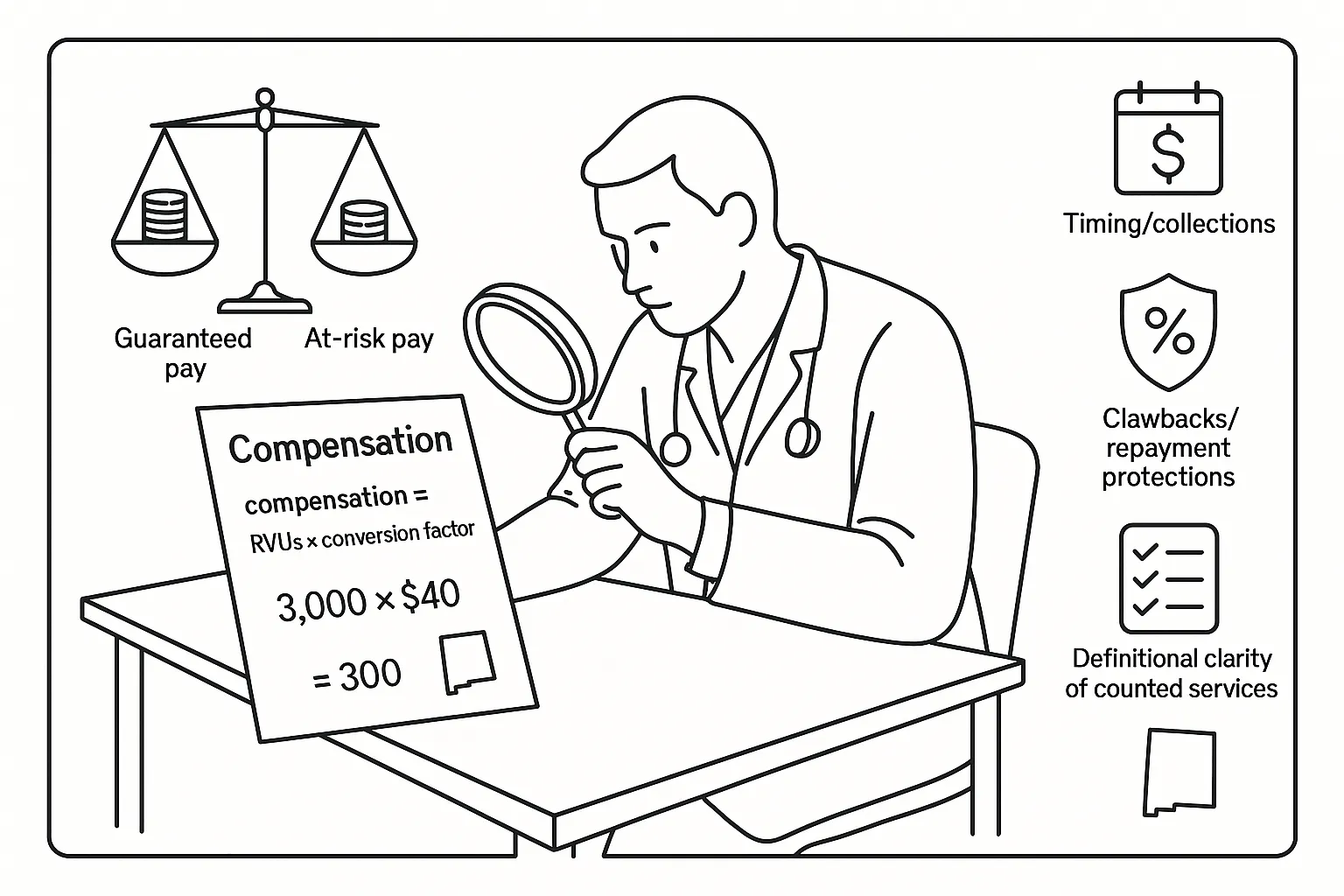
Compensation language is often the most complex and consequential part of a PA agreement. A thorough review of PA compensation and productivity terms should identify how base pay, variable compensation, reconciliations, withholdings, and employer-controlled metrics affect actual earnings.
Base Salary, RVUs, and Collections-Based Pay
A guaranteed base salary provides stability, but its interaction with productivity compensation requires close scrutiny. An RVU formula may calculate production compensation by multiplying credited RVUs by a conversion factor. For example, a $40 conversion factor applied to 3,000 RVUs produces $120,000, but the agreement must still explain which services count, when credit is recorded, whether a threshold applies, and whether quality adjustments or negative accrual reduce payment. PAs considering this model should understand the practical details of RVU compensation before relying on projected earnings.
Collections-based compensation creates different risks because payment depends on money the employer actually receives. The contract should distinguish charges, allowed amounts, and net collections while explaining how denials, refunds, chargebacks, billing delays, and post-termination collections are handled. It should also identify when the employer calculates and pays variable compensation and whether the PA can verify the underlying data.
Bonuses, Relocation Assistance, and Repayment Obligations
Signing bonuses, relocation assistance, loan repayment, and other incentives may be conditioned on completing a service period. The agreement should state whether repayment is prorated, which termination events trigger it, and whether the employer can offset an alleged debt against final compensation. Reviewing sign-on bonus repayment terms is particularly important when a large incentive could become immediately due after an early departure.
Malpractice Insurance and Liability Allocation
Malpractice provisions should identify the policy type, coverage limits, premium responsibility, covered activities, and the party responsible for post-employment protection. An occurrence policy generally covers professional services performed during the policy period even if a claim is made later. A claims-made policy ordinarily requires coverage to remain in effect when the claim is reported, which may make extended reporting endorsement coverage relevant after employment ends.
The contract should clearly allocate responsibility for any required tail insurance coverage and explain whether that responsibility changes based on the reason for termination. Defense-cost provisions, exclusions, claim-reporting duties, and broad indemnification or hold-harmless clauses also deserve attention. These terms can create exposure beyond ordinary premium costs when the PA is asked to assume liability for employer-controlled operations or actions performed within the expected scope of work.
Scope of Practice, Supervision, and Work Expectations
The agreement should describe clinical duties with enough precision to establish the anticipated specialty, patient population, schedule, call responsibilities, administrative work, and practice locations. Open-ended language such as duties assigned by the employer may permit material changes without additional compensation or adequate consideration of training, credentialing, and New Mexico professional requirements. Supervision, delegation, documentation, and prescribing provisions should also remain consistent with the role the PA is licensed and authorized to perform.
Credentialing and privileges can affect the employment start date and the ability to perform compensated work. A contract should explain what happens if payer enrollment or facility privileges are delayed or denied, whether compensation begins before credentialing is complete, and whether the employer may terminate the agreement during that period. Multi-site and telehealth provisions should likewise identify expected locations, travel obligations, scheduling authority, available support, and responsibility for maintaining any required credentials.
Restrictive Covenants and Contract Termination
Post-employment restrictions and termination clauses should be read together because the circumstances of departure may determine whether a restriction, repayment obligation, or insurance expense applies. These provisions can affect both the cost of leaving and the PA’s ability to continue practicing in the same community.
Non-Compete and Non-Solicitation Restrictions
A non-compete may define restricted services, locations, facilities, geographic areas, and a period during which the PA cannot perform certain work. A practical review should consider whether the restriction follows every employer location or only the PA’s actual practice site and whether it could limit opportunities across a broader area than expected. Related restrictive covenant terms, including patient and employee non-solicitation provisions, may independently affect future employment even when the non-compete appears narrow.
Without-Cause Termination, Notice, and Final Compensation
The agreement should distinguish termination for cause from termination without cause and state the notice required from each party. Broad cause definitions may permit immediate termination and trigger forfeiture, repayment, or other adverse consequences without a meaningful opportunity to correct the issue. A focused termination clause review should also address accrued compensation, unpaid productivity bonuses, post-termination collections, unused benefits, patient-transition duties, return of records or property, and continuing restrictive obligations.
What an Attorney-Led PA Contract Review Covers
Legal review is especially important when an agreement contains an unclear productivity formula, extensive repayment language, an open-ended schedule, multiple required locations, PA-funded tail coverage, broad indemnification, or restrictive covenants that could interfere with another New Mexico position. Ambiguous supervision or scope language also warrants attention when the written duties do not clearly match the role discussed during recruitment.
Chelle Law’s review addresses compensation mechanics, malpractice coverage, duties, work locations, restrictive covenants, termination rights, repayment exposure, and other provisions that materially affect the PA’s income and mobility. The objective is to explain how the clauses operate together, identify language that requires clarification, and help the PA prioritize proposed revisions before signing. Employment and independent contractor agreement review may raise different tax, benefit, insurance, and control considerations, so the document should be evaluated according to the actual structure of the proposed relationship.
Review Your New Mexico PA Contract Before You Sign
Chelle Law can evaluate your compensation, malpractice coverage, scope and supervision language, restrictive covenants, repayment obligations, and termination rights so you can make an informed decision.
Contact Chelle LawExplore Physician Assistant Contract Guidance
Review attorney-led services, practical contract resources, and state-specific guidance for physician assistants.