
New York physician assistant employment and independent contractor agreements must account for requirements administered by the New York State Education Department, Office of the Professions and the New York State Board for Medicine. New York requires physician assistants to be licensed and registered, and a PA may provide medical services only under physician supervision and within the supervising physician’s scope of practice. Although supervision is continuous, the supervising physician’s physical presence is not necessarily required. New York also generally limits a physician in private practice to employing or supervising six PAs, while that limit does not apply to hospital services. These rules can affect supervision language, assigned duties, credentialing, prescribing authority, and staffing across healthcare markets such as New York City, Buffalo, and Rochester. Contract review can determine whether the written role aligns with New York practice requirements while identifying financial and professional risks before the agreement is signed.
Employer-drafted agreements may also give broad discretion over compensation, scheduling, work locations, call coverage, malpractice arrangements, and termination. A focused review examines what the contract guarantees, which obligations survive the end of the relationship, and whether important terms depend on policies the employer may change. These concerns apply to experienced PAs, new graduates, and clinicians considering W-2 employment, a 1099 arrangement, hospital privileges, telehealth responsibilities, or work at multiple New York facilities.
Agreement Structure, Parties, and Contract Term

Employment, Independent Contractor, and Offer Letter Terms
Review begins by identifying whether the document is an employment agreement, independent contractor agreement, locum tenens contract, offer letter, or combination of incorporated documents. The classification may affect taxes, benefits, malpractice arrangements, expense reimbursement, and the allocation of administrative responsibilities. The written label is not the only relevant consideration; the practical degree of control over scheduling, equipment, onboarding, work locations, and clinical services also matters.
The agreement may name a clinical practice, hospital, staffing company, management organization, or affiliated entity. Analysis can identify which party pays compensation, provides malpractice coverage, controls scheduling, handles credentialing, may terminate the relationship, or can enforce repayment and restrictive-covenant provisions. Physician assistants comparing classifications can also review the practical distinctions between W-2 and 1099 PA arrangements.
Effective Date, Renewal, and Incorporated Policies
The effective date, initial term, renewal process, and notice deadlines determine when obligations begin and how long they continue. Automatic renewal provisions may extend the relationship or trigger a new notice window, while a fixed contractual term does not necessarily prevent earlier termination if the agreement separately permits termination without cause.
Policies, compensation plans, handbooks, schedules, and benefit documents incorporated by reference require separate attention. Review can determine whether those documents were provided, whether they conflict with the primary agreement, and whether the employer retains unilateral authority to change material terms. Undefined or unavailable policies can make the economic value and day-to-day expectations of the position difficult to assess.
Compensation, Productivity, and Benefits
Base Salary, RVUs, Collections, and Bonuses
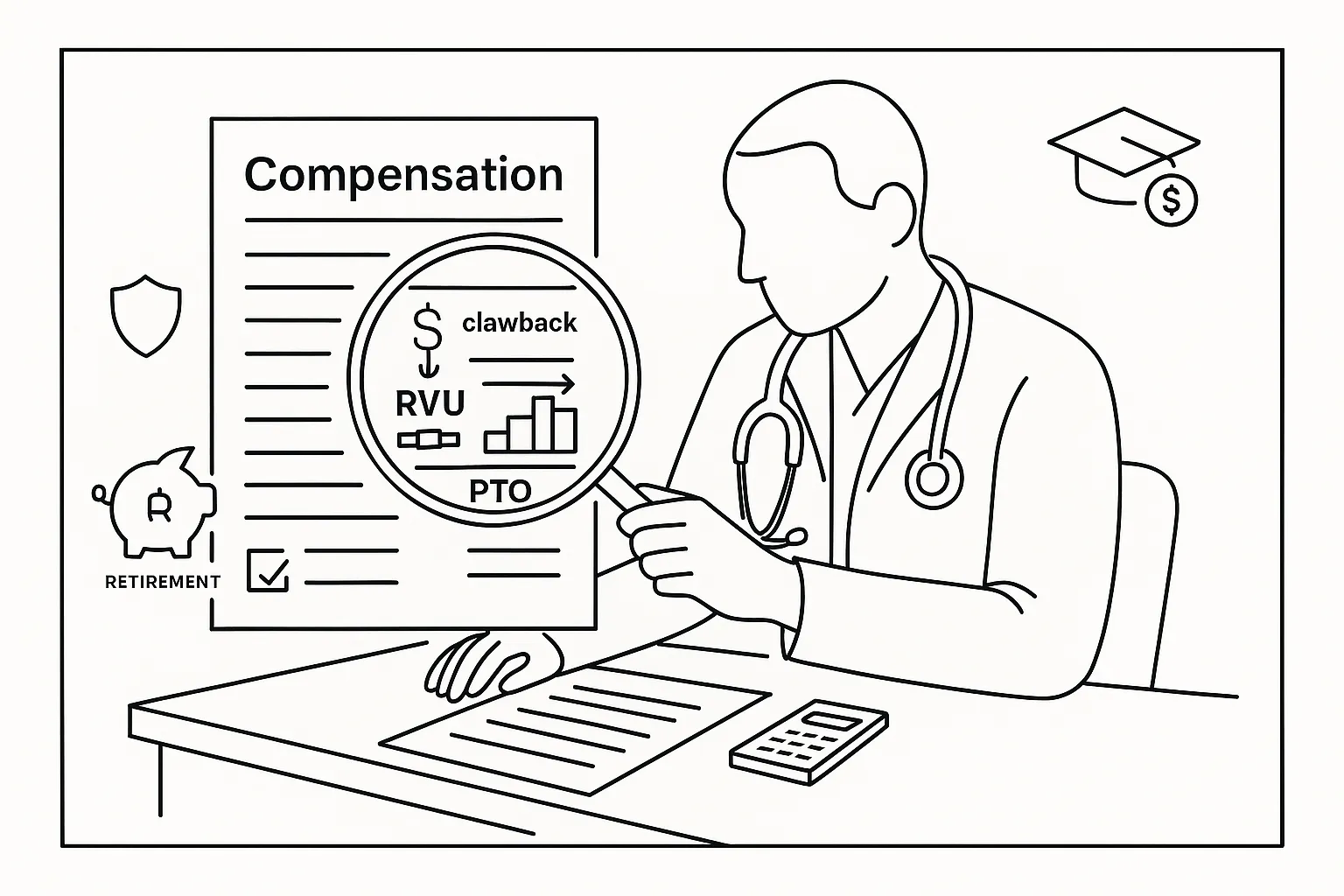
A PA contract may use a fixed salary, production compensation, collections-based pay, or a hybrid model. RVU provisions may identify the applicable schedule, conversion factor, threshold, measurement period, reconciliation process, and payment timing. Collections formulas require similar detail, including whether compensation is based on gross or net collections and which write-offs, refunds, contractual adjustments, or other deductions reduce the amount credited to the PA.
Bonus provisions may depend on productivity, quality measures, documentation, patient satisfaction, or continued employment on the payment date. A physician assistant compensation and productivity review can evaluate whether the formula is understandable, internally consistent, and objectively verifiable. Particular attention may be warranted when the employer can change a conversion rate, exclude collections, revise targets, or decide whether compensation has been earned.
Negative accrual can carry a productivity deficit into a later period or create an asserted repayment obligation. Review of the contract’s negative-accrual language can clarify whether compensation is truly guaranteed, whether advances are reconciled, and what happens to a deficit when employment ends.
Benefits, Expenses, and Total Compensation
Total compensation may include paid time off, health insurance, retirement contributions, CME leave and funding, professional dues, licensing expenses, relocation assistance, and student loan benefits. Eligibility dates, contribution limits, vesting schedules, approval requirements, and unused-leave rules can materially affect the offer’s value. A benefit described only in recruiting materials may not create the same contractual commitment as a term included in the signed agreement.
Benefits tied to a service commitment must be read alongside termination and repayment provisions. Analysis can identify whether repayment is prorated, whether it applies when the employer ends the relationship, and whether the agreement authorizes payroll deductions, interest, collection costs, or recovery of gross rather than net amounts.
New York Licensure, Supervision, and Clinical Authority
Licensure, Registration, and Defined Clinical Duties
New York physician assistants must be licensed and registered, and only a licensed person may use the physician assistant title. Contract language may allocate responsibility for maintaining licensure, registration, certifications, payer enrollment, hospital privileges, and employer-required credentials. Review can distinguish obligations within the PA’s control from administrative tasks that require employer cooperation or timely submission by another party.
Clinical-duty provisions may address patient care, prescribing, documentation, quality initiatives, administrative work, procedures, call, and coverage at additional locations. Broad language permitting any duty assigned by the employer can expand the role without corresponding adjustments to scheduling, support, training, or compensation. The description of services also needs to remain consistent with the PA’s training, privileges, and lawful authority.
Physician Supervision and Private-Practice Staffing
A New York PA may perform medical services only under physician supervision and within the supervising physician’s scope of practice. Supervision is continuous, although it does not necessarily require the physician to be physically present. The agreement can clarify the supervising physician relationship, physician availability, escalation procedures, coverage during absences, and the process followed if the designated physician leaves the organization.
New York generally permits a physician to employ or supervise no more than six physician assistants in private practice; the statutory limit does not apply to hospital services. Contract review can flag staffing or coverage language that appears inconsistent with the proposed setting and can identify whether responsibility for maintaining compliant supervision is allocated clearly rather than shifted entirely to the PA.
Hospital Orders, Prescribing, and Standing Regimens
A licensed PA employed by or privileged at a New York hospital may write inpatient medical orders, including controlled-substance orders, when hospital bylaws permit and the patient is under the supervising physician’s care. New York law does not necessarily require countersignature before an authorized inpatient order is executed. The contract and related hospital documents may therefore need to align assigned responsibilities with bylaws, privileges, supervision, and institutional procedures.
New York also permits a PA to prescribe controlled substances in good faith, within lawful scope, and to the extent assigned by the supervising physician for patients under that physician’s care and supervision. PAs may issue certain non-patient-specific regimens to registered professional nurses for specified services when statutory, regulatory, and public-health requirements are met. Review can identify language that is broader than the PA’s authorized role or that assigns compliance responsibility without addressing necessary employer systems and support.
Malpractice Insurance, Tail Coverage, and Indemnification
Malpractice provisions can create significant exposure during and after the contractual relationship. No material New York PA-specific rule requiring employer-provided malpractice insurance, occurrence coverage, claims-made coverage, or a particular allocation of tail costs was identified in the reviewed authorities. These issues therefore require clear treatment in the agreement rather than assumptions about what the employer will provide.
Review can identify the policy type, coverage limits, named insureds, exclusions, premium responsibility, consent-to-settle terms, and procedure for obtaining proof of coverage. Occurrence coverage generally responds to covered events occurring during the policy period, while claims-made coverage typically requires coverage to remain available when a later claim is made. If the employer provides claims-made insurance, the agreement may allocate tail responsibility differently depending on whether the PA resigns, is terminated for cause, or is terminated without cause. Additional guidance about tail insurance for physician assistants explains why policy structure and termination language must be evaluated together.
Indemnification requires separate analysis because it may obligate the PA to reimburse the employer or defend claims outside the protection of malpractice insurance. Relevant questions include whether the obligation is mutual or one-sided, what conduct triggers it, whether it extends to the employer’s acts, and whether defense costs or attorney fees are included. A statement that malpractice coverage is provided does not resolve the risk created by a broad indemnification clause.
Scheduling, Call, Locations, and Practice Structure
Work Schedule, Call Coverage, and Additional Duties
Schedule provisions may define regular hours, weekends, holidays, on-call coverage, administrative time, and the employer’s authority to change shifts. General phrases such as “as needed” or “as reasonably assigned” can leave the scope of additional work uncertain. Review can determine whether call is included in base compensation, separately paid, subject to frequency limits, or accompanied by post-call scheduling protections.
The agreement may also permit reassignment among departments, specialties, or clinical and nonclinical duties. Analysis can compare that authority with compensation, training, supervision, malpractice coverage, and the PA’s ability to decline work outside the contemplated role. Material expectations communicated during recruitment are more useful when reflected in the signed documents rather than left to informal assurances.
Multi-Site Work, Telehealth, and Credentialing Delays
Multi-site clauses may allow assignment to any existing or future employer location, sometimes without a mileage boundary. The scope of that language can affect commuting, scheduling, call coverage, expense reimbursement, and the practical reach of a post-employment restriction. Review can identify the primary worksite, permitted additional locations, travel expectations, and whether reassignment triggers any compensation or notice rights.
Telehealth and credentialing provisions may address approved service locations, technology support, payer enrollment, privileges, start dates, and compliance responsibilities. Delays can affect compensation and termination rights if the agreement conditions employment on timely credentialing. A balanced analysis distinguishes delays caused by the PA from those resulting from an employer, payer, hospital, or incomplete administrative process.
New York professional-practice and fee-splitting restrictions may also become material when a PA is an owner, member, shareholder, or independent contractor rather than solely an employee. Percentage-based compensation, referral arrangements, management fees, and professional-entity provisions require careful review to identify potential professional-control or fee-sharing concerns. The agreement should not be assumed compliant merely because the contracting entity supplied it.
Termination Rights and Repayment Exposure
For-Cause and Without-Cause Termination
Termination provisions control how quickly the relationship can end and what happens to compensation, benefits, malpractice obligations, and post-employment restrictions. A for-cause clause may address loss of licensure, exclusion from a payer program, failure to maintain privileges, policy violations, alleged misconduct, or performance concerns. Review can evaluate whether cause standards are objective, whether immediate termination is permitted, and whether a reasonable cure period applies to remediable issues.
Without-cause termination permits one or both parties to end the agreement without proving a breach, usually after written notice. The notice period must be considered alongside the employer’s ability to remove the PA from the schedule, discontinue compensation, require continued availability, restrict paid leave, or condition bonus payment on active employment. A dedicated PA contract termination review can identify mismatched notice rights, unclear delivery requirements, and obligations that continue after notice is given.
Bonuses, Relocation, Training, and Other Repayments
Signing bonuses, relocation payments, training costs, student loan assistance, and compensation advances may be repayable if employment ends within a stated period. The amount may depend on who terminates the relationship, the reason for termination, and whether the obligation is prorated over the service period. Some agreements also authorize payroll setoff, interest, collection expenses, or attorney fees.
Review can calculate the maximum potential exposure and identify repayment triggers that extend beyond voluntary resignation. It can also determine whether repayment applies after termination without cause, a role or location change, loss of privileges unrelated to misconduct, disability, or another event outside the PA’s control. These terms are best understood before funds are accepted and spent.
New York Restrictive Covenants and Pre-Signing Review
Non-Compete and Non-Solicitation Restrictions
No New York statute categorically prohibits or automatically validates non-competes for physician assistants. New York generally evaluates restrictive covenants based on whether the restraint is reasonable in duration, geographic reach, and scope; necessary to protect a legitimate employer interest; not unduly burdensome to the worker; and not harmful to the public. Professional healthcare agreements may receive close scrutiny, but enforceability remains fact-specific.
A PA contract may restrict work for competing practices, patient solicitation, employee recruitment, use of confidential information, or professional activity near covered locations. Restrictions tied to every facility in a health system may have a broader practical effect than language limited to the PA’s actual worksite. A physician assistant non-compete review can identify the triggering events, restricted activities, geographic area, duration, covered locations, exceptions, and stated remedies without assuming whether a court would enforce the provision.
Ambiguity and Contract Review Priorities
Undefined terms such as “net collections,” “reasonable efforts,” “as needed,” “cause,” or “failure to meet expectations” can give one party substantial interpretive discretion. Similar concerns arise when productivity standards, auditing rights, schedules, or bonus conditions appear only in policies subject to unilateral amendment. A structured review connects terms that may appear harmless when considered separately.
- Confirm the agreement type, named parties, effective date, initial term, renewal process, and incorporated documents.
- Verify guaranteed compensation, productivity formulas, bonus conditions, reconciliation timing, and modification rights.
- Compare assigned duties, supervision, prescribing, call, credentialing, telehealth, and location terms with the proposed New York role.
- Identify the malpractice policy type, coverage limits, named insureds, exclusions, and tail responsibility.
- Evaluate cause definitions, cure rights, without-cause notice, final compensation, and obligations during the notice period.
- Calculate potential repayment exposure and examine every non-compete, non-solicitation, confidentiality, and indemnification provision.
Potential red flags include undefined cause standards, claims-made coverage without clear tail allocation, negative accrual, unilateral compensation changes, unrestricted multi-site assignments, broad restrictive covenants, and repayment clauses that are not prorated. Chelle Law provides remote, attorney-led physician assistant contract review with written comments or redlines and a consultation explaining the agreement’s practical implications. Pre-signing review can help a New York PA understand risk, identify terms that may warrant clarification or revision, and make an informed decision about the position.
Speak With a New York Physician Assistant Contract Lawyer Before You Sign
Get attorney-led review of compensation, malpractice coverage, New York practice terms, termination rights, repayment obligations, and post-employment restrictions. Chelle Law can identify risk and explain provisions that may warrant clarification or revision.
Request a Contract Review