
New York physician assistant employment and independent contractor agreements must account for the state-specific rules administered by the New York State Education Department, Office of the Professions. Requirements affecting physician assistant scope of practice, licensure, supervision, delegation, and prescribing can shape how an employer defines clinical duties, oversight, credentialing, and responsibility for regulatory compliance. Those details matter across healthcare markets such as New York City, Buffalo, and Rochester, where contracts may also address multiple facilities, call obligations, productivity expectations, and telehealth services. Chelle Law reviews how these New York practice requirements interact with compensation formulas, malpractice coverage, termination rights, repayment obligations, and post-employment restrictions. A line-by-line review can identify provisions that shift financial or professional risk to the PA before the agreement is signed.
Employer-drafted agreements often use broad language that can materially affect income, liability exposure, and career mobility. A focused review examines what the contract actually guarantees, which obligations continue after employment ends, and whether important terms depend on employer discretion. These concerns apply to experienced PAs, new graduates, and clinicians considering a W-2 position, a 1099 arrangement, or a role involving several New York practice locations.
Agreement Type, Parties, and Contract Term

The first step is identifying whether the document is an employment agreement, an independent contractor agreement, a locum tenens contract, or an offer letter that incorporates additional terms. The label can affect tax classification, benefits eligibility, malpractice arrangements, and the parties responsible for clinical oversight. A detailed review should confirm whether the contracting entity is the clinical employer, a practice group, a management company, or a staffing agency and identify any affiliated entity assigned separate duties.
The agreement should also clearly state its effective date, initial term, renewal mechanics, and whether employment is at will or governed by a fixed term. Automatic renewal provisions may extend notice deadlines, repayment obligations, or restrictive covenants. For 1099 arrangements, a PA should compare the written classification with the practical level of control over scheduling, equipment, onboarding, and clinical work; our guide to W-2 and 1099 status for physician assistants explains the contract distinctions in greater detail.
- Confirm every named party and the obligations assigned to each entity.
- Identify the stated employment or independent contractor relationship.
- Review the effective date, contract term, renewal process, and notice deadlines.
- Determine which entity may terminate the agreement, enforce restrictions, or seek repayment.
New York PAs can also consult the New York State Society of Physician Associates for profession-focused information about evolving practice and regulatory issues. Contract terms should still be assessed against the individual position, compensation structure, and allocation of legal and financial responsibilities.
Compensation, Productivity, and Benefits
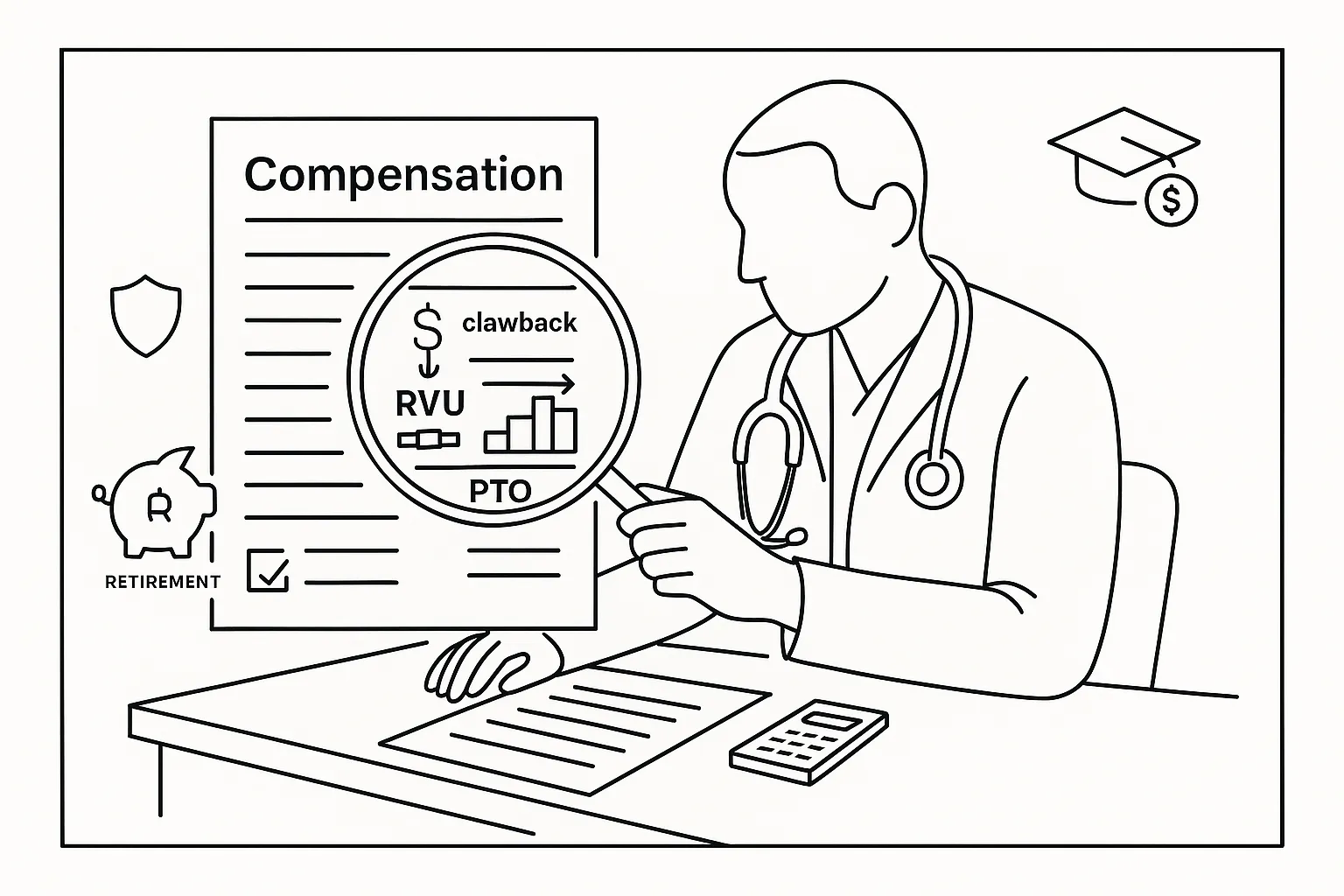
Compensation provisions are often the most consequential economic terms in a PA agreement. Review should extend beyond the stated salary to productivity formulas, bonus conditions, reconciliation procedures, benefit eligibility, and employer rights to modify a compensation plan. A seemingly guaranteed payment may function as an advance if another provision permits a later reconciliation or clawback.
Salary, Bonuses, RVUs, and Collections
A contract may provide a base salary, production-based compensation, or a hybrid model. RVU provisions should identify the applicable schedule, conversion rate, threshold, calculation period, and payment timing. Collections-based formulas should define whether compensation uses gross or net collections and list the write-offs, contractual adjustments, or other deductions that reduce the amount credited to the PA. A comprehensive PA compensation and productivity review can test whether the written formula is understandable and internally consistent.
Bonus language also deserves close attention. Quality metrics, productivity thresholds, and documentation requirements should be objective enough for the PA to verify performance. Provisions allowing the employer to change the dollar-per-RVU rate, exclude selected collections, or decide whether a bonus is earned can undermine the apparent value of the offer. Negative accrual provisions are especially important because they may carry a production deficit into a later period or create repayment exposure; PAs should understand how negative accrual affects compensation before accepting the formula.
Benefits and Total Compensation
Total compensation can include paid time off, CME funds and leave, health insurance, retirement contributions, licensing expenses, professional dues, student loan assistance, and relocation benefits. The contract or incorporated policies should address eligibility dates, vesting schedules, employer contribution limits, and documentation requirements. Any benefit tied to a service commitment should be reviewed alongside the termination and repayment provisions so the PA can identify what may be owed if the relationship ends early.
Malpractice Insurance, Tail Coverage, and Indemnification
Malpractice terms can create substantial post-employment exposure. The agreement should identify the policy type, coverage limits, named insureds, and the party responsible for premiums and post-termination coverage. Occurrence coverage generally responds to covered events occurring during the policy period, while claims-made coverage typically requires the policy or appropriate tail coverage to remain available when a later claim is made.
When an employer provides claims-made insurance, the contract should clearly allocate responsibility for tail coverage. Some agreements shift that cost to the PA after a voluntary resignation or for-cause termination, while others condition employer payment on the reason employment ends. Our guide to tail insurance for physician assistants outlines why the policy structure and termination language must be read together.
Indemnification provisions require separate analysis because they may obligate the PA to reimburse the employer or defend claims beyond the protection afforded by malpractice insurance. Review should consider whether the obligation is mutual or one-sided, what conduct triggers it, and whether it conflicts with the insurance provisions. The contract should not be evaluated solely by confirming that the employer says malpractice coverage is provided.
New York Scope of Practice, Supervision, and Job Duties
Clinical-duty provisions should be consistent with New York requirements and the PA’s training, privileges, and assigned practice environment. The agreement may address patient care, administrative work, call coverage, prescribing, documentation, quality initiatives, and work at additional facilities. Broad catchall language allowing the employer to assign any duty or location can expand the role without corresponding changes to compensation, scheduling, or professional support.
Supervision and delegation terms should identify how physician oversight will function and who is responsible for maintaining the required arrangements. Vague language can leave uncertainty about physician availability, escalation procedures, and the employer’s responsibilities when a supervising physician leaves. Credentialing and privileging provisions should likewise address application responsibilities, filing timelines, employer cooperation, and the consequences of a delay or adverse decision rather than automatically treating every issue as grounds for immediate termination.
Telehealth and multi-site work require additional clarity. The contract should define approved service locations, scheduling expectations, technology support, payer credentialing responsibilities, and the allocation of compliance duties. Provisions making the PA solely responsible for every regulatory issue, even when the employer controls the platform, staffing, or billing process, warrant careful review.
Termination Rights and Repayment Obligations
Termination language controls how quickly either party can end the relationship and what financial obligations follow. Agreements commonly distinguish termination for cause from termination without cause. The definition of cause, availability of a cure period, required notice, and treatment of pending compensation can determine whether the PA has time to address an alleged breach or prepare for a transition.
Without-cause notice should be evaluated together with scheduling, paid leave, bonus eligibility, and the employer’s ability to remove the PA from duties during the notice period. A contract may require the PA to provide lengthy notice while allowing the employer to end work or compensation sooner. A focused termination clause review can identify mismatched notice rights, unclear cure procedures, and provisions that affect compensation after notice is given.
Signing bonuses, relocation payments, training expenses, loan assistance, and compensation advances may be subject to repayment when employment ends within a stated period. Review should determine whether repayment is prorated, whether it applies regardless of who terminates the agreement, and whether interest, collection costs, or payroll setoff rights are included. These obligations should be quantified before signing rather than discovered after resignation or termination.
Restrictive Covenants and Ambiguous Contract Language
Post-employment restrictions may include non-compete, non-solicitation, confidentiality, and non-disparagement provisions. A New York PA should understand the restricted activities, geographic area, duration, covered locations, and events that trigger each covenant. A restriction tied to every facility in a health system may affect more opportunities than a clause limited to the PA’s actual practice site.
Non-solicitation clauses should identify the patients, employees, or referral sources covered by the restriction. Confidentiality language should distinguish protected business information from general clinical knowledge and professional experience. Remedies also matter because a contract may authorize injunctive relief, damages, attorney fees, or other consequences following an alleged breach. PAs facing broad restrictions can seek a dedicated non-compete and restrictive covenant review.
Ambiguous language presents a separate risk throughout the agreement. Undefined terms such as “net collections,” “reasonable efforts,” “as needed,” or “failure to meet expectations” can give the employer substantial interpretive discretion. The same concern applies when performance standards, deadlines, auditing rights, or bonus conditions appear only in policies that the employer may change unilaterally.
Pre-Signing Review Priorities for New York PAs
A structured pre-signing review helps connect provisions that might appear harmless when read separately. Compensation should be compared with scheduling and productivity requirements, malpractice obligations with termination triggers, and bonus promises with repayment clauses. Restrictive covenants should be assessed against every location where the PA could be assigned, not only the primary office listed in the offer.
- Confirm the agreement type, named parties, effective date, term, and renewal process.
- Verify guaranteed compensation, bonus formulas, reconciliation timing, and employer modification rights.
- Identify malpractice policy type, coverage limits, named insureds, and tail responsibility.
- Compare duties, supervision, credentialing, call, telehealth, and location terms with the proposed role.
- Review cause definitions, cure rights, without-cause notice, and compensation during the notice period.
- Calculate potential repayment exposure and examine every post-employment restriction.
Red flags include undefined cause standards, claims-made coverage without clear tail allocation, negative accrual, unilateral compensation changes, broad multi-site non-competes, and repayment clauses that are not prorated. Chelle Law provides remote, attorney-led contract review with written comments or redlines and a consultation to explain the practical implications of the agreement. Reviewing the terms before signing gives the PA an opportunity to understand risk, seek clarification, and make an informed decision about the position.
Review Your New York PA Contract Before You Sign
Understand how compensation, malpractice coverage, New York practice requirements, termination rights, repayment terms, and post-employment restrictions affect your position.
Contact Chelle Law