
Physician assistants practicing in North Carolina are regulated by the North Carolina Medical Board and may not begin practice until the Board has processed an Intent to Practice identifying a primary supervising physician. North Carolina also requires the PA and primary supervising physician to maintain a signed written supervisory arrangement addressing delegated duties and prescribing instructions at each practice site. These requirements can affect how an employment or independent contractor agreement handles the start date, credentialing delays, clinical authority, prescribing, supervision, and multi-site assignments. Positions in major healthcare markets such as Charlotte and Raleigh may add hospital privileges, payer enrollment, productivity compensation, or coverage across several facilities. Contract review can determine whether those operational terms align with the offered position and identify compensation, malpractice, restrictive covenant, termination, and repayment provisions that may create financial or professional risk.
The provisions must also be read together. A broad work-location clause may expand both commuting obligations and the practical reach of a non-compete, while a delayed start date may affect bonus eligibility, benefits, and repayment deadlines. Chelle Law provides attorney-led physician assistant contract review focused on explaining these connections, flagging unclear terms, and identifying provisions that may warrant clarification or revision before signing.
North Carolina PA Practice and Supervisory Terms
Licensure, Intent to Practice, and Start Dates
A North Carolina PA must be licensed or otherwise authorized under state law and cannot begin practicing until the North Carolina Medical Board has processed the required Intent to Practice. The contract can address what happens if licensure, the Intent to Practice, hospital privileges, payer enrollment, or credentialing is not complete by the anticipated start date. Review can identify whether a delay permits termination, postpones compensation or benefits, changes bonus eligibility, or triggers obligations even though the PA cannot yet provide services.
Written Supervision, Delegated Duties, and Prescribing
North Carolina permits a PA to perform medical acts, tasks, or functions only under physician supervision. The PA and primary supervising physician must maintain a signed written supervisory arrangement describing delegated responsibilities and prescribing instructions at each practice site. Contract analysis can compare those requirements with the proposed clinical role, procedures, schedule, telehealth duties, work locations, and coverage structure.
Prescribing language deserves particular attention when the position involves controlled substances. North Carolina prohibits PAs from prescribing controlled substances for a supervising physician’s use, and Board guidance calls for consultation with the supervising physician before prescribing targeted controlled substances when therapeutic use exceeds or is expected to exceed 30 days. The agreement and related policies may clarify documentation, consultation, and compliance responsibilities without assigning duties outside the PA’s authorized role.
Practice Ownership and Physician Contracting
North Carolina permits a professional corporation to be formed by a physician and physician assistant to provide services each is licensed to perform. An advanced-practice-provider-owned practice may contract with a physician to satisfy legal supervision requirements, but North Carolina Medical Board guidance distinguishes that arrangement from employing or contracting with a physician to provide medical services on behalf of the APP-owned practice. That distinction may matter when reviewing an ownership, contractor, supervision, or management agreement.
Compensation, Productivity, and Repayment Terms
Base Salary and Productivity Formulas
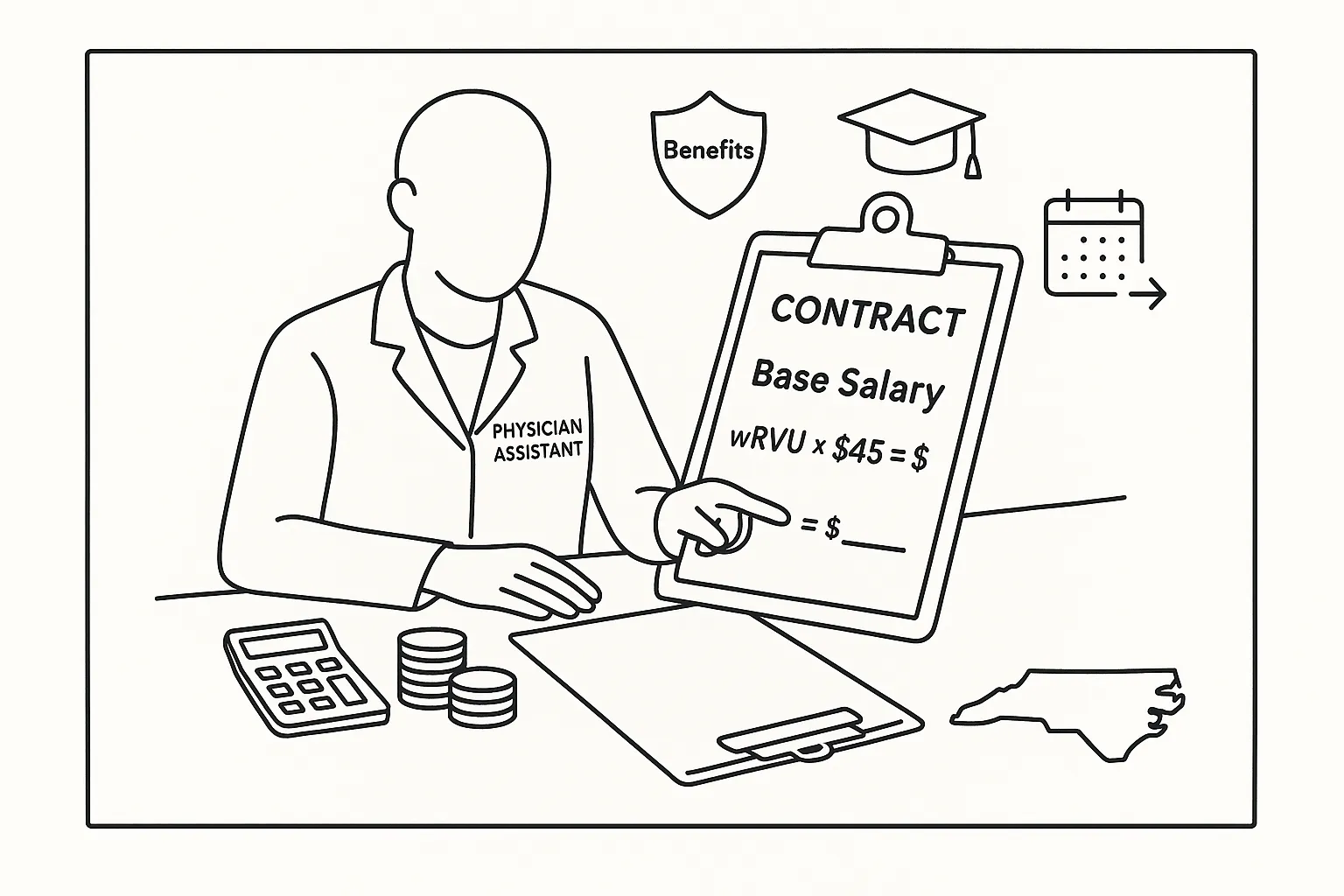
Base salary establishes the guaranteed component of compensation, while incentive pay may depend on work relative value units, gross or net collections, quality measures, encounters, or other defined metrics. An RVU formula may multiply credited work RVUs by a conversion factor and then apply a threshold, cap, reconciliation process, or attribution rule. For example, a $45 conversion factor multiplied by 4,000 wRVUs produces $180,000 before accounting for any guarantee, threshold, cap, or adjustment.
A focused PA compensation and productivity review can identify how the agreement defines credit, when bonuses are calculated, and whether the employer may change the formula. Collections-based models also create timing and collection risk because denials, write-offs, payer delays, and post-termination receipts may affect credited revenue. Review can clarify negative accrual, draw reconciliation, payment dates, supporting reports, and whether earned productivity remains payable after departure.
Benefits, Bonuses, and Clawbacks
Total compensation may include health insurance, retirement contributions, continuing medical education funds, paid leave, licensing costs, professional dues, relocation assistance, student loan support, and a signing bonus. Each benefit may have separate eligibility dates, reimbursement procedures, vesting terms, or forfeiture conditions. Those details are especially important when the start date depends on licensing, credentialing, or completion of the Intent to Practice process.
Repayment clauses may apply to signing bonuses, relocation funds, advances, loan assistance, or compensation guarantees. Analysis can identify the repayment period, proration formula, acceleration language, and events that trigger a clawback. A balanced review also considers whether repayment differs when the employer terminates without cause, cannot complete credentialing, materially changes the position, or ends the relationship for another stated reason.
Classification, Scheduling, and Workload
W-2 Employment and 1099 Contractor Agreements
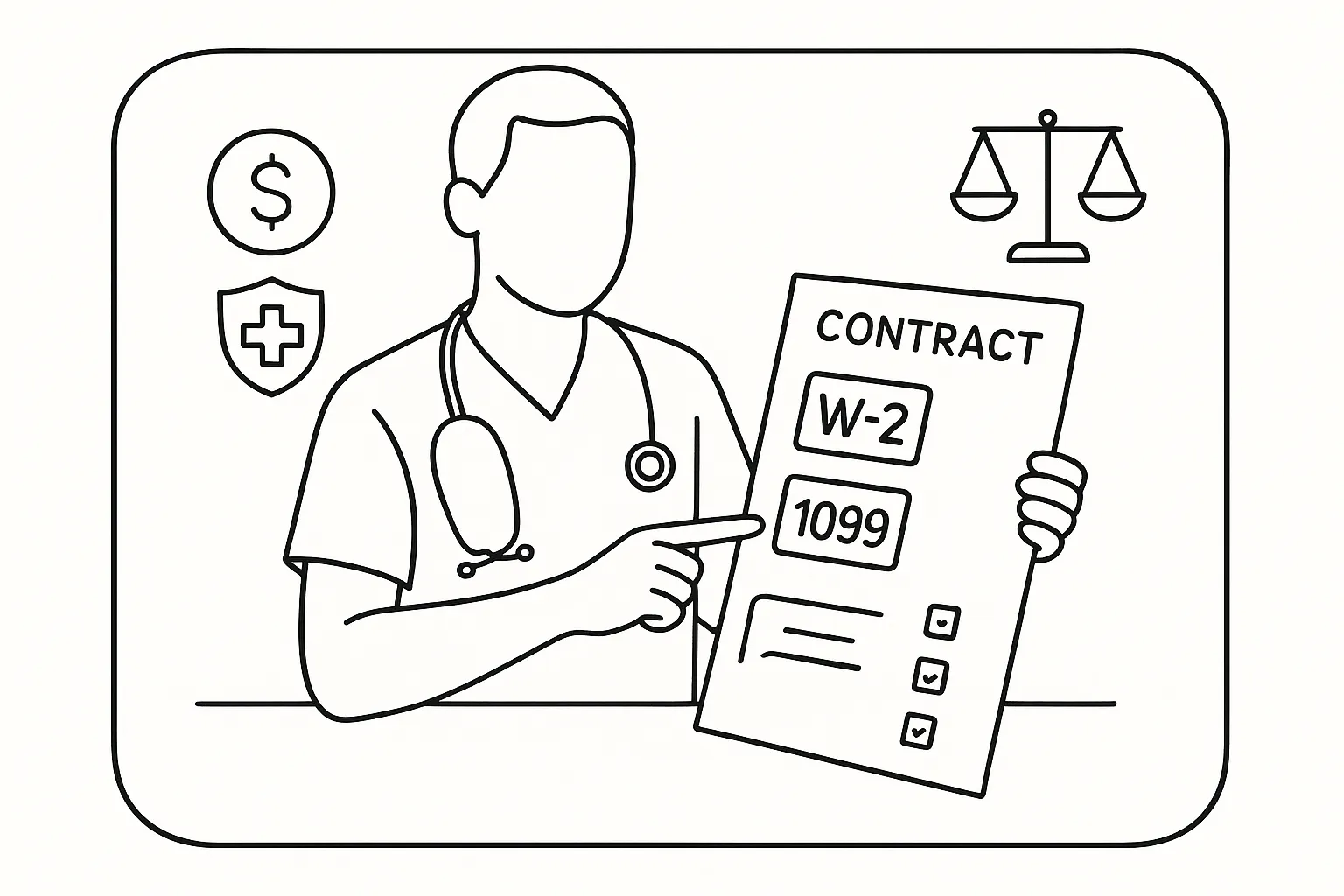
Classification affects tax withholding, benefits, professional expenses, malpractice arrangements, and the predictability of take-home pay. A 1099 agreement may shift estimated taxes, health insurance, retirement savings, licensing expenses, equipment, and other business costs to the PA. The stated hourly or daily rate therefore does not provide a complete comparison with a W-2 offer.
The contract label alone does not determine how the relationship operates. Contractor agreements may still impose detailed scheduling, billing, credentialing, performance, supervision, and location requirements. Chelle Law’s guide to W-2 versus 1099 terms for physician assistants explains the principal financial and contractual differences to evaluate alongside compensation.
Schedule, Call, and Multi-Site Assignments
Scheduling provisions may define regular hours, administrative time, patient volume, weekends, holidays, call, call-back responsibilities, and the circumstances under which assignments can change. Broad authority to require work at any current or future facility can increase commuting time and may enlarge the geographic effect of a restrictive covenant. Review can also compare procedural duties and site assignments with the PA’s training, credentialing, supervisory arrangement, and offered role.
Call and coverage obligations can materially increase workload without changing base salary. The agreement may distinguish remote availability from an in-person return, identify response times, allocate weekend and holiday rotations, and state whether extra shifts receive additional pay. Reviewing physician assistant call and coverage terms can expose obligations that are not apparent from an offer letter or compensation summary.
Malpractice Insurance and Liability Allocation
Occurrence and Claims-Made Coverage
Malpractice provisions may identify the policy type, coverage limits, named insureds, exclusions, covered services, and whether protection extends to every required location. Occurrence coverage generally protects covered acts occurring during the policy period even when a claim is filed later. Claims-made coverage ordinarily depends on the policy being active when the claim is reported, potentially creating a need for extended reporting coverage after the relationship ends.
No material North Carolina PA-specific statute or North Carolina Medical Board rule requiring a particular malpractice policy or contractual allocation of tail coverage was identified in the verified state research. The written agreement is therefore especially important for understanding what coverage the employer offers and who bears any post-employment cost. This overview of malpractice insurance for physician assistants explains common policy structures and related contract questions.
Tail Coverage, Indemnification, and Personal Liability
When claims-made coverage applies, review can determine who must obtain and pay for tail coverage, whether an employer policy remains available, and whether the obligation changes based on the reason for termination. Indemnification clauses may separately shift responsibility for claims, defense costs, settlements, billing issues, or contractual losses. These provisions should be considered with any insurance exclusion and any term that survives termination.
North Carolina’s professional-corporation rules generally do not make a shareholder, director, or officer individually liable for another shareholder’s professional negligence solely because of corporate status. An individual remains responsible for that person’s own errors, omissions, negligence, malpractice, incompetence, or malfeasance. Ownership status, insurance protection, and contractual indemnity therefore address related but distinct sources of risk.
North Carolina Non-Competes and Other Restrictions
Non-Compete Scope and Enforceability
Under North Carolina common law, an employee non-compete generally must be written, supported by valuable consideration, made part of the employment contract, reasonable in time and territory, and consistent with public policy. Enforceability remains fact-dependent, and North Carolina courts do not simply rewrite an overbroad restraint. Pre-signing review is important because the wording, timing, restricted activities, covered locations, and asserted business interest can affect the analysis.
A physician assistant non-compete review can map the restricted area against the PA’s actual and potential work sites and identify language covering facilities where the PA never practiced. Analysis may also flag restrictions that apply to services the PA did not provide, every facility in a health system, or an extended period after departure. Potential revisions may focus on location, duration, activities, triggering events, or clearly defined exceptions.
Non-Solicitation, Confidentiality, and Non-Interference
Restrictions are not limited to a clause labeled “non-compete.” Non-solicitation provisions may address patients, referral sources, employees, contractors, or business relationships, while non-interference language may reach a broader range of communications. Definitions of solicitation, confidential information, and covered relationships can determine whether ordinary professional contact creates a claimed violation.
These clauses are best evaluated together because their combined effect may be broader than any one provision suggests. Review can also distinguish legitimate protection of confidential business information from language that could restrict the PA’s use of general skill, experience, or publicly available information.
Termination, Payment, and Dispute Provisions
Without-Cause and For-Cause Termination
Termination language determines whether either party may end the agreement without cause, how much notice is required, and what events permit immediate termination. Review can identify whether notice rights are mutual, whether the PA must continue working throughout the notice period, and whether the employer can remove the PA from the schedule without continuing compensation. It can also assess the effect of termination on benefits, malpractice coverage, bonuses, leave, credentialing, and restrictive covenants.
For-cause definitions may address loss of licensure, exclusion from government programs, failure to maintain privileges, policy violations, professional conduct, or alleged contract breaches. A cure period can provide time to correct some remediable issues, while vague standards may leave substantial discretion with the employer. Contract analysis can distinguish objective triggers from provisions that depend on an employer’s unilateral judgment.
Final Compensation, Disputes, and Assignment
The agreement may state whether earned productivity compensation, collections received after departure, accrued benefits, expense reimbursements, or unused leave remain payable. Final-payment language should be compared with bonus measurement periods and any requirement that the PA remain employed on the payment date. Otherwise, compensation generated before termination may be forfeited under a separate eligibility condition.
Dispute-resolution, governing-law, venue, and assignment provisions affect how later disagreements are handled. Arbitration may alter available procedures, and a venue clause may require a dispute to proceed in the employer’s selected forum. Assignment and change-of-control terms can determine whether a purchaser or successor may assume the agreement, transfer work locations, administer compensation, or attempt to enforce post-employment restrictions following a sale or acquisition.
What a North Carolina PA Contract Review Covers
Integrated Review of the Complete Agreement
An attorney-led review evaluates the agreement as a whole rather than treating each clause in isolation. The analysis can connect North Carolina supervision and Intent to Practice requirements with the start date, assigned locations, prescribing duties, credentialing, compensation, and termination rights. It also examines how malpractice coverage, repayment provisions, restrictive covenants, and assignment language may affect the PA after employment ends.
Common warning signs include undefined productivity metrics, unilateral amendment rights, vague call obligations, unclear tail responsibility, expansive work-location clauses, broad for-cause standards, accelerated repayment, and post-employment restrictions tied to locations where the PA never worked. Chelle Law can provide a documented risk assessment, explain the practical and financial effect of important provisions, and identify language that may warrant comments, proposed revisions, or redlines. Remote document review and phone or video consultation are available to physician assistants evaluating opportunities throughout North Carolina, including Charlotte, Raleigh, Greensboro, and surrounding communities.
Request a North Carolina Physician Assistant Contract Review
Chelle Law can review your proposed agreement, identify compensation and liability risks, explain restrictive covenants and termination terms, and flag provisions that may warrant clarification or revision before you sign.
Contact Chelle Law