
Physician assistants practicing in North Carolina work under rules administered by the North Carolina Medical Board, including state-specific requirements involving scope of practice, supervision, collaboration, delegation, and prescribing. Those obligations can affect how an employment or independent contractor agreement assigns clinical duties, identifies supervising relationships, addresses credentialing, and allocates responsibility for compliance. Opportunities in major healthcare markets such as Charlotte and Raleigh may also involve multi-site systems, hospital privileges, or productivity structures that make the contract’s operational details especially important. Chelle Law reviews North Carolina PA agreements to determine whether compensation formulas, malpractice protection, call and workload expectations, restrictive covenants, termination rights, and repayment obligations align with the position the PA was offered. A careful review connects the written agreement to the regulatory and practical conditions under which the PA will actually work before the commitment is made.
North Carolina PA Practice Terms and Contract Duties
A physician assistant contract should clearly define the clinical role, permitted procedures, work locations, schedule, and any responsibilities tied to supervision, collaboration, delegation, or prescribing. Vague or expansive language may permit scope creep, additional duties without corresponding compensation, or assignments that do not match the position discussed during recruitment. The agreement should also explain how hospital credentialing, payer enrollment, privileges, and delays outside the PA’s control affect the employment start date and compensation.
Supervision and delegation provisions should be compatible with North Carolina practice requirements and the employer’s actual operating structure. We review who is responsible for required documentation, physician signatures, coverage arrangements, and compliance procedures, as well as whether telehealth or multi-site assignments change those responsibilities. Physician assistants may also consult the North Carolina Academy of Physician Assistants for professional and legislative updates affecting PA practice in the state.
Compensation, Productivity, and Financial Terms
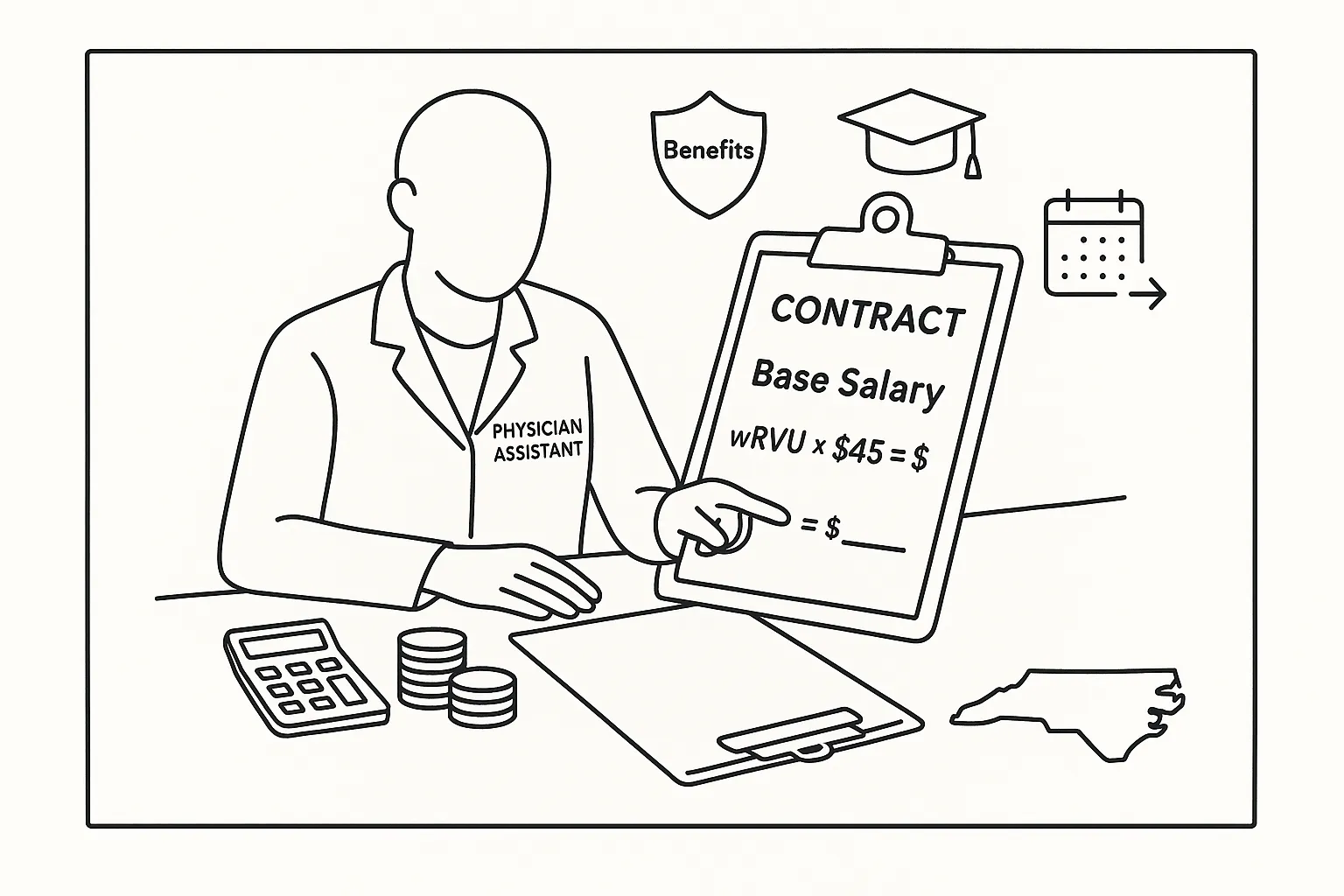
Base salary provisions establish the guaranteed component of pay, while productivity provisions may tie additional compensation to gross collections, net collections, relative value units, or quality measures. An RVU formula usually multiplies work RVUs by a conversion factor and may apply thresholds, caps, attribution rules, or payer adjustments. For example, a $45 conversion factor multiplied by 4,000 wRVUs would produce $180,000 before any guarantee, threshold, cap, or adjustment. A focused PA compensation and productivity review can identify definitions or calculation methods that materially change expected earnings.
Collections-based compensation creates timing and collection risk because charges may be generated in one period but paid months later, while denials and write-offs may reduce credited revenue. Bonus language should identify the measurement period, payment date, eligibility conditions, and whether the employer can change the formula unilaterally. The agreement should also address negative accrual, draw reconciliation, and whether productivity earned before termination will be paid afterward.
Benefits and reimbursements form part of total compensation and may include health insurance, retirement contributions, continuing medical education allowances, licensing fees, DEA-related expenses, student loan assistance, signing bonuses, and relocation payments. These provisions should explain eligibility, vesting, reimbursement procedures, and any repayment schedule. Because sign-on bonus repayment terms can create substantial obligations after an early departure, we examine whether repayment is prorated and which termination events trigger a clawback.
Employee and Independent Contractor Classification
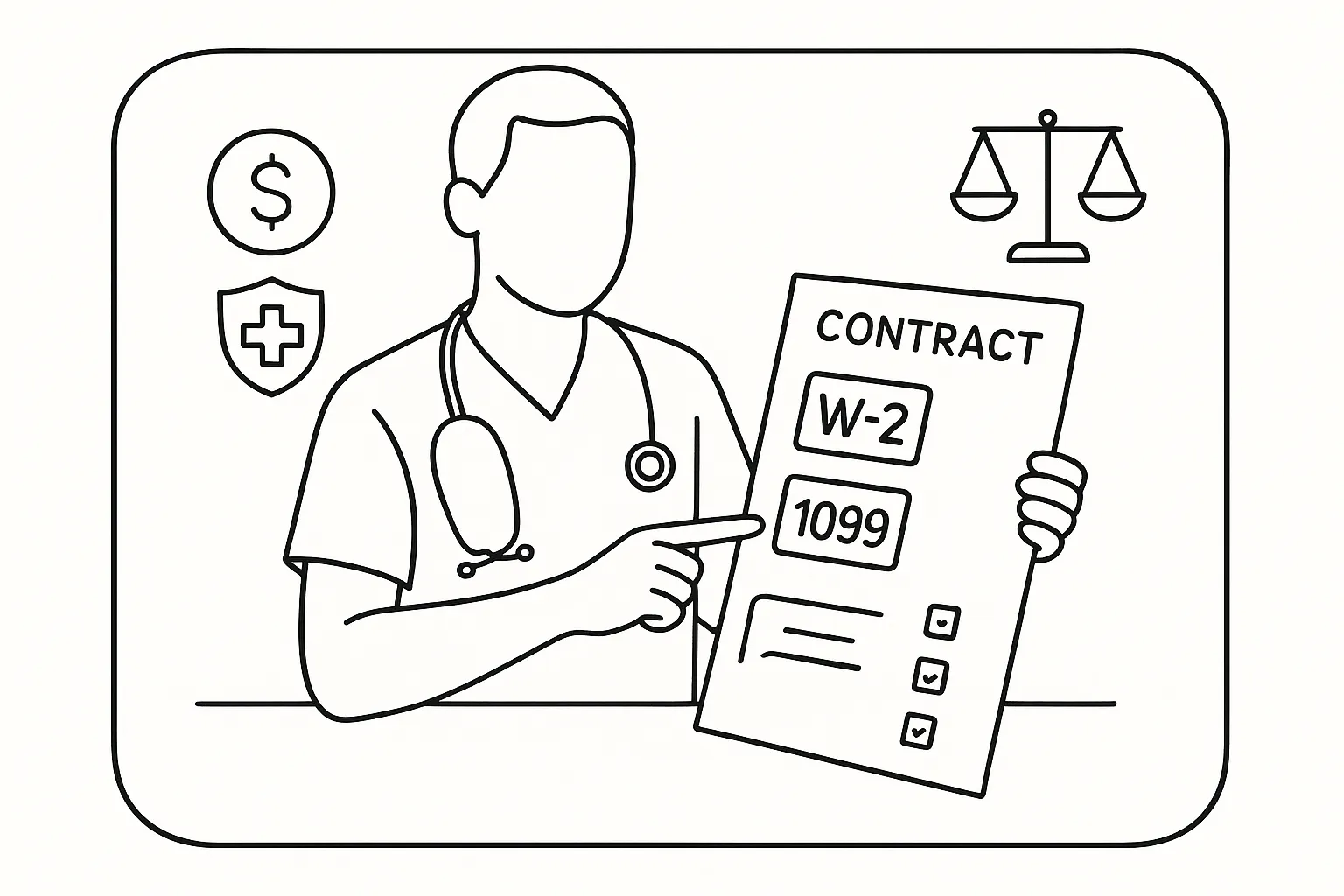
Classification as a W-2 employee or 1099 independent contractor affects tax withholding, benefits eligibility, expense responsibility, malpractice arrangements, and the predictability of take-home pay. An independent contractor agreement may shift responsibility for estimated taxes, retirement savings, health insurance, licensing expenses, and business costs to the PA. Our guide to W-2 versus 1099 status for physician assistants explains the practical contract differences that should be evaluated alongside the stated compensation rate.
The label used in the agreement does not by itself resolve how the relationship operates. Contractor agreements may still impose detailed scheduling, performance, billing, credentialing, and supervision requirements. We evaluate the allocation of control, payer enrollment responsibilities, professional expenses, benefits, and insurance to identify terms that may undermine the financial assumptions behind a contractor offer or create avoidable compliance concerns.
Scheduling, Call Coverage, and Workload Expectations
The contract should identify the regular schedule, expected hours, primary location, administrative duties, patient volume expectations, and circumstances under which the employer may change assignments. Broad language allowing work at any present or future location may materially increase commuting time or expand the practical reach of a later non-compete. Procedural duties and clinical privileges should also correspond to the PA’s training, credentialing, and agreed role.
Call, call-back, weekend, holiday, and coverage obligations require particular attention because they can substantially increase workload without changing base salary. The agreement should state how coverage is assigned, whether remote availability differs from an in-person return, and whether extra shifts or call duties receive additional compensation. Reviewing call schedule and coverage requirements before signing helps reveal obligations that may not be apparent from the compensation summary alone.
Malpractice Insurance, Tail Coverage, and Indemnification
Malpractice provisions should identify the type of policy, coverage limits, named insureds, exclusions, and whether the employer’s policy covers all locations and services required by the agreement. Occurrence coverage generally protects acts occurring during the policy period even if a claim is made later. Claims-made coverage ordinarily requires the policy to remain active when the claim is reported, which can create a need for extended reporting, commonly called tail coverage, after employment ends.
A contract should expressly state who must obtain and pay for tail coverage when claims-made insurance ends. Our guide to malpractice insurance for physician assistants addresses coverage structures and related contract risks. We also review indemnification language, defense-cost allocation, settlement authority, and provisions that survive termination because these terms can shift significant post-employment liability to the PA.
North Carolina Non-Compete and Restrictive Covenant Terms
Restrictive covenants may limit where a PA can work, which services the PA can provide, and whether the PA may communicate with patients or employees after leaving. Important variables include the restricted activities, duration, geographic area, covered facilities, and whether the restriction applies to every location operated by a health system. Under North Carolina law, enforceability is fact-dependent and may involve the wording, reasonableness, specificity, and business interest asserted in support of the restriction.
A physician assistant non-compete review can identify language that may unnecessarily restrict future hospital privileges, employment, or practice near an established patient base. Potential revisions may include a narrower geographic area, a shorter restricted period, clearer patient definitions, limitations tied to the PA’s actual work location, or appropriate exceptions. Non-solicitation, confidentiality, and non-interference clauses should be examined with the non-compete because their combined effect may be broader than any single provision suggests.
Termination, Repayment, and Dispute Provisions
Termination clauses establish whether either party may end the agreement without cause, how much notice is required, and what conduct permits immediate for-cause termination. Vague standards may give the employer broad discretion while leaving the PA without meaningful time to transition patients, secure another position, or complete credentialing elsewhere. A contract termination review also considers whether notice periods are mutual, whether a cure period applies, and how termination affects benefits, malpractice coverage, severance, and unpaid compensation.
Repayment clauses may apply to signing bonuses, relocation funds, student loan assistance, advances, or unearned guarantees. We evaluate the repayment window, proration formula, acceleration language, and whether obligations differ depending on who terminates the agreement and why. The contract should also explain whether earned productivity compensation, collections received after departure, or accrued benefits remain payable after the relationship ends.
Dispute resolution, governing-law, venue, and assignment provisions can affect how future disagreements are handled. Mandatory arbitration may alter available procedures, while a court venue clause may require litigation in the employer’s preferred forum. Assignment and change-of-control language should be reviewed to determine whether a purchaser or successor may assume the agreement, alter compensation, transfer work locations, or enforce restrictive covenants after a practice sale or health-system acquisition.
What a North Carolina PA Contract Review Covers
Our attorney-led review evaluates the agreement as a whole rather than treating each clause in isolation. The review focuses on how compensation, classification, supervision, workload, insurance, restrictive covenants, termination, repayment, and assignment provisions interact. Common warning signs include ambiguous bonus triggers, unilateral amendment rights, undefined call obligations, unclear tail responsibility, broad for-cause standards, repayment acceleration, and post-employment restrictions tied to locations where the PA never worked.
Chelle Law provides a documented risk assessment, explains the practical and financial effect of important provisions, and may prepare comments, proposed revisions, or redlines where appropriate. Remote document review and phone or video consultation allow PAs throughout North Carolina, including Charlotte, Raleigh, Greensboro, and surrounding communities, to evaluate an agreement before accepting obligations that may affect income, licensure, liability, or future mobility.
Have a North Carolina PA Contract Reviewed Before You Sign
Chelle Law can identify compensation, malpractice, restrictive covenant, termination, and repayment terms that may affect your income and professional flexibility.
Contact Chelle Law