
A North Dakota physician assistant employment or independent contractor agreement must address both business terms and the clinical rules administered by the North Dakota Board of Medicine. The Board regulates PA licensure and title use, and a person providing PA services to a patient located in North Dakota must hold an active North Dakota license or qualifying compact privilege. State law permits a broad range of medical services but requires collaboration, consultation, or referral when indicated by the patient’s condition, the PA’s competence and experience, and the applicable standard of care. Although a written collaborative agreement is generally not required, a PA with fewer than 4,000 Board-approved practice hours must execute one with a physician. For PAs considering positions in Fargo, Bismarck, or elsewhere in North Dakota, these rules can affect clinical-duty descriptions, credentialing timelines, physician relationships, prescribing, scheduling, and the conditions that must be satisfied before work begins.
The financial provisions require equally careful review. Compensation formulas, malpractice insurance, call coverage, termination rights, bonus repayment obligations, and post-employment restrictions can create costs or limitations that are not apparent from an offer letter. Chelle Law provides attorney-led physician assistant contract review to explain how these provisions work together, identify language that shifts risk to the PA, and flag terms that may warrant clarification or revision before signing.
Employment Status and Contract Structure
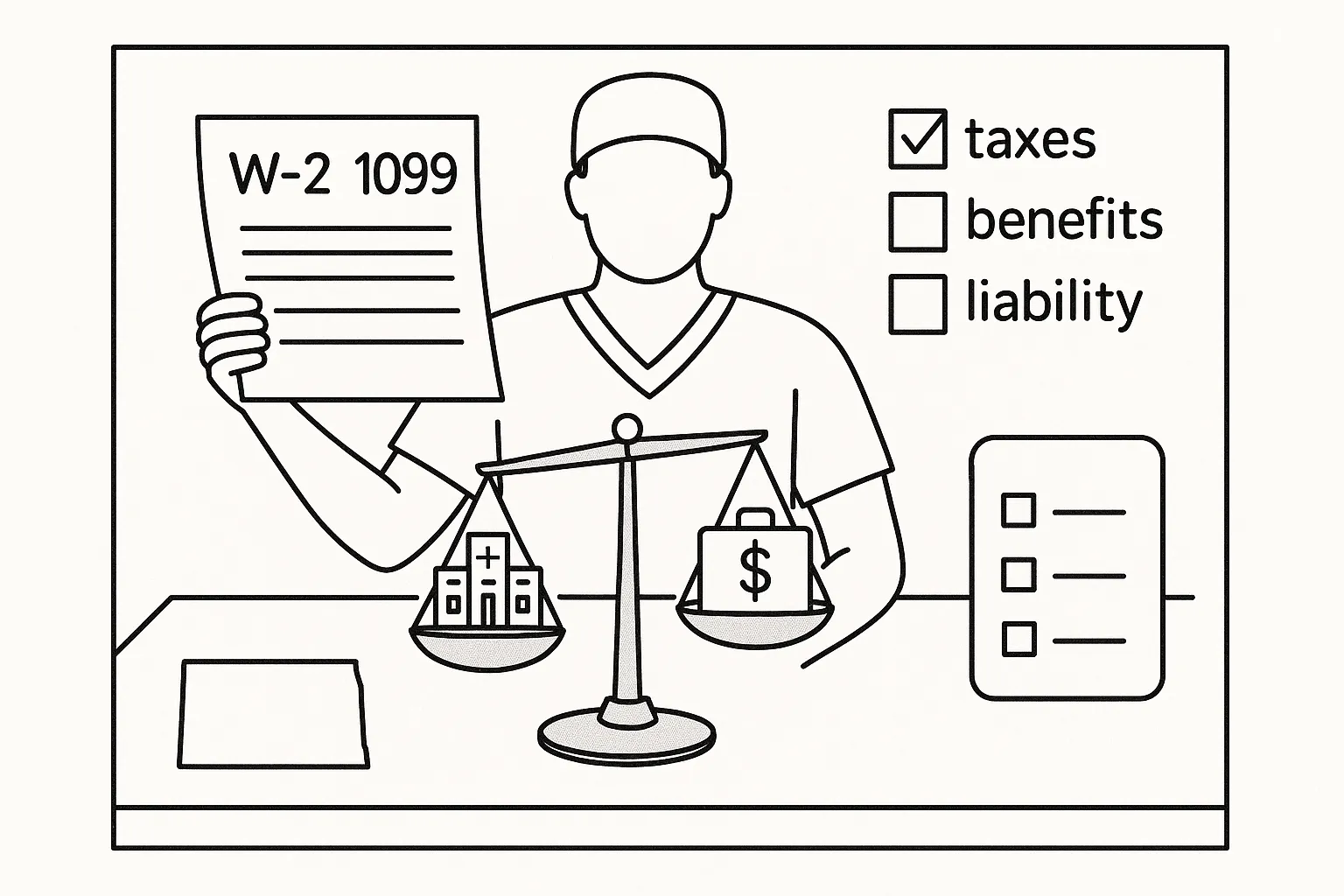
W-2 Employee or 1099 Independent Contractor
The agreement may classify the PA as a W-2 employee or a 1099 independent contractor. That distinction can affect tax withholding, benefits, unemployment coverage, workers’ compensation, professional expenses, and responsibility for self-employment taxes. The contract’s label is only one part of the arrangement; scheduled hours, required policies, control over clinical operations, equipment, billing, and other practical terms also help define how the relationship functions.
A higher contractor rate may not offset the loss of health coverage, retirement contributions, paid leave, employer-paid payroll taxes, or malpractice benefits. Comparing the complete economics of W-2 and 1099 physician assistant arrangements can reveal expenses and obligations that are not reflected in the quoted compensation.
Offer Letters, Exhibits, and Incorporated Policies
The signed contract may incorporate a compensation plan, benefits summary, employee handbook, clinical protocol, malpractice policy, or restrictive-covenant exhibit. Review is incomplete when a material document is missing or when the employer may revise an incorporated policy unilaterally. Compensation, schedule, location, signing incentives, and other material recruitment promises are more reliable when included in the agreement or an attached exhibit rather than left in informal communications.
Professional-employer-organization arrangements deserve additional attention. Under North Dakota law, the client retains direction and control over a licensed employee’s professional activities, while the PA remains subject to the North Dakota Board of Medicine. The contract can be evaluated to determine which entity controls clinical work and which entity handles payroll, benefits, insurance, discipline, and termination.
Compensation, Productivity, and Benefits
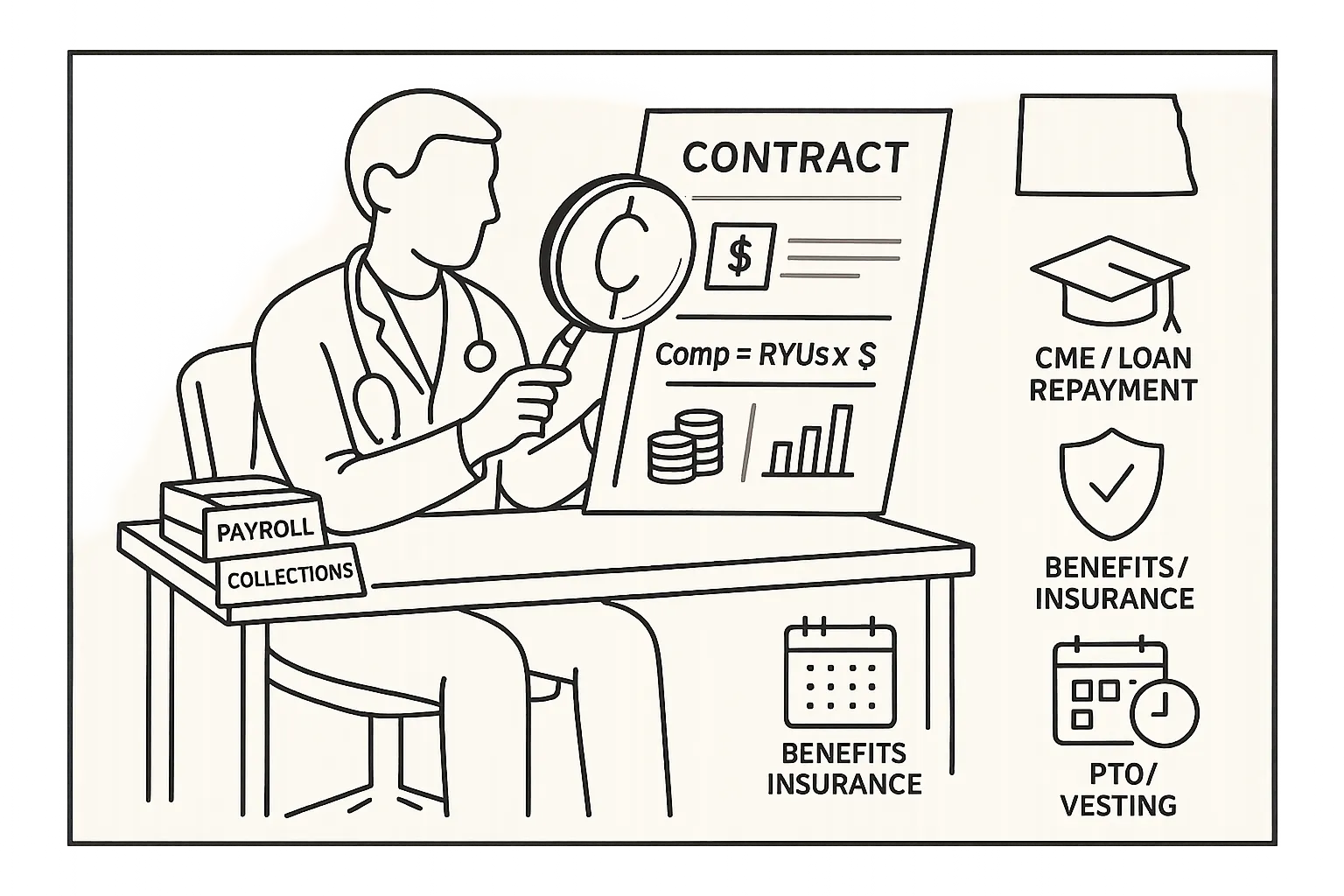
Base Salary and Productivity Formulas
Base-compensation language may establish the annual or hourly rate, pay frequency, guaranteed period, and method for prorating compensation when employment begins or ends mid-period. Review can also identify whether the employer may reduce compensation, recover alleged overpayments, change a productivity plan, or perform a retroactive reconciliation.
Productivity compensation may use collections, relative value units, encounters, quality measures, or a blended formula. An RVU provision is more understandable when it defines the services that receive credit, the applicable conversion factor, the measurement period, reporting access, and the treatment of adjustments or negative accrual. A collections model raises different questions because the employer often controls coding, billing, collection timing, refunds, and write-offs. A focused PA compensation and productivity review can test whether expected earnings can be calculated from the written terms.
Benefits, Bonuses, and Repayment Obligations
Benefits may include health insurance, retirement contributions, paid time off, continuing medical education funds, professional dues, licensing expenses, and DEA registration costs. The agreement can be compared with the benefits summary to identify waiting periods, eligibility conditions, or language allowing material changes.
Sign-on bonuses, relocation assistance, student-loan payments, and training expenses frequently carry repayment obligations. Important variables include the repayment period, triggering events, proration method, treatment of taxes, and whether repayment applies after termination without cause, disability, an employer breach, or a material change in duties. Reviewing the specific sign-on bonus repayment terms can clarify the amount at risk throughout the commitment period.
North Dakota Licensure, Collaboration, and Prescribing
Licensure, Title Protection, and Compact Privileges
The North Dakota Board of Medicine regulates physician assistants, and the titles “physician assistant” and “P.A.” are restricted to authorized individuals. A PA treating a patient located in North Dakota must hold an active North Dakota PA license or a qualifying privilege under the Physician Assistant Licensure Compact. A compact privilege remains subject to compact requirements and the authority of the state where the patient is located.
Contract provisions concerning start dates, remote care, credentialing, or multi-state coverage should account for the time needed to secure required licenses and privileges. Review can identify whether compensation begins before credentialing is complete, who pays application expenses, and what occurs if approval is delayed or denied.
Scope of Practice and Required Collaboration
North Dakota law authorizes PAs to perform specified medical services that include evaluation, diagnosis, treatment, ordering studies, therapeutic procedures, issuing medical orders, delegation, and death pronouncement. Collaboration, consultation, or referral is required when indicated by the patient’s condition, the PA’s education and experience, competence, and the applicable standard of care. The practice and employer may determine the degree of collaboration, and state law generally does not require a written collaborative agreement.
A different rule applies to a PA with fewer than 4,000 Board-approved practice hours. That PA must execute a written collaborative agreement with a physician describing how the required collaboration will occur and provide it to the Board upon request. The employment contract can allocate responsibility for arranging the physician relationship, maintaining the agreement, documenting qualifying hours, and addressing a change in the collaborating physician. It may also clarify whether compensation or continued employment depends on satisfying those requirements.
Practice Setting and Prescriptive Authority
A North Dakota PA must practice in an authorized licensed, credentialed, physician-owned, or Board-approved setting. Contract review can compare the stated work locations and service lines with the intended practice arrangement, particularly when the employer may add sites, telehealth responsibilities, or duties at affiliated facilities.
North Dakota permits PAs to prescribe, dispense, administer, and procure drugs and devices, including Schedule II through V controlled substances and legend drugs, subject to federal and state law. Controlled-substance prescribing or dispensing requires federal DEA registration. The agreement may address registration costs, credentialing support, prescribing protocols, formulary expectations, and the consequences of a delayed or restricted registration.
Malpractice Coverage, Scheduling, and Clinical Duties
Claims-Made and Occurrence Coverage
Malpractice provisions may identify the policy type, coverage limits, named insured, premium responsibility, duty to defend, and applicable exclusions. Occurrence coverage generally applies to incidents occurring during the policy period even when a claim is filed later. Claims-made coverage ordinarily requires coverage to be active when the claim is reported, creating possible post-employment exposure if extended reporting coverage is not obtained.
When claims-made insurance applies, the agreement can be analyzed to determine who pays for tail coverage and whether that obligation changes with the reason for separation. Review may also address prior-acts coverage, credentialing gaps, leaves of absence, indemnification, consent-to-settle language, and exclusions for alleged misconduct. Understanding tail insurance for physician assistants is important because the obligation may become a substantial cost after employment ends.
Schedule, Call, Travel, and Additional Sites
Clinical-duty language may define ordinary hours, patient volume, administrative time, call coverage, weekends, holidays, procedures, and responsibility for inbox or chart completion. Vague language allowing duties “as assigned” can make the expected workload difficult to measure. The agreement may also specify whether call or work beyond the ordinary schedule receives separate compensation.
Multi-site provisions can affect commute time, expenses, credentialing, and scheduling predictability. Review can identify the geographic area in which the employer may assign work, whether travel is reimbursed, how much notice applies to a location change, and whether a materially different assignment permits the PA to decline or end the agreement without repayment consequences.
North Dakota Non-Competes and Other Restrictions
Employment Non-Compete Provisions
North Dakota generally treats contracts restraining a person from practicing a lawful profession, trade, or business as void. North Dakota courts have consistently applied that rule to employment non-competes, including restrictions involving physicians. Statutory exceptions primarily concern the sale of business goodwill and specified ownership-related dissolution, dissociation, or sale transactions rather than ordinary employment agreements.
A PA contract may nevertheless contain a non-compete, so the provision should not be ignored. Review can identify whether the clause is tied to employment or a separate ownership transaction, what conduct it purports to prohibit, and whether related remedies or repayment provisions may create practical risk. A contract-specific physician assistant non-compete review can distinguish the non-compete from other post-employment obligations.
Nonsolicitation, Confidentiality, and Employer Property
The treatment of a non-compete does not automatically resolve narrower confidentiality, nonsolicitation, trade-secret, or employer-property provisions. Each restriction requires separate analysis based on its wording and practical effect. Patient and employee nonsolicitation clauses may define solicitation broadly enough to reach general announcements, responses to unsolicited inquiries, or contact with people the PA knew before joining the employer.
Confidentiality terms may protect legitimate nonpublic business information, but expansive definitions can include general professional knowledge or information already available to the public. The agreement may also address medical records, electronic devices, social media, intellectual property, and the return of employer property. Review can flag language that extends beyond the employer’s identified interests or conflicts with continuing legal and professional obligations.
Termination, Repayment, and Dispute Terms
For-Cause and Without-Cause Termination
Termination provisions may distinguish termination for cause from termination without cause. Review can identify the required notice period, permitted delivery methods, cure rights, final compensation, benefits treatment, and whether the PA must continue working during the notice period. Definitions of cause deserve particular attention when they rely on subjective concepts such as employer dissatisfaction, failure to perform, reputational harm, or alleged misconduct.
Licensure, credentialing, DEA registration, exclusion from government programs, or loss of facility privileges may also trigger immediate termination. The agreement can be evaluated to determine whether a temporary restriction has the same effect as a permanent loss and whether curable administrative problems receive a reasonable correction period. North Dakota also protects employees from specified retaliation for reporting suspected legal violations, participating in governmental investigations, or refusing an objectively unlawful order after informing the employer of the reason.
Post-Termination Payments and Dispute Procedures
Separation may trigger repayment of bonuses, relocation assistance, loan payments, training expenses, or alleged compensation overpayments. It may also determine whether productivity compensation, collections received after departure, unused paid time, or other accrued amounts remain payable. Contract review can compare these provisions and identify whether financial consequences differ based on which party ends the relationship and why.
Governing-law, venue, arbitration, attorney-fee, and limitation-period clauses can affect how a dispute is handled and the cost of pursuing or defending a claim. Reviewing the mechanics of terminating a physician assistant contract can clarify notice requirements, continuing obligations, and terms that survive separation.
North Dakota PA Contract Review Checklist
A complete review considers the agreement as a whole rather than evaluating compensation or a non-compete in isolation. Issues that commonly warrant closer analysis include:
- Undefined or subjective termination-for-cause language
- Start dates that do not account for licensure, compact privileges, credentialing, or DEA registration
- Collaboration terms that do not reflect North Dakota’s general rule or the 4,000-hour requirement for newer practitioners
- Clinical duties, prescribing expectations, or work locations that are broader than the intended position
- Collections or RVU formulas without defined metrics, reporting rights, or reconciliation timing
- Unclear malpractice coverage or responsibility for tail insurance
- Bonus and relocation repayment terms that lack proration or exceptions
- Unspecified call, weekend, multi-site, travel, or additional-duty requirements
- Non-compete language that does not account for North Dakota law
- Overbroad nonsolicitation, confidentiality, indemnification, or dispute provisions
Supporting documents may be necessary to assess the offer fully. These can include the compensation-plan exhibit, benefit summaries, malpractice policy information, productivity reports, credentialing requirements, collaborative documents, and a written description of the schedule and practice locations. Attorney-led review can explain how the provisions interact, identify financial and professional exposure, and provide written comments or proposed revisions for the PA to consider before making a final decision.
Speak With a North Dakota Physician Assistant Contract Lawyer Before You Sign
Chelle Law can review your proposed agreement, explain its practical effect, identify financial and professional risks, and flag provisions that may warrant clarification or revision.
Request a Contract Review