
Ohio physician assistants evaluating employment or independent contractor agreements must consider both the written business terms and the state rules governing clinical practice. The State Medical Board of Ohio regulates PA licensure and practice, while Ohio law requires a PA to work under a physician’s supervision, control, and direction pursuant to a signed supervision agreement. That framework affects how a contract describes delegated services, physician availability, prescribing, staffing, credentialing, and responsibility for clinical care. Whether a PA is joining a hospital system in Columbus, a specialty group in Cleveland, or another Ohio healthcare employer, the agreement should be reviewed against the position’s actual duties and locations. Compensation formulas, malpractice protection, restrictive covenants, termination rights, call coverage, and repayment provisions also can determine the financial and professional consequences of accepting or leaving the role.
Chelle Law provides attorney-led contract review that helps Ohio PAs understand how these provisions operate together. Review can identify ambiguous compensation terms, supervision language that does not reflect Ohio requirements, gaps in insurance protection, broad post-employment restrictions, and financial obligations that survive termination. The goal is to explain the agreement’s practical effect and flag provisions that may warrant clarification or revision before signing.
Why Ohio Physician Assistant Contract Review Matters

Employment Agreements Allocate More Than Salary
A physician assistant agreement establishes the framework for compensation, professional duties, schedule expectations, liability, and the end of the working relationship. Employer-drafted language may shift economic risk to the PA through collections-based compensation, adjustable productivity formulas, repayment triggers, restrictive covenants, or responsibility for malpractice tail coverage. A focused physician assistant contract review evaluates how these provisions interact rather than treating each clause in isolation.
The review also can compare the written agreement with the offer, recruitment discussions, compensation exhibits, benefit summaries, and referenced policies. If important terms appear only in a handbook or remain subject to unilateral change, the PA may have less contractual protection than expected.
Employee and Independent Contractor Terms Differ
An independent contractor agreement may allocate taxes, benefits, insurance, business expenses, billing obligations, and liability differently from a W-2 employment contract. Under Ohio’s general classification framework, the label used in the agreement does not by itself determine whether a worker is an employee or contractor; direction and control remain important considerations. PA supervision requirements also continue to matter regardless of the contract’s classification label.
Review of a physician assistant independent contractor agreement can assess control over scheduling and duties, responsibility for overhead and insurance, termination rights, and whether the proposed arrangement accounts for Ohio’s physician-supervision framework.
Ohio Supervision, Scope of Practice, and Prescribing Terms
The Supervision Agreement and Employment Contract
Ohio requires a physician assistant to hold a current license and practice under a physician’s supervision, control, and direction pursuant to a signed supervision agreement. That supervision agreement allocates supervisory and PA responsibilities, identifies limitations and referral circumstances, and addresses applicable facility policies. Ohio law also places legal responsibility for authorized PA services on the supervising physician.
The employment contract and supervision agreement serve different purposes, but conflicting language can create operational uncertainty. Contract review can determine whether the stated duties, reporting structure, procedures, prescribing responsibilities, and practice locations are consistent with the contemplated supervision arrangement. It also can identify whether employment consequences are tied to the expiration or termination of supervision, because the supervising physician’s statutory responsibility does not extend to services performed after the supervision agreement ends.
Physician Availability, Delegation, and Staffing
An Ohio supervising physician must remain continuously available for direct communication, actively review the PA’s professional activities, and maintain quality assurance. A physician may supervise no more than five PAs at one time. These requirements may affect staffing, cross-coverage, remote work, call assignments, multi-site practice, and contractor arrangements.
A PA may perform services authorized by the supervising physician when those services fall within the physician’s normal course of practice and expertise and within the supervision agreement. Facility policies or the supervising physician may impose additional limitations. Contract language that permits broad reassignment among specialties, facilities, or service lines therefore warrants careful analysis, particularly if the employer may change duties without the PA’s consent.
Prescriptive Authority and Credentialing
Prescribing in Ohio requires a valid State Medical Board prescriber number and physician-delegated prescriptive authority. The PA remains limited by the supervising physician’s delegated authority and applicable conditions, including special restrictions involving Schedule II controlled substances and controlled-substance prescribing. Ohio rules also generally require the first 500 hours in which a PA exercises physician-delegated prescriptive authority to occur under on-site supervision, subject to exceptions and documentation requirements.
Credentialing and privileging provisions can identify who manages applications, pays associated costs, supplies supporting documentation, and bears the effect of a delayed approval. A delay may affect the start date, base salary, benefits, bonus eligibility, or the ability to meet productivity thresholds. Review can flag language allowing termination when credentialing is delayed for reasons outside the PA’s control.
Compensation, RVUs, and Productivity Formulas
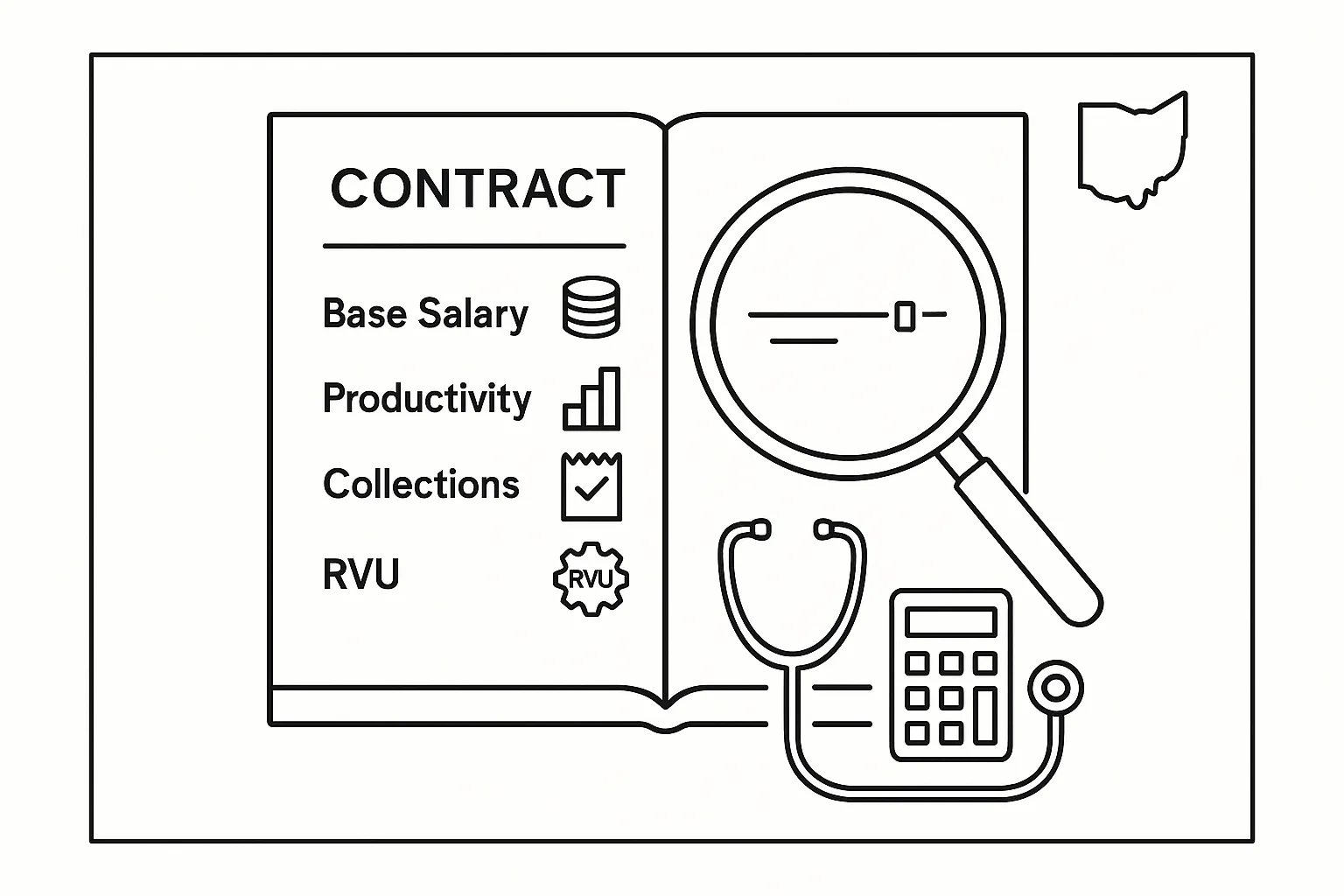
Base Salary, Collections, and RVU Compensation
Common PA compensation structures include a guaranteed salary, salary plus incentives, collections-based pay, and RVU-based compensation. The stated annual amount does not reveal whether pay is predictable unless the agreement also defines credited work, thresholds, payment timing, adjustments, and the employer’s ability to modify the formula. A PA compensation and productivity review can test whether the formula is complete and internally consistent.
Collections-based compensation ties earnings to money actually received rather than billed charges, potentially shifting payer delays and collection risk to the PA. An RVU model applies a conversion factor to credited relative value units, but the agreement may need to address shared visits, procedures, telehealth, modifiers, global periods, administrative work, and services billed under another provider. For example, 1,000 credited RVUs at a $40 conversion factor produce $40,000, while the same production at $60 produces $60,000.
Accounting, Reconciliation, and Negative Accrual
Compensation review can determine when the employer calculates production, how frequently it provides an accounting, and whether the PA can inspect supporting data. The formula may need to explain how denials, refunds, chargebacks, coding changes, uncollected accounts, or post-termination receipts affect final pay. Unclear reconciliation procedures can make projected compensation difficult to verify.
A draw against future earnings may create a negative balance when production falls below the amount advanced. Some agreements carry that balance forward or make it immediately repayable when employment ends. Analysis of negative accrual provisions can clarify whether deficits reset, whether the employer can offset other compensation, and what happens when low production results from leave, inadequate staffing, credentialing delays, or limited scheduling.
Malpractice Insurance, Tail Coverage, and Indemnification
Policy Type, Limits, and Tail Responsibility
A claims-made policy generally responds when the claim is reported while coverage is active, which may create a need for extended reporting, commonly called tail coverage, after the PA leaves. An occurrence policy generally covers an incident occurring during the policy period even if the claim is reported later. The contract can identify the policy type, limits, exclusions, covered locations, and whether all assigned clinical services fall within the employer’s coverage.
The reviewed Ohio authorities do not establish a PA-specific requirement that an employer pay for malpractice insurance or tail coverage. Allocation is therefore an important contractual issue. Review of tail insurance terms for physician assistants can determine whether responsibility changes based on resignation, termination without cause, termination for cause, or a failure to obtain credentials.
Indemnification and Post-Termination Cooperation
Indemnification is separate from malpractice insurance. Broad language may require the PA to defend or reimburse the employer for claims extending beyond the PA’s own conduct, while narrow employer protection may leave uncertainty about defense costs for services performed within the role. Review can compare indemnification obligations with the insurance policy and Ohio’s rule assigning responsibility to the supervising physician for authorized PA services.
The agreement also may require cooperation with claims, audits, medical-record requests, or legal proceedings after employment ends. Those provisions can be evaluated for reasonable notice, reimbursement of expenses, scheduling expectations, access to records, and whether the obligation has a defined duration.
Non-Competes, Non-Solicitation, and Career Mobility
Ohio’s Reasonableness Standard for Non-Competes
Ohio generally evaluates employment restrictive covenants under a reasonableness standard. Relevant considerations may include whether the restriction protects a legitimate business interest, creates undue hardship, or harms the public, along with its duration, geographic scope, treatment of confidential information, and effect on the worker’s ability to use professional skills. No enacted Ohio PA-specific non-compete rule was identified in the reviewed authorities.
A physician assistant non-compete review can map the restriction against the PA’s actual facilities, specialty, services, and likely future opportunities. The triggering event also matters because some clauses apply regardless of whether the PA resigns, is terminated without cause, or leaves after an employer breach.
Non-Solicitation, Confidentiality, and Other Restrictions
Non-solicitation provisions may restrict contact with patients, referral sources, employees, contractors, or business partners. Broad drafting may reach general announcements, passive communications, or social media activity. Review can clarify who is protected, what conduct is prohibited, how long the restriction lasts, and whether it extends to people with whom the PA had no professional contact.
Confidentiality, intellectual-property, and outside-activity clauses also can affect future employment or side work. Restrictions covering general professional knowledge, any organization serving similar patients, or all outside clinical activity may reach farther than a PA expects from the recruitment discussion.
Termination, Notice, Repayment, and Leave
Without-Cause Notice and For-Cause Termination
Termination provisions determine how quickly the relationship can end and which obligations survive. Material terms include the initial contract period, automatic renewal, without-cause notice, for-cause events, cure opportunities, immediate suspension, severance, final compensation, and payment of pending incentives. A PA termination clause review can assess how these provisions interact with credentialing, supervision, patient-transition duties, malpractice coverage, and restrictive covenants.
Notice periods deserve particular attention when the employer can remove the PA from the schedule, stop productivity credit, or require continued availability during the notice period. For-cause definitions tied to licensing, prescribing authority, policy violations, quality concerns, or loss of supervision can be evaluated for objective standards and any available notice or cure process.
Bonus Clawbacks, Expenses, and Leave
Repayment provisions may apply to signing bonuses, relocation assistance, training costs, CME expenses, licensing fees, or compensation advances. The practical exposure depends on whether repayment is prorated, which termination events trigger it, when the amount becomes due, and whether the employer may deduct it from final wages or other compensation. A clawback may be especially significant when combined with a negative productivity balance or PA-paid tail coverage.
Leave provisions may affect benefits, productivity targets, incentive accruals, repayment periods, and contract extensions. Review can identify whether parental, medical, military, or other leave changes compensation calculations or extends a service commitment. The analysis also can address whether call, weekend coverage, travel, and multi-site assignments continue during a notice or transition period.
Ohio PA Contract Red Flags
Not every unfavorable term makes an agreement unacceptable, but the following provisions commonly warrant closer analysis or clarification:
- Supervision or delegation language that does not reflect the contemplated Ohio practice arrangement.
- Broad duties or reassignment rights that do not account for physician expertise, delegated authority, facility policies, or credentialing.
- Prescribing expectations that do not address the required prescriber number, delegated authority, or initial on-site supervision rules.
- Undefined or adjustable RVU conversion factors, production thresholds, or bonus metrics.
- Collections-based compensation without clear treatment of payment timing, denials, refunds, and chargebacks.
- Draws or negative accrual balances that become immediately repayable at termination.
- Silence about tail insurance responsibility under a claims-made policy.
- Broad PA indemnification obligations that do not align with available insurance protection.
- Undefined call, weekend, telehealth, travel, or multi-site responsibilities.
- Restrictive covenants that apply after every form of termination or cover broad services, facilities, or geographic areas.
- Bonus, relocation, or expense clawbacks without prorated repayment or clear triggering events.
- Immediate termination rights based on vague policy, quality, or professional-conduct standards.
Attorney review is particularly useful when an offer includes complex productivity pay, substantial repayment obligations, unclear malpractice protection, multi-site duties, unusual supervision terms, or restrictions that may affect the PA’s next position. Chelle Law’s review process can include secure document submission, written analysis or redlining, and a consultation focused on the agreement’s practical consequences.
Request an Ohio Physician Assistant Contract Review Before You Sign
Chelle Law can analyze compensation, Ohio supervision terms, malpractice coverage, restrictive covenants, termination rights, and repayment obligations and identify provisions that may warrant clarification or revision.
Contact Chelle Law