
Physician assistant employment and independent contractor agreements in Oklahoma operate within requirements administered by the Oklahoma State Board of Medical Licensure and Supervision, its Physician Assistant Committee, and, when an osteopathic physician is involved, the Oklahoma State Board of Osteopathic Examiners. Oklahoma generally permits practice under a written agreement with a delegating physician, while a PA with at least 6,240 hours of postgraduate clinical experience may qualify for independent practice if statutory and reporting requirements are satisfied. These distinctions can affect supervision, delegation, prescribing authority, malpractice coverage, and the allocation of compliance duties. They are especially relevant when evaluating hospital, private-practice, urgent-care, or telehealth opportunities in Oklahoma City and Tulsa. An Oklahoma physician assistant contract review can identify whether the agreement reflects the anticipated practice model and explain how employer-drafted terms may affect compensation, scheduling, liability, termination rights, and professional mobility.
Chelle Law provides attorney-led physician assistant contract review focused on the language of the proposed agreement. Review can compare the contract with the offer, identify provisions that may warrant clarification or revision, and explain how compensation formulas, malpractice obligations, restrictive covenants, repayment terms, and termination clauses interact. A contract cannot itself create clinical authority that Oklahoma law does not permit, but it can impose operational requirements or financial obligations beyond the regulatory baseline.
Oklahoma PA Employment and Contractor Agreements

A physician assistant agreement may address employment classification, clinical duties, compensation, benefits, professional liability insurance, regulatory responsibilities, confidentiality, termination, and post-employment restrictions. Separate policies or addenda may govern productivity calculations, call coverage, multi-site assignments, telehealth, or electronic health record responsibilities. Incorporated documents deserve review because they may materially change the obligations stated in the primary agreement.
Employee and Independent Contractor Classification
The distinction between employee and contractor status affects payroll taxes, benefits, insurance arrangements, expense reimbursement, and responsibility for business costs. Contract review can compare the written classification with the proposed working relationship and identify expenses that the agreement assigns to the PA. These may include licensing fees, continuing education, equipment, travel, malpractice coverage, credentialing costs, or administrative support.
The label “independent contractor” is separate from Oklahoma’s clinical rules governing independent PA practice. A PA may be classified as a contractor while still practicing under a physician agreement, and an employee may qualify clinically for independent practice. Understanding the differences between W-2 and 1099 physician assistant arrangements helps place the contract’s tax and benefit provisions in context.
Written Practice Agreements and Independent Practice
An Oklahoma PA practicing with a delegating physician generally uses a written practice agreement defining delegation, supervision, collaboration, and scope. The delegating physician may be licensed by the Oklahoma State Board of Medical Licensure and Supervision or the Oklahoma State Board of Osteopathic Examiners. Required filings and amendments remain distinct from the employment contract, although the documents need to be operationally consistent.
A PA with at least 6,240 hours of postgraduate clinical experience may qualify to practice independently without physician supervision, subject to Oklahoma statutory requirements and board reporting. Eligible PAs may instead elect to continue under a physician practice agreement. Contract analysis can determine whether the document accurately describes the selected model and whether it assigns responsibility for filings, updates, recordkeeping, and employer cooperation.
Prescribing, Billing, and Payer Enrollment
Prescribing authority depends in part on whether the PA practices independently or under a practice agreement. Independent PAs may prescribe within applicable statutory limits, including Schedule III through V controlled substances. A PA practicing under an agreement may prescribe Schedule II drugs only under the required written protocol and applicable rules. Contract language describing prescribing duties, protocols, registrations, or related fees should fit the PA’s actual authority and practice structure.
Oklahoma also recognizes PA billing and payment authority in specified circumstances. An agreement may address payer enrollment, ownership of billing and collections, documentation standards, refunds, audits, and cooperation after termination. Review can flag compensation formulas that depend on collections without adequately explaining attribution, payer delays, adjustments, or access to supporting reports.
Compensation, Productivity, and Benefits
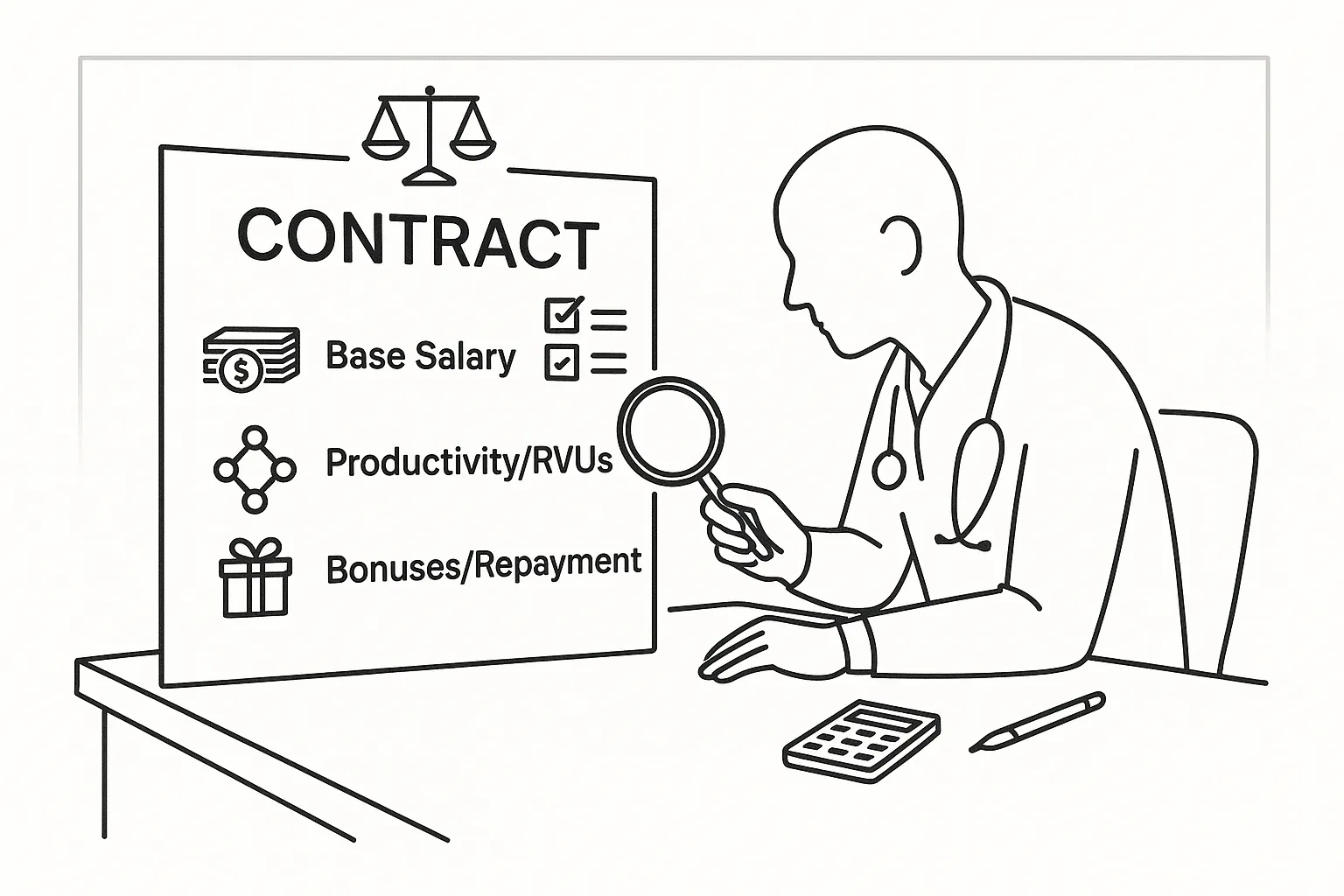
Compensation analysis extends beyond the stated annual salary. A detailed physician assistant compensation and productivity review can evaluate guaranteed pay, incentive formulas, reconciliation procedures, benefit eligibility, and circumstances in which compensation may be reduced, forfeited, or recovered.
Base Salary and Productivity Formulas
Base-pay provisions may specify whether compensation remains guaranteed throughout the term and whether the employer can impose offsets, deductions, or chargebacks. Separate compensation for call, night shifts, administrative work, or assignments at additional locations is easier to evaluate when the agreement defines eligibility, rates, approval requirements, and payment timing.
Productivity compensation may use work relative value units, collections, encounters, quality measures, or several metrics together. A formula paying $30 per credited wRVU would produce $120,000 for 4,000 credited wRVUs, but that example is meaningful only if the agreement also defines thresholds, attribution rules, measurement periods, reconciliation, and payment dates. Collections models can be affected by payer delays and adjustments, while negative accrual provisions may carry a deficit into later periods.
Bonuses, Relocation Assistance, and Benefits
Signing bonuses, relocation assistance, training payments, and loan-repayment benefits can increase an offer’s value while creating repayment exposure. Analysis can identify the events that trigger repayment, whether the amount is prorated, whether interest or collection costs apply, and whether termination without cause is treated differently from resignation or termination for cause.
Health coverage, retirement contributions, paid leave, continuing education allowances, and reimbursement for licensing or prescribing-related expenses also affect total compensation. The written terms may determine when benefits begin, whether unused leave is paid at separation, and whether earned incentives or employer contributions are forfeited when employment ends.
Malpractice Insurance, Tail Coverage, and Indemnification
Malpractice provisions affect protection during the relationship and potential exposure after it ends. Oklahoma requires a PA practicing independently to maintain malpractice coverage as required by the Physician Assistant Act. Regardless of the practice model, contract review can identify the policy type, limits, named insureds, premium responsibility, reporting duties, and any obligation to obtain supplemental coverage.
Claims-Made Coverage and Tail Insurance
A claims-made policy generally responds when a covered claim is reported while the policy is active, subject to its terms. An occurrence policy generally covers an incident occurring during the policy period even if the claim is asserted later. When an employer provides claims-made coverage, the agreement may allocate responsibility for tail coverage or another form of extended reporting protection after separation.
Tail responsibility may vary depending on whether the PA resigns, is terminated without cause, or is terminated for cause. Because this obligation may create a significant post-employment cost, review of the contract’s physician assistant tail insurance terms can clarify the triggering events, required limits, proof of coverage, and payment responsibility.
Indemnification, Defense, and Claim Reporting
Indemnification language may require the PA to reimburse the employer for specified claims, losses, regulatory matters, or contractual breaches. Comparing that language with available insurance can reveal obligations that may fall outside policy coverage or transfer business risks unrelated to the PA’s own conduct.
The agreement may also allocate control over legal defense, counsel selection, settlement approval, incident reporting, and responses to licensing-board matters. Short or vague notice requirements can create disputes if delayed reporting is treated as a breach or as grounds to deny contractual protection.
Scope of Practice and Work Expectations
The job description provides the operational link between the contract and the PA’s authorized practice. Review can compare the stated clinical services, locations, schedule, call duties, procedures, and administrative responsibilities with the anticipated position. Broad clauses allowing unilateral changes may materially expand workload or travel without changing compensation.
Scheduling, Call, and Multi-Site Assignments
Schedule terms may address shifts, weekends, holidays, call frequency, response times, and coverage at additional facilities. Important details include whether call is restricted or unrestricted, whether it receives separate compensation, how schedules are changed, and whether travel time or mileage is reimbursed. Patient-volume expectations and protected administrative time may also affect whether the proposed compensation reflects the actual workload.
Multi-site clauses can create practical burdens when the contract does not identify locations, geographic limits, notice requirements, or reimbursement. Telehealth provisions may raise similar questions about approved locations, scheduling, equipment, documentation, and the states in which patients are located.
Credentialing and Regulatory Cooperation
The agreement may assign responsibility for licensing, credentialing, payer enrollment, prescribing registrations, privileges, and practice-agreement filings. Review can identify whether deadlines depend on employer cooperation and what happens if credentialing is delayed for reasons outside the PA’s control. Start-date, compensation, and termination provisions need to be read together when employment is contingent on approvals.
When an osteopathic physician serves as the delegating physician, additional Oklahoma State Board of Osteopathic Examiners requirements may apply to written supervision arrangements, reporting, and applicable limits or exceptions. Contract language should not obscure which party handles required submissions or impose responsibility on the PA without access to the information and support needed for compliance.
Oklahoma Restrictive Covenants and Post-Employment Duties
Post-employment provisions may address competition, solicitation, confidentiality, employee recruitment, repayment obligations, and use of proprietary information. Their practical effect depends on the exact wording, the PA’s role, and Oklahoma law. A focused physician assistant non-compete review can separate restrictions that appear broad on paper from obligations Oklahoma law specifically permits.
Oklahoma Limits on Employee Non-Competes
Oklahoma generally permits an employee to engage in the same or a similar business after termination so long as the former employee does not directly solicit the former employer’s established customers. Contract provisions conflicting with that statutory rule are void and unenforceable. Review can examine whether a clause attempts to prohibit employment altogether, how it defines restricted customers, and whether other provisions effectively impose a broader restraint.
The statutory framework does not make every post-employment clause irrelevant. Confidentiality, customer solicitation, repayment, and other contractual provisions require separate analysis. The agreement’s severability or reformation language may also affect how the employer describes its intended remedies.
Non-Solicitation, Confidentiality, and Repayment
Oklahoma permits contracts restricting an employee or independent contractor from soliciting the employer’s employees or independent contractors. Patient, customer, referral-source, and workforce restrictions therefore need to be distinguished rather than grouped under a single “noncompete” label. Definitions of solicitation, established customers, confidential information, and competitive activity may determine whether a clause affects a future role.
Repayment provisions, liquidated damages, and offset rights may create additional consequences after termination. Analysis can clarify how final salary, productivity compensation, bonuses, relocation assistance, and other amounts are calculated, as well as whether the employer claims authority to deduct an alleged debt from final compensation.
Termination, Discipline, and Dispute Resolution
Termination language affects income security, transition planning, malpractice obligations, repayment exposure, and the activation of post-employment restrictions. A physician assistant contract termination review can evaluate cause definitions, cure opportunities, without-cause notice, suspension rights, and compensation due at separation.
For-Cause and Without-Cause Termination
For-cause provisions may allow immediate termination following loss of licensure, exclusion from a payer program, loss of required privileges, specified misconduct, or breach of the agreement. Broad language covering policy violations or conduct the employer deems harmful can give the employer substantial discretion. Review can distinguish events triggering immediate termination from breaches that provide notice and an opportunity to cure.
Without-cause termination permits one or both parties to end the relationship after the required notice. The practical effect depends on the length of notice, whether the employer may remove the PA from the schedule, whether compensation and benefits continue, and whether unused notice changes repayment or restrictive-covenant obligations.
Final Compensation and Dispute Procedures
Separation provisions may determine whether the PA receives earned bonuses, post-termination collections, unused leave, expense reimbursement, or severance. Productivity arrangements deserve particular attention when payments are calculated after the last day worked or depend on collections received after departure.
Arbitration, governing-law, venue, attorney-fee, and remedy provisions determine how a contractual dispute will proceed. Review can explain the selected forum, fee allocation, decision-maker selection, available remedies, and whether procedural requirements impose short notice or filing deadlines.
Oklahoma Physician Assistant Contract Review Checklist
Before signing, compare the offer, employment agreement, practice agreement, incorporated policies, compensation exhibits, and other addenda. Important review points include:
- Whether W-2 or 1099 classification fits the proposed working arrangement
- Whether the contract accurately reflects practice under a physician agreement or qualified independent PA practice
- Responsibility for required filings, amendments, credentialing, and payer enrollment
- Salary, productivity, bonus, attribution, reconciliation, and payment calculations
- Call, schedule, location, patient-volume, travel, and administrative expectations
- Malpractice policy type, limits, tail responsibility, and claim-reporting duties
- Prescribing, delegation, billing, and compliance responsibilities
- Noncompete, non-solicitation, confidentiality, and employee-recruitment restrictions
- For-cause definitions, cure rights, without-cause notice, and final compensation
- Bonus, relocation, training, benefit, or other repayment obligations
- Indemnification, dispute resolution, governing law, venue, and attorney-fee terms
No single provision determines whether an offer is favorable. The agreement needs to be evaluated as a whole because termination may trigger tail insurance, repayment obligations, or post-employment restrictions, while compensation may depend on duties, billing rules, and schedules described elsewhere. Chelle Law reviews these interactions, flags financial and professional risks, and helps physician assistants understand provisions that may warrant clarification or revision before signing.
Speak With an Oklahoma Physician Assistant Contract Lawyer Before You Sign
Chelle Law can review the proposed agreement, identify compensation and liability risks, explain Oklahoma-specific provisions, and flag terms that may warrant clarification or revision.
Request a Contract Review