
Physician assistant employment and independent contractor agreements in Oklahoma must account for the requirements administered by the Oklahoma State Board of Medical Licensure and Supervision. Scope of practice, licensure, supervision, delegation, and prescribing requirements can shape how a PA works, while the contract determines compensation, malpractice obligations, scheduling, termination rights, and post-employment restrictions. These issues are particularly important for physician assistants evaluating opportunities with hospitals, private practices, urgent care groups, and telehealth organizations in healthcare markets such as Oklahoma City and Tulsa. Chelle Law reviews how the agreement allocates regulatory responsibility, whether the stated duties fit the anticipated practice arrangement, and how employer-drafted terms may affect income or professional mobility. A state-focused review also considers whether supervision and delegation provisions align with the position while identifying repayment obligations, restrictive covenants, and liability provisions before the PA signs.
Oklahoma PA Employment and Contractor Agreements

A physician assistant agreement typically addresses employment classification, clinical duties, compensation and benefits, malpractice insurance, supervision and delegation, confidentiality, restrictive covenants, termination rights, and dispute resolution. Hospital systems, private practices, urgent care groups, and telehealth companies may also use separate addenda for productivity formulas, call coverage, multi-site assignments, or electronic health record responsibilities.
The distinction between employee and contractor status affects taxes, benefits, insurance arrangements, and the allocation of business expenses. A PA should evaluate the actual working relationship along with the contract label, particularly when comparing W-2 and 1099 arrangements. The agreement should also state the job duties accurately rather than allowing the employer to expand clinical or administrative responsibilities without corresponding compensation.
Oklahoma regulatory requirements inform supervision, delegation, and prescriptive authority, but an employer may draft contractual restrictions that are more demanding than the practice arrangement requires. Physician assistants can consult updates and professional information from the Oklahoma Academy of Physician Associates, while an attorney reviews how regulatory and operational requirements are expressed in the individual agreement.
Compensation, Productivity, and Benefits
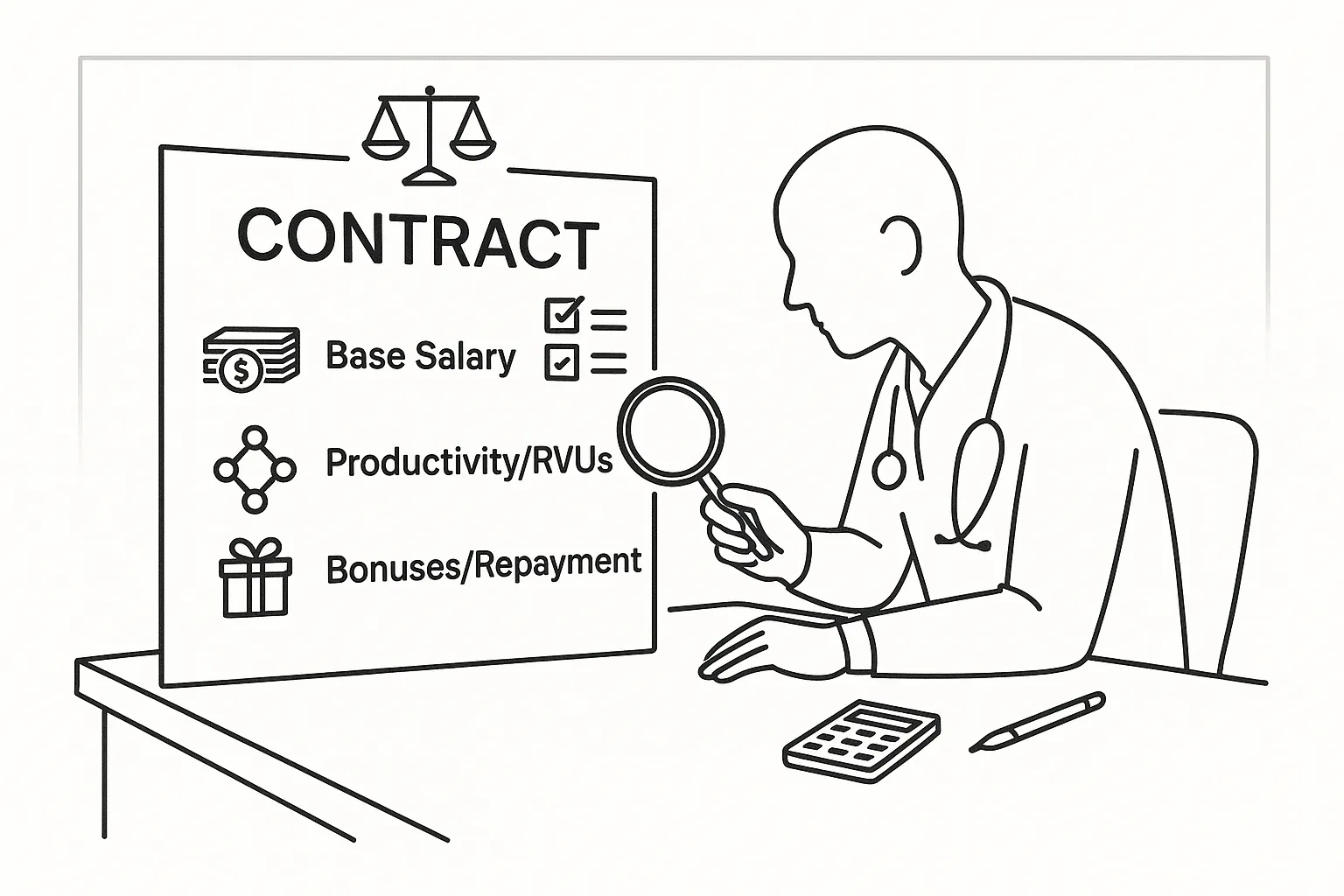
Compensation clauses determine more than the stated annual salary. A thorough PA compensation and productivity review examines guaranteed pay, incentive formulas, reconciliation procedures, benefit eligibility, and the circumstances in which the employer may reduce or recover compensation.
Base Salary and Productivity Compensation
Base salary provisions should explain whether compensation is guaranteed throughout the term and identify any offsets, deductions, or chargebacks. Separate stipends for call, night shifts, administrative work, or additional locations should state the amount, eligibility requirements, and payment schedule. The agreement should also clarify how employment classification affects PTO, retirement contributions, payroll taxes, and other benefits.
Productivity compensation may be based on work relative value units, collections, encounters, quality measures, or a combination of metrics. For example, a formula paying $30 per wRVU would produce $120,000 for 4,000 credited wRVUs, but the contract must still explain thresholds, attribution rules, measurement periods, and payment timing. Collections-based compensation can fluctuate when payer receipts are delayed, while draws and negative accrual provisions can permit an employer to carry a deficit into later periods.
Bonuses, Relocation Assistance, and Benefit Terms
Signing bonuses, relocation assistance, and loan repayment can improve an offer while creating substantial repayment exposure. The contract should identify which events trigger repayment, whether the amount is prorated, whether interest applies, and how termination without cause differs from voluntary resignation or termination for cause.
Health coverage, retirement benefits, CME allowances, paid leave, and reimbursement for licensure or prescribing-related fees should be described with enough detail to determine their value. A PA should also confirm whether employer contributions are conditioned on continued employment and whether unused benefits or earned bonuses are forfeited at separation.
Malpractice Insurance, Tail Coverage, and Indemnification
Malpractice provisions affect both current protection and potential liability after the relationship ends. The agreement should identify the policy type, limits, named insureds, premium responsibility, reporting obligations, and whether the PA must obtain separate or supplemental coverage.
Claims-Made Coverage and Tail Insurance
A claims-made policy generally responds when a covered claim is reported during the policy period, while an occurrence policy generally covers an incident that occurred during the covered period even if the claim is made later. When an employer provides claims-made coverage, the contract should clearly allocate responsibility for extended reporting protection after separation.
The obligation to purchase tail coverage may depend on whether the PA resigns, is terminated without cause, or is terminated for cause. Because that obligation can create a significant post-employment expense, the PA should understand the policy mechanics and review the agreement’s tail insurance terms before accepting responsibility.
Indemnification, Defense, and Claim Reporting
Indemnification language may require a PA to reimburse the employer for certain claims, losses, or regulatory matters. These provisions should be compared with the available insurance coverage so the contract does not create obligations that fall outside the policy or transfer broad business risks to the PA.
The agreement should also address who controls the defense, selects counsel, approves settlement, and reports incidents or board complaints. Vague notice requirements can create avoidable disputes, particularly when the contract imposes short reporting deadlines or treats delayed notice as a breach.
Oklahoma Scope of Practice, Supervision, and Work Expectations
The job description should match the clinical services, locations, schedule, call duties, and administrative responsibilities the PA is expected to perform. Vague language allowing duties to be changed unilaterally can expand workload without additional pay, while unclear multi-site or call provisions can create scheduling and travel burdens that were not apparent during recruitment.
Supervision and delegation clauses should reflect the intended Oklahoma practice arrangement and explain how the employer will support compliance. The contract may need to address prescribing, chart review or co-signature expectations, telehealth protocols, clinical privileges, advanced procedures, and responsibility for maintaining required approvals. A PA should be cautious when the agreement shifts regulatory responsibility to the individual without corresponding employer cooperation or resources.
Operational expectations also affect compensation and liability. Call frequency, weekend coverage, patient volume, administrative time, and responsibility for staffing or documentation should be stated clearly enough to evaluate whether the proposed pay reflects the actual workload.
Restrictive Covenants and Post-Employment Obligations
Post-employment restrictions can affect where a physician assistant works, which patients or referral sources the PA may contact, and whether the PA can recruit former colleagues. A review of restrictive covenant terms should consider the stated duration, geographic reach, restricted activities, triggering events, and any connection between the restriction and the PA’s actual role.
Non-solicitation and confidentiality clauses may be broader than a traditional noncompete. Definitions of patients, employees, referral sources, confidential information, and competitive activity should be examined carefully because expansive wording can interfere with a future position even when the PA does not take records or proprietary information.
Repayment clauses, liquidated damages, and employer offset rights can create additional consequences after termination. The agreement should state how final salary, unpaid productivity compensation, bonuses, relocation assistance, and other amounts will be calculated, as well as whether the employer may deduct alleged debts from the final payment.
Termination, Discipline, and Dispute Resolution
Termination provisions affect income security, transition planning, malpractice obligations, and the activation of restrictive covenants or repayment duties. A focused contract termination review evaluates definitions of cause, opportunities to cure an alleged breach, without-cause notice periods, suspension rights, and compensation owed at separation.
Broad for-cause language may allow immediate termination for loosely defined conduct, policy violations, or loss of privileges. The contract should distinguish issues that justify immediate termination from breaches that can reasonably be corrected, and it should explain whether the PA remains paid during an investigation or notice period. Any severance or transition pay should have clear eligibility and payment terms.
Arbitration, governing-law, and venue provisions determine how and where a dispute will proceed. A PA should understand fee allocation, available remedies, selection of the decision-maker, and whether the chosen venue creates a practical barrier to pursuing or defending a claim.
Oklahoma PA Contract Review Checklist
Before signing, physician assistants should compare the offer discussions, written agreement, policies, and incorporated addenda. The following issues deserve particular attention:
- Whether the W-2 or 1099 classification matches the proposed working arrangement
- Exact salary, productivity, bonus, reconciliation, and payment calculations
- Call, schedule, location, patient-volume, and administrative expectations
- Malpractice policy type, limits, tail responsibility, and claim-reporting duties
- Oklahoma supervision, delegation, prescribing, and compliance responsibilities
- Noncompete, non-solicitation, confidentiality, and post-employment restrictions
- For-cause definitions, cure rights, without-cause notice, and final compensation
- Bonus, relocation, training, or benefit repayment obligations
- Indemnification, dispute resolution, governing law, and venue
A complete physician assistant employment agreement checklist can help organize the initial review, but the effect of each provision depends on how it interacts with the rest of the contract. Chelle Law provides attorney-led review focused on explaining those interactions, identifying income and liability exposure, and helping the PA understand the practical consequences before signing.
Have an Oklahoma PA Contract Reviewed Before You Sign
Chelle Law can review compensation, malpractice coverage, supervision terms, restrictive covenants, repayment obligations, and termination provisions so you can evaluate the agreement with greater clarity.
Contact Chelle Law